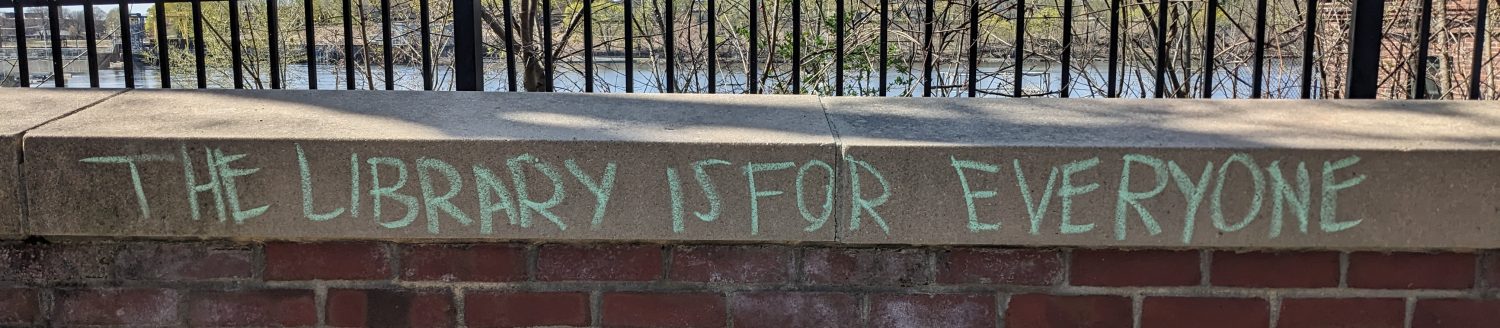
BEA 2014, Part One: When we love a book, we can’t stop talking about it

Thanks to Gene Ambaum and Bill Barnes (perhaps better known as “the Unshelved guys“), I got to go to BookExpo America (BEA) for free this year. I built a schedule in advance with the BEA show planner, and ended up following the schedule pretty closely.
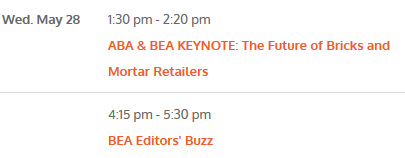
BEA14WedThe keynote on Wednesday afternoon, “The Future of Bricks and Mortar Retailers,” was focused on booksellers, but much of it could apply to libraries as well. Oren Teicher, CEO of the American Booksellers Association, noted that there was a “real resurgence in indie bookselling,” and that “localism” was becoming a powerful movement (“Small Business Saturday” being one example). However, it’s still a challenge to convince customers to think of bookstores as places to buy e-books.

Michael Tamblyn, president of Kobo, acknowledged that the virtual browsing experience doesn’t (yet) match the physical, but that booksellers could be strategic about what books they stock in print. Romance novels, for example, sell better in e-book format, so it’s less important to have them on the shelves – just point customers toward the e-bookstore. Cookbooks, gift books, and picture books, however, are much more popular in print.

John Ingram, CEO of Ingram, said of digital and print, “it’s not either/or, it’s either/and.” Many readers buy both print books and e-books; this is supported by research from Library Journal. On the limited (thus far) success of bundling a digital book with the purchase of a print book, Ingram said, “Somewhere in there, there are economics that work for everybody.” Ingram also proposed that “each [bookstore] could be a publisher.”

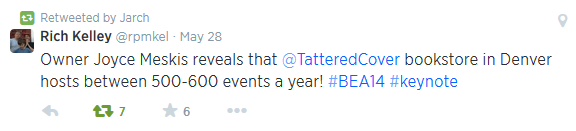
Joyce Meskis, owner of the Tattered Cover bookstore, had great advice about connecting to the community and attracting customers. Tattered Cover has 500-600 events annually, including storytime, author events, and “Book Happy Hour.” She recommended using media, including public radio and podcasts, to “be part of the story.”
BEA14_tatteredcoverOf course, the keynote wouldn’t have been complete without a dig at the ongoing Amazon/Hachette issue; indie booksellers “make ALL publishers’ books available all the time.”
BEA14buzz

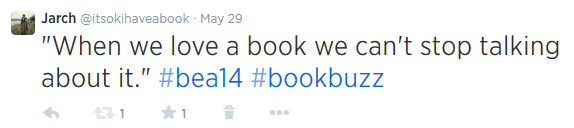
Next was the BEA Editors’ Buzz. Robert Sindelar from Third Place Books in Seattle moderated a panel of seven editors, each of whom raved about one book from their list. Sindelar said he initially had a negative reaction to the word “buzz,” but said it connotes activity; “When we really love a book we can’t stop talking about it.” The best editors and salespeople, he said, are “cool, have good taste, and know how to talk about books.” All editors on the panel fit this description, and after the event there was a mob around the tables of galleys that resembled hyenas feasting on a carcass. (Note to the organizers: Spread the galleys out. Use more than two tables for a room of a few hundred people. Have an exit plan. Have signs. Encourage people to form lines. Etc.) Though the print galleys disappeared in a flash, e-galleys should be available through Edelweiss. Here are the titles and authors:

  • Jenny Jackson from Knopf called Station Eleven by Emily St. John Mandel “a requiem for the world as we know it.” This “plausible and terrifying” book, which she compared to Peter Heller’s The Dog Stars, is about art and fame, and has already garnered positive word-of-mouth buzz.
  • Marysue Rucci from S&S described Matthew Thomas‘ ten-years-in-the-making We Are Not Ourselves as an “epic” of three generations of an Irish family in New York, a novel that describes “the great unwinding of the middle class” and “resilience in the face of disappointment.”
  • Lee Boudreaux from Ecco mentioned a slew of comp titles for The Miniaturist by Jessie Burton, including Billy Lynn’s Long Halftime Walk, The Story of Edgar Sawtelle, The Song of Achilles, Slammerkin, and The Signature of All Things. Suspense builds in this “dollhouse mystery” set in 1700s Amsterdam.
  • Jeff Shotts from Graywolf Press was aware of the irony of his last name when introducing On Immunity: An Inoculation by Eula Biss. This slim work of nonfiction addresses parents’ impulse to protect themselves and their children, as well as issues of race, class, and government, and the “far-reaching ramifications” of the “implications of vaccination.”
  • Amy Einhorn touted My Sunshine Away by M.O. Wilson from her eponymous imprint. Like The Help, My Sunshine Away is set in the South, and the story is inseparable from the setting. A debut novel and a literary mystery, My Sunshine Away is about adolescence, family, memory, and forgiveness.
  • Josh Kendall from Little, Brown admitted that author Laird Hunt was “not the new guy,” but that Neverhome was going to be his breakout novel. Hunt discovered a trove of letters in a family barn in Indiana, and those letters inspired this tale of a woman who goes to war in place of her husband.
  • Colin Harrison from Scribner closed the session with The Short and Tragic Life of Robert Peace: A Brilliant Young Man Who Left Newark for the Ivy League But Did Not Survive by Jeff Hobbs, Peace’s roommate for two years at Yale. This is a true tale of poverty, race, education, drugs, murder, discrimination, and fate.

And that was just the first day. Stay tuned for more.

MLA Conference 2014, Day Two (Thursday)

Screen shot 2014-05-08 at 8.53.24 PMHarvard Library Innovation Lab: Pop-Ups, Prototypes, and Awesome Boxes

Annie Cain, Matt Phillips, and Jeff Goldenson from the Harvard Library Innovation Lab  presented some of their recent projects. Cain started off by introducing Awesome Box: the Awesome Box gives library users the opportunity to declare a library item (book, audiobook, movie, TV show, magazine, etc.) “awesome” by returning it to an Awesome Box instead of putting it into the book drop. Library staff can then scan the “awesome” items and send them to a custom website (e.g. arlington.awesomebox.io), where anyone can see the “recently awesome” and “most awesome” items. Instead of librarian-to-patron readers’ advisory, it’s patron-to-patron/librarian. Cool, fun, and easy to use! “Awesome” books can also be put on display in the library.

Phillips talked about the idea of “hovermarks,” bringing favicon-style images to the stacks by placing special bookmarks in books. Patrons or librarians could place a hovermark in a book to draw attention to local authors, Dewey Decimal areas, beach reads, favorites, Awesome Box picks, or anything else. It’s a “no-tech” way to “annotate the stacks.”

Goldenson floated the idea of a Library Community Catalog, inspired by the Whole Earth Catalog. The Library Community Catalog could contain real things, ideas, speculations, interviews, or other articles. It could be “hyper-local,” in print and/or online.

Of the three ideas presented, Awesome Box is definitely the most developed, and Harvard, which “isn’t necessarily known for sharing,” is eager to get it into public libraries. Contact them if you’re interested in setting it up at your library!

Libraries are Keeping Readers First: An Update on the National Initiative and How You Can Participate

Readers First is “a movement to improve e-book access and services for public library users.” Kelvin Watson from Queens Library and Michael Santangelo from BookOps presented an update on this initiative, explaining the work that’s been done thus far and how far we have to go. The more people (and libraries) sign on, the stronger the team, the better ability to effect change. Already, said Santangelo, Readers First represents over 20 million readers.

Screen shot 2014-05-09 at 3.57.31 PM

It’s worth going to the Readers First site (link in the previous paragraph) to read their principles. The two main challenges regarding e-books in libraries are availability and discoverability/access. Availability is an issue with the publishers; the issues of discoverability and access can be taken up with the vendors. Because libraries are only indirectly connected to publishers, but directly connected to vendors, Readers First decided to focus its efforts on the discoverability/access challenge.

Santangelo said that Ranganathan’s Five Laws of Library Science applied to e-books also (save the time of the reader, (e)books are for use, etc.) and that libraries have a responsibility to ensure open, easy, and free access to e-books the same as we do for print books. However, the e-book experience now is fragmented, disjointed, and cumbersome, creating a poor user experience. This is where the four Readers First principles come in: readers should be able to discover content in one comprehensive catalog; access a variety of content from multiple sources; interact with the library in the library’s own context; and read e-books compatible with all e-reading devices.

A Readers First Working Group sent a survey to vendors in order to create a guide to library e-book vendors. This guide will help librarians who are choosing an e-book vendor for the first time, or moving from one to another; it will also help vendors design their systems and decide what to prioritize.

Watson said that libraries should see vendors as partners, and challenge them to “do the right thing.” Librarians should hold all vendors accountable to the Readers First principles, with the end goal of a seamless experience for the user. The long-term objective, said Michael Colford of the Boston Public Library, is to “have the discovery layer be the platform.” Until then, we’re relying on APIs. “We can make things less complicated, but we can’t make it easier,” said Santangelo.

Readers First is working with the National Information Standards Organization (NISO) to develop standards for e-books, but according to Watson, the perfect format hasn’t been invented yet. (Other than PDFs, most e-book files are proprietary formats, wrapped in DRM and not usable across devices.)

MA E-Book Project

Deb Hoadley presented an update on the Massachusetts E-Book Project on behalf of the Massachusetts Library System. I was already familiar with the project because Robbins is one of the pilot libraries, but it was good to review the history, see where the project had hit snags, and hear from other librarians at pilot libraries (Jason Homer from Wellesley and Jackie Mushinsky from WPI) about how they had introduced the project to patrons.

150x71-MA-EbooksYou can read about the project’s history, the RFP, and see updates on the website, so I want to use this space to draw a parallel between the MA E-Book Project and Readers First. Although the pilot consists of three different vendors (BiblioBoard, Baker & Taylor (Axis 360), and EBL) with three different models, the end goal is a single e-book platform that offers integrated and seamless discovery. Any Massachusetts resident would have access through this user-friendly platform to e-content that is owned – not licensed – by Massachusetts libraries; local content would also be hosted and discoverable.

Although we are far from this goal right now, “Our vendors are listening to us,” said Homer. He said that participating in the pilot project has enabled him to start conversations with patrons about how much we spend on e-books now and why we need a new model. Mushinsky, who added local content through BiblioBoard, said that we need to ask, “Will this resource be of value to us? Can we add value to it?”

I came away from these two sessions (Readers First and the MA E-Book Project) convinced that we have the right goals, and dedicated people working toward them, but a little depressed at how far we have to go. Slowly but surely…


Teaching the Tools: Technology Education in Public Libraries

Clayton Cheever live-blogged this session; his notes are posted on the Teaching the Tools site.

Anna Litten from Wellesley did an excellent job moderating this informative panel. Litten and the other panelists (Michael Wick, Theresa Maturevitch, Jason Homer, and Sharani Robins) built a website called Teaching the Tools: Libraries and Technology Education, which they hope will serve as a resource going forward. To borrow from the site: “All reference librarians are technology trainers, educators and instructors these days.  But what does it really mean to teach technology topics in public libraries?  What can and should we teach?  How does technology instruction fit into our broader mission and core responsibilities?  What resources are available to use and to our clients?  How do we become better presenters and instructors?”

The panelists addressed these questions during the session. They all teach in their libraries, but the teaching takes different forms. “I teach to whatever question comes to the door, in whatever way the learner can understand it,” said Wick. Maturevich talked about printed brochures, online resources, and videos; Robins talked about beginner classes, one-on-one sessions, and “Wired Wednesday,” when patrons can drop in for tech help. Robins has also had reps from Barnes & Noble and Best Buy come in to help people with e-reading devices, and she often uses the resources at GCF LearnFree.org. Homer teaches intermediate classes in the Wellesley computer lab, and other Wellesley staff teach beginner classes. Clearly, there are many approaches, and flexibility is key.

Litten suggested taking the time to read instructional design blogs; most librarians don’t have a background in instructional design, but the field does exist and there’s a lot we can learn. “We have to focus on what’s going to work,” she said. “If it’s not working, abandon! Abandon!”

What to do when you offer a class and no one shows up? Wick and Litten talked about forming partnerships in the community. “We can be really useful to you in ways you didn’t even realize,” said Litten. “Listen,” Wick encouraged. Ask people, “What do you want? We’ll give it to you.” As for whether teaching technology is part of the library’s mission, Wick said, why wouldn’t it be? “We help everybody with everything else. Why aren’t we helping them as much as we can, more than they’re asking?” Find your audience first, said Wick, then design your classes.

Some library staff are reluctant to teach classes, but that isn’t the only kind of teaching. Nor do tech teachers have to be experts; in fact, said Wick, good teachers can be just one step ahead of their students. Knowing the librarian/teacher is not an expert but a fellow learner can put patrons/students at ease. Confronted with a question she doesn’t know the answer to, Maturevich often uses the line, “I don’t know either, but this is how we find out.”

“Good instruction depends on having good goals,” said Litten. “We’re already doing these things, we just need to do them a little bit better.”

carlitos_Simple_Pencil_ho

That’s all, folks! If you missed it, you can read about Wednesday’s sessions here (part 1) and here (part 2).

See the whole MLA conference program here [PDF]


We interrupt this broadcast…

Another post or three about MLA still to come, but first: May 6 was International Day Against DRM. Please go read what Sarah (a.k.a. the Librarian In Black) has to say about this, and follow all her links (especially check out Defective By Design).

librariansagainstDRM“Consumers, and libraries by extension, should have the right to access eBooks on any technological platform, including the hardware and software we choose.” -Sarah Houghton

And now, back to our regularly scheduled programming…

World Book Night 2014: Experience of a First-time Giver

World Book Night was last week, and I had twenty copies of Code Name Verity to give away. It was April 23, a perfect spring evening…no, scratch that, it was cold and windy, because it is Massachusetts and Spring is being especially coy this year. But I went ahead with my original plan to hand out the books near a subway stop and shopping center. I was a little nervous, because although I have spent my life talking to people about books, and do so daily at my job, I do not habitually approach strangers on the street and try to foist books upon them, even really excellent, free books.

WBNGiverSticker_wbn2014It turns out, as I suspected, that it’s pretty tricky to convince people that you want to give them a good book for free. Even though I wasn’t sporting any of the red flags that pedestrians typically try to avoid (a clipboard, a windbreaker with a logo on it, a handful of pamphlets about Our Lord and Savior), people were hesitant to slow down or make eye contact. Everyone expects to be asked for things; no one expects to be given something (something they might want) for free.

Also, about half the people walking by were wearing headphones or had their eyes glued to a mobile device (or both); I let these people pass by. My most successful pitch to draw people in was “Would you like a free book for World Book Night?”

Once they’d stopped, I still felt rushed; I had more short transactions than long conversations. No one had heard of World Book Night, except for one woman who had encountered another WBN giver earlier in the day. I explained to those who stopped that it was a night where volunteers gave out free copies of books that authors and publishers had donated to spread the love of reading, and then I told them a little about the book I was giving out. Of the people who stopped, most were happy to take a copy of the book. One woman considered it for her daughter, but thought it might scare her (fair enough), so she didn’t take it. More men than women stopped, and they seemed really pleased to get a book – they’re not exactly the target demographic, and I wonder what they’ll make of Code Name Verity, but I do think anyone can enjoy it.

http://mcbookwords.blogspot.com/2014/04/world-book-night-april-23-2014.html
Special World Book Night cover design

Although I picked up my box of books the week before World Book Night, I didn’t open the box till that day, and was a little dismayed to see that the special WBN cover had a white border that made the book look self-published; more than one person asked if I was the author. As much as I would love to have written Code Name Verity, I tried to clear up the misconception; it helped that it said “New York Times Bestseller” on the front, but the initial impression wasn’t that of a traditionally published book.

So, what would I do differently next time? I’d follow my librarian blogger friend Anna’s lead: she joined up with two other givers on World Book Night. This has a couple advantages: (1) it gives potential recipients a choice of books, and (2) it allows the givers to lend each other moral support. Anna and her team also set up in a local Starbucks (with the management’s permission, of course), so they could set up signs and people could choose to approach them and engage in conversation or not – much more comfortable for everyone than the hawking-on-the-sidewalk method.

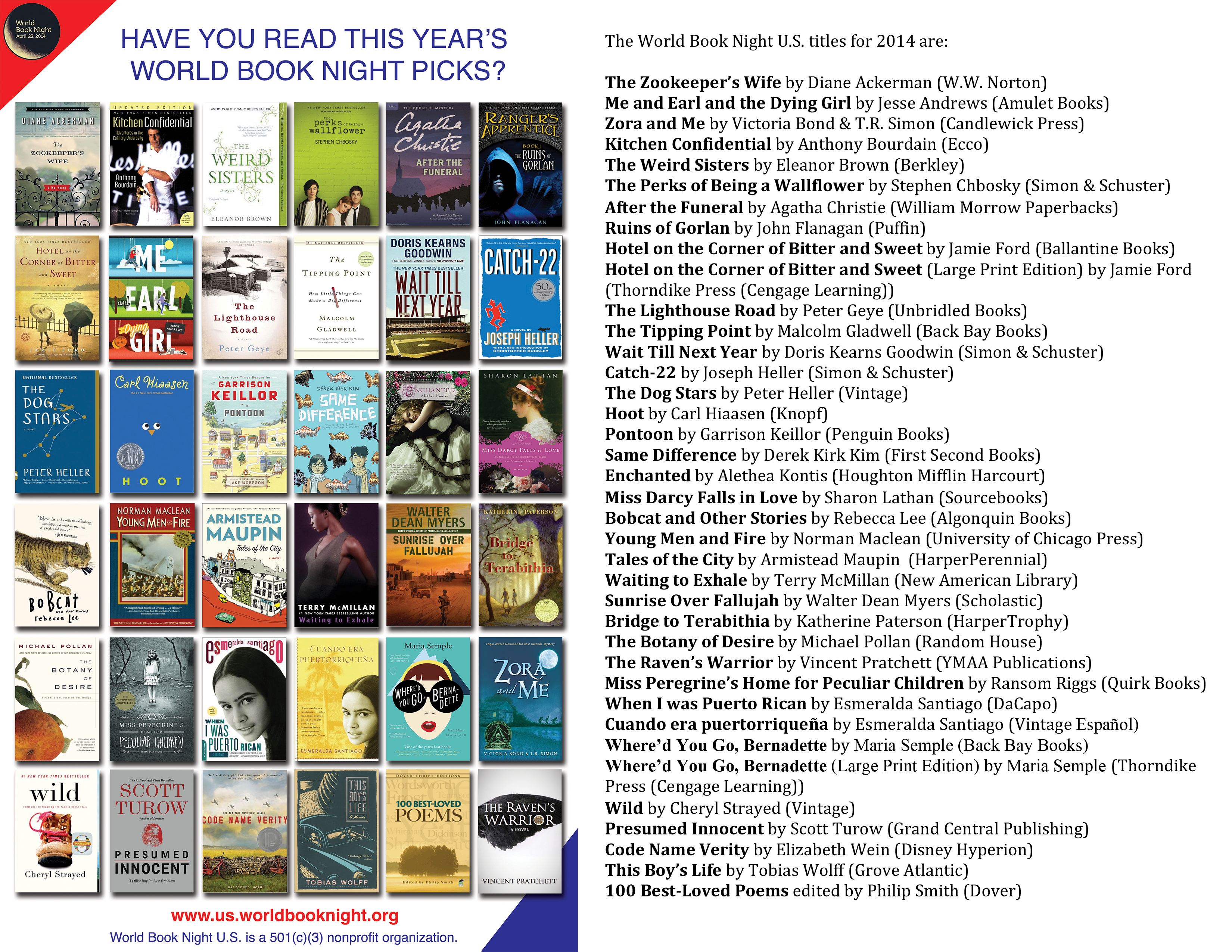
I still think WBN is a fantastic initiative, and I want to thank the authors and publishers that donated their books, and the WBN organization itself for making this happen year after year. Here are all the WBN 2014 titles:

Books_wbn2014

Gabrielle Zevin at Porter Square Books

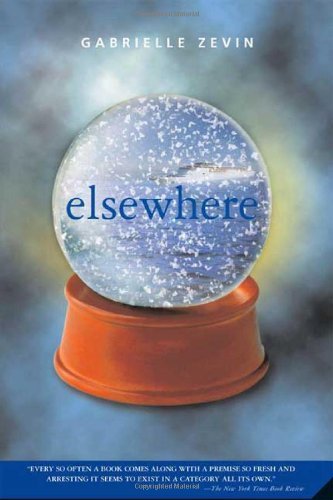
elsewhereJust over a year ago, the children’s librarian at the library where I work pressed a book called Elsewhere into my hands and convinced me to read it simply because she had loved it so much herself; even though she’d read it for the first time years ago, she said she still thought about it regularly. (This is usually a good sign.)

I think I read the book in a day, or maybe a weekend. I found it just as sweet, thoughtful, and unique as promised. However, I neglected to hunt down the author’s other books, and when I began hearing about The Storied Life of A.J. Fikry a few months ago, I did not make the connection. I put two and two together just in time to see Gabrielle Zevin speak at Porter Square Books this past Monday.

A bookstore employee introduced Zevin as a graduate of “our local university down the street” (i.e., Harvard). Zevin started her talk by telling the audience how she got into publishing. She sold her first two novels, Elsewhere and Margarettown, in the same year; Elsewhere was an ALA Notable Children’s Book and won a few other awards as well, while Margarettown, despite several good reviews, “was a flop.”

“A flop” can mean two things in publishing: it can mean that the book was terrible and/or got bad reviews, but it can also mean that the book was decent, even good, but didn’t merit significant attention, and was buried beneath the next season’s books. Margarettown is still on the shelves of fourteen of the libraries in the Minuteman Library Network, so while it may be out of print, it’s still available; it may find fans yet.

Zevin spoke about her relationship with books going back to childhood. Ever since her parents used to drop her off at a bookstore while they went grocery shopping, she said, entering a bookstore fills her with “a heady sense of freedom and possibility.” In bookstores, she said, she always felt safe, like nothing bad could ever happen in a bookstore – “and nothing bad ever has happened to me in a bookstore.”

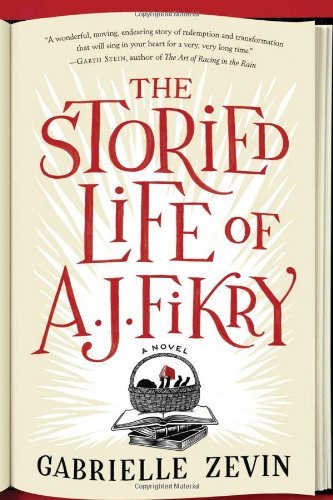
storiedlifeajfikryOn to the matter of inspiration: where do her ideas for books come from? “Most of my books have started with a question.” For A.J. Fikry, there were two questions: What is the importance of bookstores to the world? And what effect do the stories we read have on our lives?

Zevin is obviously a believer in books and stories. She stated, “Children who read grow into adults you want to know.” People who read develop empathy. (I’ve written about the link between fiction and empathy here before, especially in this post inspired by an interview with Lauren Groff.) Bookstores, Zevin believes, are special places; they “represent the good in a community. They are about more than just commerce; they are about the exchange of ideas.” (The same can be said of libraries, which are entirely about ideas and community and not about commerce at all.) Reading and writing may be solitary activities, but they connect us as a community. Though those in the self-publishing business (more about that later) may disdain gatekeepers, Zevin said, “We need people [editors, booksellers, librarians] to tell us what is good and what is bad. The future of literary culture depends on these people. Booksellers are curators.”

The book world is changing. From 2005, when Elsewhere was published, to 2014, there have been huge changes: the ubiquity of the Internet, the expectation that authors will have a social media presence, the rise of e-books. “I think it’s worth being mindful of what we lose as these changes occur,” said Zevin. She doesn’t worry about futures in which children fight to the death or Chicago is divided into factions by personality type (clear allusions to The Hunger Games and Divergent); “I do, however, worry very much about the world without books.”

An Indie Next Pick for April 2014, The Storied Life of A.J. Fikry was published as The Collected Works of A.J. Fikry in the U.K. The idea behind this title is that “collected works” can refer to everything a person has read in his or her life, rather than everything s/he has written. This idea instantly reminded me of Audrey Niffenegger’s graphic novel The Night Bookmobile, in which Alexandra discovers a bookmobile filled with every book she’s ever read. (The Night Bookmobile was first serialized in The Guardian, then published in hardcover by Jonathan Cape.) Such a bookmobile would be fascinating; as Zevin said, “Anybody’s reading life is so gloriously random.”

“We read to know we’re not alone. We read because we are alone. We read and we are not alone. We are not alone.” —The Storied Life of A.J. Fikry, Gabrielle Zevin

During the Q&A, Zevin spoke again about debuts. Her first two books were published quite close together, and while Elsewhere was successful, Margarettown was less so; its publisher actually folded, and the book is now out of print. Zevin said, “Everybody has a sad story about a first novel…Most of the time everyone fails. Most of the time everyone gets it wrong. How do you get over failure? You keep working…A lot of debuts are not a writer’s best work.” She added, “The work is separate from people’s response to it,” which struck me as a sensible and wise perspective to maintain.

Because Zevin writes for both YA and adult audiences, someone asked her how she shifted between them, and how she decided which audience to write for. Zevin said that the main character’s age and situation determine the audience; she has the idea first, then decides on the audience accordingly. She shared an anecdote from another author’s response to this question; that author said that the difference is hope – YA books must be hopeful – but Zevin thinks “adults like hope too.”

I haven’t yet read The Storied Life of A.J. Fikry (though it’s next on my to-read list), but I know the eponymous main character is a bookseller. (Zevin read a funny passage wherein Fikry elucidates to the sales rep, Amelia, all the kinds of books he isn’t interested in.) However, Zevin said, “A.J.’s [literary] tastes aren’t mine.” She’s a keen observer of other people’s reading habits, and noted that spying on people’s reading on the subway is much harder now because of e-readers.

Another audience question concerned research. Zevin said that while she doesn’t write two books at one time, she can research one while writing another, and she did quite a lot of research for her novel The Hole We’re In, about “female soldiers in Iraq.” (She also mentioned, offhandedly, that she dislikes National Novel Writing Month – or at least thinks it “needs to be preceded by National Thinking About Your Novel Month.”)

After about ten years of working with traditional publishers, Zevin has learned a lot about how they work, and she has “respect and appreciation” for all jobs in publishing. Although “the books are still more important than how they get sold,” a tremendous amount of work goes into all aspects of a book: not just the writing of it, but the editing, the design, the jacket copy and cover art, the distribution and marketing and sales. She started off knowing very little of this – she admitted she didn’t even know that sales reps, who bring publishers’ books and catalogs to bookstores, existed – but concluded, “I do think it’s always better to be armed with information.” Many articles about self-publishing (she mentioned the Wall Street Journal particularly) display a “deep misunderstanding about the publishing process.” There is more to making a book that writing it and clicking a button. (See also: “In defense of editors,” “We built this together.”)

I’m really excited to start reading The Storied Life of A.J. Fikry, and maybe some of Zevin’s other books too. You can see all of her books on her website, and if you live in the Cambridge area, check out the upcoming events at Porter Square Books.

“I’d listen to her read a grocery list”: On Audiobooks

It doesn’t take that much endurance to read a picture book aloud. Reading for longer periods of time, however, can be taxing, which makes the work that audiobook narrators do even more impressive. I started listening to audiobooks when I started driving to and from work; I used to commute via subway, where I found that external noise drowned out anything coming through my headphones.

At first, not sure how much concentration I’d be able to spare, I started by re-reading books I’d already read, such as Philip Pullman’s His Dark Materials trilogy, which is performed by the author and a full cast. (It’s excellent.) I moved on to the Hunger Games trilogy, which Carolyn McCormick narrates (she is also excellent). Then I listened to Life by Keith Richards, read by Johnny Depp, Joe Hurley, and “Keef” himself; the switching between narrators seemed random and was somewhat jarring, but each individual reader was very good.

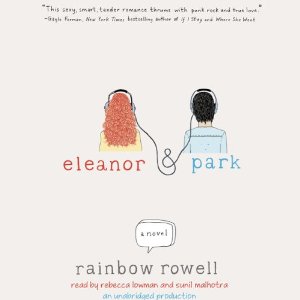
eleanorandpark_audioEventually, I started reading books I hadn’t read before, and I’ve become hooked on audiobooks; as soon as I finish one, I start another. Because my commute is blessedly brief and I’m usually only in the car for half an hour each day, I read a lot of shorter books (7-9 hours), often young adult novels. I’ve started seeking out particular narrators, such as Rebecca Lowman (Eleanor & Park, Rules of Civility) and Morven Christie (Code Name Verity, Burial Rites).

Luckily for me, audiobooks are becoming more popular, and publishers are producing more of them (see “Actors Today Don’t Just Read for the Part. Reading IS the Part,” Leslie Kaufman, The New York Times, June 29, 2013). As for whether listening to an audiobook counts as reading, there is plenty of debate. I would venture to say that as long as one has mastered the ability to read in print, audiobooks are as legitimate a way to consume books as reading them on paper (or on a screen). “We tend to regard reading with our eyes as more serious, more highbrow, than hearing a book read out loud,” T.M. Luhrman wrote in a New York Times  piece called “Audiobooks and the return of storytelling” on February 22. She continued, “The ability to read has always been invested with more importance than mere speech….But for most of human history literature has been spoken out loud.”

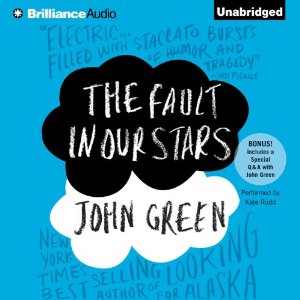
TFIOS_audioOne experiences a story differently, and remembers it differently, when hearing it read aloud as opposed to reading the text visually. Partly, audiobooks are a different reading experience for me because I don’t skip over sentences or skim paragraphs; I hear every single word. And a truly talented narrator can bring a book to life: listen to Jim Dale perform the Harry Potter books or Erin Morgenstern’s The Night Circus, or Rebecca Lowman read Eleanor & Park or Rules of Civility. Kate Rudd reading The Fault in Our Stars brought me to tears, though I didn’t cry when I first read the book in print.

I think we are all hungry for stories, whether we read them to ourselves in print, listen to them as audiobooks, or read them out loud to ourselves or each other. If you aren’t an audiobook devotee already, I’d encourage you to give them a try. Libraries usually carry them on CD and sometimes on Playaways, and they are often downloadable in mp3 format too.

Characters, Gender, and Likability

Yesterday I followed a couple of links from Twitter and read these two pieces: “Why Talking About Girl Reading Matters” from Kelly Jensen at Stacked and “On Liking Characters” by Liz Burns at School Library Journal (SLJ). The Stacked post linked to Laurel Snyder’s post “Boys Will Be Boys, And Girls Will Be Accommodating.” Together, these pieces make the point that in focusing on “books for boys” (boys are generally more reluctant readers than girls) we do everyone an injustice.

If boys only ever read “books for boys,” they may never discover that they like other kinds of books as well. Those of us putting books into the hands of growing readers can’t underestimate them; we ought to encourage them to stretch and try something new. At the same time, “girl books” tend to be pushed to the sides, sending the message that they are less important. “The best solution,” writes Snyder, “would require us to push against the gender bias in the world, and in ourselves.”

If there’s one thing The Hunger GamesDivergent, and The Fault in Our Stars have proved, it’s that boys will read books that have girls as the main character. (As for the author’s gender, it’s not something I remember ever paying attention to much as I was growing up, and I don’t pay much attention now, either; this is borne out in my reading stats. But in the above examples, those incredibly successful trilogies are written by women.)

A character’s gender also affects their likability, as Burns points out in her piece. Some readers are quick to label girl characters unlikable if the character acts in a nontraditional way. But a likable character isn’t the same as a good one (i.e., a well-written, realistic one). Here’s my response to Burns’ piece:

The most important thing about character is believability. Are the character’s actions believable? Is there an internal consistency? Does the reader understand the character’s motivation? If the answer to these questions is yes, then the author has probably created a good character: recognizably human, with some flaws and some talents.

Likability is a different issue entirely. Personally, I would be bored reading about likable characters all the time, or if all characters were binary, either likable or unlikable – protagonist/antagonist, hero/villain. Real people are more complicated than that.

As Claire Messud has pointed out, the likability issue does affect female characters (and female authors) disproportionately; it’s more common for readers to criticize female characters for being unlikable than male characters.

My friend Anna has also written about the “books for boys/books for girls” issue, both at YALSA’s The Hub and on her own blog. On The Hub, she wrote, “…it doesn’t matter if a book is ‘for’ a guy or a girl; the gender of the intended audience tends to get all mixed up when you factor in the power of a good story. Boys like stories; girls like stories. Readers in general like stories” (emphasis added). Anna added to this thought a few days later on her blog, asking, “What About Books for Girls?” She wrote,

“Readers are readers. If we could just take off the gendered lenses entirely, I think we could serve our readers better. Let’s focus on writing, reading, and recommending stories that are true (in the manner of Truth, not necessarily a nonfiction story), that matter, that touch the soul, that are real, that show the varieties of human emotion and experience, that are maybe even an inspiration. Let’s do that instead of focusing on the gender we think might like the book the best. Books for girls are books for boys, and books for boys are books for girls. It’s all just stories.”

A skilled author, male or female, can write excellent, believable, well-rounded characters of any gender. Let’s try to focus on getting great stories into the hands of all readers.

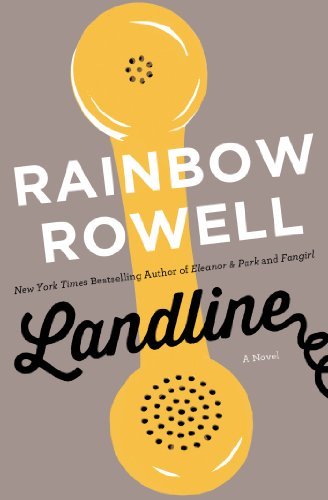
Landline by Rainbow Rowell

landline

She had to call. You can’t just ignore a phone that calls into the past. You can’t know it’s there and not call.

In her three previous books, Attachments, Eleanor & Park, and Fangirl, Rainbow Rowell has demonstrated an ability to create characters that are as recognizable as real people. She has proven herself adept at writing all kinds of relationships – romantic and otherwise – for characters in high school, college, and early adulthood. In Landline, Rowell leaves the YA realm and returns to the adult world, delving into the marriage of Georgie McCool and Neal Grafton.

Georgie and Neal meet in college, marry at twenty-three, and have two children. Georgie works as a TV writer with her friend Seth, who has been her writing partner for longer than Georgie and Neal have been together. Georgie and Seth are on the verge of achieving their longtime dream of getting their own show, but there’s a catch: they have to have material ready in a matter of days. But it’s almost Christmas, and Georgie is supposed to go with her family to Omaha for the holiday.

Instead, Georgie stays in California to work on scripts with Seth while Neal takes their daughters to Omaha. Georgie’s mother and sister treat her as though Neal has left her, which is not what Georgie thinks has happened at all…or has it? Georgie begins to fall apart. She can’t get in touch with Neal on the phone, until she tries calling from the old landline phone at her mom’s house. Talking to Neal on the phone brings back old memories of their time in college, and the terrible week when they were broken up, before he drove twenty-seven hours back from Omaha to California and proposed to her on Christmas morning. Georgie can’t remember that week very well, but as she talks to Neal, pieces she didn’t know were missing begin to fall into place.

The plot hinges on two phones: Georgie’s dead cell phone, and the landline (a.k.a. the magicfuckingphone). I found the landline, where present-day Georgie talks to past Neal, much easier to go along with than the idea that a responsible adult with children would let her cell phone die as often as Georgie did. But that’s my one complaint.

Rowell has an incredible depth of understanding of her characters, and of marriage generally, but she also has a lovely light touch: there are plenty of funny, witty moments alongside (and sometimes during) the darker, bleaker ones. At one point, Georgie realizes that even though Neal is perfect for her, she might not be perfect for him; that “she wanted him more than she wanted him to be happy.” Throughout the novel, Georgie wrestles with big questions like these. She has always known what she wanted: a career in TV, Neal, and her kids. Neal has never really known what he wanted, except for Georgie. Seth adds another layer of tension to Georgie and Neal’s relationship: there’s no love lost between Seth and Neal, but they’ve maintained a tense truce all these years, for Georgie’s sake. Is Seth ready to break that truce? 

Readers may occasionally pause to dwell on issues of feminism. (Georgie wanted to take Neal’s last name, but he wouldn’t let her, because “You don’t come into this world with a name like Georgie McCool and throw it away on the first pretty face.”) In the McCool-Grafton marriage, Georgie is the careerist, the breadwinner, the busy one, while Neal is the stay-at-home dad; Georgie’s own sister points out that Neal would get custody in a divorce. But the novel doesn’t read like a book with an agenda; it only presents a scenario that is the reverse of the traditional one.

Rowell is as magical as her landline phone. Georgie and Neal’s marriage, with all its history and weight, comes through clearly: their good moments and bad moments, the joys and stresses, the selfishness and compromises. Georgie and Neal recognize that they may not be perfect for each other, that their lives might not “fit together,” but, as Neal says, “Nobody’s lives fit together. Fitting together is something you work at. It’s something you make happen – because you love each other.” Stranded half a country away from Neal and her kids, Georgie has to figure out how to make it happen.

I had incredibly high expectations for this book, and though high expectations often lead to disappointment, that wasn’t the case here at all. Instead, I was wholly delighted, and I think Rowell’s fans will be too. In fact, moving seamlessly between YA and adult, she’s likely to bring her old fans with her and attract some new ones as well.

I received an e-galley of LANDLINE from publisher Macmillan via Edelweiss. The expected publication date is July 8, 2014. Quotes in the review above are from the galley, not the final copy.

“New Adult” Revisited, Or, Where are all the books about college?

It’s easy to find books about characters in high school. And it’s easy to find books about adult characters anywhere, doing anything. But there is a sparsely populated area between these two: books about characters who are transitioning from childhood/teenagerhood to adulthood. A few years ago, in response to a post on the Young Adult Review Network (YARN), I struggled to come up with a handful of titles that fit this category. YARN responded with additional titles (November 2011), but I don’t think anyone was satisfied that there were enough “new adult” books at the time.

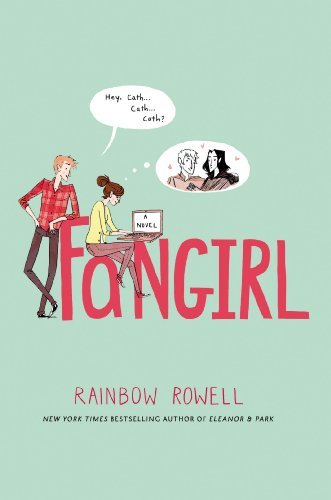
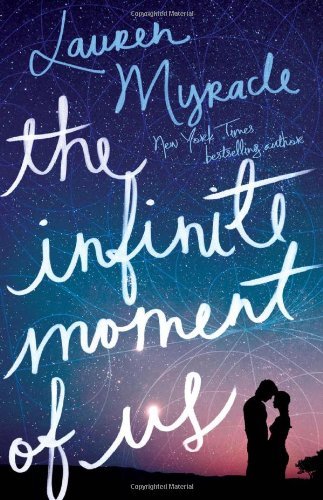
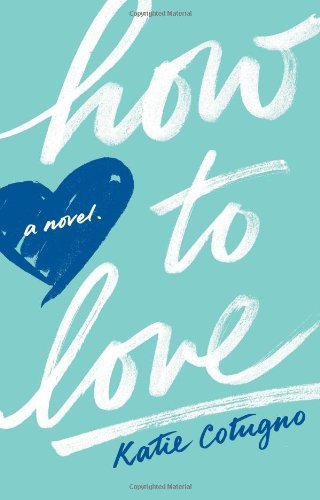
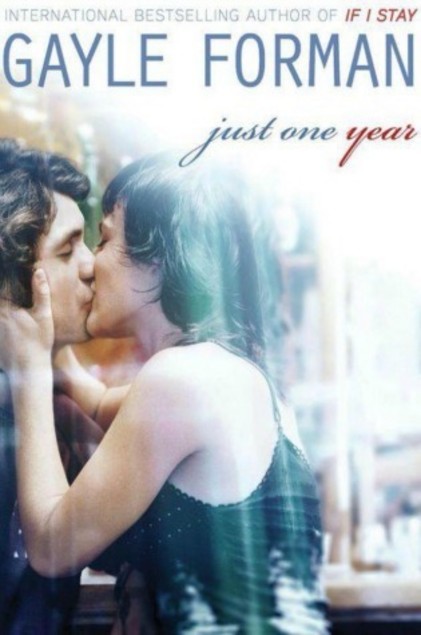
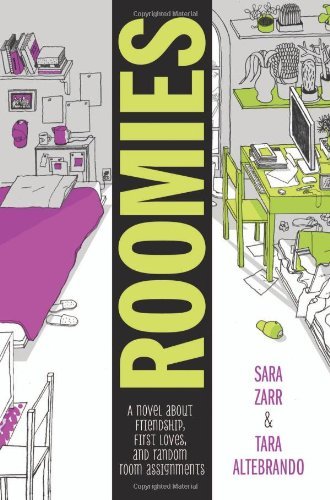
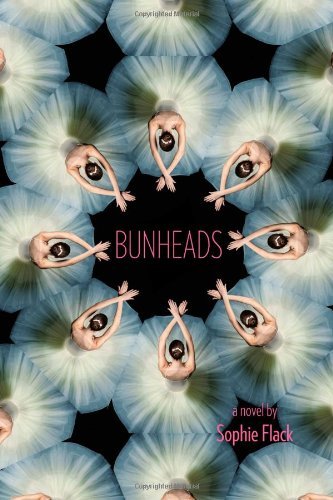
fangirlinfinitemomentofusThe topic came up again at ALA 2013. I didn’t attend in person, but followed the coverage on blogs and Twitter; Hannah Gomez’s piece for YALSA’s The Hub provides a great recap, as well as a link to a resource list, which has been updated – a pleasant surprise! – since the conference. (There’s another good piece on The Hub about adult books with teen appeal, from August 2012. I’d add Tell the Wolves I’m Home by Carol Rifka Brunt to this list, and I’m not alone – it’s a 2013 Alex Award winner.) I was glad to see that a few of my recent favorites that fit snugly into the “new adult” category are on the reader’s advisory resource list, including Bunheads by Sophie Flack, The Infinite Moment of Us by Lauren Myracle, Fangirl by Rainbow Rowell, Roomies by Sara Zarr and Tara Altebrando, and Just One Day and Just One Year by Gayle Forman; I’d also add How to Love by Katie Cotugno.

howtolovejustoneyearThe years after high school, whether they include college or not, and the first few years in the working world are a transitional time of great change and (hopefully) growth. It is strange that authors haven’t mined this emotion-rich area more. Perhaps these books fell into that gray area that is neither YA nor adult, and publishers weren’t sure how to market them, but if that’s the case, it’s a weak one: so many adults are openly reading YA lit now that these”crossover” books should appeal to both audiences, rather than being lost between them.

roomiesbunheads

Lourdes at YARN made an important point about some of the books I suggested back in 2011: that they contained an element of nostalgia, and were told from an adult point of view in a present that looked back on the past, as opposed to being told from the point of view of a young adult in the present. The books I mentioned above fit this criteria much better, and I hope to discover and read more of these (suggestions are welcome in the comments).

However, as a reader, I like the adult-looking-back perspective; one example I can think of is Joshua Henkin’s Matrimony, which starts when its three main characters are in college. Maggie Shipstead’s forthcoming Astonish Me (April 2014) also begins when its main character is a young adult, and it follows her until her own son is a teenager. (I’d definitely recommend it to anyone who liked Bunheads.) Much of the action in Karen Joy Fowler’s We Are All Completely Beside Ourselves takes place when the narrator is in college, though in the present she is middle-aged. Eleanor Brown’s The Weird Sisters also deals with three young women who have been out in the world for a few years, but who don’t yet feel like (or, sometimes, act like) adults. All the Light There Was by Nancy Kricorian is also adult fiction, but its main character, Maral, grows from fourteen to twenty during WWII in Paris – perfect for “new adults” who like historical fiction, as Maral makes several difficult and important choices as she comes of age.

The titles in the paragraph above were gleaned from my own reading over the past several months, so clearly “new adults” exist in literature – they can just be hard to find. I’d love to see more books like Fangirl and Roomies, though. Again, if you have suggestions, let me know in the comments!

Note: There are many definitions of the “new adult” category (and many disagreements about whether it’s a genre or a marketing ploy, exciting or a hassle), but no consensus. Therefore, I’m using my preferred definition of “new adult”: books about characters who are in the 18-25-year-old range, told from their perspective (not necessarily first person, present tense, but not from an adult perspective looking back). 

Yearly wrap-up, 2013 edition

In the spirit of those sites that do a weekly wrap-up (like Dooce’s “Stuff I found while looking around” and The Bloggess’ “Sh*t I did when I wasn’t here”), here are a few odds and ends I found while going through my work e-mail inbox and my drafts folder.

How to Search: “How to Use Google Search More Effectively” is a fantastic infographic that will teach you at least one new trick, if not several. It was developed for college students, but most of the content applies to everyday Google-users. Google has its own Tips & Tricks section as well, which is probably updated to reflect changes and new features.

How to Take Care of Your Books: “Dos and Don’ts for Taking Care of Your Personal Books at Home” is a great article by Shelly Smith, the New York Public Library’s Head of Conservation Treatment. Smith recommends shelving your books upright, keeping them out of direct sunlight and extreme temperatures, and dusting. (Sigh. Yes, dusting.)

The ARPANET Dialogues: “In the period between 1975 and 1979, the Agency convened a rare series of conversations between an eccentric cast of characters representing a wide range of perspectives within the contemporary social, political and cultural milieu. The ARPANET Dialogues is a serial document which archives these conversations.” The “eccentric cast of characters” includes Ronald Reagan, Edward Said, Jane Fonda, Jim Henson, Ayn Rand, and Yoko Ono, among others. A gem of Internet history.

All About ARCs: Some librarians over at Stacked developed a survey about how librarians, bloggers, teachers, and booksellers use Advance Reader Copies (ARCs). There were 474 responses to the survey, and the authors summarized and analyzed the results beautifully. I read a lot of ARCs, both in print and through NetGalley or Edelweiss, and I was surprised to learn the extent of the changes between the ARC stage and the finished book; I had assumed changes were copy-level ones, not substantial content-level ones, but sometimes they are. (I also miss the dedication and acknowledgements.)

E-books vs. Print books: There were, at a conservative estimate, approximately a zillion articles and blog posts this year about e-books, but I especially liked this one from The Guardian, “Why ebooks are a different genre from print.” Stuart Kelly wrote, “There are two aspects to the ebook that seem to me profoundly to alter the relationship between the reader and the text. With the book, the reader’s relationship to the text is private, and the book is continuous over space, time and reader. Neither of these propositions is necessarily the case with the ebook.” He continued, “The printed book…is astonishingly stable over time, place and reader….The book, seen this way, is a radically egalitarian proposition compared to the ebook. The book treats every reader the same way.”

On (used) bookselling: This has been languishing in my drafts folder for nearly two years now. A somewhat tongue-in-cheek but not overly snarky list, “25 Things I Learned From Opening a Bookstore” includes such amusing lessons as “If someone comes in and asks for a recommendation and you ask for the name of a book that they liked and they can’t think of one, the person is not really a reader.  Recommend Nicholas Sparks.” Good for librarians as well as booksellers (though I’d hesitate to recommend Sparks).

The-Library-Book-154x250_largeOn Libraries: Along the same lines, I really enjoyed Lucy Mangan’s essay “The Rules” in The Library Book. Mangan’s “rules” are those she would enforce in her own personal library, and they include: (2) Silence is to be maintained at all times. For younger patrons, “silence” is an ancient tradition, dating from pre-digital times. It means “the absence of sound.” Sound includes talking. (3) I will provide tea and coffee at cost price, the descriptive terms for which will be limited to “black,” “white,” “no/one/two/three sugars” and “cup.” Anyone who asks for a latte, cappuccino or anything herbal anything will be taken outside and killed. Silently.

On Weeding: It’s a truth often unacknowledged that libraries possessed of many books must be in want of space to put them – or must decide to get rid of some. Julie Goldberg wrote an excellent essay on this topic, “I Can’t Believe You’re Throwing Out Books!” I also wrote a piece for the local paper, in which I explain the “culling” of our collection (not my choice of headline).

“What We Talk About When We Talk About Public Libraries”: In an essay for In the Library with the Lead Pipe, Australian Hugh Rundle wrote about the lack of incentives for public librarians to do research to test whether public libraries are achieving their desired outcomes.

Public Journalism, Private Platforms: Dan Gillmor questions how much journalists know about security, and how much control they have over their content once it’s published online. (Article by Caroline O’Donovan at Nieman Journalism Lab)