See Part I and Part II of Libraries in a Post-Truth World.

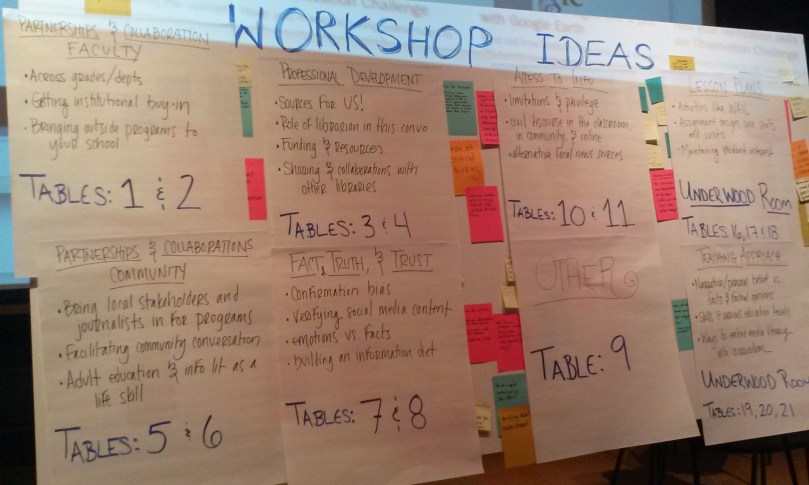
In the Fact, Truth, and Trust group of academic and public librarians and researchers, we discussed confirmation bias, verifying social media content, emotions vs. facts, and building an information diet. We started with introductions and why we had chosen this group. People expressed interest in:
- How to separate fact from opinion (“Where does truth lie in a society that’s all about opinion and rhetoric?”)
- How to have programs in libraries and schools without political slant or agenda
- Advocacy for funding for librarians in schools
- Teaching/encouraging critical thinking skills
- Information-seeking behavior and narrative theory, how people construct narratives
- Trust in/use of data (what people talk about when they talk about data; presentation of data)
One participant commented that “Uncovering bias is one of the highest-order thinking skills we have…it can be almost invisible.” As one of the panelists had pointed out earlier, confirmation bias affects people on both/all political sides. Two people mentioned the site allsides.com (“Don’t be fooled by bias. Think for yourself”), which offers left, right, and central perspectives for real news stories.
Eventually we came to the idea of “building an information diet” and spent most of our time discussing how we might use that idea to offer library programs on information literacy. The diet analogy will be immediately familiar to most people: a healthy information diet, like a healthy food diet, should be varied and mostly wholesome. There are many ways to approach this:
- Read/watch/listen to a news source that has the opposite perspective from your usual source(s). Expand/broaden your news-universe; whether or not you agree with it, know where the other side is coming from. Begin to build a bridge from your emotional comfort areas to increase empathy. You may not change your mind, but understand where others are coming from.
- Debate whose responsibility it is to curb “fake news”/ propaganda/misinformation/disinformation. Social media platforms? The government? Individuals?
- Incorporate international media sources: look at international coverage of world news and U.S. news. If teaching a class or workshop, international examples are less political, as are sports and entertainment/cultural coverage.
- Affirm belief in truth and facts: encourage people to be skeptical, but convince them that verification is possible.
As for specific program ideas:
- Include it in existing summer reading programs.
- Use the “Whole 30” model, or modify it to a day- or week-long challenge. Those who want to participate can meet at the beginning and end to discuss their strategies and results.
- Create a game aspect with competition and prizes. Tracking down original sources can be like a mystery or a treasure hunt.
- Try a version of the Human Library to encourage discussions across political differences. A conversation with a real live person is more likely to change someone’s mind (or create that empathy bridge) than reading an article.
- Checkology from the News Literacy Project can be used in public libraries. It’s designed for students in grades 6-12 but some parts are appropriate for adults as well.
It’s important to maintain the trust that people already have in libraries, and strike a balance between advocacy and alienation. Be aware that the term “fake news” itself is very polarizing. (But “propaganda” is even more so.) Frame information literacy programs as helpful for “brushing up your skills” instead of teaching something entirely new.
The information diet idea isn’t original to the Libraries in a Post-Truth World conference; a NYT article has been published since the conference on the same topic (“Fatigued by the News? Experts Suggest How to Adjust Your Information Diet,” Christopher Mele, The New York Times, February 1, 2017). This article was somewhat short on actual suggestions, however, beyond (1) seeking out positive news as an antidote to the barrage of negativity, (2) reading a print newspaper instead of Internet sources, and (3) not reading or watching the news before bed. It also links to an article that cites Dan Gillmor, who popularized the “slow news” movement, partly as a reaction to the 24-hour news cycle.
I used to read Dan Gillmor’s blog regularly, and actually did an activity he assigns to the students in his media literacy class at ASU: to track your own media consumption for one day. It was interesting to do, and could easily be adapted into a library program if patrons were interested in sharing their experience.
I’m grateful for the experience of attending this conference, and hope to put some of the ideas to work here in my library.
“Truth will ultimately prevail where there is pains taken to bring it to light” –George Washington

Adult Fiction
Children’s board books and picture books
The Clementine series by Sara Pennypacker – I listened to all seven of these audiobooks (narrated by Jessica Almasy) and loved every single one. Clementine reminds me of Ramona Quimby (especially when adults tell her to “pay attention” and she says that she was paying attention…to something else. Perfect kid logic). The parents are great characters too.
On November 30, journalist and author Caitlin Moran (pronounced CAT-lin mo-RAN) spoke in conversation with Boston Globe columnist Meredith Goldstein at the Brattle Theater in Cambridge, hosted by the
The Wonder by Emma Donoghue: Donoghue switches fluidly between contemporary and historical novels, and she excels at both. The Wonder is the story of Nightingale-trained English nurse Lib Wright, who takes a two-week job watching Irish eleven-year-old Anna O’Donnell, who claims not to have eaten in four months. Is it a miracle or a hoax? Lib is sure it’s a hoax and that Anna is a liar, but she quickly comes to care for the girl, and concern at her deteriorating condition compels her to ask not how Anna is maintaining her fast, but why she feels the need to fast at all. The answer is a tangle of religious beliefs and a dark family secret.
The Trespasser by Tana French: I’ve been devoted to Tana French’s psychological suspense novels since In the Woods, and I’m always eager to read her new books, though I think The Likeness will always be my favorite. The Trespasser takes place largely in the police office and interview rooms rather than out on the scene; it was a touch long but never felt sluggish, as Conway and Moran dug into what was apparently a domestic murder but turned out to be more complicated than that.
The View From the Cheap Seats: Selected Nonfiction by Neil Gaiman: This one sneaked up on me; it was not preceded by a lot of fanfare. I’d read a few of the pieces already but enjoyed them again, particularly
This Must Be the Place by Maggie O’Farrell: O’Farrell is another of my favorite authors and I read an e-galley of this novel in a few huge gulps, the result being that I don’t remember it as well as if I’d read it more slowly. It’s the story of Daniel Sullivan and his various family members, in various parts of the world (Donegal, Paris, California, New York, Chile), at various times (from the 1980s to 2016). O’Farrell has a genius for character; I would read this again and probably enjoy it just as much.
Commonwealth by Ann Patchett: On my admittedly long list of favorite authors, Patchett is firmly in the top five. Commonwealth is the story of two families who break apart and combine, leaving the children to cope with divorce, cross-country moves, and a singular tragedy. Various family members (but not all of them) narrate over a long time frame, during which their personal tragedy is made public in a famous author’s thinly fictionalized account.
Eligible by Curtis Sittenfeld: I had high expectations for this book (Curtis Sittenfeld! Pride & Prejudice!), and though some reviews were negative or mixed, I thoroughly enjoyed it, as did the other members of my book club. Sittenfeld brings the P&P story and characters into present-day Cincinnati, and she does it very well: with cleverness and wit and invention. She makes one or two significant changes from the original plot and characters, but remains true to the heart of the story.
The Last Painting of Sara de Vos by Dominic Smith: I do love a good art history story, and this one didn’t disappoint. It takes place in three time periods: Holland in the 1630s, when the painting is created; Manhattan in the 1950s, when the painting is stolen and copied; and Sydney, Australia in 2000 when both the original and the forgery arrive at a museum show. Suspenseful and satisfying, a good choice for those who liked The Art Forger (B.A. Shapiro) or The Miniaturist (Jessie Burton).
A Gentleman in Moscow by Amor Towles: I loved Rules of Civility so much that I was doubtful his next novel could be nearly as good, but my library colleague raved about it and it’s gotten very good reviews. I’ve just started reading and am enjoying it so far.
These stories are set in different places and times, real and imaginary, past and present. The characters are different as well: optimistic and pessimistic, gay and straight, poor and middle-class and wealthy, Christian and Jewish and pagan, Black and white, skeptical and romantic. (One can see why it’s YA authors who are leading the #WeNeedDiverseBooks campaign.) All in all, it’s a pretty near perfect collection, and I’m looking forward to Stephanie Perkins’ other anthology, Summer Days and Summer Nights: Twelve Love Stories.