See the first Libraries in a Post-Truth World conference post here.
The panelists:
John Palfrey, Head of School, Phillips Academy, and author
Mary Robb, Teacher, Media Literacy and Democracy, Andover High School
Adam Schrader, Former Facebook editor and news fact checker
Damaso Reyes, Program Coordinator, The News Literacy Project
Melissa Zimdars, PhD, Assistant Professor of Communication at Merrimack College
Catherine Tousignant, English Instructor, Phillips Academy
Alison Head, PhD, Project Information Literacy
John Wihbey, Assistant Professor of Journalism and New Media at Northeastern University
Claire Wardle, First Draft News
Ben Sobel, Fellow, Berkman Klein Center for Internet and Society, Harvard University
Right away, many of the panelists took issue with the term “post-truth”:
- Not post-truth but post-accountability; the responsibility is on all of us to call out inaccuracies. It is important to teach students the skills to tell fact from fiction. (Mary Robb)
- “Post-truth” is a useful way to think about how information and politics are converging. Immediacy sacrifices deep digging. When people only read headlines, what kind of information are they taking from that and what does that mean? Variety of the internet includes misinformation and disinformation (and “bullshit”). (Melissa Zimdars)
- “There is a world of truth and a world of facts and it doesn’t go away. But there’s also a world of words that occupies its own space…the words have their own power.” Who has authority? Whose authorship is valuable and meaningful? Perspective does matter. Words have power even if they’re untrue. (Catherine Tousignant)
- Students look for consensus, not answers/truth….Untruth works well when it confirms how you feel. (Alison Head)
They also discussed “fake news” and its synonyms:
- There is a difference between untruth and bias. (Adam Schrader)
- “Fake news” is a new term for an old thing – PROPAGANDA. It is important to call these things by their actual names. (Damaso Reyes)
- A lot of the fake news propagated during the election were fueled by economic motives, not political ones (clicks = money). Antidotes/possible correctives are complicated. (John Wihbey)
- “I don’t want to take us down the rabbit hole of darkness, but…we have to think about this” ability to create and disseminate. Trust shifts. Trust bubbles/filter bubbles increase peer-to-peer influence in the absence of gatekeepers. (Claire Wardle)
- The best way to combat fake news is to understand how it is created and disseminated. (Adam Schrader)
Information literacy, media literacy, news literacy:
- “Information is coming towards [students], they don’t have to seek it out….Reach has become a proxy for authority. There are more sources of information” being seen as valid. (Damaso Reyes)
- There has been a slippage in authority – we’ve moved from scarcity to abundance [of information], moving target. (Alison Head)
- Confirmation bias is a bipartisan challenge (Damaso Reyes)
- “We’re surrounded by editorial speech” (e.g. Google search autocomplete). “[People think] the way we obtain our news…are neutral conduits for information, when in fact they are not.” What does it mean to hold Google and Facebook accountable? (Ben Sobel)
What can librarians do?
- Librarians are the “intellectual beating heart of our institutions.” (John Palfrey)
- Different types of libraries can take different actions. Read Pew reports, PIL reports, etc. Libraries are a trusted institution. (Whereas newspapers are less so now.) Librarians are good at ferreting out what exists and good at making partnerships. Librarians are in the right position to make an impact. (Alison Head)
- Academic libraries trying to prepare students to be successful may be using the ACRL Framework for Information Literacy for Higher Education, though this framework mentions quality but not truth. Evaluation is the one skill students tend to take and build on. What kind of tools [for evaluation of information] already exist? What partnerships are formed around those tools? Twitter Trails is one example of a tool to determine where information came from and how it spread. (Alison Head)
- Public libraries are going through a shift not unlike the shift newspapers and media have gone through….It’s not about directing a student to a book…it’s about teaching them how to find information. The best thing librarians can do is give students/patrons the tools to find, sort, prioritize information. “It’s about having the tools to interrogate the information that you find.” (Damaso Reyes)
- Teach students to look for WAIL in news stories: Word choice, Adjectives/adverbs, facts Included, Left out. Sometimes you don’t know what’s left out until you consult another source. Students used to come to school for information, now they have information but don’t know its quality. Teach critical analysis. (Mary Robb)
- Have programs with journalists. What libraries could do is bring in different journalists who covered the same event and have them “unpack” how they covered that story: what goes into news creation, how stories can be reported in two different ways. (Damaso Reyes)
- Students love to talk to journalists. It’s a great way to get students to understand how news is created. (Melissa Zimdars)
- Improve (or help explain) the presentation of information, e.g. from government websites. Improve library websites – they could be much more user-friendly. (John Wihbey)
Q&A
Question for the journalists on the panel: What process do you use for fact-checking?
Panel response: It depends on the type of fact. For a quote, try to find video or audio recording of the person saying it (video is better, so you can carefully examine whether the sound and the lips moving sync up – both audio and video can be faked). For a statistic, go to the organization that issued it. Obtain multiple, credible sources. Cross-verify independently. Use government sources (but be skeptical about these too). Sometimes it’s better to “wait for the debris to clear,” then accurately report the truth. For verification of unofficial sources (e.g. social media content), try to determine the providence, source, state, location.
Question/comment: How to evaluate validity and quality is a complicated problem. Librarians are best-trained to deal with this problem, even better than journalists (who are often trying to be first to break the news). Provide evidence of incorrect information/lies. As humans we just cannot process all of this information. Tech people can create plug-ins to create alerts for lies, satire. Companies must cut off advertising to fake news purveyors. Schools need to teach media literacy and critical thinking. People should understand the scientific method and apply it to your everyday thinking and decisions. Understand the difference between fact and opinion. Understand who you are – know your biases.
Panel response: Silicon Valley needs to hire a nation of librarians! There are some programs and browser plugins that can help (e.g. Hoaxy). Re: Citizen journalism and breaking news: encourage students to keep off of social media (either viewing or sharing) during breaking news situations.
Question: Those of us who teach information literacy classes traditionally direct our students to government websites….
Panel response: During the government shutdown, many pages were inaccessible. Approach with skepticism. Each president has a different agenda; what have they said on a topic? Look elsewhere for information. Figure out which information source is most appropriate for each task. There are more ways to get information, there are ways to evaluate it. Someone introduced an idea about different versions (algorithms) of Facebook, as alternate versions of their usual (secret) algorithm; users could choose the MIT version, LOC version, etc.
All that discussion and Q&A filled an hour and a half and gave participants plenty to think about. In my next post, I’ll write about the afternoon discussion session on “fact, truth, and trust,” where we came up with ideas to use in academic and public libraries.
 Adult Fiction
 Children’s board books and picture books
 The Clementine series by Sara Pennypacker – I listened to all seven of these audiobooks (narrated by Jessica Almasy) and loved every single one. Clementine reminds me of Ramona Quimby (especially when adults tell her to “pay attention” and she says that she was paying attention…to something else. Perfect kid logic). The parents are great characters too.
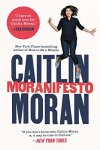 On November 30, journalist and author Caitlin Moran (pronounced CAT-lin mo-RAN) spoke in conversation with Boston Globe columnist Meredith Goldstein at the Brattle Theater in Cambridge, hosted by the
 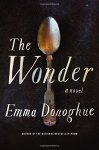 The Wonder by Emma Donoghue: Donoghue switches fluidly between contemporary and historical novels, and she excels at both. The Wonder is the story of Nightingale-trained English nurse Lib Wright, who takes a two-week job watching Irish eleven-year-old Anna O’Donnell, who claims not to have eaten in four months. Is it a miracle or a hoax? Lib is sure it’s a hoax and that Anna is a liar, but she quickly comes to care for the girl, and concern at her deteriorating condition compels her to ask not how Anna is maintaining her fast, but why she feels the need to fast at all. The answer is a tangle of religious beliefs and a dark family secret.
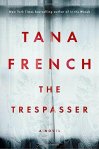 The Trespasser by Tana French: I’ve been devoted to Tana French’s psychological suspense novels since In the Woods, and I’m always eager to read her new books, though I think The Likeness will always be my favorite. The Trespasser takes place largely in the police office and interview rooms rather than out on the scene; it was a touch long but never felt sluggish, as Conway and Moran dug into what was apparently a domestic murder but turned out to be more complicated than that.
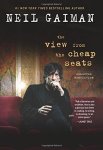 The View From the Cheap Seats: Selected Nonfiction by Neil Gaiman: This one sneaked up on me; it was not preceded by a lot of fanfare. I’d read a few of the pieces already but enjoyed them again, particularly
 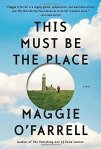 This Must Be the Place by Maggie O’Farrell: O’Farrell is another of my favorite authors and I read an e-galley of this novel in a few huge gulps, the result being that I don’t remember it as well as if I’d read it more slowly. It’s the story of Daniel Sullivan and his various family members, in various parts of the world (Donegal, Paris, California, New York, Chile), at various times (from the 1980s to 2016). O’Farrell has a genius for character; I would read this again and probably enjoy it just as much.
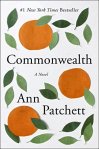 Commonwealth by Ann Patchett: On my admittedly long list of favorite authors, Patchett is firmly in the top five. Commonwealth is the story of two families who break apart and combine, leaving the children to cope with divorce, cross-country moves, and a singular tragedy. Various family members (but not all of them) narrate over a long time frame, during which their personal tragedy is made public in a famous author’s thinly fictionalized account.
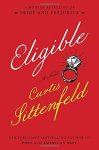 Eligible by Curtis Sittenfeld: I had high expectations for this book (Curtis Sittenfeld! Pride & Prejudice!), and though some reviews were negative or mixed, I thoroughly enjoyed it, as did the other members of my book club. Sittenfeld brings the P&P story and characters into present-day Cincinnati, and she does it very well: with cleverness and wit and invention. She makes one or two significant changes from the original plot and characters, but remains true to the heart of the story.
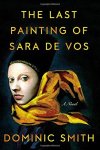 The Last Painting of Sara de Vos by Dominic Smith: I do love a good art history story, and this one didn’t disappoint. It takes place in three time periods: Holland in the 1630s, when the painting is created; Manhattan in the 1950s, when the painting is stolen and copied; and Sydney, Australia in 2000 when both the original and the forgery arrive at a museum show. Suspenseful and satisfying, a good choice for those who liked The Art Forger (B.A. Shapiro) or The Miniaturist (Jessie Burton).
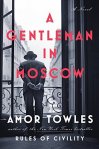 A Gentleman in Moscow by Amor Towles: I loved Rules of Civility so much that I was doubtful his next novel could be nearly as good, but my library colleague raved about it and it’s gotten very good reviews. I’ve just started reading and am enjoying it so far.
 These stories are set in different places and times, real and imaginary, past and present. The characters are different as well: optimistic and pessimistic, gay and straight, poor and middle-class and wealthy, Christian and Jewish and pagan, Black and white, skeptical and romantic. (One can see why it’s YA authors who are leading the #WeNeedDiverseBooks campaign.) All in all, it’s a pretty near perfect collection, and I’m looking forward to Stephanie Perkins’ other anthology, Summer Days and Summer Nights: Twelve Love Stories.
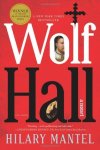 Some novels take famous figures from history and are centered around important historical events. In the case of Philippa Gregory’s The Other Boleyn Girl and Hilary Mantel’s Wolf Hall and Bring Up the Bodies, it is the court of King Henry VIII in England. In the former, Anne Boleyn’s sister Mary is the main character during Anne’s rise, marriage to Henry VIII, the formation of the Church of England, and Henry’s disenchantment with (and beheading of) Anne. For her books – the first two of a planned trilogy – Mantel takes Thomas Cromwell as her main character.
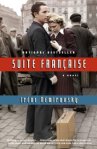 Other novels are about ordinary people in extraordinary times, and the draw of these stories is how their authors are able to make the time and place come to life in a way that seems real. Like Henry VIII’s era, World War II is a popular time period for historical fiction; most recently, the exceptional All the Light We Cannot See by Anthony Doerr was a bestseller (and with good reason). A few of my favorite WWII novels are Suite Francaise by Irene Nemirovsky, The Guernsey Literary and Potato Peel Pie Society by Annie Barrows and Mary Ann Shaffer, Corelli’s Mandolin by Louis de Bernieres, Life After Life by Kate Atkinson, and Code Name Verity by Elizabeth Wein.
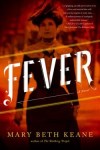 Still a third type of historical novel features extraordinary people in ordinary (for them) times. These characters are as vivid as their settings: Mary Malone (better known as Typhoid Mary) in Fever by Mary Beth Keane, set in turn of the century New York. Katy Kontent in Amor Towles’ Rules of Civility, also in New York, in the 1930s. Regret, a Korean “picture bride” in Alan Brennert’s Honolulu. Tom and Isabel in post-WWI Australia in The Light Between Oceans by M.L. Stedman. Mattie Gokey in the Adirondacks in 1906 in Jennifer Donnelly’s A Northern Light, and Desdemona Hart in 1930s Massachusetts in Maryanne O’Hara’s Cascade.
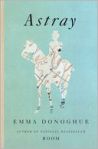 For those who have been counting, this has been more than ten, but I want to mention just three more. Astray is a collection by Emma Donoghue, in which each story was inspired by a real piece of history; Donoghue is so inventive that she can spin two sentences from an old newspaper into a complete, absorbing story.
 Jenny Arch