Introduction to Cyber Security

FutureLearnThis fall, I enrolled in, and completed, my first first MOOC (massive open online course), Introduction to Cyber Security at the Open University (UK) through their FutureLearn program. I found out about the course almost simultaneously through Cory Doctorow at BoingBoing and the Radical Reference listserv (thanks, Kevin).

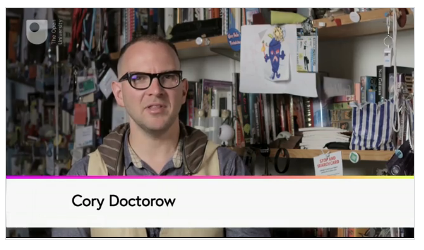
Screen shot from course "trailer," featuring Cory Doctorow
Screen shot from course “trailer,” featuring Cory Doctorow

The free eight-week course started on October 15 and ended on December 5. Each week started with a short video, featuring course guide Cory Doctorow, and the rest of the week’s course materials included short articles and videos. Transcripts of the videos were made available, and other materials were available to download in PDF. Each step of each week included a discussion area, but only some of the steps included specific prompts or assignments to research and comment; facilitators from OU moderated the discussions and occasionally answered questions. Each week ended with a quiz; students had three tries to get each answer, earning successively fewer points for each try.

Week 1: [Security] Threat Landscape: Learn basic techniques for protecting your computers and your online information.
Week 2: Authentication and passwords
Week 3: Malware basics
Week 4: Networking and Communications: How does the Internet work?
Week 5: Cryptography basics
Week 6: Network security and firewalls
Week 7: “When your defenses fail”: What to do when things go wrong
Week 8: Managing and analyzing security risks

The FutureLearn website was incredibly easy to use, with a clean and intuitive design, and each week of the course was broken down into little bite-size chunks so it was easy to do a little bit at a time, or plow through a whole week in one or two sessions. I tended to do most of the work on Thursdays and Fridays, so there were plenty of comments in the discussions by the time I got there.

Anyone can still take the course, so I won’t go too in-depth here, but the following are some tips, facts, and resources I found valuable or noteworthy during the course:

  • Identify your information assets: these include school, work, and personal documents; photos; social media account information and content; e-mail; and more, basically anything you store locally on your computer or in the cloud. What is the value (high/medium/low) of this information to you? What are the relevant threats?
  • Passwords are how we identify ourselves (authentication). Passwords should be memorable, long, and unique (don’t use the same password for different sites or accounts). Password managers such as LastPass or KeyPass can help, but that is placing a lot of trust in them. Password managers should: require a password, lock up if inactive, be encrypted, and use 2-factor authentication.
  • Use 2-factor authentication whenever it is available.
  • 85% of all e-mail sent in 2011 was spam.
  • Anti-virus software uses two techniques: signatures (distinctive patterns of data) and heuristics (rules based on previous knowledge about known viruses).
  • The Sophos “Threatsaurus” provides an “A-Z of computer and data security threats” in plain English.
  • The Internet is “a network of networks.” Protocols (e.g. TCP/IP) are conventions for communication between computers. All computers understand the same protocols, even in different networks.
  • Wireless networks are exposed to risks to Confidentiality, Integrity, and Availability (CIA); thus, encryption is necessary. The best option currently is Wireless Protected Access (WPA2).
  • The Domain Name Server (DNS) translates URLs to IP addresses.
  • Any data that can be represented in binary format can be encrypted by a computer.
  • Symmetric encryption: 2 copies of 1 shared key. But how to transmit the shared key safely? Asymmetric encryption (a.k.a. public key cryptography) uses two keys and the Diffie-Hellman key exchange. (The video to explain this was very helpful.)
  • Pretty Good Privacy (PGP) is a collection of crypto techniques. In the course, we sent and received encrypted e-mail with Mailvelope.
  • Transport Layer Security (TLS) has replaced Secure Sockets Layer (SSL) as the standard crypto protocol to provide communication security over the Internet.
  • Firewalls block dangerous information/communications from spreading across networks. A personal firewall protects the computer it’s installed on.
  • Virtual Private Networks (VPNs) allow a secure connection across an untrusted network. VPNs use hashes, digital signatures, and message authentication codes (MACs).
  • Data loss is often due to “insider attacks”; these make up 36-37% of information security breaches.
  • Data is the representation of information (meaning).
  • The eight principles of the Data Protection Act (UK). Much of the information about legislation in Week 7 was specific to the UK, including the Computer Misuse Act (1990), the Regulation of Investigatory Powers Act (2000), and the Fraud Act (2006).
  • File permissions may be set to write (allows editing), read (allows copying), and execute (run program).
  • Use a likelihood-impact matrix to analyze risk: protect high-impact, high-likelihood data like e-mail, passwords, and online banking data.

Now that I’ve gained an increased awareness of cyber security, what’s changed? Partly due to this course and partly thanks to earlier articles, conference sessions, and workshops, here are the tools I use now:

See also this excellent list of privacy tools from the Watertown Free Library. Privacy/security is one of those topics you can’t just learn about once and be done; it’s a constant effort to keep up. But as more and more of our data becomes electronic, it’s essential that we keep tabs on threats and do our best to protect our online privacy.

Library Programs for Adults

One of my favorite things about librarianship is the culture of sharing. Libraries “do a lot with a little,” and we can’t afford to be reinventing the wheel all the time. If a librarian creates a display you admire, makes a useful handout, or runs a successful program, chances are she’ll be happy to help you duplicate or modify it for your library. So when some of us in the Adult Services department got a question from our former co-worker, an amazing all-around librarian who is now working in Adult Services, we were happy to help.

“The main part of my job is going to be programming.  I am trying to strike a balance between providing what the community has embraced in the past (book groups, movies, etc.) with new and innovative ideas.  Our director is new too and comes from an Adult Services background and is really invested in us trying out some new things.”

  • If there are ongoing programs (movie night, book club) that are already working, by all means keep those going.
  • You don’t want to try to do too much (or add too many new programs) at once and burn yourself out. Keep a list of all the good ideas you come up with or collect, and then you can refer to it when you want to try something new.
  • Do you have a programming budget? Will other library staff be helping you, or are you on your own?
  • Try to get ideas from the community – can you do a survey?
  • Can you partner with community organizations? What programs are already available elsewhere (at the senior center, etc.). Try to collaborate wherever possible, instead of competing/overlapping.
  • Go ahead and do something you’re interested in. Enthusiasm can be contagious!
  • Food programs tend to be popular. Even if you can’t cook in the library, can you assemble ingredients, or have a potluck, or discuss cookbooks or cooking tips?
  • Sign up for newsletters from libraries of a similar size so you can see what programs they are running and how you might adapt those (or use guest presenters). The Library Journal column “Programs That Pop” is a good source of ideas too, though some of those require a lot of staff hours.
  • Speaking of guest presenters, are there people in the community who would volunteer to run/teach a program? How can you support them?
  • Develop an evaluation form so that people who come to programs can let you know what they liked about it, what they didn’t like, how they heard about it, and ideas for other programs they’d like to see.
  • If a book club is too much commitment, try a book chat, where people can come talk about any books they’ve read, instead of one particular book. Plus, everyone gets lots of suggestions this way.
  • Be realistic. If you are expected to run multiple programs a month on your own, then create a schedule you know you can handle. Movies, book chats, a knitting group, or a discussion group on your favorite topic are things that shouldn’t take a lot of prep time but can be very popular. Mix in an author program, someone discussing bee keeping, or any interesting presenter you can find to round out the schedule.
  • Don’t feel bad about giving up on a failing program, even if people tell you how much they enjoy it! There is a big difference between people liking an idea for a program and programs people will drive to the library to attend. Unfortunately you don’t always know the difference until you try it.

Now it’s your turn, librarians who are reading this. What’s your best tip for programs? Where do you get your ideas? General advice, specific tips, and links to your favorite programming resources are all welcome. Please comment!

There’s a lot we don’t say.

I hope by now that readers of this blog have already seen the excellent “Things That Make the Librarian Angry” piece by Jessamyn West over at Medium; if you haven’t already, please go ahead and read it and come back. She articulates the “frustrating truth” about e-books in libraries in a way that will have librarians nodding along, and library users understanding a bit better.

Reading West’s article finally caused something I’ve thought about a lot in the past years to crystallize, and I made this Euler diagram (I was thinking of the Project Management Triangle) to illustrate it:

Euler diagram 2014-12-17 (2)
Euler diagram of privacy, cost, and convenience. Created with Google Drawing. (Creative Commons – Attribution – NonCommercial)

Citizens – or consumers, as we’re now usually called – often have to choose between privacy, cost, and convenience. Many web services are “free,” meaning that the company providing the service is collecting your data: you’re sacrificing your privacy for convenience and no/low financial cost. In other cases, you may pay for privacy and/or convenience.

At least you get one or two of the three, though; for libraries, as West puts it, “There is no good ebook lending solution, yet.” Libraries pay more than consumers do for e-books and digital audiobooks, but that extra cost doesn’t allow us to give access to more people at a time; most lending models are still “one copy, one user” (1C1U), meaning that publishers require DRM that restricts what is otherwise technically possible.

The DRM is usually provided by Adobe, which, as West wrote, “has not been real trust-inspiring lately” in the way that they handle patrons’ personal, private data. (If you are thinking, “I don’t care who knows what I read or when,” please see “Nothing to Hide: Readers’ rights to privacy and confidentiality.”) Library privacy policies often aim for minimal data collection and retention, but our vendors might not share our ideals. (Libraries ought to use their contracts with vendors to ensure the privacy of patron data, but this hasn’t always been possible.)

Lastly, convenience: anyone who has borrowed an e-book or digital audiobook from the library in the past several years knows that it is not as easy as buying one. It is nowhere near “frictionless” (though it has definitely improved by leaps and bounds. I only hope that library users who tried to download an e-book from the library once four years ago weren’t scared off the whole thing forever, but I’m afraid there are plenty who were). I won’t speak for all librarians, but for me, it’s hard to stand at the reference desk and smile as I say “in just seventeen easy steps…”

West makes an excellent point: this “byzantine hokey-pokey dance” to access “free” material spreads a “deceptive and unnecessary ‘tech is hard’ message.” For some people, this means mere frustration, but for others – those who are under-confident in their tech abilities to begin with, who preface a conversation with “I’m computer-illiterate” or “I don’t know how to work this thing” – it’s a little bit heartbreaking.

Which brings us back to West’s opening paragraph, which I’m quoting here to close:

“I was drawn to librarianship because I like to help people, I’m organized, and I believe in intellectual freedom — people’s right to learn and teach and know whatever they want. I like technology because it can solve problems, lots of them. Sometimes the overlap between my two favorite things creates pockets of cognitive dissonance where the technology that solves a problem for the market creates one for the library and its users.”

The sooner we solve this, the better.

Thanksgiving vacation reads: middle grade books

I read a lot of picture books, and a lot of YA (to say nothing of adult fiction and nonfiction). Recently, though, I went on a middle-grade kick, and found some fantastic books. (Plus, it felt great to read an entire grocery bag full of books in a week. You can do that when the print is a little bigger, and you don’t have to go to work.) Some of these were recommended to me by friends and librarian-friends, some I chose from the ALSC summer reading lists for grades 3-5 and 6-8, and others came from review journals or blogs.

Print books

bookcover_questforamaidQuest for a Maid by Frances Mary Hendry: Someone at my book club was staggered that I hadn’t read this growing up, so I remedied the situation, and this book was right up my alley. It’s got a little bit of magic and a lot of adventure, with a gutsy young heroine, Meg, and her loyal friends: Peem Jackson, a cottar’s boy whose life she saved (and who, in turn, saved her life several times over), and Davie Spens, a clever young boy with a harelip that prevents others from understanding him. (Meg can understand him, though, and they wind up betrothed at a young age.) Meg winds up as the protector of the young princess of Norway during an ocean crossing that is cursed – by Meg’s own adored older sister Inge. (Inge is definitely the most complex character in the book, but it’s Meg’s story.) This fits perfectly between The Boggart by Susan Cooper and The Golden Compass by Philip Pullman. The Scots dialect isn’t too tricky, and there’s a glossary in the back.

bookcover_wednesdaywarsThe Wednesday Wars by Gary D. Schmidt: Set on Long Island during the 1967-68 school year, this is the story of seventh-grader Holling Hoodhood, lone Presbyterian in a class full of Catholics and Jews, often at the mercy of his teacher, Mrs. Baker, who makes him read Shakespeare, probably because she hates him. (Actually, Holling realizes pretty quickly that she doesn’t, and also that Caliban has some pretty good curses.) Beyond ordinary seventh-grade concerns, world events intrude into the everyday life of teachers and students, most notably the war in Vietnam. This is a great piece of realistic recent-historical fiction that features a character who is beginning to be aware of the world and people around him, including his conservative father, flower child sister, disempowered mother, and his teacher, who, it turns out, wasn’t born behind that desk.

bookcover_lemoncelloEscape from Mr. Lemoncello’s Library by Chris Grabenstein: This was such a fun read! It reminded me of The Westing Game and Mr. Penumbra’s 24-Hour Bookstore. I’ve always liked mysteries and puzzles, and this is full of both, plus there are tons of allusions to other books and authors, from The Mixed-Up Files of Mrs. Basil E. Frankweiler to Sherlock Holmes. The main character, Kyle, is the youngest of three brothers, and he loves playing games, especially Mr. Lemoncello’s games. It turns out that Mr. Lemoncello has designed the new library in town, and Kyle is one of the lucky twelve to enter it first. The lock-in turns out to be a contest, a la Charlie and the Chocolate Factory, and Kyle quickly teams up with his friend Akimi. Kyle demonstrates a really interesting set of qualities: he loves games and is competitive, but he’s also fair to the other players, and he’s generous with his family, friends, and teammates. Charles Chiltington provides a foil for Kyle: he’s got all the competitiveness but none of the sense of fair play, and he’s arrogant besides. Naturally, Kyle’s team prevails, but the tight time frame and the puzzles make for a page-turner. (Grabenstein’s next book is out in March 2015!)

bookcover_dollbonesDoll Bones by Holly Black: He wondered whether growing up was learning that most stories turned out to be lies.” Poppy, Zach, and Alice are all struggling with the transition from childhood to adolescence: Zach’s dad, who has been absent for years, wants him to be more manly; Alice’s grandmother will ground her for the slightest offense; and Poppy is afraid that she isn’t changing, when her closest friends are. These realistic fears blend with the surreal: a doll they call the Queen makes ghostly overtures to Polly, sending all three of them on a quest to return her to her home. Will this be their last game? Or is it for real? Between Black’s The Coldest Girl in Coldtown and Neil Gaiman’s Coraline, I actually expected this to be much creepier than it was. It has remained pretty vivid in my memory, though.

bookcover_grimmlegacyThe Grimm Legacy by Polly Shulman: This was a really enjoyable read full of fairy tale lore, set in modern-day New York. Elizabeth Rew hasn’t really made friends yet at her new school, but one of her teachers sends her to interview for a job as a page at the New York Circulating Material Depository. It’s a library of sorts, but instead of lending books, it lends all kinds of things – including objects from the Grimm Collection, objects associated with the fairy tales the Grimm brothers collected. Something shady is going on with the GC, though, and Elizabeth has to figure out if she can trust her fellow pages – hotshot basketball player Marc, prickly Aaron, and beautiful, competent Anjali – and how they can find out what’s going wrong, and put a stop to it. The Grimm Legacy is fast-paced, magical, and realistic; it will capture the imaginations of those who want to believe magic exists, but know that sometimes it creates more problems than it solves. (It inspired me to pick up Philip Pullman’s Fairy Tales from the Brothers Grimm, too.)

bookcover_titanicTitanic: Voices from the Disaster by Deborah Hopkinson: No matter how much I read about the Titanic, it turns out I can always read more – and learn something new. Deborah Hopkinson’s Titanic is an excellent new resource, with a clear, chronological narrative; she highlights a few lesser-known survivors, including men, women, children, passengers from all classes, and crew members. There’s plenty of added value in the form of photographs, illustrations, charts and lists, a timeline, primary source documents (such as letters from survivors), and a bibliography. One letter from a third-class passenger who survived read: “Our ship struck an iceberg. I went on deck and met a sailor who asked me to help lower the boats. The sailor said, ‘Take a chance yourself.’ I did, as did my friend, but the officers came along and ordered us off the boat. A woman said, ‘Lay down, lad, you’re somebody’s child.’ She put a rug over me and the boat went out, so I was saved.”

bookcover_wimpykidDiary of a Wimpy Kid by Jeff Kinney: This “novel in cartoons” takes us through a year of middle school for Greg Heffley. Greg’s certain he’s amazing, but he’s stuck with a lame best friend, a jerk older brother, and bullies at school. He gets himself (and hapless friend Rowley) in trouble trying to circumvent rules and/or make money, but despite the repercussions, he doesn’t really change his ways – he continues blithely on with his self-confidence intact. He’s honest, if unreflective, in his journal, and it’s clear he’s trying to do his best to jump through all the hoops set up by school and parents. The cartoons are entertaining and I can definitely see the appeal, though I’m not the target audience.

bookcover_bignateBig Nate: In a Class by Himself by Lincoln Peirce: Nate knows he’s “destined for greatness,” and a fortune cookie fortune confirms that he will “surpass all others today,” so it must be a great day! But class after class, Nate collects detention slips from each of his teachers…when is his good fortune coming? Irrepressibly optimistic and confident, Nate is somewhere between Bill Watterson’s Calvin and Jeff Kinney’s Greg (Wimpy Kid). Text is interspersed with comics, and both are pretty funny. (“You have so much POTENTIAL!”
“And this is news? Dude, I KNOW I have potential. I’m just SAVING it for something more important than school.”)

bookcover_countingby7sCounting By 7s by Holly Goldberg Sloan: For someone grieving, moving forward is the challenge. Because after extreme loss, you want to go back.” Twelve-year-old Willow Chance was adopted at birth, and she is also a genius, but that doesn’t help her fit in during her first day at middle school. It also doesn’t help when she loses her adopted parents in a car crash. Without extended family or close family friends, Willow latches on to teenage Mai, Mai’s mom Pattie, and her brother Quang-ha. Willow’s unimpressive school counselor, Dell Duke, is also drawn in, by virtue of having been there when Willow got the news. Over the next few months, in shock and grief, Willow binds these people to her and begins to rebuild her life. Willow’s insights and the way she processes her loss are unique; this is a memorable book.

Audiobooks

Will Grayson, Will Grayson by John Green and David Levithan: This is YA, and I’ve read it before, but the audio version is amazing. Should you happen to be going on a seven-hour car ride, you can’t bring a better traveling companion than Tiny Cooper.

bookcover_nightmaresNightmares! by Jason Segel and Kirsten Miller: I’ve been waiting for this to hit the shelves ever since I first heard about it. Celebrity books can be hit or miss, but I had faith in Jason Segel (The Muppet Movie, How I Met Your Mother, and did I mention The Muppet Movie?), and my faith was rewarded. I missed out on the illustrations in the print version, but his narration more than made up for it. Segel and Miller used some familiar elements – a stepmother (“stepmonster”), a haunted house, a doorway/portal between worlds (the waking world and the Netherworld where nightmares reside) and spun them into an original tale about Charlie Laird, a boy who faces his fears and defeats them. Charlie is afraid – his fear is so big that it allows the door between the worlds to open – but when his little brother Jack is threatened, Charlie finds he has the courage to rescue him.

bookcover_gregoroverlanderGregor the Overlander by Suzanne Collins: I’m less than halfway through this right now, but I like it very much so far. Eleven-year-old Gregor and his two-year-old sister, Boots, fall through an air duct in the basement laundry room of their New York apartment and find themselves in the Underland, which is populated by four-foot-tall cockroaches (“crawlers”), pale and violet-eyed humans, bats, and most terrifying of all, rats. Gregor realizes this is the place his father disappeared to over two years ago, and he makes it his mission to find him. The Underlanders believe Gregor is the warrior in one of their prophecies, so they agree to help. Fly you high, Gregor: I suspect you’ll survive your mission, as this is a series now.

Why Your Library’s Privacy Policy Matters

Today’s ALA/Booklist webinar, Why Your Library’s Policy Matters, was led by Cherie L. Givens, author of Information Privacy Fundamentals for Librarians and Information Professionals. The webinar seemed almost like a commercial for the book, because Givens only spoke generally, pointing listeners to the book for further detail. In fairness, it would be difficult to cover the topic of library privacy policies in depth in an hour, but I was still hoping for something slightly more concrete and practical. Nevertheless, here are the points she covered:

  • When drawing up a library privacy policy, make sure you are aware of relevant federal* and state legislation. State legislation (e.g. California) may be stricter than federal legislation.

*Particularly the Children’s Online Privacy Protection Act (COPPA), Family Education Rights and Privacy Act (FERPA), Protection of Pupil Rights Amendment (PPRA), No Child Left Behind (NCLB), the PATRIOT Act, Foreign Intelligence Surveillance Act (FISA), and National Security Letters (NSLs). (If your library does receive an NSL, the lawyers at ACLU would love to hear about it.)

  • The Federal Trade Commission (FTC) is a good resource for consumer protection (“We collect complaints about hundreds of issues from data security and deceptive advertising to identity theft and Do Not Call violations”).
  • People should have control over their Personally Identifiable Information (PII), including sensitive personal data such as Social Security Numbers. People should know when, how, and what PII is being communicated to others. It’s always best to collect as little information as possible, only what is necessary; minimize data collection and retention.
  • Every library needs a privacy policy, but the policy is just step one. The next step is to make sure your procedures match the policy, and that you contract for privacy with third parties (vendors) to ensure that they handle patron data according to the same standards.*
  • Perform a privacy audit/assessment: what information do you collect and how do you use it?
  • Look at other libraries’ privacy policies, and the privacy policies of small/medium-sized businesses.
  • The library privacy policy should be visible to users: hand it out with new library cards, post it near computers, keep a copy at the reference desk. (And on the library website?)
  • Privacy is important not just for intellectual freedom, but intellectual curiosity.

*I haven’t seen the contract language, but I would imagine this is much more difficult than it sounds, especially if a library is working with Overdrive, which allows patrons to check out Kindle books through Amazon. Amazon is a data-hungry beast.

These fair information practice principles I copied directly from slide 10 of Givens’ presentation:

  • Notice/Awareness: Provide notice of information collection practices before information is collected.
  • Choice/Consent: Give the subjects of data collection options about whether and how their personal information may be used.
  • Access/Participation: Provide access to an individual’s personal information so that the individual can review and correct it.
  • Integrity/Security: The data collector must take reasonable steps to make sure the data is accurate and secure.
  • Accountability or Enforcement/Redress: There must be a mechanism for addressing and resolving complaints for failing to abide by the above four principles.

Lastly, this great article was cited by one of the webinar participants. I remember reading it before (it was a Library Link of the Day on 10/4/14): “Librarians won’t stay quiet about government surveillance,” Washington Post, Andrea Peterson, 10/3/14.

This webinar will be archived with the rest of Booklist’s webinars, probably within the next week.


There is a LION in the LIBRARY: My love affair with picture books continues

extrayarnTuesday was Veterans’ Day, and the library was closed. A librarian friend was in town, so what did we do? Went to bookstores, of course. This friend is a children’s librarian, so naturally we ended up in the picture book section, discovering new titles and sharing our favorites. She read Mac Barnett and Jon Klassen’s newest, Sam and Dave Dig A Hole, but I decided to wait for the library copy to come in so I could read it with my husband. (He’s hooked now too. We just read Barnett and Klassen’s Extra Yarn and loved it.)

tangomakes3I tried Paul Schmid’s Oliver and His Egg again, but I still didn’t love it as much as Oliver and His Alligator, one of my all-time favorites (“…a lady who was NOT his mom…”). I finally read And Tango Makes Three, the oft-banned nonfiction book about penguins in the Central Park Zoo, and thought it did a beautiful job telling the story in a straightforward way. (The illustrations of the fuzzy-headed baby penguins didn’t hurt, either.) I discovered Marcel the Shell in print (The Most Surprised I’ve Ever Been), and Birgitta Sif’s Oliver, about a little boy whose only friends are toys and puppets…until he chases his tennis ball into another little girl’s yard and finds someone who’s different in the same way he is.

meerkatmailAt home, we’ve been on an Emily Gravett (Orange, Pear, Apple, Bear) kick; my favorites so far are The Odd Egg and Meerkat Mail. The latter might be the first epistolary book I’ve seen for the picture book crowd: Sunny the meerkat goes visiting relatives and sends postcards home to his family.

Before Gravett’s books, I brought home a stack of Peter Reynolds’ books, after seeing him speak at this year’s NELA conference. We both loved The Dot and Ish, colorful books with lots of white space that encourage readers to let their creative and artistic sides flourish.

Reading picture books as a grown-up is different from reading them as a kid (or having them read to you), when pattern and rhyme are particularly important. As an adult reader of picture books, I like a blend of cute, funny, and sincere: too much of one quality and not enough of the others makes the book less enticing to me. (However, I remember reading Patricia Polacco’s The Keeping Quilt and Robert Munsch and Sheila McGraw’s Love You Forever as a kid and not finding them cloying at all – though Love You Forever did make my parents tear up. And don’t even mention Bob and Jack: A Boy and his Yak by Jeff Moss and Chris Demarest to my father unless you want to see a grown man cry.)

journeyThe best books are those that maintain their appeal, reading after reading. One way to achieve this lasting appeal is by making the reader do the work: books with minimal text, such as David Wiesner’s Mr. Wuffles and Aaron Becker’s Journey, let the reader narrate from the illustrations alone. The story can change from reading to reading, depending on who is reading it. (Mr. Wuffles can get particularly vehement at our house.)

Stories that encourage a lot of expression in the reader, and reaction or participation in the listener, are also sturdy favorites; one of these is Bark, George! by Jules Feiffer, which always seems to be checked out of the library. George is a dog, but instead of barking, he meows, quacks, and moos. George’s mom hauls him to the doctor/vet, who reaches deep down inside George and pulls out the true cause of George’s curious sounds. George’s mom’s mounting frustration and surprise, and George’s own innocent surprise, make this book a favorite, even before the ending – but I won’t ruin it for you. Read it yourself!

librarylionGot any favorite picture books I haven’t mentioned here (or here)? Please share in the comments.

The title of this post comes from Michelle Knudsen and Kevin Hawkes’ book Library Lion, which should be the default graduation gift for any library school student.

Nothing to hide: Readers’ rights to privacy and confidentiality

One of the first arguments that comes up in the privacy debate – whether the issue at hand is a police search of your vehicle or Amazon keeping a record of every Kindle book you read – is that only people who have “something to hide” care about privacy.

To say this is disingenuous, and if the people who made this argument thought for even five minutes, I bet they could come up with a few things about their lives that aren’t illegal, or even morally or ethically wrong, but that they’d like to keep private anyway. Let’s consider the issue of library books, and what the books you check out may reveal about you. (Notice The Anarchist Cookbook is not on the following list. I don’t know the statistics about where terrorists get their bomb-making instructions, but I doubt most of it comes from the public library. There’s this thing called the Internet, you see.)

  • What to Expect When You’re Expecting, or other books that might indicate you’re trying to start a family before you’ve told anyone else.
  • Cracking the New GRE, or other test-prep books for grad school or a planned career change you aren’t ready to tell your current boss about.
  • Managing Your Depression, The Lahey Clinic Guide to Cooking Through Cancer, or other books about medical conditions you or someone close to you may be experiencing.
  • Bankruptcy for Small Business Owners might prove worrisome to your clients or your bank.
  • The Guide to Getting It On, or any books on the topics of sexuality, sexual health, safe sex, etc. (In many libraries, kids can get their own library cards at a young age, and parents aren’t allowed to monitor their accounts.) See also: It Gets Better: Coming Out, Overcoming Bullying, Creating a Life Worth Living, or Transgender Lives, etc.
  • God Is Not Great or other anti-religious texts would likely be poorly received if you’re part of a religious family or community.
  • A Gentle Path Through the Twelve Steps, or other books about personal struggle and recovery.
  • How to Buy a House; How to Sell A House, or other real estate books when you haven’t told anyone you’re thinking of moving.

These are just a few examples of information that people might justifiably want to keep personal and private, but not because of any wrongdoing. And this is why librarians strive to protect patron privacy.

“We protect each library user’s right to privacy and confidentiality with respect to information sought or received and resources consulted, borrowed, acquired or transmitted.” -ALA Code of Ethics

11/1/14 Edited to add: This short graphic novel about privacy and technology from Al Jazeera America expands this idea, looking not just at people’s reading history but about all the information they share, voluntarily or not. Thanks to Library Link of the Day for the link.

"Even if you have nothing bad to hide, giving up privacy can mean giving up power over your life story and competing with others for control."
“Even if you have nothing bad to hide, giving up privacy can mean giving up power over your life story and competing with others for control.”


TOS42

“Maybe we’ve been given a false choice between opting in and giving up control over how that information is used–” “–between sharing and being left out.”

11/3/14 Edited to add: Kevin O’Kelly from the Somerville Public Library reminded me of Glenn Greenwald’s excellent TED Talk, “Why Privacy Matters.” In it, Greenwald says, “People who say that…privacy isn’t really important, they don’t actually believe it, and the way you know that they don’t actually believe it is that while they say with their words that privacy doesn’t matter, with their actions, they take all kinds of steps to safeguard their privacy. They put passwords on their email and their social media accounts, they put locks on their bedroom and bathroom doors, all steps designed to prevent other people from entering what they consider their private realm and knowing what it is that they don’t want other people to know.

And also: “We as human beings, even those of us who in words disclaim the importance of our own privacy, instinctively understand the profound importance of it. It is true that as human beings, we’re social animals, which means we have a need for other people to know what we’re doing and saying and thinking, which is why we voluntarily publish information about ourselves online. But equally essential to what it means to be a free and fulfilled human being is to have a place that we can go and be free of the judgmental eyes of other people.”

Greenwald is the author of No Place to Hide: Edward Snowden, the NSA, and the U.S. surveillance state (2014). His TED talk is well worth 20 minutes of your time.


E-books in libraries: a snapshot of publishers’ models

The good news: E-books are available to library users in most places for free (well, you know, taxes, but only a very tiny amount of the taxes you pay actually go to supporting the library [PDF]. We do a lot with a little).

The other news: E-books are still mostly only available to one person at a time (the “one copy, one user” model); the physical restrictions of print books are artificially imposed on e-books, despite the fact that the technological capability exists for an unlimited number of people to read an e-book at one time (the “simultaneous use” model). To enforce the 1C1U model, e-books come wrapped in Digital Rights Management (DRM) technology; enter private, third-party vendors in all their clunky, privacy-invading glory.

But at least e-books are cheap, right? Not to libraries, they aren’t. While consumers often see deals on e-books, and prices are generally lower than print books, libraries get gouged. Depending on the publisher’s model (see below), prices for a single 1C1U book may be as high as $90.

A note: I appreciate that publishers are dipping their toes into strange and scary waters with the whole e-book thing, and that no transition is without hiccups. I also believe that books have value, whether they’re printed on paper or in e-ink; what you’re paying for isn’t the dead tree matter, but the work of the author and editor, as well as the other services publishers provide, like publicity, marketing, and distribution.

On the other hand, it would be nice if publishers, in turn, recognized libraries’ role in the book ecosystem: we are both customers (there are more libraries in the U.S. than McDonalds, and we buy a lot of books) and promoters. Readers discover new books and authors at the library, and often go on to purchase those books.

Publishers and libraries share the goal of getting books into readers’ hands, or onto their e-readers. But it can be frustrating for librarians to buy e-books for their libraries, not least because every publisher has a different set of lending rules. In Overdrive, for example – the third-party e-book vendor that the Minuteman Library Network uses – here’s what we’ve got from the “Big Six” publishers (Penguin and Random House have merged, but still retain different models), all of which only offer the 1C1U model:

HarperCollins: 26 checkouts, then the book expires and needs to be “purchased” (licensed) all over again.

Penguin: 1 year of unlimited downloads (“unlimited” in the sense that there isn’t a 26-checkout cap like HC, but it’s still a 1C1U model)

Random House: Books do not expire, but are very expensive.

Macmillan: 2 years or 52 checkouts, whichever comes first. Previously, Macmillan would only sell to individual libraries, but recently they have made their titles available to consortia.

Hachette: Books do not expire, but are only available to individual libraries, not consortia.

Simon & Schuster: 1 year, and requires the added “feature” of a “Buy It Now”* button, so readers who don’t want to wait in line for the e-book from the library can choose to buy it from another service instead.

*The add-BIN-or-no-books-for-you blackmail was not received well at all by librarians. Personally, I am much more concerned about Amazon collecting reading data from Kindle users, and Adobe collecting data from everyone; it’s an invasion of privacy with no choice to opt out, whereas the BIN button does not cause users to purchase a book accidentally if they only mean to borrow. Protecting patrons’ privacy and confidentiality is a core value of librarianship.

Another core value is resource sharing, which makes some publishers’ refusal to sell to consortia particularly aggravating. (The books are the same price regardless.) Being part of a larger network of libraries offers tremendous advantages to the people we serve. It allows libraries to specialize somewhat, by developing a foreign language collection, for example, and eases some of the “a lot with a little” burden. (Academic libraries face the problem of not being able to share digital materials because of publisher and vendor restrictions as well, which is a threat to the InterLibrary Loan (ILL) system on which they rely.)

So that’s a little snapshot of where we are now, at least those of us using Overdrive as a vendor. There are those who are trying to break out of this mold (e.g. the Douglas County Libraries, and now the Massachusetts State E-book Project), and their efforts are admirable, especially considering the significant hurdles they face. It may be a brave new world, but it has librarians in it.

NELA 2014: The Youngish Leader on Changing Direction

Stand Up and Shout: The Youngish Leader on Changing Direction, Zach Newell and Peter Struzziero (Monday, 4:30pm)

Peter and Zach presented a polished talk on some of the challenges of being a young leader in libraries. Peter is the director of the Winthrop Public Library (MA), and Zach is the Humanities Librarian at Salem State University (MA). In addition to their experience in NELLS (the New England Library Leadership Symposium), both have been involved on several committees at the local, state, and regional levels; this is one way to acquire leadership experience as library staffs shrink and the middle management level disappears. With little or no middle management, the route to the top is quicker, but people aren’t always excited to step up; they may fear they’re underqualified, or they may not want a different job than the one they have. However, Zach and Peter pointed out, younger/newer librarians can use other experiences and committee work as leadership training, and they can learn on the job by listening and observing.

Being a library director is “a different job from librarianship” – you’re removed from the “front lines,” and have to deal with things like union negotiations, staff issues, the budget, statistics, old buildings, new websites, and new programs. As Zach said, “We never stop to admire a job well done, because it’s never done.” (While it’s true that we’re always working toward our goals, I do think there’s time to appreciate progress and achievement.)

Advice:

  • Building relationships is essential; communicate with staff and with others in the town and community, even/especially when you don’t need anything from them.
  • Get involved in the community. Be a familiar friendly face. Go to Town Hall meetings.
  • Take risks to make positive change.
  • Recruit good Trustees, and build a Friends group if there isn’t one (or if they all quit on you…)
  • Get involved in your town library board (if you live in a different town than the one you work in)
  • Collect before-and-after stats to illustrate progress; “the proof is in the pudding.”
  • Consider the future of libraries, but also YOUR future.
  • Look at job postings for library director jobs, even if you don’t feel ready yet. See what skills and abilities are required. (“You may be ready now, even if you don’t feel ready. You never feel ready.”)
  • There are lots of places to acquire MBA skills without actually getting an MBA. Try edX, lynda.com, and TED talks; ask for informational interviews. There are also NELA and ALA (ALSC, YALSA, NMRT) mentoring programs.

Tweets from the session:

NELAtweet3NELAtweet4NELAtweets5

Citations and references:

Are you a library leader? What’s your #1 tip? Share in the comments.

NELA 2014: Library Corps of Adventure

Library Corps of Adventure! Looking at Libraries Across the Lewis & Clark Trail, Mary Wilkins Jordan (Monday, 2pm)

This presentation had very little to do with my day-to-day work at my library, but it’s good to go to at least one of those sessions during a conference. Mary Wilkins Jordan is a popular professor at the Simmons School of Library and Information Science (SLIS, formerly GSLIS), and she didn’t disappoint in this session. As we wandered virtually along the Lewis and Clark trail (not really just one trail, it turns out), Mary covered the following:

  • Coming up with the idea: she ended up driving more than 10,000 miles across ten states in three months
  • Obtaining funding: a Kickstarter plan failed, but the word got out to library listservs across the country, and librarians – surprise! – were happy to help
  • Researching libraries, museums, and historical sites along the trail
  • Planning, packing, preparation (including logistical hurdles like “no car”)
  • Her trusty GPS, Jane, and the danger of accidentally turning off the “stay on paved roads” option
  • The cool libraries she found along the way, including at least one with cats available for checkout (Someone on Twitter responded to this news: “Wait…living cats?!” Yes. Living cats. They had barcodes on their collars.)
  • The difference between the U.S. Army Corps of Engineers dams and private dams*
  • A library with plexiglass-esque floors (Actual question from the audience: “Does everyone wear pants at that library?” Answer: Yes, but that may be coincidence – the floors aren’t actually see-through.)
  • The different information needs that people have in different areas, and how that information is communicated
  • Seeing ALA’s summer reading theme (Fizz Boom Read) in action in libraries from Missouri to Oregon
  • Seeing a community get into the “Geek the Library” campaign
  • Encountering new topography (“Everything in Washington is up a very steep hill. I don’t know how they do it but everything is uphill”) and dangers (“An interesting thing about the West is that it catches on fire ALL THE TIME”)
  • Observing that libraries are struggling for funding, but still doing great things in their communities
  • The importance of seeking better information, not just accepting the first information you find. (Seek better information, find cleaner bathrooms!)
  • Interesting facts about Lewis and Clark’s traveling party (“Everyone lived. Everyone but one guy. He died of appendicitis. It was no one’s fault”)
  • Photos of various historical sites along the way
  • The lack of diversity in library staff
  • The different ways libraries are working in and with their communities (“Community involvement is critical”)

*I made a terrible, obvious pun about this on Twitter, to which the US ACE responded:

USACEtweet1USACEtweet2


Mary’s talk was entertaining, and she said she’s planning to write a book about her experience, so stay tuned. The data analysis stage, apparently, is less fun than the travel stage, but she’s looking at the size of communities she visited, how many libraries were Carnegie buildings, how many and what kind of programs they offer, and whether or not they have a strategic plan.

“Everything is amazingly beautiful.”

One of the unique things about working in a library is the opportunity to visit other libraries to see what they do differently and what’s the same. If you have a job in a regular office, you probably don’t see a lot of other people’s offices, or at least you have to make an appointment with someone to do so. With libraries, you can just walk in and look around anytime they’re open. (As Gina Sheridan says, “What makes a public library amazing is that we welcome everyone. Everyone!”) I like to visit other local libraries when I can, and I try to visit libraries when I’m traveling as well, but I’ve never made an official project out of it (though I do enjoy stealing cool display ideas). Vermont librarian Jessamyn West, on the other hand, is working on such a project: she’s going to visit all 183 of Vermont’s libraries, and Mary’s project reminded me a little bit of hers.

Are you a library tourist? What are some of the coolest/strangest things you’ve seen in libraries?