World Book Night 2014

WBN2014_logo_672x652My fabulous YA librarian friend Anna wrote about World Book Night last December and inspired me to apply. I had heard of World Book Night before (basically, I knew that it was a night where people gave out free books), but Anna explains all the important stuff in her post.

This year is my first year as a giver, and I’m giving out Code Name Verity by Elizabeth Wein. Why did I choose Code Name Verity? Because it is one of the most compelling WWII stories I’ve ever read, which is saying something, given the glut of WWII fiction and the amount of it I’ve consumed. It features a young British pilot, Maddie, and a young Scottish (“I am not English!“) spy, and their friendship is central to the story: “We make a sensational team,” says the Scot.

The Scot tells the first half of the story as a written confession to her Nazi captors in occupied France. She has made a Faustian bargain with a Gestapo officer in order to be able to write her account, which she tells, mostly, in the third person, referring to herself as “Queenie.” It is a powerful narrative, heartbreaking and gruesome in turns, and also, improbably, with moments of humor.

I can’t well tell about the second half without giving much of the story away; suffice to say I think teens and adults can and will enjoy the story equally, and the conversational, journalistic style makes for easy reading. The audiobook, read by Morven Christie and Lucy Gaskell, is also incredibly good (though I won’t be handing those out on World Book Night, just the good old paper copies).

World Book Night is April 23 this year. If you missed signing up to be a giver this year, don’t fret – there’s always next year!

Graduates in Wonderland

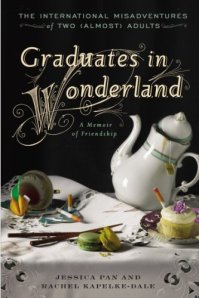
graduatesinwonderlandSometimes a book comes along, and as you read the description, you realize it ticks every one of your boxes. Here’s the tagline for Graduates in Wonderland from the LibraryThing Early Reviewers program: “Two best friends document their post-college lives through emails in this hilarious, relatable, and powerfully honest memoir.”

Best friends. Check. More books should have friendship at their core.

Post-college. Check. This book occupies that nebulous “new adult” space, and proves NA isn’t just YA with sex scenes.

E-mails. Check. I love a good epistolary novel, and these e-mails are really in-depth letters.

Hilarious, relatable, honest, etc. Check. I take any adjectives in a publisher’s description with a grain of salt, but as it turns out, these ones apply.

I don’t know if Jessica Pan and Rachel Kapelke-Dale wrote these letters with an eye toward publication the whole time, or whether they were edited after the fact (for clarity and grammar if nothing else), but either way, this is a fantastic read that I wanted to recommend to many of my friends before I’d even finished it. Because of the format (e-mail), both authors use a casual, honest, straightforward style. They reveal their fears and insecurities about their nascent careers and love lives, and they encourage each other, offer advice, and build each other up.

Graduates of Brown, the authors are privileged but conscientious. Jessica moves from New York to Beijing to Australia, while Rachel spends more time in New York before going to Paris; both of them end up in London, though the book ends before they settle there. They are both creative, and explore various career paths; they aren’t completely sure what they want to do at first. They’re also struggling with living in unfamiliar places and speaking second languages, and of course they’re both looking for The One. The e-mails strike a perfect balance in subject matter between work and romance.

They are honest: “I don’t think the people I see on a daily basis realize how down I really am.”

They are funny: “Get a French person to try to read the word hodgepodge out loud. They will say, ‘hogey-pogey,’ and it will be the best moment of your life.”

They are practical: “Note to future selves: Never buy anything. You will just have to pack it in a suitcase one day.”

They are observant: “Yesterday, I was in a park and I saw a Chinese man out walking his birds. In each hand he held a birdcage as he strolled, showing the birds the park scenery before hanging the cages from a tree while he went to go socialize with his fellow bird-walkers. I’m really going to miss this place.”

They are contemplative: “Everywhere people and friendships are changing. I’m starting to wonder how many friends I’ve made here will still be friends for the long haul. How many places can you leave people behind and still expect to keep in touch with all of them?”

They are, sometimes, wise: “I feel like I haven’t lived enough to really focus on my writing. I don’t think I’m ready.” / “He sounds great, but we need to listen to the warnings that guys give about themselves.” 

They have a sense of themselves in the world: “These beautiful moments are a nice distraction from the stagnation of my career. (Is it stagnation if it hasn’t begun?)”

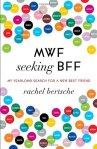
While I’m not sold on the title or the cover, I really, really liked this book, and would recommend it to anyone who is in college now or who has graduated in the past ten years or so. It fits perfectly between Tara Altebrando and Sara Zarr’s novel Roomies, which takes place in the summer between high school and college, and Rachel Bertsche’s MWF Seeking BFF: My Yearlong Search for a New Best Friend, a memoir of the author’s experience moving from New York to Chicago after getting married.

roomies MWFseeking BFF

404 Day: Action Against Censorship

Join EFF!

Today is 4/04, “a nation-wide day of action to call attention to the long-standing problem of Internet censorship in public libraries and public schools.” Read the Electronic Frontier Foundation (EFF) piece about Internet filtering in libraries and the Children’s Internet Protection Act (CIPA). Though CIPA requires some Internet filtering in libraries that accept federal funding, libraries often go further than is required. (Also, no filter is perfect: some “bad” content will always get through, and plenty of legitimate content will be blocked.)

Barbara Fister at Inside Higher Ed is also eloquent, as always, in her piece “404 Day: Protecting Kids From…What?” She mentions Gretchen Casserotti, a public library director in Meridian, Idaho, who live-tweeted a school board meeting in which Sherman Alexie’s The Absolutely True Diary of a Part-Time Indian was, ultimately, removed from the school curriculum. (Book Riot collected these tweets in order.)

Kids don’t need to be protected from literature. They need to engage with it, think about it, and discuss it; if adults can help with that, all the better. But as Fister points out, it would be better to protect kids from, say, hunger, than from “dangerous” books.

Problem Novels or Resilience Literature?

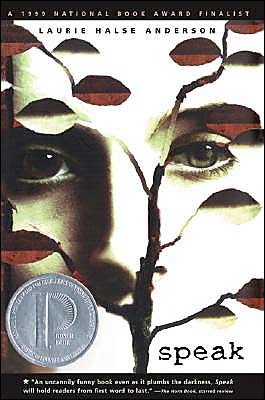
speakLast month there was a snippet in EarlyWord that caught my eye; librarian Nancy Pearl interviewed YA author Laurie Halse Anderson. Anderson’s books, which tackle difficult but real topics such as rape (Speak) and eating disorders (Wintergirls), are occasionally targeted by those who wish to censor them. Pearl asked her about the “problem novel” label that is “often applied to books about teens dealing with real-life situations.” Anderson reframed the issue by calling these books “resilience literature” instead, “because the goal of the books is to help strengthen kids facing difficult situations.” I think that’s a beautiful and apt way to put it.

As my co-worker Rebecca wrote during Banned Books Week last year, “Books are safe spaces to experience new things. New thoughts. New ideas. Different points of view….Books teach us how to empathize with each other, how to stand up for the little guy, and how to recognize the bad guys in our lives….We experience strong emotion alongside our favorite characters – joy, catharsis, loss, excitement. Books are a safe way to learn about life, without all the painful bumps and bruises.”

There is a quote attributed to Mahatma Gandhi: “Your beliefs become your thoughts, your thoughts become your words, your words become your actions, your actions become your habits, your habits become your values, your values become your destiny.” Your thoughts become your words. Your words become your actions. Words are important, and labels are especially so. Anderson’s renaming “problem novels” to “resilience literature” is not only a more accurate term, it also casts these books, and the discussion surrounding them, into a more positive and constructive light.

Speak: Have you read books that fall into this category? What did you think of them?

“A letter always feels to me like immortality”: on letters and epistolary novels

Cross-posted at the Robbins Library blog, with minor modifications.

“A letter always feels to me like immortality because it is the mind alone without corporeal friend.” -Emily Dickinson, quoted in To The Letter by Simon Garfield

An epistle, from the Latin epistula, is a letter: a composition in prose sent from one person to another, or from one person to a group of people. An epistolary novel is a novel in letters, a unique style of narration. According to the Encyclopaedia Britannica, the first novel written in this way was Pamela by Samuel Richardson in 1740; Richardson employed the form again with Clarissa in 1748. Other authors began to write epistolary novels as well, including Goethe, who published The Sorrows of Young Werther in 1774. And one of the most well-known epistolary novels is Les Liaisons Dangereuses (Dangerous Acquaintances), which has been adapted into film more than once (Dangerous Liaisons in 1988, Cruel Intentions in 1999).

Why are epistolary novels so compelling? One reason may be that they feel intimate. There’s the illegal thrill of reading someone else’s mail, but there’s also a first person voice, usually one character writing to another that they know well, or come to know well. The pace of the correspondence may heighten the suspense as characters – and readers – wait for a reply.

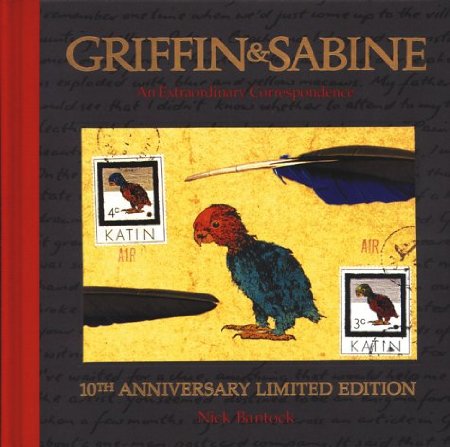
griffinandsabineMost epistolary novels are printed in the same way as regular books, but some go as far as to include actual envelopes and letters. Nick Bantock’s beautiful, mysterious Griffin & Sabine: An Extraordinary Correspondence is one of these: Griffin Moss and Sabine Strohem correspond in handmade postcards at first, then move on to longer letters, which the reader pulls out from an envelope and unfolds to read. (A word to the wise: there are six of these books. You may want to get them all at once and set aside a day or two to read them. You will want to know what happens next.)

guernseyOne deservedly popular novel in letters is The Guernsey Literary & Potato Peel Pie Society by Mary Ann Shaffer and Annie Barrows, published in 2008. This book has had lasting appeal, and at least some of that appeal must come from the style in which it is written. The characters’ letters are direct, honest, funny, sorrowful, angry, heartbreaking, and romantic in turn. The reader feels as though she has direct access to the characters, without the authors as intermediaries.

attachmentsOther authors use a more traditional style of narration, but employ letters, journal entries, or – more recently – e-mails, text messages, and chats. A significant chunk of Rainbow Rowell’s first novel, Attachments, is told through two characters’ e-mail exchange – an exchange read by a third person, their company’s IT manager. Kimberly McCreight’s Reconstructing Amelia includes text messages and facebook status updates. The young adult favorite The Perks of Being a Wallflower by Stephen Chbosky is written as a series of letters from Charlie to an unknown recipient; Roomies by popular YA authors Sara Zarr and Tara Altebrando also includes lengthy e-mails between the two main characters, high school graduates who are to be roommates in the fall.

lettersfromskyeOther recent epistolary or semi-epistolary novels are Letters From Skye by Jessica Brockmole, set in Scotland and America, and The Confidant by Helene Gremillon, set in France. These two novels don’t just use the contents of the letters to tell the reader a story; the letters’ discovery by other people becomes part of the plot. Letters are physical: they can be lost, delayed, delivered to the wrong address, or received, read, and tucked away in a drawer and forgotten until someone else comes along and finds them.

Letters often become a part of history, like journals, newspapers, books, and other documents. Simon Garfield’s book To The Letter: A Celebration of the Lost Art of Letter Writing provides dozens of examples of historical letters, from Cicero to Kerouac. Many biographies include a subject’s letters and journals (e.g. Arthur Conan Doyle: A Life in Letters, The Complete Letters of Oscar Wilde, and Jane Austen’s Letters). There is even a website, Letters of Note, that gathers fascinating letters from a variety of letter-writers, such as this one from Samuel Clemens (Mark Twain) to his wife.

There are far more epistolary novels and excellent collections of letters than I have mentioned above. What’s your favorite? What are your thoughts on this manner of telling a story? And when was the last time you wrote (or received) a pen-and-paper letter?

“Men and women have been collecting letters since letters began. Unlike other collecting hobbies, philately say, or beautiful antique cars, the collecting of letters has always been a wholly natural endeavor. If you treasured what was said in a letter you kept it, and once you have three, you had a correspondence, and no one would accuse you of being a nerd or obsessive.” -Simon Garfield, To The Letter

Swash_ornament_zeimusu

Letter to the School Board of Strasburg (CO) High School

Two of John Green’s books, Looking for Alaska and Paper Towns, are being challenged at a high school in Colorado. They are two of the nineteen books (see list below) proposed for the elective course in young adult literature. Parents are petitioning the school board to change the book list. John Green is asking for letters in support of the teacher, who is standing by her curriculum. Here’s my letter:

To the School Board of Strasburg (CO) High School,

I am writing in support of the books in the new YA literature course, and in support of their authors, the teachers and librarians who wish to teach them, and the students who want to read them.

Parents have a right to decide what their own children read, watch, and listen to, but they do not have a right to dictate what other parents’ children read, watch, and listen to. Parents who object to the content of the books included on the YA course syllabus may choose not to allow their students to participate in the course, but they ought not be able to dictate to other parents, students, and teachers.

An earlier letter/petition to this Board asked, “How can students develop into strong and productive citizens when their minds are fed with that which is criminal and vile, crass and crude?” I would respectfully disagree with this characterization of the books included in this course. (I have read thirteen of the nineteen books on the list, including the two by John Green.) I would also argue that this question does a disservice to teens, as does the statement that “Teens have very impressionable minds.” Children and teens are able to tell right from wrong in life and in literature, and literature is one of the safest places to explore the gray area between the two. In her book Reading Magic, Australian author Mem Fox wrote, “The whole point of books is to allow us to experience troubled realities that are different from our own, to feel the appropriate emotions, to empathize, to make judgments, and to have our interest held. If we sanitize everything children read, how much more shocking and confusing will the real world be when they finally have to face it?”

Presumably, these same teens who may be denied access to and, crucially, guided discussion about, these YA novels are learning about “criminal and vile, crass and crude” events in their history classes. They have grown up with graphic images not just in music videos and magazines but on the nightly news. They are aware of the real horrors in the real world. Please don’t underestimate their ability to process literature – especially literature in which the characters are dealing with very real situations.

Fiction has a proven link with empathy*; if you truly want your students to develop into compassionate individuals with good judgment and strong character, you should be encouraging them to read and discuss the novels on this list, and many more besides.

Sincerely,

Jenny Arch
Librarian
Hampshire College, 2003-2007
Columbia Publishing Course, 2007
Simmons College Graduate School of Library and Information Science, 2010-2012

*See “The Neuroscience of Your Brain on Fiction” by Annie Murphy Paul for The New York Times, March 17, 2012

Young Adult Fiction Elective Course (grades 10-12) Book List:

  1. Feed by M.T. Anderson
  2. Thinner Than Thou by Kit Reed
  3. Delirium by Lauren Oliver
  4. Uglies by Scott Westerfield
  5. Taken by Erin Bowman
  6. The Curious Incident of the Dog in the Night Time by Mark Haddon
  7. The Fault in Our Stars by John Green
  8. Flowers for Algernon by Daniel Keyes
  9. Will Grayson, will grayson by John Green and David Levithan
  10. Go Ask Alice by Anonymous
  11. 13 Little Blue Envelopes by Maureen Johnson
  12. Paper Towns by John Green
  13. If I Stay by Gayle Forman
  14. Before I Fall by Lauren Oliver
  15. Thirteen Reasons Why by Jay Asher
  16. Looking for Alaska by John Green
  17. Miss Peregrine’s Home for Peculiar Children by Ransom Riggs
  18. Clockwork Angel by Cassandra Clare
  19. The Lion, the Witch and the Wardrobe by C.S. Lewis

“I’d listen to her read a grocery list”: On Audiobooks

It doesn’t take that much endurance to read a picture book aloud. Reading for longer periods of time, however, can be taxing, which makes the work that audiobook narrators do even more impressive. I started listening to audiobooks when I started driving to and from work; I used to commute via subway, where I found that external noise drowned out anything coming through my headphones.

At first, not sure how much concentration I’d be able to spare, I started by re-reading books I’d already read, such as Philip Pullman’s His Dark Materials trilogy, which is performed by the author and a full cast. (It’s excellent.) I moved on to the Hunger Games trilogy, which Carolyn McCormick narrates (she is also excellent). Then I listened to Life by Keith Richards, read by Johnny Depp, Joe Hurley, and “Keef” himself; the switching between narrators seemed random and was somewhat jarring, but each individual reader was very good.

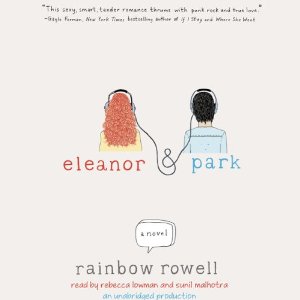
eleanorandpark_audioEventually, I started reading books I hadn’t read before, and I’ve become hooked on audiobooks; as soon as I finish one, I start another. Because my commute is blessedly brief and I’m usually only in the car for half an hour each day, I read a lot of shorter books (7-9 hours), often young adult novels. I’ve started seeking out particular narrators, such as Rebecca Lowman (Eleanor & Park, Rules of Civility) and Morven Christie (Code Name Verity, Burial Rites).

Luckily for me, audiobooks are becoming more popular, and publishers are producing more of them (see “Actors Today Don’t Just Read for the Part. Reading IS the Part,” Leslie Kaufman, The New York Times, June 29, 2013). As for whether listening to an audiobook counts as reading, there is plenty of debate. I would venture to say that as long as one has mastered the ability to read in print, audiobooks are as legitimate a way to consume books as reading them on paper (or on a screen). “We tend to regard reading with our eyes as more serious, more highbrow, than hearing a book read out loud,” T.M. Luhrman wrote in a New York Times  piece called “Audiobooks and the return of storytelling” on February 22. She continued, “The ability to read has always been invested with more importance than mere speech….But for most of human history literature has been spoken out loud.”

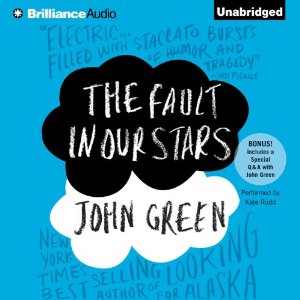
TFIOS_audioOne experiences a story differently, and remembers it differently, when hearing it read aloud as opposed to reading the text visually. Partly, audiobooks are a different reading experience for me because I don’t skip over sentences or skim paragraphs; I hear every single word. And a truly talented narrator can bring a book to life: listen to Jim Dale perform the Harry Potter books or Erin Morgenstern’s The Night Circus, or Rebecca Lowman read Eleanor & Park or Rules of Civility. Kate Rudd reading The Fault in Our Stars brought me to tears, though I didn’t cry when I first read the book in print.

I think we are all hungry for stories, whether we read them to ourselves in print, listen to them as audiobooks, or read them out loud to ourselves or each other. If you aren’t an audiobook devotee already, I’d encourage you to give them a try. Libraries usually carry them on CD and sometimes on Playaways, and they are often downloadable in mp3 format too.

Characters, Gender, and Likability

Yesterday I followed a couple of links from Twitter and read these two pieces: “Why Talking About Girl Reading Matters” from Kelly Jensen at Stacked and “On Liking Characters” by Liz Burns at School Library Journal (SLJ). The Stacked post linked to Laurel Snyder’s post “Boys Will Be Boys, And Girls Will Be Accommodating.” Together, these pieces make the point that in focusing on “books for boys” (boys are generally more reluctant readers than girls) we do everyone an injustice.

If boys only ever read “books for boys,” they may never discover that they like other kinds of books as well. Those of us putting books into the hands of growing readers can’t underestimate them; we ought to encourage them to stretch and try something new. At the same time, “girl books” tend to be pushed to the sides, sending the message that they are less important. “The best solution,” writes Snyder, “would require us to push against the gender bias in the world, and in ourselves.”

If there’s one thing The Hunger Games, Divergent, and The Fault in Our Stars have proved, it’s that boys will read books that have girls as the main character. (As for the author’s gender, it’s not something I remember ever paying attention to much as I was growing up, and I don’t pay much attention now, either; this is borne out in my reading stats. But in the above examples, those incredibly successful trilogies are written by women.)

A character’s gender also affects their likability, as Burns points out in her piece. Some readers are quick to label girl characters unlikable if the character acts in a nontraditional way. But a likable character isn’t the same as a good one (i.e., a well-written, realistic one). Here’s my response to Burns’ piece:

The most important thing about character is believability. Are the character’s actions believable? Is there an internal consistency? Does the reader understand the character’s motivation? If the answer to these questions is yes, then the author has probably created a good character: recognizably human, with some flaws and some talents.

Likability is a different issue entirely. Personally, I would be bored reading about likable characters all the time, or if all characters were binary, either likable or unlikable – protagonist/antagonist, hero/villain. Real people are more complicated than that.

As Claire Messud has pointed out, the likability issue does affect female characters (and female authors) disproportionately; it’s more common for readers to criticize female characters for being unlikable than male characters.

My friend Anna has also written about the “books for boys/books for girls” issue, both at YALSA’s The Hub and on her own blog. On The Hub, she wrote, “…it doesn’t matter if a book is ‘for’ a guy or a girl; the gender of the intended audience tends to get all mixed up when you factor in the power of a good story. Boys like stories; girls like stories. Readers in general like stories” (emphasis added). Anna added to this thought a few days later on her blog, asking, “What About Books for Girls?” She wrote,

“Readers are readers. If we could just take off the gendered lenses entirely, I think we could serve our readers better. Let’s focus on writing, reading, and recommending stories that are true (in the manner of Truth, not necessarily a nonfiction story), that matter, that touch the soul, that are real, that show the varieties of human emotion and experience, that are maybe even an inspiration. Let’s do that instead of focusing on the gender we think might like the book the best. Books for girls are books for boys, and books for boys are books for girls. It’s all just stories.”

A skilled author, male or female, can write excellent, believable, well-rounded characters of any gender. Let’s try to focus on getting great stories into the hands of all readers.

The Pleasure of Picture Books (and Reading Magic by Mem Fox)

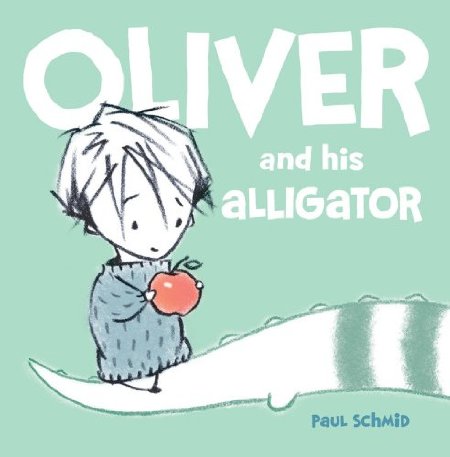
readingmagicI’ve been on a picture book kick recently, starting with the indescribably adorable Oliver and His Alligator by Paul Schmid, which I read about in a review from Kirkus. The children’s librarians at my library were happy to provide me with more contemporary picture books, and then I started revisiting old favorites.

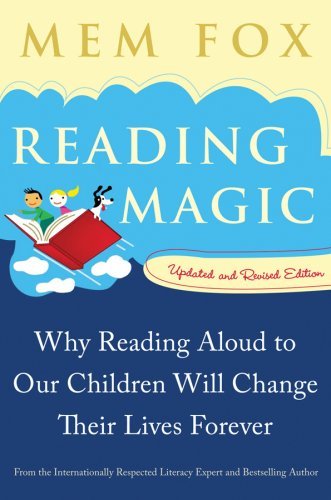
Along the way, I read Australian author Mem Fox’s book Reading Magic: Why Reading Aloud to Children Will Change Their Lives Forever. As a librarian, and as someone whose parents read her stories every night, I’m already sold on the reading-to-kids idea, but Fox emphasizes how important it truly is.

Among all the anecdotes and tips for reading aloud, I came across this quote on page 142, which struck me as perfect for Banned Books week. But Banned Books Week is in September, and I didn’t want to wait to share:

“The whole point of books is to allow us to experience troubled realities that are different from our own, to feel the appropriate emotions, to empathize, to make judgments, and to have our interest held. If we sanitize everything children read, how much more shocking and confusing will the real world be when they finally have to face it?”

Books are a safe place to encounter new ideas and situations, and think (or talk) through them. Experiencing something vicariously or hypothetically is often safer than having that experience oneself. Though “difficult topics” may be uncomfortable for some, books are an excellent “vehicle for true learning and understanding.” (For more on this topic, see “Censorship and Invisibility,” one of my Banned Book Week blog posts from last fall.)

Picture books naturally lend themselves to discussion. For those of us who tend to focus on the text, they are also a good reminder that reading an image requires another type of literacy. In a good picture book, the text and the image complement each other; the pictures aren’t just a representation of the text, they can contain more information – and often jokes. It’s worth taking a bit of extra time to look at the pictures on each page closely, not just because they are colorful or cute, but because there is more going on. (Officer Buckle and Gloria by Peggy Rathmann is an excellent example of this.)

oliveralligatorcoverHere are a few of my favorite picture books, old and new. I keep a current list, tagged “children’s” in LibraryThing.

Sometimes I Forget You’re A Robot by Sam Brown, 2013

Mr. Wuffles by David Wiesner, 2013

Oliver and His Alligator by Paul Schmid (also, A Pet for Petunia), 2011, 2013

A Kiss Like This by Mary Murphy, 2012

I Want My Hat Back by Jon Klassen (also, This Is Not My Hat), 2011, 2012

13 Words by Lemony Snicket, illustrated by Maira Kalman, 2010

Orange Pear Apple Bear by Emily Gravett, 2007

Martha Speaks by Susan Meddaugh, 1992

Julius, the Baby of the World by Kevin Henkes, 1990

Alexander and the Terrible, Horrible, No Good, Very Bad Day by Judith Viorst, illustrated by Ray Cruz, 1972

Harry the Dirty Dog by Gene Zion, illustrations by Margaret Bloy Graham (also, Harry by the Sea and No Roses for Harry), 1956-1965

What are your favorite picture books from childhood? When was the last time you read a picture book, quietly to yourself or out loud?

Landline by Rainbow Rowell

landline

She had to call. You can’t just ignore a phone that calls into the past. You can’t know it’s there and not call.

In her three previous books, Attachments, Eleanor & Park, and Fangirl, Rainbow Rowell has demonstrated an ability to create characters that are as recognizable as real people. She has proven herself adept at writing all kinds of relationships – romantic and otherwise – for characters in high school, college, and early adulthood. In Landline, Rowell leaves the YA realm and returns to the adult world, delving into the marriage of Georgie McCool and Neal Grafton.

Georgie and Neal meet in college, marry at twenty-three, and have two children. Georgie works as a TV writer with her friend Seth, who has been her writing partner for longer than Georgie and Neal have been together. Georgie and Seth are on the verge of achieving their longtime dream of getting their own show, but there’s a catch: they have to have material ready in a matter of days. But it’s almost Christmas, and Georgie is supposed to go with her family to Omaha for the holiday.

Instead, Georgie stays in California to work on scripts with Seth while Neal takes their daughters to Omaha. Georgie’s mother and sister treat her as though Neal has left her, which is not what Georgie thinks has happened at all…or has it? Georgie begins to fall apart. She can’t get in touch with Neal on the phone, until she tries calling from the old landline phone at her mom’s house. Talking to Neal on the phone brings back old memories of their time in college, and the terrible week when they were broken up, before he drove twenty-seven hours back from Omaha to California and proposed to her on Christmas morning. Georgie can’t remember that week very well, but as she talks to Neal, pieces she didn’t know were missing begin to fall into place.

The plot hinges on two phones: Georgie’s dead cell phone, and the landline (a.k.a. the magicfuckingphone). I found the landline, where present-day Georgie talks to past Neal, much easier to go along with than the idea that a responsible adult with children would let her cell phone die as often as Georgie did. But that’s my one complaint.

Rowell has an incredible depth of understanding of her characters, and of marriage generally, but she also has a lovely light touch: there are plenty of funny, witty moments alongside (and sometimes during) the darker, bleaker ones. At one point, Georgie realizes that even though Neal is perfect for her, she might not be perfect for him; that “she wanted him more than she wanted him to be happy.” Throughout the novel, Georgie wrestles with big questions like these. She has always known what she wanted: a career in TV, Neal, and her kids. Neal has never really known what he wanted, except for Georgie. Seth adds another layer of tension to Georgie and Neal’s relationship: there’s no love lost between Seth and Neal, but they’ve maintained a tense truce all these years, for Georgie’s sake. Is Seth ready to break that truce? 

Readers may occasionally pause to dwell on issues of feminism. (Georgie wanted to take Neal’s last name, but he wouldn’t let her, because “You don’t come into this world with a name like Georgie McCool and throw it away on the first pretty face.”) In the McCool-Grafton marriage, Georgie is the careerist, the breadwinner, the busy one, while Neal is the stay-at-home dad; Georgie’s own sister points out that Neal would get custody in a divorce. But the novel doesn’t read like a book with an agenda; it only presents a scenario that is the reverse of the traditional one.

Rowell is as magical as her landline phone. Georgie and Neal’s marriage, with all its history and weight, comes through clearly: their good moments and bad moments, the joys and stresses, the selfishness and compromises. Georgie and Neal recognize that they may not be perfect for each other, that their lives might not “fit together,” but, as Neal says, “Nobody’s lives fit together. Fitting together is something you work at. It’s something you make happen – because you love each other.” Stranded half a country away from Neal and her kids, Georgie has to figure out how to make it happen.

I had incredibly high expectations for this book, and though high expectations often lead to disappointment, that wasn’t the case here at all. Instead, I was wholly delighted, and I think Rowell’s fans will be too. In fact, moving seamlessly between YA and adult, she’s likely to bring her old fans with her and attract some new ones as well.

I received an e-galley of LANDLINE from publisher Macmillan via Edelweiss. The expected publication date is July 8, 2014. Quotes in the review above are from the galley, not the final copy.