We interrupt this broadcast…

Another post or three about MLA still to come, but first: May 6 was International Day Against DRM. Please go read what Sarah (a.k.a. the Librarian In Black) has to say about this, and follow all her links (especially check out Defective By Design).

librariansagainstDRM“Consumers, and libraries by extension, should have the right to access eBooks on any technological platform, including the hardware and software we choose.” -Sarah Houghton

And now, back to our regularly scheduled programming…

MLA Conference 2014, Day One (Wednesday), Part One

It’s that time again! This year, the Massachusetts Library Association conference is in Worcester, and once again the lovely and gracious Friends of the Library enabled some of our library staff (myself included) to attend. Here’s my round-up of the first three sessions I went to today, with more to come. Several conference-goers are also on Twitter (#masslib14).

Brand New You: How Libraries Use Branding to Establish Relevance and Engage Users

Anna Popp from the Massachusetts Library System presented on MLS’ experience developing their brand with Walter Briggs of Briggs Advertising. Popp convened a task force and established a clear decision-making protocol (essential, according to Briggs). Popp and Briggs explained that an organization’s brand is evolutionary, not visionary; it’s not the same as its vision or mission statement (‘it’s not what you aim to be, it’s what you are’).

MLS logoThe process involved brainstorming everything about the organization, then crossing out everything that wasn’t unique, with the goal of distilling it down to 3-5 words or phrases – the “brand mantra.” The brand mantra is an internal tool, and is not the same thing as a tagline (e.g., Nike’s brand mantra is “Authentic Athletic Performance,” not “Just Do It.”) MLS came up with “Uniting, Empowering, Library Enhancement.” The brand mantra is “the most important deliverable” from the branding process, more important even than the logo (at left). The logo’s job is not to show or tell what an organization does.

The tagline should be “evocative, inspiring, brief, lyrical” and have “integrity.” The (awesome) MLS tagline is “Stronger together,” which perfectly suits an organization dedicated to building a statewide community of libraries, empowering those libraries, and championing resource sharing.

Briggs finished the presentation by sharing some of his past work. I especially loved the Patten Free Library tagline, “More than you’ll ever know,” and the tangram-like logos (below) for the Curtis Memorial Library (both libraries are in Maine).

CurtisMemorialLibrary logoCurtisMemorialTeenCurtisMemorialKids


The takeaways from this session included: (1) Recognize what people bring to the table, (2) Establish role clarity – who will have an advisory role, who will have a decision-making role?, (3) Let people do their jobs, help when necessary, (4) Prepare to learn something about yourself, (5) Plan ahead, but be prepared for eventualities and opportunities. It may be hard to prove the ROI on a logo, but Popp mentioned the idea of “mindshare”: “in marketing, repetition wins.” Establish your relevance and constantly reaffirm it.

An Agenda for Information Activism: Internet Freedom and Press Freedom Today

Kevin Gallagher stepped up here in place of the original presenter, Josh Stearns, formerly of Free Press. Gallagher clearly knew his stuff, particularly the threat that government mass surveillance poses to journalists and society at large, and he did a good job on short notice. He wasn’t the most comfortable speaker, and his presentation jumped around a little bit; the audience wasn’t all familiar with some of the terms he used or the services he referenced. The presentation had no handouts or visual component (other than the trailer for the upcoming Aaron Schwartz documentary, The Internet’s Own Boy). However, privacy is something librarians care deeply about, and this program took a step toward convincing us all to do more research for ourselves, and think about what we can offer patrons, both in terms of tools and education. Here are a few points and links from the session (thanks also to Alison Macrina of Watertown Free Public Library):

  • When the government undermines and weakens Internet security standards for the purposes of surveillance and data-gathering, it makes us all less safe, not more.
  • There are library privacy laws in 48 states and the District of Columbia. Patron privacy and confidentiality is essential for the free pursuit of knowledge.
  • If the government can collect metadata on journalists’ communications, that exposes journalists’ sources, whose confidentiality should be protected.
  • Read the full text of the Guerilla Open Access Manifesto by Aaron Schwartz on the Internet Archive.
  • “There is already a war” against whistleblowers, journalists, and activists (examples: Julian Assange, Jeremy Hammond, Edward Snowden, Barrett Brown, Jim Risen).
  • “We need a new Church Committee.”
  • Government agencies and private companies are collecting personal data and metadata. Be aware of what personal data private companies are collecting, and what permissions you are giving when you use services like facebook. See Terms of Service; Didn’t Read.
  • Use search engines that value privacy, like DuckDuckGo, or use plugins like Ghostery or services like Disconnect.me. Install Tails, an operating system that lets you use the Internet anonymously via TOR.
  • What can we (in libraries) do? Use more privacy and security tools (like https everywhere from the EFF). Use free and open software instead of proprietary software (“There’s a free and open alternative to everything”). Make sure patron privacy policies are up to date, and make sure we aren’t collecting any more patron information than necessary. If libraries are receiving federal funds that force compliance with CIPA, make sure you aren’t filtering any more than you have to – or, if possible, don’t accept the strings-attached funds. Host a “crypto party.” Support the USA Freedom Act, make FOIA requests. Remember the Library Bill of Rights.

How We Doin’?: Public Libraries Using LibSat to Gather Patron Feedback

The Los Angeles Public Library uses LibStat.

The Massachusetts Board of Library Commissioners (MBLC) is providing LibSat from Counting Opinions to all Massachusetts libraries for a three-year term. All library directors have the login information, and can pass it on to any of their staff. From what we saw in this session, LibSat is a pretty incredible tool to gather continuous patron feedback about their library experience; data nerds in the room were audibly delighted.

This session began with the proverb “A guest sees more in an hour than the host sees in a year.” Patron feedback is valuable to libraries, offering reminders of how much people appreciate library services and staff as well as presenting opportunities for improvement; patrons who rate the library’s importance as high but their satisfaction with the library as low direct attention to areas for improvement.

LibSat offers patrons a choice of a short survey (3-5 minutes), a regular survey (5-7 minutes), and an in-depth survey (~15 minutes). Other than possible survey fatigue, there’s really no reason MA libraries shouldn’t be using this tool. The results could really come in handy when it’s time to prepare those annual reports…

Next up:

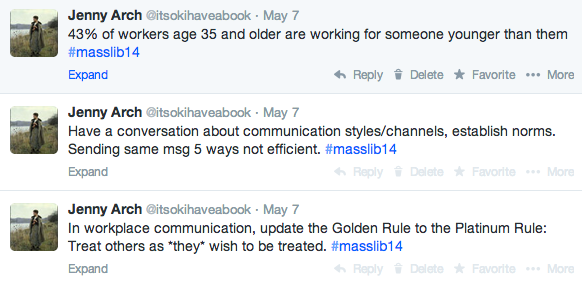
Working with and Managing Multigenerational Staff/People

Building Intergenerational Collaboration & Programs: Serving People of Different Ages

Last year’s (rather long) MLA posts:

4/24/13: Teaching Technology to Patrons and Staff & Afraid to Advocate? Get Over It! & Library Services and the Future of the Catalog: Lessons from Recent ILS Upgrades & Loaning E-Readers to the Public: Legal and Strategic Challenges

4/25/13: On Life Support, But Not Dead Yet!: Revitalizing Reference for the 21st Century & Authors, Authors, Authors!: Three Local Authors Strut Their Stuff & Analyze Your Collection & Print and Digital Publishing: How Are Publishers, Editors, and Authors Adapting.

The Storied Life of A.J. Fikry by Gabrielle Zevin

Some novels take place over the course of a day; some cover several decades. How much story is an author able to fit into 350 pages or 500 pages or 750 pages? How much they can develop their characters so the reader feels like they are real people? These questions point to the magic and the mystery of writing. A reader might pause on page twelve and wonder, How do I already know so much about these people? How did the author do that? Or the reader might be fifty pages in, thinking, Nothing has happened yet, but I sure do know a lot about nineteenth-century London. Some writers are economical; some are expansive. Either kind of book can be powerful.

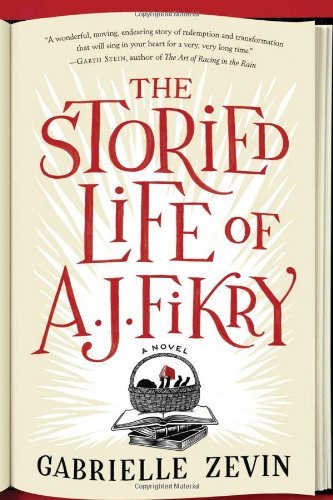
storiedlifeajfikryGabrielle Zevin does a lot with a little. The Storied Life of A.J. Fikry is 272 pages, and it covers about sixteen years. A.J. is a widower and a bookshop owner on Alice Island; he has just told off a new sales rep, Amelia Loman, and is proceeding with his plan to drink himself to death when he discovers two-year-old Maya in his shop, accompanied by a note. Soon afterward, Maya’s mother’s body washes up on the shore, and instead of handing the baby over to social services, A.J. decides to keep her.

A.J. does the paperwork and jumps through the necessary hoops off-screen, as it were, leaving the reader to enjoy Maya’s non-christening christening party in the bookstore. Because of Maya, A.J. becomes involved in the life of the town in a way he never did before; though his wife Nic was an islander, A.J. himself was perceived as an outsider. He emerges from his shell, becoming friends with the remarkably kind and sensible police chief, Lambiase, and forging a relationship with Amelia. (Again, they surmount some practical obstacles – i.e., the inconvenience of her living on an island when her job involves so much travel – off the page.)

“Shelf-talkers” for short stories serve as section dividers. These are addressed not to the reading public, but to Maya; the reason A.J. is writing these becomes clear late in the book. Maya’s history is also revealed: Lambiase discovers it (along with the valuable copy of Tamerlane that went missing from A.J.’s apartment just before Maya’s arrival) not through detective work but when he begins to date A.J.’s ex-sister-in-law, Ismay, after the death of her husband.

The characters in The Storied Life of A.J. Fikry are at once easy to slot into roles, and more complicated than they appear. Books and stories play a powerful role in all of their lives, and there is a good deal of book-related wisdom throughout this novel, delivered with a light touch. “We are what we love,” A.J. finally concludes. Most people who love books (and especially those who have ever dreamed of living in a bookstore) will like this one.


World Book Night 2014: Experience of a First-time Giver

World Book Night was last week, and I had twenty copies of Code Name Verity to give away. It was April 23, a perfect spring evening…no, scratch that, it was cold and windy, because it is Massachusetts and Spring is being especially coy this year. But I went ahead with my original plan to hand out the books near a subway stop and shopping center. I was a little nervous, because although I have spent my life talking to people about books, and do so daily at my job, I do not habitually approach strangers on the street and try to foist books upon them, even really excellent, free books.

WBNGiverSticker_wbn2014It turns out, as I suspected, that it’s pretty tricky to convince people that you want to give them a good book for free. Even though I wasn’t sporting any of the red flags that pedestrians typically try to avoid (a clipboard, a windbreaker with a logo on it, a handful of pamphlets about Our Lord and Savior), people were hesitant to slow down or make eye contact. Everyone expects to be asked for things; no one expects to be given something (something they might want) for free.

Also, about half the people walking by were wearing headphones or had their eyes glued to a mobile device (or both); I let these people pass by. My most successful pitch to draw people in was “Would you like a free book for World Book Night?”

Once they’d stopped, I still felt rushed; I had more short transactions than long conversations. No one had heard of World Book Night, except for one woman who had encountered another WBN giver earlier in the day. I explained to those who stopped that it was a night where volunteers gave out free copies of books that authors and publishers had donated to spread the love of reading, and then I told them a little about the book I was giving out. Of the people who stopped, most were happy to take a copy of the book. One woman considered it for her daughter, but thought it might scare her (fair enough), so she didn’t take it. More men than women stopped, and they seemed really pleased to get a book – they’re not exactly the target demographic, and I wonder what they’ll make of Code Name Verity, but I do think anyone can enjoy it.

http://mcbookwords.blogspot.com/2014/04/world-book-night-april-23-2014.html
Special World Book Night cover design

Although I picked up my box of books the week before World Book Night, I didn’t open the box till that day, and was a little dismayed to see that the special WBN cover had a white border that made the book look self-published; more than one person asked if I was the author. As much as I would love to have written Code Name Verity, I tried to clear up the misconception; it helped that it said “New York Times Bestseller” on the front, but the initial impression wasn’t that of a traditionally published book.

So, what would I do differently next time? I’d follow my librarian blogger friend Anna’s lead: she joined up with two other givers on World Book Night. This has a couple advantages: (1) it gives potential recipients a choice of books, and (2) it allows the givers to lend each other moral support. Anna and her team also set up in a local Starbucks (with the management’s permission, of course), so they could set up signs and people could choose to approach them and engage in conversation or not – much more comfortable for everyone than the hawking-on-the-sidewalk method.

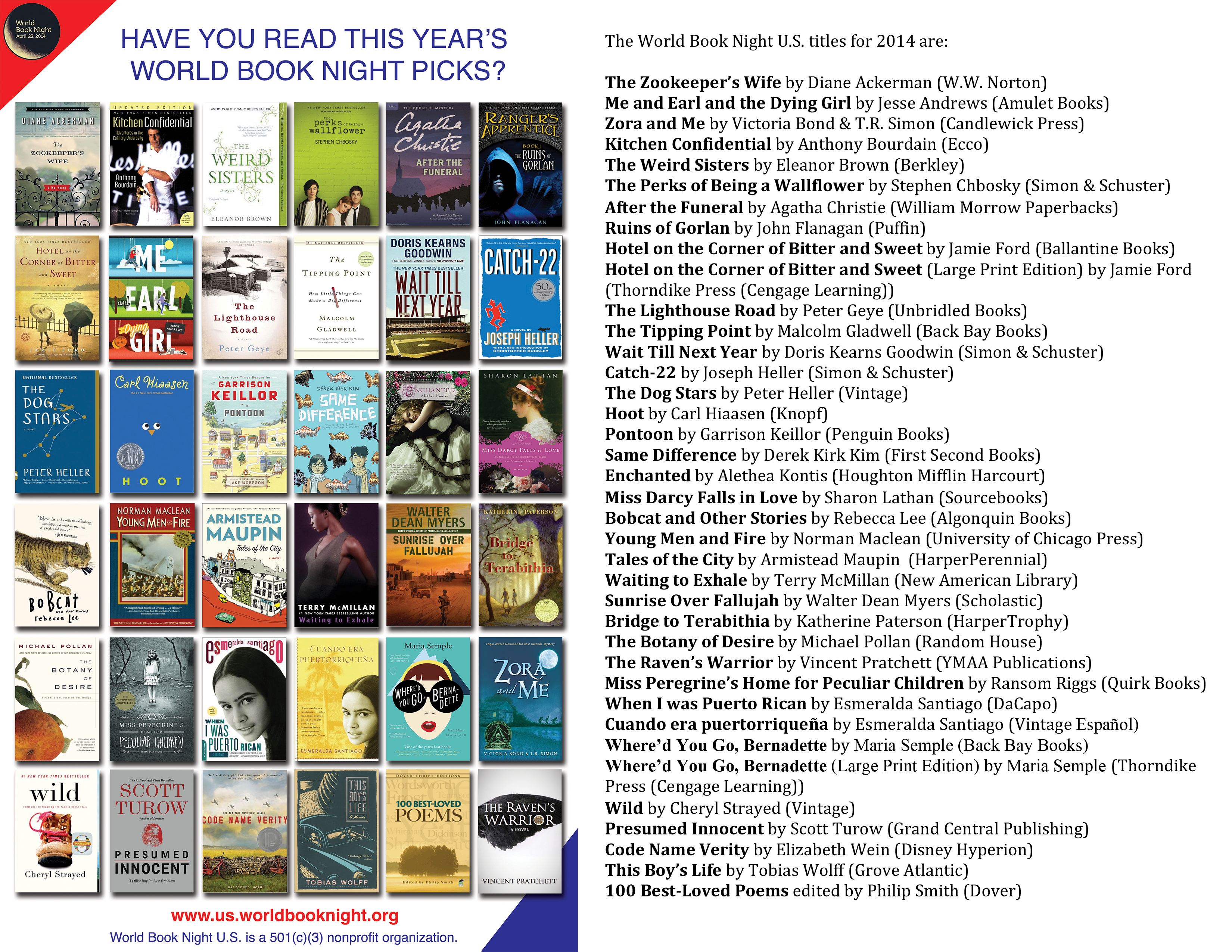
I still think WBN is a fantastic initiative, and I want to thank the authors and publishers that donated their books, and the WBN organization itself for making this happen year after year. Here are all the WBN 2014 titles:

Books_wbn2014

Gabrielle Zevin at Porter Square Books

elsewhereJust over a year ago, the children’s librarian at the library where I work pressed a book called Elsewhere into my hands and convinced me to read it simply because she had loved it so much herself; even though she’d read it for the first time years ago, she said she still thought about it regularly. (This is usually a good sign.)

I think I read the book in a day, or maybe a weekend. I found it just as sweet, thoughtful, and unique as promised. However, I neglected to hunt down the author’s other books, and when I began hearing about The Storied Life of A.J. Fikry a few months ago, I did not make the connection. I put two and two together just in time to see Gabrielle Zevin speak at Porter Square Books this past Monday.

A bookstore employee introduced Zevin as a graduate of “our local university down the street” (i.e., Harvard). Zevin started her talk by telling the audience how she got into publishing. She sold her first two novels, Elsewhere and Margarettown, in the same year; Elsewhere was an ALA Notable Children’s Book and won a few other awards as well, while Margarettown, despite several good reviews, “was a flop.”

“A flop” can mean two things in publishing: it can mean that the book was terrible and/or got bad reviews, but it can also mean that the book was decent, even good, but didn’t merit significant attention, and was buried beneath the next season’s books. Margarettown is still on the shelves of fourteen of the libraries in the Minuteman Library Network, so while it may be out of print, it’s still available; it may find fans yet.

Zevin spoke about her relationship with books going back to childhood. Ever since her parents used to drop her off at a bookstore while they went grocery shopping, she said, entering a bookstore fills her with “a heady sense of freedom and possibility.” In bookstores, she said, she always felt safe, like nothing bad could ever happen in a bookstore – “and nothing bad ever has happened to me in a bookstore.”

storiedlifeajfikryOn to the matter of inspiration: where do her ideas for books come from? “Most of my books have started with a question.” For A.J. Fikry, there were two questions: What is the importance of bookstores to the world? And what effect do the stories we read have on our lives?

Zevin is obviously a believer in books and stories. She stated, “Children who read grow into adults you want to know.” People who read develop empathy. (I’ve written about the link between fiction and empathy here before, especially in this post inspired by an interview with Lauren Groff.) Bookstores, Zevin believes, are special places; they “represent the good in a community. They are about more than just commerce; they are about the exchange of ideas.” (The same can be said of libraries, which are entirely about ideas and community and not about commerce at all.) Reading and writing may be solitary activities, but they connect us as a community. Though those in the self-publishing business (more about that later) may disdain gatekeepers, Zevin said, “We need people [editors, booksellers, librarians] to tell us what is good and what is bad. The future of literary culture depends on these people. Booksellers are curators.”

The book world is changing. From 2005, when Elsewhere was published, to 2014, there have been huge changes: the ubiquity of the Internet, the expectation that authors will have a social media presence, the rise of e-books. “I think it’s worth being mindful of what we lose as these changes occur,” said Zevin. She doesn’t worry about futures in which children fight to the death or Chicago is divided into factions by personality type (clear allusions to The Hunger Games and Divergent); “I do, however, worry very much about the world without books.”

An Indie Next Pick for April 2014, The Storied Life of A.J. Fikry was published as The Collected Works of A.J. Fikry in the U.K. The idea behind this title is that “collected works” can refer to everything a person has read in his or her life, rather than everything s/he has written. This idea instantly reminded me of Audrey Niffenegger’s graphic novel The Night Bookmobile, in which Alexandra discovers a bookmobile filled with every book she’s ever read. (The Night Bookmobile was first serialized in The Guardian, then published in hardcover by Jonathan Cape.) Such a bookmobile would be fascinating; as Zevin said, “Anybody’s reading life is so gloriously random.”

“We read to know we’re not alone. We read because we are alone. We read and we are not alone. We are not alone.” —The Storied Life of A.J. Fikry, Gabrielle Zevin

During the Q&A, Zevin spoke again about debuts. Her first two books were published quite close together, and while Elsewhere was successful, Margarettown was less so; its publisher actually folded, and the book is now out of print. Zevin said, “Everybody has a sad story about a first novel…Most of the time everyone fails. Most of the time everyone gets it wrong. How do you get over failure? You keep working…A lot of debuts are not a writer’s best work.” She added, “The work is separate from people’s response to it,” which struck me as a sensible and wise perspective to maintain.

Because Zevin writes for both YA and adult audiences, someone asked her how she shifted between them, and how she decided which audience to write for. Zevin said that the main character’s age and situation determine the audience; she has the idea first, then decides on the audience accordingly. She shared an anecdote from another author’s response to this question; that author said that the difference is hope – YA books must be hopeful – but Zevin thinks “adults like hope too.”

I haven’t yet read The Storied Life of A.J. Fikry (though it’s next on my to-read list), but I know the eponymous main character is a bookseller. (Zevin read a funny passage wherein Fikry elucidates to the sales rep, Amelia, all the kinds of books he isn’t interested in.) However, Zevin said, “A.J.’s [literary] tastes aren’t mine.” She’s a keen observer of other people’s reading habits, and noted that spying on people’s reading on the subway is much harder now because of e-readers.

Another audience question concerned research. Zevin said that while she doesn’t write two books at one time, she can research one while writing another, and she did quite a lot of research for her novel The Hole We’re In, about “female soldiers in Iraq.” (She also mentioned, offhandedly, that she dislikes National Novel Writing Month – or at least thinks it “needs to be preceded by National Thinking About Your Novel Month.”)

After about ten years of working with traditional publishers, Zevin has learned a lot about how they work, and she has “respect and appreciation” for all jobs in publishing. Although “the books are still more important than how they get sold,” a tremendous amount of work goes into all aspects of a book: not just the writing of it, but the editing, the design, the jacket copy and cover art, the distribution and marketing and sales. She started off knowing very little of this – she admitted she didn’t even know that sales reps, who bring publishers’ books and catalogs to bookstores, existed – but concluded, “I do think it’s always better to be armed with information.” Many articles about self-publishing (she mentioned the Wall Street Journal particularly) display a “deep misunderstanding about the publishing process.” There is more to making a book that writing it and clicking a button. (See also: “In defense of editors,” “We built this together.”)

I’m really excited to start reading The Storied Life of A.J. Fikry, and maybe some of Zevin’s other books too. You can see all of her books on her website, and if you live in the Cambridge area, check out the upcoming events at Porter Square Books.

World Book Night 2014

WBN2014_logo_672x652My fabulous YA librarian friend Anna wrote about World Book Night last December and inspired me to apply. I had heard of World Book Night before (basically, I knew that it was a night where people gave out free books), but Anna explains all the important stuff in her post.

This year is my first year as a giver, and I’m giving out Code Name Verity by Elizabeth Wein. Why did I choose Code Name Verity? Because it is one of the most compelling WWII stories I’ve ever read, which is saying something, given the glut of WWII fiction and the amount of it I’ve consumed. It features a young British pilot, Maddie, and a young Scottish (“I am not English!“) spy, and their friendship is central to the story: “We make a sensational team,” says the Scot.

The Scot tells the first half of the story as a written confession to her Nazi captors in occupied France. She has made a Faustian bargain with a Gestapo officer in order to be able to write her account, which she tells, mostly, in the third person, referring to herself as “Queenie.” It is a powerful narrative, heartbreaking and gruesome in turns, and also, improbably, with moments of humor.

I can’t well tell about the second half without giving much of the story away; suffice to say I think teens and adults can and will enjoy the story equally, and the conversational, journalistic style makes for easy reading. The audiobook, read by Morven Christie and Lucy Gaskell, is also incredibly good (though I won’t be handing those out on World Book Night, just the good old paper copies).

World Book Night is April 23 this year. If you missed signing up to be a giver this year, don’t fret – there’s always next year!

Graduates in Wonderland

graduatesinwonderlandSometimes a book comes along, and as you read the description, you realize it ticks every one of your boxes. Here’s the tagline for Graduates in Wonderland from the LibraryThing Early Reviewers program: “Two best friends document their post-college lives through emails in this hilarious, relatable, and powerfully honest memoir.”

Best friends. Check. More books should have friendship at their core.

Post-college. Check. This book occupies that nebulous “new adult” space, and proves NA isn’t just YA with sex scenes.

E-mails. Check. I love a good epistolary novel, and these e-mails are really in-depth letters.

Hilarious, relatable, honest, etc. Check. I take any adjectives in a publisher’s description with a grain of salt, but as it turns out, these ones apply.

I don’t know if Jessica Pan and Rachel Kapelke-Dale wrote these letters with an eye toward publication the whole time, or whether they were edited after the fact (for clarity and grammar if nothing else), but either way, this is a fantastic read that I wanted to recommend to many of my friends before I’d even finished it. Because of the format (e-mail), both authors use a casual, honest, straightforward style. They reveal their fears and insecurities about their nascent careers and love lives, and they encourage each other, offer advice, and build each other up.

Graduates of Brown, the authors are privileged but conscientious. Jessica moves from New York to Beijing to Australia, while Rachel spends more time in New York before going to Paris; both of them end up in London, though the book ends before they settle there. They are both creative, and explore various career paths; they aren’t completely sure what they want to do at first. They’re also struggling with living in unfamiliar places and speaking second languages, and of course they’re both looking for The One. The e-mails strike a perfect balance in subject matter between work and romance.

They are honest: I don’t think the people I see on a daily basis realize how down I really am.”

They are funny: Get a French person to try to read the word hodgepodge out loud. They will say, ‘hogey-pogey,’ and it will be the best moment of your life.”

They are practical: Note to future selves: Never buy anything. You will just have to pack it in a suitcase one day.”

They are observant: Yesterday, I was in a park and I saw a Chinese man out walking his birds. In each hand he held a birdcage as he strolled, showing the birds the park scenery before hanging the cages from a tree while he went to go socialize with his fellow bird-walkers. I’m really going to miss this place.”

They are contemplative: Everywhere people and friendships are changing. I’m starting to wonder how many friends I’ve made here will still be friends for the long haul. How many places can you leave people behind and still expect to keep in touch with all of them?”

They are, sometimes, wise: “I feel like I haven’t lived enough to really focus on my writing. I don’t think I’m ready.” / He sounds great, but we need to listen to the warnings that guys give about themselves.” 

They have a sense of themselves in the world: These beautiful moments are a nice distraction from the stagnation of my career. (Is it stagnation if it hasn’t begun?)”

While I’m not sold on the title or the cover, I really, really liked this book, and would recommend it to anyone who is in college now or who has graduated in the past ten years or so. It fits perfectly between Tara Altebrando and Sara Zarr’s novel Roomies, which takes place in the summer between high school and college, and Rachel Bertsche’s MWF Seeking BFF: My Yearlong Search for a New Best Frienda memoir of the author’s experience moving from New York to Chicago after getting married.

roomies MWFseeking BFF

404 Day: Action Against Censorship

Join EFF!

Today is 4/04, “a nation-wide day of action to call attention to the long-standing problem of Internet censorship in public libraries and public schools.” Read the Electronic Frontier Foundation (EFF) piece about Internet filtering in libraries and the Children’s Internet Protection Act (CIPA). Though CIPA requires some Internet filtering in libraries that accept federal funding, libraries often go further than is required. (Also, no filter is perfect: some “bad” content will always get through, and plenty of legitimate content will be blocked.)

Barbara Fister at Inside Higher Ed is also eloquent, as always, in her piece “404 Day: Protecting Kids From…What?” She mentions Gretchen Casserotti, a public library director in Meridian, Idaho, who live-tweeted a school board meeting in which Sherman Alexie’s The Absolutely True Diary of a Part-Time Indian was, ultimately, removed from the school curriculum. (Book Riot collected these tweets in order.)

Kids don’t need to be protected from literature. They need to engage with it, think about it, and discuss it; if adults can help with that, all the better. But as Fister points out, it would be better to protect kids from, say, hunger, than from “dangerous” books.

Problem Novels or Resilience Literature?

speakLast month there was a snippet in EarlyWord that caught my eye; librarian Nancy Pearl interviewed YA author Laurie Halse Anderson. Anderson’s books, which tackle difficult but real topics such as rape (Speak) and eating disorders (Wintergirls), are occasionally targeted by those who wish to censor them. Pearl asked her about the “problem novel” label that is “often applied to books about teens dealing with real-life situations.” Anderson reframed the issue by calling these books “resilience literature” instead, “because the goal of the books is to help strengthen kids facing difficult situations.” I think that’s a beautiful and apt way to put it.

As my co-worker Rebecca wrote during Banned Books Week last year, “Books are safe spaces to experience new things. New thoughts. New ideas. Different points of view….Books teach us how to empathize with each other, how to stand up for the little guy, and how to recognize the bad guys in our lives….We experience strong emotion alongside our favorite characters – joy, catharsis, loss, excitement. Books are a safe way to learn about life, without all the painful bumps and bruises.”

There is a quote attributed to Mahatma Gandhi: “Your beliefs become your thoughts, your thoughts become your words, your words become your actions, your actions become your habits, your habits become your values, your values become your destiny.” Your thoughts become your words. Your words become your actions. Words are important, and labels are especially so. Anderson’s renaming “problem novels” to “resilience literature” is not only a more accurate term, it also casts these books, and the discussion surrounding them, into a more positive and constructive light.

Speak: Have you read books that fall into this category? What did you think of them?

“A letter always feels to me like immortality”: on letters and epistolary novels

Cross-posted at the Robbins Library blog, with minor modifications.

“A letter always feels to me like immortality because it is the mind alone without corporeal friend.” -Emily Dickinson, quoted in To The Letter by Simon Garfield

An epistle, from the Latin epistulais a letter: a composition in prose sent from one person to another, or from one person to a group of people. An epistolary novel is a novel in letters, a unique style of narration. According to the Encyclopaedia Britannica, the first novel written in this way was Pamela by Samuel Richardson in 1740; Richardson employed the form again with Clarissa in 1748. Other authors began to write epistolary novels as well, including Goethe, who published The Sorrows of Young Werther in 1774. And one of the most well-known epistolary novels is Les Liaisons Dangereuses (Dangerous Acquaintances), which has been adapted into film more than once (Dangerous Liaisons in 1988Cruel Intentions in 1999).

Why are epistolary novels so compelling? One reason may be that they feel intimate. There’s the illegal thrill of reading someone else’s mail, but there’s also a first person voice, usually one character writing to another that they know well, or come to know well. The pace of the correspondence may heighten the suspense as characters – and readers – wait for a reply.

griffinandsabineMost epistolary novels are printed in the same way as regular books, but some go as far as to include actual envelopes and letters. Nick Bantock’s beautiful, mysterious Griffin & Sabine: An Extraordinary Correspondence is one of these: Griffin Moss and Sabine Strohem correspond in handmade postcards at first, then move on to longer letters, which the reader pulls out from an envelope and unfolds to read. (A word to the wise: there are six of these books. You may want to get them all at once and set aside a day or two to read them. You will want to know what happens next.)

guernseyOne deservedly popular novel in letters is The Guernsey Literary & Potato Peel Pie Society by Mary Ann Shaffer and Annie Barrows, published in 2008. This book has had lasting appeal, and at least some of that appeal must come from the style in which it is written. The characters’ letters are direct, honest, funny, sorrowful, angry, heartbreaking, and romantic in turn. The reader feels as though she has direct access to the characters, without the authors as intermediaries.

attachmentsOther authors use a more traditional style of narration, but employ letters, journal entries, or – more recently – e-mails, text messages, and chats. A significant chunk of Rainbow Rowell’s first novel, Attachments, is told through two characters’ e-mail exchange – an exchange read by a third person, their company’s IT manager. Kimberly McCreight’s Reconstructing Amelia includes text messages and facebook status updates. The young adult favorite The Perks of Being a Wallflower by Stephen Chbosky is written as a series of letters from Charlie to an unknown recipient; Roomies by popular YA authors Sara Zarr and Tara Altebrando also includes lengthy e-mails between the two main characters, high school graduates who are to be roommates in the fall.

lettersfromskyeOther recent epistolary or semi-epistolary novels are Letters From Skye by Jessica Brockmole, set in Scotland and America, and The Confidant by Helene Gremillon, set in France. These two novels don’t just use the contents of the letters to tell the reader a story; the letters’ discovery by other people becomes part of the plot. Letters are physical: they can be lost, delayed, delivered to the wrong address, or received, read, and tucked away in a drawer and forgotten until someone else comes along and finds them.

Letters often become a part of history, like journals, newspapers, books, and other documents. Simon Garfield’s book To The Letter: A Celebration of the Lost Art of Letter Writing provides dozens of examples of historical letters, from Cicero to Kerouac. Many biographies include a subject’s letters and journals (e.g. Arthur Conan Doyle: A Life in LettersThe Complete Letters of Oscar Wilde, and Jane Austen’s Letters). There is even a website, Letters of Note, that gathers fascinating letters from a variety of letter-writers, such as this one from Samuel Clemens (Mark Twain) to his wife.

There are far more epistolary novels and excellent collections of letters than I have mentioned above. What’s your favorite? What are your thoughts on this manner of telling a story? And when was the last time you wrote (or received) a pen-and-paper letter?

“Men and women have been collecting letters since letters began. Unlike other collecting hobbies, philately say, or beautiful antique cars, the collecting of letters has always been a wholly natural endeavor. If you treasured what was said in a letter you kept it, and once you have three, you had a correspondence, and no one would accuse you of being a nerd or obsessive.” -Simon Garfield, To The Letter

Swash_ornament_zeimusu