The final two sessions I attended this afternoon were “Building and sustaining an effective school library program: Exploring state impact studies for ideas to improve the evaluation of school libraries” and “Pleasure Reading for ELL.” I’m combining them into one post not because they are related but because I am tired.
Deeth Ellis, a PhD candidate at Simmons and the head librarian at the Boston Latin School, presented “Building and sustaining an effective school library program: Exploring state impact studies for ideas to improve the evaluation of school libraries.” It’s a pretty big topic for a 50-minute session, which started late because of technical difficulties, but here are some takeaways:
- School library impact studies show that school libraries make a difference to student learning.
- The role of the principal is important; a Mississippi study showed that the attitude of the principal toward the school library program had a significant effect.
- “Advocacy is powerful. Research that underpins advocacy is really powerful.” Yet advocacy (”cheerleading”) takes time away from other library work and can lead to burnout. “We can do some things, but we definitely need partners to help us”; advocacy needs to be a combined effort.
Resources:
- Deeth’s MSLA academic column “School Library Evaluative Framework” (including citations of Kachel, Lance, and Todd)
- Project SLIDE
- MA Equity & Access study (2018)
 “Pleasure Reading for ELL” was presented by Katy Gallagher, library teacher at Hingham High School, and Erin Dalbec, library teacher at Newton North High School. Katy cited research on immersion and dual-language education programs that showed positive outcomes for students who maintained their native language in addition to English; libraries can support English Language Learners (ELL) by providing materials in other languages. First, however, you need to figure out what language(s) the students in your school speak. Even then, it may be difficult to build a collection of books in that language; librarians using the chat feature discussed the difficulty of finding affordable, popular titles in various language, from Portuguese to Arabic.
Public libraries can fill in the gap somewhat; high school students don’t need parental approval to get a public library card, and can request books throughout the consortium. School librarians can bridge the gap by showcasing some of the titles from the public library; Katy used a padlet to do this. She also went to the public library to pick up books for students who couldn’t get there on their own. Students can also get BPL cards and use e-books and audiobooks from Sora. (There was much love for Sora at this conference; it has been “a lifesaver” during the pandemic.)
For her part of the presentation (the last few minutes of which I missed because I had to go pick up my kiddo at the bus stop), Erin talked about identifying your ELL students, encouraging them to share their own stories via writing, reading, and speaking. Her students did active listening activities and podcasting: they listened to a sample podcast, wrote one page on a topic of their choice, practiced reading it aloud with peers, then recorded it. Erin and Katy also mentioned that ELL teachers and world language teachers could be good resources.
Resources:
- Colorín Colorado
- MA DESE School and District Profiles: you can look up the percentage and number of ELL in your district and school, although to get more detailed information about which languages they speak, you’ll need to ask your “district data person” or ELL teachers
- WIDA
- Deep L (an alternative to Google Translate)
- Narrative4: “Share Today. Change Tomorrow.”
So that was my MSLA experience. Whew! Check out recaps of other MSLA sessions and keynotes here. Did you attend the conference? What were your key takeaways?


 Separately from her keynote,
  Anna Ring of Chickering Elementary School in Dover/Sherborn conducted an action research project, surveying hundreds of elementary, middle, and high school libraries to find out what organizational systems they use: the Dewey Decimal System, an adapted version of Dewey, or something else (Library of Congress, BISAC, or a homegrown system). She found that most elementary libraries are still using Dewey or adapted Dewey, while some middle and high schools are using other systems. A few key themes emerged from Anna’s presentation and from the discussion among the participants:


 Big thanks to the children’s librarians at the Newton Free Library for organizing, promoting, hosting, and moderating a delightful



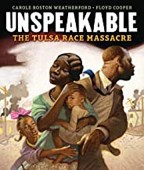 I can’t imagine anyone was surprised that Unspeakable by Carole Boston Weatherford, illustrated by Floyd Cooper, won two Coretta Scott King awards (for author and for illustrator), as well as a Sibert honor and a Caldecott honor. I’m looking forward to reading CSK illustrator honor book Nina, but I’m really surprised that Christian Robinson’s other 2021 book, Milo Imagines the World, didn’t get any official recognition.
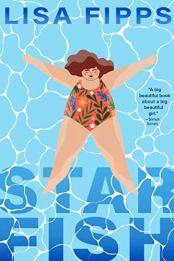
 Other Printz honor books included Starfish by Lisa Fipps (a novel in verse!), Concrete Rose by Angie Thomas, Last Night at the Telegraph Club by Malinda Lo, and Revolution in Our Time by Kekla Magoon (the latter is the only Printz book I hadn’t already read, but it’s on my list now).
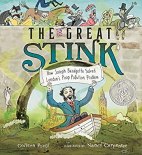 I’d actually read a bunch of Sibert honor books, though not the winner; I was super excited to see The Great Stink on the list. We Are Still Here by Traci Sorrell and Unspeakable also got honors, as did Summertime Sleepers (which taught me the word “estivate,” which is like hibernating but in the summer).
 Jenny Arch