
MLA Conference 2014, Day Two (Thursday)

Screen shot 2014-05-08 at 8.53.24 PMHarvard Library Innovation Lab: Pop-Ups, Prototypes, and Awesome Boxes

Annie Cain, Matt Phillips, and Jeff Goldenson from the Harvard Library Innovation Lab  presented some of their recent projects. Cain started off by introducing Awesome Box: the Awesome Box gives library users the opportunity to declare a library item (book, audiobook, movie, TV show, magazine, etc.) “awesome” by returning it to an Awesome Box instead of putting it into the book drop. Library staff can then scan the “awesome” items and send them to a custom website (e.g. arlington.awesomebox.io), where anyone can see the “recently awesome” and “most awesome” items. Instead of librarian-to-patron readers’ advisory, it’s patron-to-patron/librarian. Cool, fun, and easy to use! “Awesome” books can also be put on display in the library.

Phillips talked about the idea of “hovermarks,” bringing favicon-style images to the stacks by placing special bookmarks in books. Patrons or librarians could place a hovermark in a book to draw attention to local authors, Dewey Decimal areas, beach reads, favorites, Awesome Box picks, or anything else. It’s a “no-tech” way to “annotate the stacks.”

Goldenson floated the idea of a Library Community Catalog, inspired by the Whole Earth Catalog. The Library Community Catalog could contain real things, ideas, speculations, interviews, or other articles. It could be “hyper-local,” in print and/or online.

Of the three ideas presented, Awesome Box is definitely the most developed, and Harvard, which “isn’t necessarily known for sharing,” is eager to get it into public libraries. Contact them if you’re interested in setting it up at your library!

Libraries are Keeping Readers First: An Update on the National Initiative and How You Can Participate

Readers First is “a movement to improve e-book access and services for public library users.” Kelvin Watson from Queens Library and Michael Santangelo from BookOps presented an update on this initiative, explaining the work that’s been done thus far and how far we have to go. The more people (and libraries) sign on, the stronger the team, the better ability to effect change. Already, said Santangelo, Readers First represents over 20 million readers.

Screen shot 2014-05-09 at 3.57.31 PM

It’s worth going to the Readers First site (link in the previous paragraph) to read their principles. The two main challenges regarding e-books in libraries are availability and discoverability/access. Availability is an issue with the publishers; the issues of discoverability and access can be taken up with the vendors. Because libraries are only indirectly connected to publishers, but directly connected to vendors, Readers First decided to focus its efforts on the discoverability/access challenge.

Santangelo said that Ranganathan’s Five Laws of Library Science applied to e-books also (save the time of the reader, (e)books are for use, etc.) and that libraries have a responsibility to ensure open, easy, and free access to e-books the same as we do for print books. However, the e-book experience now is fragmented, disjointed, and cumbersome, creating a poor user experience. This is where the four Readers First principles come in: readers should be able to discover content in one comprehensive catalog; access a variety of content from multiple sources; interact with the library in the library’s own context; and read e-books compatible with all e-reading devices.

A Readers First Working Group sent a survey to vendors in order to create a guide to library e-book vendors. This guide will help librarians who are choosing an e-book vendor for the first time, or moving from one to another; it will also help vendors design their systems and decide what to prioritize.

Watson said that libraries should see vendors as partners, and challenge them to “do the right thing.” Librarians should hold all vendors accountable to the Readers First principles, with the end goal of a seamless experience for the user. The long-term objective, said Michael Colford of the Boston Public Library, is to “have the discovery layer be the platform.” Until then, we’re relying on APIs. “We can make things less complicated, but we can’t make it easier,” said Santangelo.

Readers First is working with the National Information Standards Organization (NISO) to develop standards for e-books, but according to Watson, the perfect format hasn’t been invented yet. (Other than PDFs, most e-book files are proprietary formats, wrapped in DRM and not usable across devices.)

MA E-Book Project

Deb Hoadley presented an update on the Massachusetts E-Book Project on behalf of the Massachusetts Library System. I was already familiar with the project because Robbins is one of the pilot libraries, but it was good to review the history, see where the project had hit snags, and hear from other librarians at pilot libraries (Jason Homer from Wellesley and Jackie Mushinsky from WPI) about how they had introduced the project to patrons.

150x71-MA-EbooksYou can read about the project’s history, the RFP, and see updates on the website, so I want to use this space to draw a parallel between the MA E-Book Project and Readers First. Although the pilot consists of three different vendors (BiblioBoard, Baker & Taylor (Axis 360), and EBL) with three different models, the end goal is a single e-book platform that offers integrated and seamless discovery. Any Massachusetts resident would have access through this user-friendly platform to e-content that is owned – not licensed – by Massachusetts libraries; local content would also be hosted and discoverable.

Although we are far from this goal right now, “Our vendors are listening to us,” said Homer. He said that participating in the pilot project has enabled him to start conversations with patrons about how much we spend on e-books now and why we need a new model. Mushinsky, who added local content through BiblioBoard, said that we need to ask, “Will this resource be of value to us? Can we add value to it?”

I came away from these two sessions (Readers First and the MA E-Book Project) convinced that we have the right goals, and dedicated people working toward them, but a little depressed at how far we have to go. Slowly but surely…


Teaching the Tools: Technology Education in Public Libraries

Clayton Cheever live-blogged this session; his notes are posted on the Teaching the Tools site.

Anna Litten from Wellesley did an excellent job moderating this informative panel. Litten and the other panelists (Michael Wick, Theresa Maturevitch, Jason Homer, and Sharani Robins) built a website called Teaching the Tools: Libraries and Technology Education, which they hope will serve as a resource going forward. To borrow from the site: “All reference librarians are technology trainers, educators and instructors these days.  But what does it really mean to teach technology topics in public libraries?  What can and should we teach?  How does technology instruction fit into our broader mission and core responsibilities?  What resources are available to use and to our clients?  How do we become better presenters and instructors?”

The panelists addressed these questions during the session. They all teach in their libraries, but the teaching takes different forms. “I teach to whatever question comes to the door, in whatever way the learner can understand it,” said Wick. Maturevich talked about printed brochures, online resources, and videos; Robins talked about beginner classes, one-on-one sessions, and “Wired Wednesday,” when patrons can drop in for tech help. Robins has also had reps from Barnes & Noble and Best Buy come in to help people with e-reading devices, and she often uses the resources at GCF LearnFree.org. Homer teaches intermediate classes in the Wellesley computer lab, and other Wellesley staff teach beginner classes. Clearly, there are many approaches, and flexibility is key.

Litten suggested taking the time to read instructional design blogs; most librarians don’t have a background in instructional design, but the field does exist and there’s a lot we can learn. “We have to focus on what’s going to work,” she said. “If it’s not working, abandon! Abandon!”

What to do when you offer a class and no one shows up? Wick and Litten talked about forming partnerships in the community. “We can be really useful to you in ways you didn’t even realize,” said Litten. “Listen,” Wick encouraged. Ask people, “What do you want? We’ll give it to you.” As for whether teaching technology is part of the library’s mission, Wick said, why wouldn’t it be? “We help everybody with everything else. Why aren’t we helping them as much as we can, more than they’re asking?” Find your audience first, said Wick, then design your classes.

Some library staff are reluctant to teach classes, but that isn’t the only kind of teaching. Nor do tech teachers have to be experts; in fact, said Wick, good teachers can be just one step ahead of their students. Knowing the librarian/teacher is not an expert but a fellow learner can put patrons/students at ease. Confronted with a question she doesn’t know the answer to, Maturevich often uses the line, “I don’t know either, but this is how we find out.”

“Good instruction depends on having good goals,” said Litten. “We’re already doing these things, we just need to do them a little bit better.”

carlitos_Simple_Pencil_ho

That’s all, folks! If you missed it, you can read about Wednesday’s sessions here (part 1) and here (part 2).

See the whole MLA conference program here [PDF]

 

MLA Conference 2014, Day One (Wednesday), Part Two

Read a recap of the first three sessions of the day in Part One.

Working with and Managing Multigenerational Staff/People

In a day full of really good sessions, this might have been my favorite. Presenter Cally Ritter was fantastic: organized, energetic, a skilled moderator who blended small group talk with lecture and discussion. The lack of diversity in libraries is a common topic, and it’s true that in terms of race, ethnicity, gender, and socioeconomic status, library staff skews toward middle-class Caucasian women, but in terms of age, library staff spans the whole range:

“Traditionals” (b. 1945 or earlier; 69+) 4% of the workforce
“Baby Boomers” (b. 1946-1964, 50-68) 44% of the workforce
“Generation X” (b. 1965-1980, 34-49) 44% of the workforce
“Generation Y” (b. 1981-1999, 14-33) 8% of the workforce

Screen shot 2014-05-08 at 8.29.46 PM

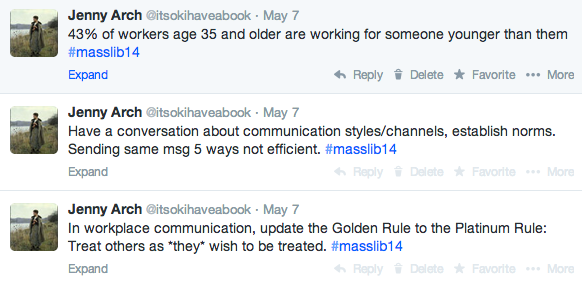
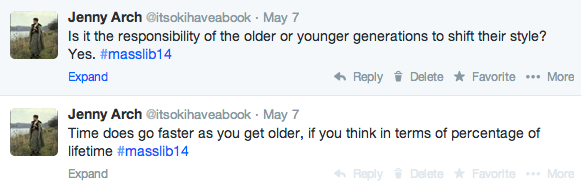
In small groups, we talked about what characterized each generation, from pop culture (TV/movies, music, hairstyles) to historical influences to preferred working styles. Because of the generational differences, Ritter said, we all need to “upgrade” from the Golden Rule to the Platinum Rule: Treat others as they wish to be treated. In order to do that, we need to listen to what people want. Ritter suggested having a conversation about preferred communication styles (face to face, phone, e-mail, paper memo, text, etc.) and then establishing norms (because it’s not efficient to send the same message through five different channels). In a situation where coworkers’ communication styles are different, Ritter asked, whose responsibility is it to shift their style? Who needs to change? (Answer: Yes!)

Screen shot 2014-05-08 at 8.29.31 PM

The age diversity among library staff as compared to other professions is remarkable. What could be the cause? One idea is that the age diversity of staff reflects the age diversity of the “customer base” – library users are all ages. One audience member/participant said, “We need all these generations to do what we do.” To which Ritter responded that every workplace needs age diversity. We should remember that what we have in common unites us more than our differences separate us; we are more similar than we are different. We should avoid stereotypes, communicate strategically, encourage collaboration, and capitalize on the diversity of thought. And get ready for “Generation Z” (b. 1999-), the Millennials…

Screen shot 2014-05-08 at 8.30.02 PM

Building Intergenerational Collaboration & Programs: Serving People of Different Ages

Andrea Weaver developed the Bridges Together program, which brings different generations together. It has been used in school systems, and recently at the Goodnow Library in Sudbury, MA. Weaver started the session at MLA by asking the audience to think of their first memory of interacting with an “older adult” (OA). Many people mentioned grandparents, great-aunts and great-uncles, neighbors, or teachers. Then, Weaver asked what activity this interaction included, and people mentioned reading (of course – it was a room full of librarians), music, games, food, holidays, and gardening.

The term “multi-generational” means that multiple generations are included; the term “intergenerational” indicates a skipped generation, e.g. grandparents and grandchildren.

Demographically, there are more and more OAs, but there are fewer opportunities for interaction. Many kids now have little or no experience interacting with OAs, and that’s what the Bridges Together program aims to correct. OA volunteers are paired with children and they build a relationship over the course of several weeks. According to Weaver, these intergenerational programs help reduce or prevent ageism, increase compassion and respect, give kids a chance to learn about possible careers, give OAs a chance to reflect on their experiences and share their stories, and give kids (and OAs) attention.

Where do libraries come in? Libraries build community by giving people permission to engage with each other. This can take the form of the Bridges Together program, or any other form; potential programming partners include the Council on Aging (every city/town in MA has one), the senior centers, garden clubs, theater troupes or dance companies, the Cultural Council, the historical society, the Parks & Rec department, and after-school programs. Other ideas mentioned: an oral history project; watching and discussing silent films, then looking them up in IMDB; hosting an intergenerational book club. (Weaver suggested books by Jennifer Chiaverini, Adriana Trigiani, and Dorothea Benton Frank; these authors generally write about multiple generations of families. She also read from a book used in the Bridges Together project, How Old Is Old? It’s out of print now, but there are still a couple copies in Minuteman.)

That’s it for the Wednesday sessions! Thanks to those who live-tweeted other sessions on Wednesday, especially Kristi (@booksNyarn), Anna (@helgagrace), Clayton (@cfcheever), Erin (@ErinCerulean), and Beth (@infogdss29).

Thursday session post(s) coming soon.

MLA Conference 2014, Day One (Wednesday), Part One

It’s that time again! This year, the Massachusetts Library Association conference is in Worcester, and once again the lovely and gracious Friends of the Library enabled some of our library staff (myself included) to attend. Here’s my round-up of the first three sessions I went to today, with more to come. Several conference-goers are also on Twitter (#masslib14).

Brand New You: How Libraries Use Branding to Establish Relevance and Engage Users

Anna Popp from the Massachusetts Library System presented on MLS’ experience developing their brand with Walter Briggs of Briggs Advertising. Popp convened a task force and established a clear decision-making protocol (essential, according to Briggs). Popp and Briggs explained that an organization’s brand is evolutionary, not visionary; it’s not the same as its vision or mission statement (‘it’s not what you aim to be, it’s what you are’).

MLS logoThe process involved brainstorming everything about the organization, then crossing out everything that wasn’t unique, with the goal of distilling it down to 3-5 words or phrases – the “brand mantra.” The brand mantra is an internal tool, and is not the same thing as a tagline (e.g., Nike’s brand mantra is “Authentic Athletic Performance,” not “Just Do It.”) MLS came up with “Uniting, Empowering, Library Enhancement.” The brand mantra is “the most important deliverable” from the branding process, more important even than the logo (at left). The logo’s job is not to show or tell what an organization does.

The tagline should be “evocative, inspiring, brief, lyrical” and have “integrity.” The (awesome) MLS tagline is “Stronger together,” which perfectly suits an organization dedicated to building a statewide community of libraries, empowering those libraries, and championing resource sharing.

Briggs finished the presentation by sharing some of his past work. I especially loved the Patten Free Library tagline, “More than you’ll ever know,” and the tangram-like logos (below) for the Curtis Memorial Library (both libraries are in Maine).

CurtisMemorialLibrary logoCurtisMemorialTeenCurtisMemorialKids


The takeaways from this session included: (1) Recognize what people bring to the table, (2) Establish role clarity – who will have an advisory role, who will have a decision-making role?, (3) Let people do their jobs, help when necessary, (4) Prepare to learn something about yourself, (5) Plan ahead, but be prepared for eventualities and opportunities. It may be hard to prove the ROI on a logo, but Popp mentioned the idea of “mindshare”: “in marketing, repetition wins.” Establish your relevance and constantly reaffirm it.

An Agenda for Information Activism: Internet Freedom and Press Freedom Today

Kevin Gallagher stepped up here in place of the original presenter, Josh Stearns, formerly of Free Press. Gallagher clearly knew his stuff, particularly the threat that government mass surveillance poses to journalists and society at large, and he did a good job on short notice. He wasn’t the most comfortable speaker, and his presentation jumped around a little bit; the audience wasn’t all familiar with some of the terms he used or the services he referenced. The presentation had no handouts or visual component (other than the trailer for the upcoming Aaron Schwartz documentary, The Internet’s Own Boy). However, privacy is something librarians care deeply about, and this program took a step toward convincing us all to do more research for ourselves, and think about what we can offer patrons, both in terms of tools and education. Here are a few points and links from the session (thanks also to Alison Macrina of Watertown Free Public Library):

  • When the government undermines and weakens Internet security standards for the purposes of surveillance and data-gathering, it makes us all less safe, not more.
  • There are library privacy laws in 48 states and the District of Columbia. Patron privacy and confidentiality is essential for the free pursuit of knowledge.
  • If the government can collect metadata on journalists’ communications, that exposes journalists’ sources, whose confidentiality should be protected.
  • Read the full text of the Guerilla Open Access Manifesto by Aaron Schwartz on the Internet Archive.
  • “There is already a war” against whistleblowers, journalists, and activists (examples: Julian Assange, Jeremy Hammond, Edward Snowden, Barrett Brown, Jim Risen).
  • “We need a new Church Committee.”
  • Government agencies and private companies are collecting personal data and metadata. Be aware of what personal data private companies are collecting, and what permissions you are giving when you use services like facebook. See Terms of Service; Didn’t Read.
  • Use search engines that value privacy, like DuckDuckGo, or use plugins like Ghostery or services like Disconnect.me. Install Tails, an operating system that lets you use the Internet anonymously via TOR.
  • What can we (in libraries) do? Use more privacy and security tools (like https everywhere from the EFF). Use free and open software instead of proprietary software (“There’s a free and open alternative to everything”). Make sure patron privacy policies are up to date, and make sure we aren’t collecting any more patron information than necessary. If libraries are receiving federal funds that force compliance with CIPA, make sure you aren’t filtering any more than you have to – or, if possible, don’t accept the strings-attached funds. Host a “crypto party.” Support the USA Freedom Act, make FOIA requests. Remember the Library Bill of Rights.

How We Doin’?: Public Libraries Using LibSat to Gather Patron Feedback

The Los Angeles Public Library uses LibStat.

The Massachusetts Board of Library Commissioners (MBLC) is providing LibSat from Counting Opinions to all Massachusetts libraries for a three-year term. All library directors have the login information, and can pass it on to any of their staff. From what we saw in this session, LibSat is a pretty incredible tool to gather continuous patron feedback about their library experience; data nerds in the room were audibly delighted.

This session began with the proverb “A guest sees more in an hour than the host sees in a year.” Patron feedback is valuable to libraries, offering reminders of how much people appreciate library services and staff as well as presenting opportunities for improvement; patrons who rate the library’s importance as high but their satisfaction with the library as low direct attention to areas for improvement.

LibSat offers patrons a choice of a short survey (3-5 minutes), a regular survey (5-7 minutes), and an in-depth survey (~15 minutes). Other than possible survey fatigue, there’s really no reason MA libraries shouldn’t be using this tool. The results could really come in handy when it’s time to prepare those annual reports…

Next up:

Working with and Managing Multigenerational Staff/People

Building Intergenerational Collaboration & Programs: Serving People of Different Ages

Last year’s (rather long) MLA posts:

4/24/13: Teaching Technology to Patrons and Staff & Afraid to Advocate? Get Over It! & Library Services and the Future of the Catalog: Lessons from Recent ILS Upgrades & Loaning E-Readers to the Public: Legal and Strategic Challenges

4/25/13: On Life Support, But Not Dead Yet!: Revitalizing Reference for the 21st Century & Authors, Authors, Authors!: Three Local Authors Strut Their Stuff & Analyze Your Collection & Print and Digital Publishing: How Are Publishers, Editors, and Authors Adapting.

Sisterland by Curtis Sittenfeld

SisterlandFrom birth, twins Daisy and Vi Shramm have had what they call “senses,” psychic abilities. Vi embraces hers, but after a bad experience in middle school, Daisy tries as hard as she can to ignore her senses and be normal. In college, she goes by Kate (from her middle name, Kathleen), and when she marries she takes her husband’s last name; so although Vi Shramm and Kate Tucker still live in their hometown of St. Louis, Missouri, their twinship isn’t obvious.

Not only do they differ in name and in appearance, their lives have taken different courses as well: Kate attended college, married, and is a stay-at-home mom, whereas Vi, after a wandering course, is a practicing psychic in town. When she predicts a massive earthquake, Kate is torn: she believes her sister, but will she support her? Kate’s husband Jeremy is a professor at Washington University, and his close friend and colleague Courtney Wheeling is an expert in seismology there; she insists that there is no way to predict an earthquake.

Sisterland is narrated by Kate, and the reader has access to all of her thoughts, feelings, and insecurities. Though the majority of the story takes place during the lead-up to the predicted date of the earthquake, there are also episodes from the twins’ childhood, adolescence, and college years, as well as Kate and Jeremy’s courtship, and their friendship with the Wheelings (Hank is a stay-at-home dad). As usual, Sittenfeld manages to cover a significant span of time without sacrificing the story’s depth.

Throughout her life, and the book, Kate’s frequent conflicts with her sister are a manifestation of her internal conflict: she has the “senses,” but she doesn’t trust them or want them; she wants to embrace conformity, be normal, be good. But can she be true to herself while ignoring this aspect of her character? The main conflict, when it comes, has little to do with Kate’s psychic abilities (or her quashing of them); it is surprising but utterly believable.

Sittenfeld has a talent/skill for making her characters’ words and actions seem reasonable by revealing their deepest thoughts and feelings. I sympathized with Kate, though it occurred to me to wonder how I would feel if Sittenfeld had chosen to narrate the story from Vi’s point of view. Sisterland encompasses a number of issues: traditional beliefs vs. new age-y ones, the value of working vs. stay-at-home parenting (and how that affects partners’ relationships), race, fidelity, and compromise. For those who were impressed by Prep and/or American Wife, be assured that Sisterland is as good, if not better.

I received a galley from Random House at the Massachusetts Library Association conference in April. Sisterland will be published on June 25, 2013.

prepamericanwife

TransAtlantic by Colum McCann

LibraryThing’s batch of author interviews for the month include Julie Wu, author of debut novel The Third Son (which I wrote about in March) and Colum McCann, author of Let The Great World Spin and, most recently, TransAtlantic. I picked up a galley of TransAtlantic from the Random House booth at the Massachusetts Library Association conference last month, in part because I had both enjoyed and been impressed by Let The Great World Spin. Many books are enjoyable, and many books are impressive, but the two don’t always overlap.

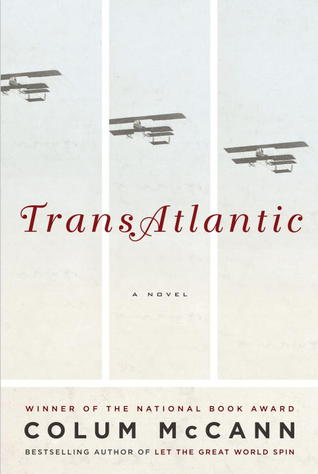
TransAtlanticTransAtlantic takes place in three discrete time periods around three significant events: Frederick Douglass’ trip to Ireland in 1845, WWI pilots Jack Alcock and Teddy Brown’s flight from England to Ireland in 1919, and George Mitchell’s diplomatic efforts to end the Troubles in 1998. However, these characters are not the only main characters; four generations of women, beginning with Lily Duggan, a maid in the household that hosts Frederick Douglass, are also connected to these events.

The different time periods, events, and character relationships are a lot for a reader to keep track of, and in the end I found that the book left impressions rather than memories. Any one of the three central stories would have been enough for a book on its own, but McCann’s style is to twine many narratives together into one. I’m not sure he succeeds here as completely as in Let The Great World Spin, but the writing is absolutely beautiful (especially if you happen to be a fan of sentence fragments, which I am).

MLA Conference, Day Two (Thursday), Part Three

On Thursday afternoon, I attended the session “Analyze Your Collection.”

weedingtweet1

“Collection analysis” in this case seemed to be a polite synonym for weeding (withdrawing books from the library collection). Two representatives from the Thomas Crane Public Library in Quincy, MA, Claudia Shutter and William Adamczyk (now of the Milton Public Library), spoke about their experience using the tool/service CollectionHQ. They described CollectionHQ as a “weeding/collection development tool” that “optimizes performance of materials”; CollectionHQ “talks” to the ILS monthly via FTP, so the library regularly sees new data.

Adamczyk spoke about the practical and ideal reasons for weeding. Practical reasons have to do with space, aesthetics, and cleanliness; “ideal” reasons have to do with updating the collection, keeping accurate statistics, and improving catalog searches. To get started, he said, (1) have a plan and goals and commit to it/them, and (2) form a team, then discuss, prioritize, and standardize.

weedingtweet2

Systematically weeding the library collection is “a great inventory project.” The hands-on aspect plus the CollectionHQ tool helped the Thomas Crane staff identify “dead items,” grubby items, and areas that were over- or under-stocked by comparing the items in the collection to the demand for those items. CollectionHQ also helped them maintain an accurate inventory and clean up their database. (Throughout the project, they used special red book trucks for weeding, so those carts wouldn’t be confused with regular circulation carts.)

Thomas Crane reported that their results after weeding and using CollectionHQ were “better circulation and better turnover, better aesthetics, better browsing, more space on the shelves…a better understanding of over/under-stocked areas.”

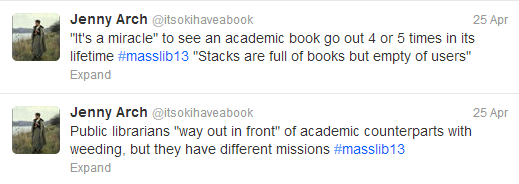
Next, we heard from Rick Lugg from Sustainable Collection Services. SCS “offers deselection decision-support tools to academic libraries.” Academic library stacks, Lugg said, are often “full of books but empty of users.” As he pointed out, it’s not free to keep a book on the shelf (see “On the Cost of Keeping a Book” by Paul Courant and Matthew Nielsen, p. 81-105, PDF), and so weeding – or “deselection” is necessary in academic libraries too. Lugg acknowledged that public librarians are “way out in front” of their academic counterparts in terms of weeding, but that academic libraries have a different mission than public libraries, and that mission includes preservation.

weedingtweet3

Lugg defined three categories of material: archive copies, service copies, and surplus copies. He spoke about redundancy, in terms of keeping a book on the shelf when it could be easily accessed elsewhere, either online (via HathiTrust or Google Books) or from another library. With “independent action in a collective context…safety is built into the system.” With SCS, libraries have the ability to “combine elements in a way that makes sense locally” and use the “rules-based interactive system” to make “data-driven decisions.” For example, a librarian could create a deselection list of withdrawal candidates that were published before 1990, have never circulated, and that are owned by at least 100 other libraries; these lists can be iterative, as weeding is “an ongoing process” rather than “one massive project.”

weedingtweet4

weedingtweet5

Overall, this was an okay session; though it was neat to see some of the CollectionHQ and SCS output, the session felt a bit like an advertisement, and I’m already very much on the weeding bandwagon for both “practical” and “ideal” reasons here at the public library. It was interesting to consider the additional parameters that academic librarians have to consider when weeding, though.

The final panel I attended at MLA on Thursday was “Print and Digital Publishing: How are Publishers, Editors, and Authors Adapting,” moderated by Skip Dye of Random House, with Liz Bicknell of Candlewick Press, M.T. Anderson (author of Feed and many other young adult novels), Amy Caldwell of Beacon Press, and Chris Stedman (author of Fathiest).

Skip Dye began by asking the question, “Adapting?” and answering it, “Are we?” The basic cycle of the publishing industry hasn’t changed: authors find agents, agents pitch the book to editors at publishing houses, publishers acquire the book and distribute it to the market. Within that cycle, however, there’s a lot of room for difference. Some editors still prefer to mark up a physical manuscript with pen or pencil (“I think with a pencil in my hand,” said Bicknell), while others will make corrections and suggestions on an electronic copy of the manuscript and e-mail it back to the author. Some editors – at Scholastic, for example – work entirely over e-mail, Anderson said, but that changes the revision process, not the writing process. At Candlewick, Bicknell said, books are still “conceived as print books,” then made “e.” Caldwell said she preferred to edit shorter pieces electronically, but still preferred to read long books on paper, for the better sense of cohesion and pacing.

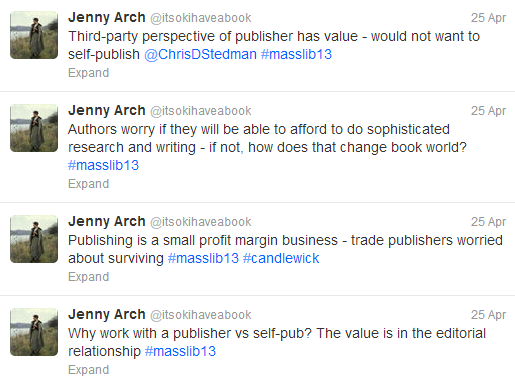
The two really disruptive elements to the publishing industry at this moment are e-books and self-publishing, and those topics made up most of the panel’s discussion in this session. The editors and authors on the panel made many salient points about how e-books affect publishing in ways large and small. Caldwell pointed out that “it does take work to make a book into an e-book”; Bicknell explained that permissions were tied to the number of copies published, so even though e-book sales are not connected to physical quantity, they can be limited by permissions. “Trade publishing is a small profit margin business,” she said. Anderson, too, expressed concern about that margin. If advances continue to shrink, authors may no longer be able to afford to write research-intensive, sophisticated books – “Then what?”

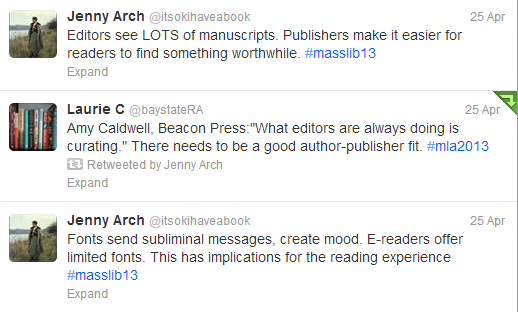
Skip Dye raised a seemingly small but non-trivial point: permissions are necessary not just for other authors’ or artists’ work, but for fonts as well. Different e-readers and tablets display different fonts, and often offer only a limited choice. Bicknell added, “Fonts send subliminal messages…[they] create mood.” (Surely some readers of this blog are familiar with the documentary Helvetica? And we all have our favorite fonts…I am fairly certain I could identify a single line from an Ann Patchett novel based solely on the font.) Dye mentioned that different devices also display different levels of color saturation, which has an effect on illustrated books, especially children’s books.

printdigpubtweet1

The discussion then turned to self-publishing. Chris Stedman is a 26-year-old active blogger, a digital native who writes and edits on the computer, and reads and writes on paper – yet he still chose to write a book and work with a traditional publisher instead of self-publishing. He said that the value of a traditional publisher lies in the “third-party perspective,” an editor’s experienced eye instead of a friend or family member’s opinion. Caldwell spoke about the author-publisher match, describing publishers as “curators in certain areas.” (Beacon Press, for example, is “an independent publisher of serious fiction and nonfiction.”)

On the topic of self-publishing, Caldwell said, “Publishers can be wrong, and not want to take risks. But, editors see lots of manuscripts and know how hard it is to write a good book. There’s so much stuff, finding something you want to spend time with is hard….Publishers make it easier for readers to find something worthwhile.” Anderson too chimed in, agreeing that self-publishing allows for “democratization” but asking, “How do you end up with the grassroots but not the dirt?” Whereupon publishers were compared to the “special environment” of hydroponics.

printdigpubtweet2During the Q&A, Stedman stated, “The way in which we consume media is changing dramatically.” Writers are trying different formats (might we see a resurgence of the long-form essay, or the novella?). Caldwell mentioned the attention span issue; with the proliferation of information (and entertainment), shorter formats like “singles” or long articles might do well.

printdigpubtweet3

This final panel might have been trying to cover too much ground in its allotted time, but the panelists certainly touched on a number of interesting topics. As a former assistant at a literary agency, I can attest that about 99.98% of manuscripts submitted were nowhere near the quality of a published book, and even with help from an agent and an editor, most of them never would be. (Which is not to say that awful books don’t get published – they do – or that worthwhile manuscripts don’t get rejected – they do.) Whatever else changes, editing is a crucial part of the writing and publishing process.

masslibtweet

MLA Conference, Day Two (Thursday), Part Two

Michael Colford, Director of Library Services at the Boston Public Library, moderated the panel, “Authors, Authors, Authors!: Three Local Authors Strut Their Stuff!” The local authors featured were Claire Messud, Christopher Castellani, and Laura Harrington. Each author had a different writing background, and all three were fascinating, refreshing, entertaining, and articulate as they spoke about their work, the book world, and culture in general. It was a wonderful panel, and the fact that it was held in the tent with fresh air and natural light didn’t hurt either.

Laura Harrington, author of Alice Blissimmediately earned cheers by saying, “Librarians are some of my favorite people….Librarians and teachers are my heroes.” Alice Bliss is Harrington’s first novel, but she is an experienced writer, having spent the last 25 years writing for the theater: operas, radio plays, screenplays, librettos, lyrics, and more. With her novel, she said, “I wanted to reconnect to the creative process by becoming a beginner again.”

authortweet1

Christopher Castellani, author of A Kiss From MaddalenaThe Saint of Lost Things, and All This Talk of Lovestarted with an overview of his books so far. His three novels deal with the same family, but each book can also stand alone; each covers a two-to-three year time span, from Italy in WWII, to immigrant life in the U.S. in the 1950s, to tension between the first and second generations of the family. He originally imagined the work as one “epic, sprawling saga” – “I wanted to write something like One Hundred Years of Solitude but for Italians” – but the story found form across three books instead. Rather than one main character, the books feature an ensemble cast.

Claire Messud, author of (most recently) The Woman Upstairs, as well as The Emperor’s Children and several other novels, spoke generally about writing (“Writers are like magpies”), rants, and angry women. Nora, the main character in The Woman Upstairs, has been perceived by critics as angry, and Messud observed, “Women’s anger is uncomfortable….If a woman is angry, she’s ‘unhinged.'” Readers confront this right away: the beginning of The Woman Upstairs is “the rantiest bit.”

“I’ve been a delighted reader of rants,” Messud said, “but all the ranters are men.” Maybe, she indicated to the mostly female audience, it’s our turn. She mentioned the Chekhov story “The Lady With the Dog” and expressed her admiration for the way the author wrote the character’s internal life. “All her torment is invisible….I wanted to write about what’s below the surface for people.” When the question of Nora’s anger came up again during the Q&A, Messud stated: “Nobody eviscerated on the table is gonna look pretty.” If Nora was real and walked into a room, you’d think she was perfectly pleasant; you’d like her. But as the reader, you see everything under the surface, not just her public face. Nora’s complexity might make her hard to like, but “Giv[ing] voice to true human experiences, that’s our job [as authors].”

While readers’ and critics’ reactions to the book are worth discussing, The Woman Upstairs also examines the questions, “What is the cost of making art? What do you have to sacrifice?”

Q&A

The issue of women and anger arose from Alice Bliss as well; Harrington said that readers have been judgmental and unforgiving of Angie, Alice’s mom, who falls apart a bit when her husband, Alice’s dad, goes to war. All This Talk of Love is not without an angry woman, either: one of the characters finally speaks for herself after a lifetime of others speaking for her, and giving up things she doesn’t want to give up, creating conflict within the family. In fiction as in real life, rage, Messud noted, “comes from helplessness, a lack of agency, struggling for control.” (She also mentioned Blood Wedding (Bodas de Sangre), a play by Federico Garcia Lorca, full of angry female characters. I read this play when I studied abroad in Spain, but hadn’t heard anyone mention it since.)

The next question from Colford had to do with families. All three writers acknowledged that, as Messud put it, “For anybody writing anything, our own experience of family informs the fiction that we write.” Castellani spoke about the “inescapability of each other and the narratives we have constructed for each other….When we change, it sends shockwaves through our family.” Harrington illuminated the fine line of using pieces of real people in one’s fictional characters: “How do you do this in a way that is inspired by real people but not slavish to them?”

Colford particularly complimented Harrington’s supporting characters (“I love supporting characters in novels”), and she credited an inspiring work (Our Town by Thornton Wilder) and her past work as a playwright: “A playwright’s job is to write great characters for actors to play.” At the same time, a playwright must be “very economical with ‘brushstrokes,'” using few words to describe each character.

An audience member asked Harrington about transitioning from a collaborative medium to a solitary one. She answered, “Collaborating is either heaven or hell. You often find yourself married to someone before you’ve had a first date.” In theater, however, “All those moving pieces [can] fall to pieces,” and with novel writing, it was “a relief to be in control.” Writing for theater and opera involves compression; novel writing allows for expansion.

On the question of character likability, Harrington said, “Likability is a slippery slope….If we’re focused on likability we’re going to forget the possibility of transformation.” While Messud acknowledged that “Readers desire to identify with the character [and] feel that she is admirable,” she pointed out that this is a gendered point of view: “Let’s try to make a list of the male protagonists we want to be friends with.” (It reminded me of when voters elected Bush because he was someone they’d like to have a beer with; great, have a drink with him, but let someone serious run the country.)

maine_sullivaninterestings_wolitzercorrections_franzen
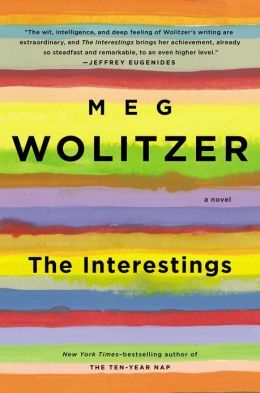
Gender makes a difference when it comes to the author, too – or at least, how publishers package authors’ books and how critics review them. “Character-driven family novels” are one example of this: think Jonathan Franzen’s The Corrections vs. Meg Wolitzer’s The Interestings (or J. Courtney Sullivan’s Maine). Castellani, who studied with Jonathan Franzen in college, said that he (Franzen) said, “It’s not as if I invented the family novel,” though The Corrections is often held up as an example of this type of book. Harrington pointed out that the same dichotomy applies to novels about war; reviewers write about male authors’ war novels as a group (not to pick on Slate, but here’s an example), and don’t mention novels about war written by women.

Despite this obvious unequal treatment, the panel ended on a positive note. An audience member asked Messud whether she’d seen Ron Charles’ book review of The Woman Upstairs (YouTube video), and she said yes – she thought it was very funny. (It is.) Overall, the “Authors, Authors, Authors!” panel was one of the most pleasurable parts of the conference. I wouldn’t have thought to group these three authors (or their books) together, but it worked just beautifully, thanks to the moderator and the panelists themselves.

Two more Thursday sessions to write about, coming soon!

MLA Conference, Day Two (Thursday), Part One

I had a hard time deciding which Thursday morning session to go to, but ultimately I chose “On Life Support, but Not Dead Yet!: Revitalizing Reference for the 21st Century” and I’m glad I did. Jason Kuhl of the Arlington Heights (IL) Memorial Library (AHML) and Celeste Choate of the Ann Arbor District Library (AADL) presented, and both had excellent ideas to share. As most librarians know, demand for “traditional” reference services have been declining, with many fewer “ready reference” questions as well as fewer complex reference questions. Multitudes of column inches in newspapers (screen inches in online publications) have been devoted to whether libraries are relevant in today’s world, and probably an equal amount has been written by librarians and our allies on why libraries are in fact relevant.

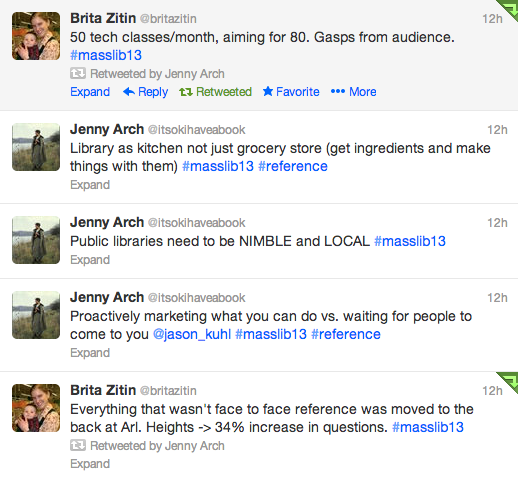
But as some libraries shift toward the “library as community center” model, others consider how to highlight the reference services that have always been libraries’ strength. One of the most obvious ways, Jason pointed out, was to make the reference desk visible: put it in a high-traffic area, near an entrance, or just make sure it’s not behind a wall where patrons have to seek it out. Another way that Arlington Heights increased the number of questions answered (by 34%!) was to separate face-to-face interactions from phone, e-mail, and chat interactions; that is, when a librarian was at the reference desk, s/he was only responsible for face-to-face interactions with patrons physically in the library. Librarians away from the desk handled all other types of reference questions. In addition to boosting the number of questions answered, this solution seems to me like a big stress-reliever; instead of trying to answer four questions at once, staff can focus on just one, and give that patron better service.

Jason also talked about a reshuffling of responsibilities at the two desks at the Arlington Heights library. Previously, they had an “Information” desk and a “Welcome” desk. At the info desk, staff with MLS degrees answered traditional reference questions, helped with database research, did technical instruction, and handled genealogy and business questions; at the welcome desk, staff without an MLS answered questions about the catalog, helped with technology, and did readers’ advisory. This distinction was unclear to patrons (most patrons, not unreasonably, assume that everyone who works in a library is a librarian with the same level of expertise), so the desk responsibilities were shifted and the names were changed accordingly. Now, patrons could go to the “Digital Services” desk to ask about the public computers, digital content, technology instruction, and e-readers/tablets/phones, or they could go to the “Information Services” desk with questions about genealogy and business, readers’ advisory, or the catalog. Some staff at each desk had an MLS and some did not. Though it required cross training for staff, the new system was more intuitive for patrons.

Jason noted the importance of “proactively marketing what you can do versus waiting for people to come to you,” as well as the importance of being “nimble and local,” by responding to rising unemployment by offering help for jobseekers, for example. The library also offers technology classes, and staff noticed that attendance at these classes rose even as public computer use declined. The Arlington Heights library is able to offer more than the usual tech classes: they offer sessions on blogging, Twitter, Android vs.  iOS, and where to listen to music online. The library is “not just a grocery store, but also a kitchen,” Jason said, meaning it is not just a place to come get things, but also a place to make things. “Libraries,” he finished, “help people be successful in their lives.”

referencetweet1


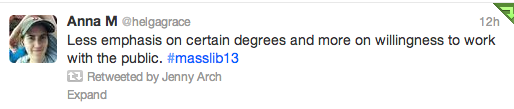
Celeste from AADL presented next, starting with an overview of the library system. The AADL is one main library and four branches; they have 8.8m checkouts, 1.6m visits, and about 80k attendance at programs annually, but reference questions have declined sharply, from 126k in 2003-2004 to 51k in 2011-2012. The AADL took a hard look at “What job needs to be done? Who is qualified to do it? Who answers which questions?” They have several levels of staff, from clerks to MLS students to library technicians, librarians, supervisors, and managers. Each level of staff spends a certain amount of time on the desk every week (the library is open 74 hours/week year-round), but there is a six-week training program that supports non-MLS staff on the desk. There is also peer-to-peer training in the form of a staff wiki, and a variety of ways for patrons and staff alike to ask questions.

referencetweet3

All of these changes seem designed to support library staff’s responsiveness to the public and to each other. Staff create wayfinders and tools for the public, like homework help, and staff and the public also create resources together, like readalike lists. There is also an “on demand” digitization process; digitization can be a long, slow process, so why not let the public decide what they want to see first? Patrons can request digitized copies of articles from old local newspapers, and instead of simply delivering that item to that patron, the item is made available to the public as well. The public also helps tag items in the catalog (crowdsourcing!) with the Points-o-Matic game.

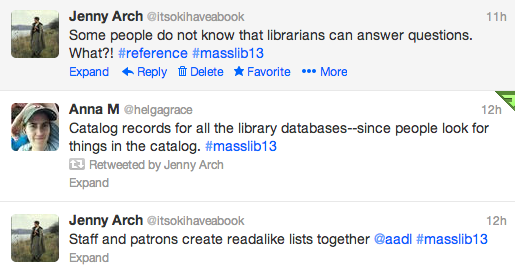
A final small outreach effort was to add a short message to the  “Ready for Pickup” notices that are automatically e-mailed to patrons when their requested items arrive at the library. Instead of just saying that the item is ready, the AADL added a sentence along the lines of “Did you know the library can answer questions?” Because, unbelievably, some people do not know this. (Celeste’s own grandmother, apparently, was one of these people. “What do you think I do all day, Grandma?”)

referencetweet2

All of the ideas that Jason and Celeste presented were thought-provoking and inspiring. I especially like the idea of a combination staff/patron chat where staff can provide answers to their fellow staff as well as to patrons (Celeste called this “the channel”), but I have to say my favorite idea is separating face-to-face reference from phone/e-mail/chat reference, and handling the latter off-desk. At AHML, this seemed to have many positive effects: it reduces stress on desk staff, improves the F2F experience for patrons, and allows library staff to answer more questions (a ringing phone doesn’t go unanswered because the person on the desk is helping someone else).

This post wound up being pretty long, so I’ll write about the remaining three Thursday sessions in the next post(s). Stay tuned, and please share your thoughts in the comments!


MLA Conference, Day One (Wednesday), Part Two

The afternoon sessions at MLA on Wednesday were just as good as the morning sessions. First up after lunch was “Library Services and the Future of the Catalog: Lessons from Recent ILS Upgrades,” with representatives from the Boston Public Library (BPL), the Merrimack Valley Library Consortium (MVLC), UMass Dartmouth, and the Massachusetts Board of Library Commissioners (MBLC); the first three library systems had recently changed from one ILS (Integrated Library System) to another, and the MBLC had helped MVLC and two other Massachusetts library consortia with the search process and transition.

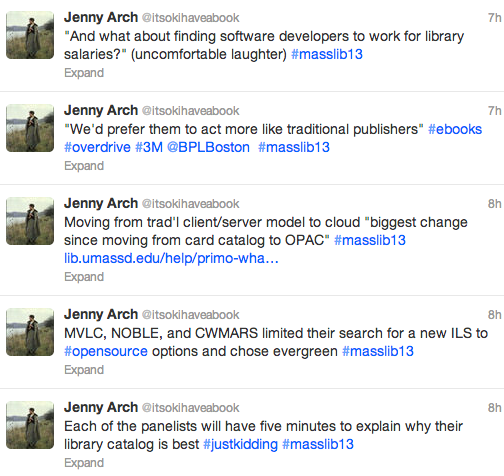
The speakers explained why their libraries wanted to change from one ILS to another and the decision-making process involved in choosing a new ILS; they also spoke about the process of the change and how it affected users and staff, pointed out some of the differences – good and bad – between old and new systems, and talked about the future of library catalogs. They touched on the differences between open source and proprietary systems: with open source, you need more in-house talent (software developers on staff), but you have more control, as well as access to the open source community; proprietary systems require less technical skill from library staff, as fixing bugs and implementing new features are outsourced.

ILStweets1

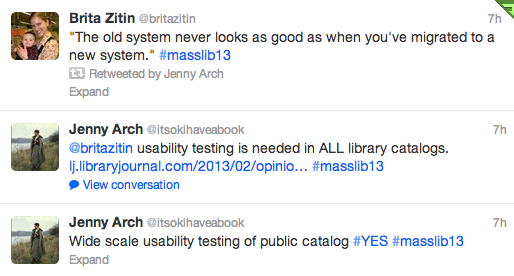
All library systems experienced some growing pains during the change; in some cases, initial training was good, but follow-up training could have been better. “The old system never looks as good as when you’ve migrated to a new system,” one speaker said somewhat ruefully. “It’s always going to be harder than you think,” said the MVLC representative. However, when asked how they felt three months after migrating to the new system, overall everyone seemed satisfied with their new ILSs, though each had a laundry list of wishes, and much of the reporting seemed based on anecdotal evidence rather than formal evaluation of either staff or patron experiences.

ILStweets2Every ILS has usability issues, and usability testing with patrons would likely identify areas in need of improvement for each ILS; developers don’t always develop with real users in mind. (As Aaron Schmidt pointed out in Library Journal, most library catalogs are designed to prioritize the collection, not the people searching the catalog.)

The last session I attended on Wednesday was “Loaning eReaders to the Public: Legal and Strategic Challenges,” where Anne Silvers Lee and Jamie Wilson from the Free Library of Philadelphia and Melissa Andrews from the Boston Public Library spoke about the lessons they learned in the process of developing programs to circulate e-reading devices: the Free Library lent B&N nooks, and the BPL will be lending iPad minis starting next month.

This was a fascinating session that started off with some startling statistics. E-readers, Ann said, are “not a cutting-edge thing anymore”; forty percent of libraries loan e-readers. Why did the Free Library want to lend e-readers? They considered the digital divide (the gap between those who are familiar with technology and those who don’t use it; in Philly, 41% of the population of 1.5 million does not have internet access at home), patron demand, innovation, and transliteracy.

The library obtained a grant to purchase e-readers and hire part-time staff to help train patrons on how to use the devices. They chose nooks because B&N offers institutional accounts for invoicing and batch wifi delivery of new content; they were also aware that Amazon had already sent out at least one cease-and-desist letter for lending Kindles. Jamie referenced copyright experts Mary Minow and Peter Hirtle of LibraryLaw.com and Cornell University, respectively, whose opinions the Free Library sought to determine the legality of their lending program. He summed up their response as “We’ve looked into this, we think it’s all right,” with Hirtle less sure than Minow (who also included a long list of caveats).

ereaders1

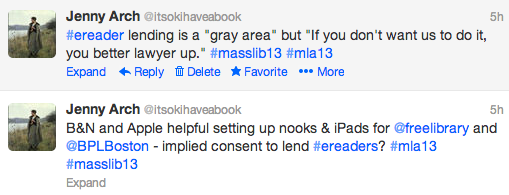
During the Q&A at the end of the session, I suggested that B&N and Apple’s cooperation in helping the libraries set up their devices for lending implied consent, but apparently it’s still a “gray area.” However, Ann said, “If [device manufacturers] don’t want us to do it, [they] better lawyer up.”

ereaders2Jamie explained the Free Library’s system for lending: the program was limited to patrons fifty years of age or older, all of whom had to have a library card and a valid ID. There were steep late fees in place (though fears that the devices would be stolen proved unfounded; none went missing), and all users had to take a training class. All of the nooks circulated from the senior center in the Main Branch, and all were pre-loaded with the same selection of fiction and nonfiction bestsellers and classics. Because they weren’t buying content through a third-party vendor like OverDrive or 3M, they could purchase titles from all “Big 6” publishers.

Results once the program launched were somewhat disappointing, with lower use of the devices than they had anticipated. In response, the library lowered the age requirement for borrowing, expanded the availability to other locations, dropped the training requirement (while providing even more training classes), and eventually repurposed some of the nooks for staff training.
ereaders3

Then, of course, there was the lawsuit: the National Federation for the Blind sued the library because the nooks were not accessible. The lawsuit was resolved, but it stands as a cautionary tale, and the BPL accordingly proceeded with caution when planning their own e-reader lending program. The NFB had sent a letter to the mayor of Boston stating that it was an ADA violation to lend nooks or Kindles; only iPads were appropriately accessible (more than just text-to-speech capability is required for a device to be considered accessible).

The BPL purchased 70 iPad minis with a grant, and worked with Apple to ensure that users’ personal data was protected and that any content a user had added to the device was wiped between checkouts. The iPads are preloaded with 40 high interest titles as well as some apps; they will circulate for two weeks at a time, and patrons will be able to place holds on them through the catalog (though Melissa anticipates long wait times due to their popularity). The iPads will show up in the results list when patrons search the catalog for books that have been preloaded onto the iPads; this is something that the Free Library staff thinks would have boosted circulation of their devices, which only appeared in the catalog if you searched for them by device name.

Overall, this was an informative session. All three speakers were well prepared and articulate, and the learning curve was evident in the changes that the Free Library made to its own lending program as well as how the BPL developed its lending program. As I’ve said before, libraries are all about sharing, and learning from each other’s experiences is one way of doing that. For any library that is considering implementing an e-reader lending program, I’d definitely recommend consulting these folks’ resources.

Next: the Thursday sessions at MLA were also fantastic. Stay tuned for not-so-concise summaries of four more sessions (probably in two parts, probably tomorrow or early next week). The Twitter hashtag war continues, so make sure to check #mla13 and #masslib13 (I was mostly using the latter).

MLA Conference, Day One (Wednesday), Part One

Today was the first day of the Massachusetts Library Association Conference in Cambridge. The conference site, located near the MIT campus, was surrounded by police, who were out in force for the memorial service for fellow officer Sean Collier. (Librarians may have seen that many police in one place before, but I doubt the police had seen that many librarians.) It made for a somber beginning, and people trickled into the 9am sessions a few minutes late due to some of the roads being closed.

Despite missing the first few minutes of the session on “Teaching Technology to Patrons and Staff,” I enjoyed Ann Lattinville and Peter Struzziero’s presentation about the series of “Tech 101” classes that they offer at the Scituate Town Library, and Jessica Lamarre’s presentation on her work with the “teen tech squad” at the Pembroke Public Library. (This was the only session during which I wasn’t on Twitter, because I didn’t get the MLA wireless password until afterward. You’d think that would be in the conference packet, or on the website…) I came in just as Ann and Peter were finishing talking about the Library Edge Initiative’s Benchmark test, and how their library’s results had led them to offer more technology training for patrons at their library, including classes on how to set up an e-mail account, Facebook and Pinterest accounts, and a “tech petting zoo” to showcase e-readers, tablets, and library databases and resources like Zinio.

They talked about the importance of having a lesson plan, giving handouts at programs as well as having them available around the library, branding (“Tech 101”), different types of marketing, and using videos to provide an overview (they showed Eric Qualman’s video “Social Media 2013,” but also recommended resources from WebJunction and TechSoup). They also emphasized the importance of promoting the library as “a place of interactive learning,” not just a warehouse for books.

Jessica’s Teen Tech Squad is a different kind of technology program; her teen volunteers are trained to help other patrons with technology needs. At first this was a drop-in program, but people didn’t always show up, so she changed it to an appointment model, which worked better. She assessed the teens’ skills and areas of expertise with different software and devices, and did role-playing exercises with them to improve their teaching skills, patience, and ability to talk through problems.

The next session I attended was “Afraid to Advocate? Get Over It!” Eric Poulin from Greenfield and John Ramsay from Springfield gave the Western Massachusetts perspective, acknowledging the perception in Western Mass that their tax money comes to the eastern part of the state and doesn’t return. Point being that they know the importance of fighting for their libraries. (By this point in the conference, I had gotten the MLA wireless password and found the Twitter hashtag – or one of them – and began posting during the sessions.)

advocacytweets


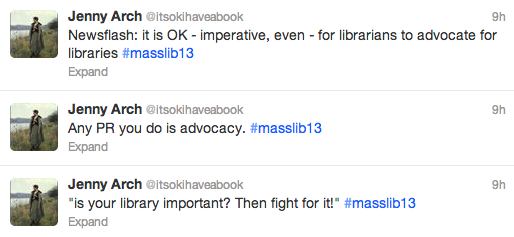
Eric and John talked about legislative breakfasts, usually held annually, and the importance of attending them, getting to know your local legislators in an informal context. Libraries can also host legislative breakfasts, and are definitely a great place for photo ops. Participation can’t be just once, though; it should be ongoing, to build a relationship: “Legislators are people too. They work for us and they are part of our community.” Librarians, of course, know that libraries are important, but not everyone knows that, and librarians can be unwilling to stand up and be loud. “Is your library important? Then fight for it! …Fighting for libraries is good citizenship.”

As public employees, librarians can’t ask or tell patrons who to vote for in local elections, or how to vote on an override, but they can provide balanced information about the issues. The Massachusetts Trial Court Law Libraries are a good resource for those who want to get involved but are afraid of crossing a legal line. Not all advocacy is political, though; any PR is advocacy, from newsletters to photo ops to social media to special events at the library. “It’s not just gonna happen by itself.”

advocacytweets2


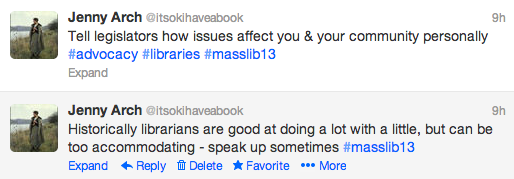
John spoke about three branch libraries closing in Springfield, and how public support brought them back. “Libraries are, in some ways, an equalizer,” he said, and Springfield patrons showed that their library was important to their community. Eric shared a story from Greenfield, where a new mayor made a particularly egregious comment about libraries and within two days the community mobilized and marched on city hall [could not find news article to link to]. He also joined the fight when the high school was considering cutting its librarian position. “Tell legislators how issues affect you personally,” he said. And don’t wait for a crisis to talk to legislators; they’re more likely to listen if you have a relationship already in place. “Anticipate the questions so you have the answers” when you talk to them.

Another part of advocacy is making sure the library has a positive image with the public. “Points of friction” may include late fees or other customer service issues; consider how your library staff handles these.

MLA logo

All that was just before lunch on Day One. More to come in the next post, where I’ll write about “Library Services and the Future of the Catalog: Lessons from Recent ILS Upgrades” and “Loaning eReaders to the Public: Legal and Strategic Challenges.” For now, you can check out the highlights on Twitter by searching for #mla13 or #masslib13.