
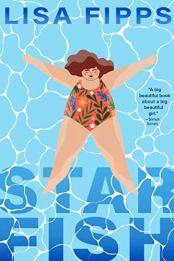
 Big thanks to the children’s librarians at the Newton Free Library for organizing, promoting, hosting, and moderating a delightful virtual author visit with Lisa Fipps, author of the novel in verse Starfish, a Printz honor book. Lisa was incredibly friendly and personable, doing only a short introduction before answering tons of questions from the Newton Free Library book club and other attendees.
Some snippets:
- On the writing process: Lisa sees “movie trailers in my head”
- On autobiographical fiction: Ellie got “the watered down story of my life” with authentic emotions
- To those who say “things like that would never happen”: “They do.”
- On growing up without seeing herself in books: “I didn’t know anybody like me” (#RepresentationMatters)
- On wanting to make post-publication changes: “I don’t know any writer who doesn’t look back on a book” and want to change something. Lisa didn’t read Starfish until six months after it was published, and while there are small things she would change if she could, “I’m okay with it.”
- On how to get published: “First you have to write the story.” Then find an agent (hers is Liza Boyce), who will help you find an editor (hers is Nancy Paulsen).
- Will there be a sequel or prequel? The Printz committee asked this too! Not sure.
- On future books: Nancy is editing book number two now, and Lisa is writing book number three.
- How long does it take you to write a book? Starfish took eight months, the next book took six. Lisa is trying to write 2-3 books a year; “I want to be a full-time author and you need to write a lot to make that happen.” (Currently she works at the Kokomo-Howard County Public Library in Indiana)
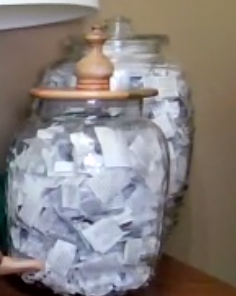
- On that stuff on the table behind you: the penguin collection is because Nancy Paulsen’s imprint is part of Penguin Random House (which at least two librarians agree should have been called Random Penguin when they merged). The “inspiration jars” (see photo) are full of good reviews, fan letters, kind words, etc. That’s a lot of warm fuzzies!
- On the role of music in writing: Lisa creates a playlist for every book she writes, to get into the characters’ heads; when actually writing, she listens to music with no lyrics.
- How have family members responded to Starfish? “I have no idea, I’m estranged from my [biological] family” (except for a nephew); “I have families of choice.”
- Advice for young writers? Write. And read a lot. “I try to read 3-5 books a week.”
- What time of day do you write? Evenings after work, with marathon writing sessions (8-10 hours!) on weekends.
- Do you read other novels in verse? Yes! The first one she read was Stop Pretending by Sonya Sones. “I think verse is a way to tell a powerful story in a short amount of words.”
- On Ann Patchett’s advice to read your work aloud to yourself: “You will hear any clunkiness in your writing like that.” Lisa even recommends doing this while wearing foam earplugs.
- On the therapist character in Starfish: Lisa used the wisdom of therapists mixed with the personality of a critique partner. (Readers loved Ellie’s therapist. Librarian Ms. Bery included Starfish in her list of books that normalize therapy.)
- On Catalina’s character: Catalina is a “composite character” (bits and pieces of different people).
Thank you so much, Lisa Fipps and Newton Free Library!
 But Taylor makes a good point about fantasy being important “now more than ever.” I went looking for the full text of her Printz honor speech and couldn’t find it (let me know if you can!), but I did find
  Jenny Arch