This morning was my last Step Into Storytime of the year! (I actually didn’t realize this until the end, when someone asked if there was going to be one next week, and I ran to check the calendar.) We started with seven or eight kids and ended up with about twelve, I think, plus a couple of babies.
Welcome and announcements (this is where I should have mentioned that there wasn’t going to be a storytime the next two Mondays)
“Hello Friends” song with ASL
Name song (“____ is here today, ____ is here today, let’s all clap our hands, ____ is here today”)
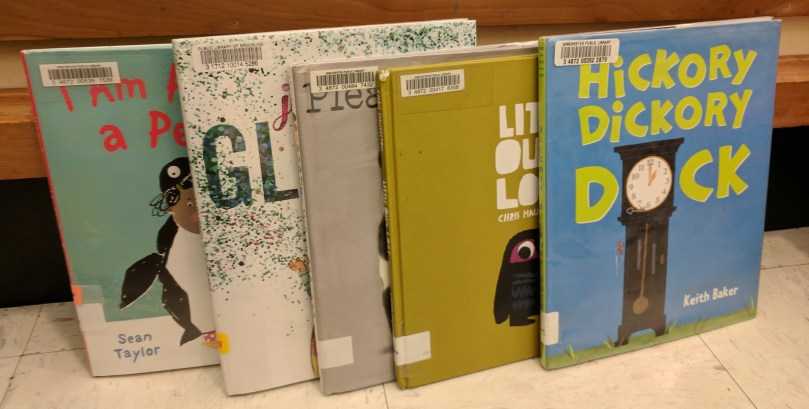
I Am Actually A Penguin by Sean Taylor, illustrated by Kasia Matyjaszek: Putting the longest book first in the set worked! The kids were pretty quiet and attentive and the grown-ups definitely enjoyed it. There is something to be said for getting the grown-ups’ engagement during storytime; it’s best if everyone enjoys the program.
“Head, Shoulders, Knees, and Toes”
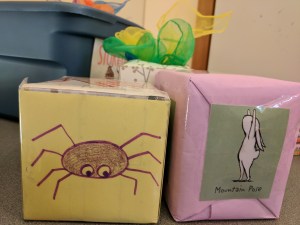
Yoga cube
Just Add Glitter by Angela DiTerlizzi and Samantha Cotterill: I encountered this one in a storytime for three- to five-year-olds and thought it could work for the younger kiddos also – and it did! (We did NOT do a related craft program.)
Song cube: “If You’re Happy and You Know It”
Please, Mr. Panda by Steve Antony
Yoga cube
Little Owl Lost by Chris Haughton
Song cube: “I’m A Little Teapot”
Hickory Dickory Dock by Keith Baker: I asked the kids to make the animal noises on the appropriate pages (pig, horse, etc.) and they are so good at that.
Yoga cube
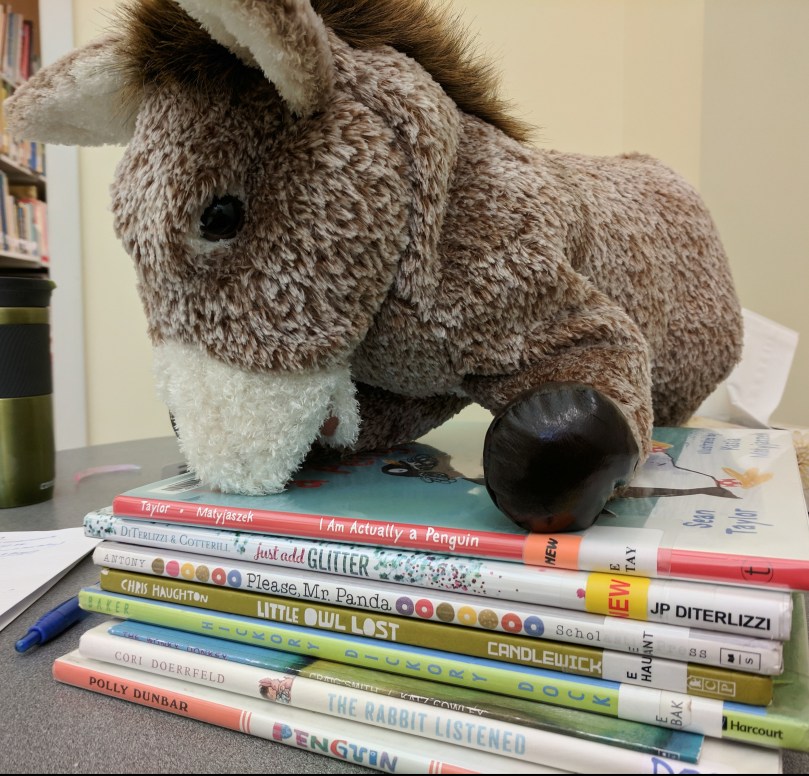
The Wonkey Donkey by Craig Smith, illustrated by Katz Cowley. (This one is so in demand in our library system right now that I bought my own copy.) We have a donkey hand puppet that I bring out as well, and the kids get to come up and pet it both before and after the book. And make the “hee-haw” sounds, of course! Lots of sound effects today.
Song cube: “ABCs,” “Itsy-Bitsy Spider,” “Zoom Zoom Zoom, We’re Going to the Moon”
Storytime this morning was incident-free! We had about twelve kids in the target age range to start, with a few more joining throughout, and some younger siblings, for maybe 17 kids altogether.
Hello friends song with ASL
Name song (“___ is here today, ___ is here today, let’s all clap our hands, ___ is here today”)
Want to Play Trucks? by Ann Stott, illustrated by Bob Graham: A librarian friend of mine read this in her storytime for 3- to 5-year-olds, and I thought it could work as a lead-off book for 2- and 3-year olds too – and it did! It’s the perfect example of “find a way to play together”; the kids resolve their differences simply and easily, without much fuss, and it ends with ice cream, which everyone can agree on.
“Head, Shoulders, Knees, and Toes” to warm up for…
…yoga cube! (3 poses)
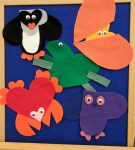
My Heart Is Like A Zoo by Michael Hall, with flannel board animals. I asked the kids to raise their hands (or wave, or point) when one of the animals in the book matched one of the ones on the flannel board (I have the crab, clam, penguin, owl, and frog).
Song cube: “I’m A Little Teapot”
Chu’s Day by Neil Gaiman, illustrated by Adam Rex: This one is always fun to read aloud because of the sneezes. This time I stretched the “Achoooo” all the way into the “Oops” (there are two wordless pages in between).
Yoga cube (three poses)
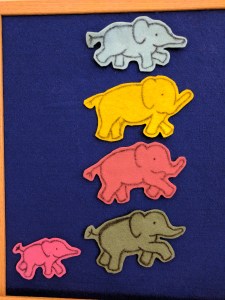
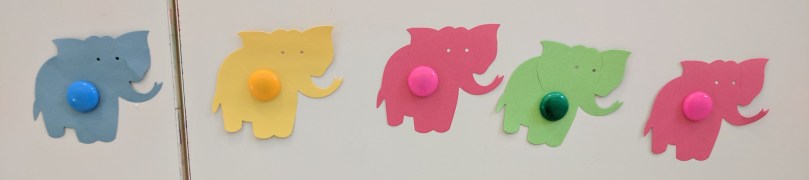
A Parade of Elephants by Kevin Henkes, with flannel elephants. I had five volunteers to put the elephants on the board (and one to take them down). We also did some marching, parading, stretching, and a related activity later.
Song cube: “If You’re Happy and You Know It” (ending with “If you’re happy and you know it, sit back down…”)
Where, Bear? by Sophy Henn: I encouraged them to say the repeated line “Where, Bear?” along with me.
Yoga cube (three poses)
The Steves by Morag Hood: This one is so funny.
Song cube: “ABCs”
Poems by Shel Silverstein (“Hug-O-War,” “Early Bird,” and “Pancake?”): These didn’t seem to go over as well as I remember from the last time I did them, but at least they’re short.
Back to elephants! I passed out die-cut paper elephants in red, yellow, green, and blue, and sang “If you’re holding [color] today, [color] today, [color] today, if you’re holding [color] today, jump up and shout hooray!” The kids seemed into the song but not the jumping up; could be that if we repeated it for a few weeks, they’d become more familiar with it and more enthusiastic. The paper elephants aren’t even necessary, as we sit on colored mats, and I made sure we only had red, yellow, green, and blue ones today. I gave the kids the choice to keep their paper elephants or return them, and most of the kids returned them; one tried to stick hers to the flannel board.
Goodbye friends song with ASL
Asked them to come put mats away in piles according to color. Not totally successful, but they did all bring their mats up front, which is something!
Kirkus has been doing its “best of 2018” lists; here is the list for picture books. Not all of these are right for storytime, or right for two- or three-year-olds, but plenty are. Have a look – and, if you’re like me, you’ll feel the need to place about a dozen requests to the library. Happy reading!
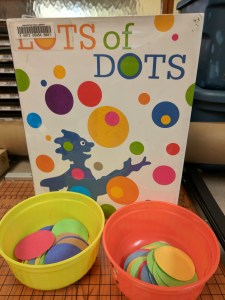
11/30/18: I covered an extra storytime this week, for the same age group (2-3 years) and some of the same kids. Because I wasn’t sure who would show up, I chose some of my favorite books that have been successful at storytime before, as well as a craft that has been popular in the past (and that is quick and easy to prepare, especially if you happen to have an extra-large “squeeze punch,” which is a giant hole punch that cuts out circles; ours is made by Fiskars).
Welcome, introduction, announcements, putting up early literacy tips
Hello Friends song with ASL
Name song (“____ is here today”)
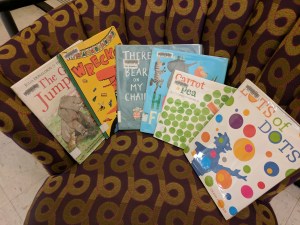
The Giant Jumperee by Julia Donaldson, illustrated by Helen Oxenbury
Song cube: “Zoom zoom zoom, we’re going to the moon”
Tyrannosaurus Wrecks by Sudipta Bardhan-Quallen, illustrated by Zacahriah Ohora (I meant to hand out scarves before this book, but forgot until a few pages in, so I paused and handed them out in the middle, so the kids could wave them on the word “wrecks”)
Yoga cube (three poses)
There’s A Bear on My Chair by Ross Collins
Song cube: “I’m a Little Teapot”
Hooray for Hat by Brian Won
Yoga cube (three poses)
Carrot and Pea by Morag Hood (foreshadowing: asked the kids what shape the peas were)
Song cube: “Itsy-bitsy Spider”
Lots of Dots by Craig Frazier (“We’ll be doing something with lots of dots later…”) When we looked around the room for dots, one observant kid noticed the round magnets holding up the early literacy tips! One grandpa also had dots on his socks.
Goodbye song with ASL
Clean up mats, set up craft (gluing colored paper dots to butcher paper)
12/3/18: Monday the weather was beautiful (sunny, spring-like, felt like 50 degrees!) and we had a HUGE group of about 20 kids plus all their grown-ups. There is some overlap between the two groups – plenty of kids come to the Monday and Friday storytimes – so I only repeated one book, There’s A Bear on My Chair. Again we skipped the name song as there were at least twelve kids at the beginning of storytime, and more showed up throughout.
Welcome and announcements
Hello song with ASL
Nanette’s Baguette by Mo Willems
“Head, Shoulders, Knees, and Toes”
Yoga cube (three poses)
A Greyhound, A Groundhog by Emily Jenkins, illustrated by Chris Appelhans
Song cube: “I’m A Little Teapot”
Cub’s Big World by Sarah L. Thomson, illustrated by Joe Cepeda: I wasn’t sure how this one would go over as it is a fair amount of text and not a lot of humor, but it went fairly well.
“Twinkle Twinkle Little Star”
Yoga cube (three poses)
Grumpy Pants by Claire Messer – always a favorite
Song cube: “I Had A Little Turtle”
There’s A Bear on My Chair by Ross Collins
Song cube: “ABCs”
A Parade of Elephants by Kevin Henkes: I cut out five elephants so we could put them up on the whiteboard with magnets on the counting page, and the kids helped tell me which color elephant came next. Then we marched in place, then marched “round” in a “parade.” There is so much to do with this book! I’m working on felt elephants so kids can put them on the flannel board.
Meant to read three Shel Silverstein poems, but forgot
Goodbye song with ASL
Clean up mats, put on music (“The Wheels on the Bus” was specifically requested”) and dance with bubbles!
Toddlers dancing to music with bubbles closely resemble a mosh pit, so it was a small miracle that when one of the littler kids vomited, no one was hit or splattered – the kid found the only clear patch of floor and aimed there. Hurrah! (If you ever want to clear out a storytime room rapidly, this is a surefire way.) The kid had good timing, too, waiting until the very end of the storytime/dance party. Well done, kiddo, and feel better.
So that was an exciting end to the program, but even throughout, it was pretty boisterous. I used as many calming and quieting techniques as I could think of, from singing “Twinkle Twinkle” to doing resting pose from the yoga cube, to anything we could all do together, like stomping our feet during Grumpy Pants; then it’s not exactly quiet, but everyone is making the same kind of noise, so it’s less chaotic. What are your favorite techniques to settle a big group?
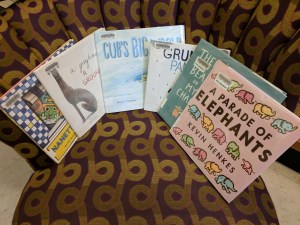
Nanette’s Baguette, A Greyhound A Groundhog, Cub’s Big World, Grumpy Pants, There’s A Bear On My Chair, A Parade of Elephants
Post-Thanksgiving, we had a big group again, with more than ten kids (plus baby siblings) at the beginning of our Step Into Storytime program for 2- and 3-year-olds. Given these numbers, we skipped the name song that we often sing after the hello song if there are fewer than ten kids.
I started off with a long-ish book, Toys Meet Snow by Emily Jenkins, because it’s one of my favorites and because we did have snow recently (and our craft was to do with snowflakes). It went okay, but may be better for a preschool group. The favorites today were (I think) Oh No, George! and Monkey and Me.
Snowflake craft: White butcher paper taped to the floor, die-cut snowflakes in light blue and dark blue, glue sticks, blue/purple/white/silver crayons, blue and gray markers. Nine kids stayed for the craft and a few stayed for a long time!
I had thought about reading Cub’s Big World after Toys Meet Snow, but I think I’ll save that for next week’s lead-off book, especially if we have snow between now and then. They All Saw A Cat and A Greyhound, A Groundhog are on deck too. Often the most successful books are the ones with some humor in them (like The Wonky Donkey and Grumpy Pants from last week). Do you have any favorite funny books for this age group? Please share!
It was a cold rainy Monday the week of Thanksgiving, so attendance was a little sparse, but we had five kids in our target age range, plus two baby siblings, and we had a great time! I introduced my new creation this week: a yoga cube, made from the illustrations in the endpapers of Yoga Bunny by Brian Russo. I showed the book but didn’t read it, explaining that it’s a little long for two-year-olds. We tried out the yoga cube and it went really well – I brought it out three times during storytime and we did about three poses each time.
I also lucked out and found a big donkey puppet in the closet, so I used that to accompany my lead-off book, The Wonky Donkey by Craig Smith. Hee haw!
Hello song with ASL
Name song (including the grown-ups, as we only had six total bodies in the room at the beginning)
The Wonky Donkey by Craig Smith, with puppet. Definitely made at least one parent giggle.
Introduced the yoga cube and did three poses together
Grumpy Pants by Claire Messer: this one is a hit every time. It is just the right length for a group of 2-3-year-olds, and just the right concept too – sometimes you can be grumpy for no reason and just need a bath to cheer you up. (A nice cold bath, in Penguin’s case.)
Song cube: “If You’re Happy and You Know It, Clap Your Hands”
Carrot and Pea by Morag Hood: Another perfect book for this group, and a nice friendship story that emphasizes how difference can be good.
Yoga cube
I Feel Teal by Lauren Rille: I love this book, and it seemed to go over okay, but it may be that this age group doesn’t quite get linking colors and moods, they are still too literal (“I’m wearing green!”)
Song cube: ABC song
88 Instruments by Chris Barton: I hadn’t planned to include this one, it was one of my backup books, but the kids in I Feel Teal play musical instruments on one page of that story so my storytime kids got excited about that too. I pulled the jingly things out of the closet and we made some noise! The jinglers aren’t especially loud, which is good, because there aren’t good prompts built into the book to tell you when to make noise (you could jingle at every page turn, though).
Song cube: “Zoom Zoom Zoom, We’re Going to the Moon”
My Heart Is Like A Zoo by Michael Hall, with flannel board. I pointed to the flannel animals before starting the book and asked the kids to point or raise their hands when one of our flannel friends showed up in the book. It worked – with help from grown-ups.
Yoga cube
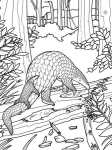
Roly Poly Pangolin by Anna Dewdney: This is a cute story about an unusual animal overcoming his shyness and making friends, plus it comes with a coloring sheet, so that’s what we did for our activity.
Goodbye song with ASL
Clean up mats, pass out coloring sheets, set out bowls of crayons
Toward the end of last year (November 17, 2017, to be exact), I posted my Top Ten list of books I had been looking forward to earlier in the year, and books I was looking forward to in 2018. Now we’re nearing the end of 2018, and it’s time to see how things went. Those who are familiar with Nick Hornby’s “Stuff I’ve Been Reading” column – or really anyone who always has a to-read list going – know that some books never quite rise to the top of the list, even if you really meant to read them, while others jump the queue. Here are the ones I was planning to read:
I Have Lost My Way by Gayle Forman (YA/new adult)
I Am, I Am, I Am by Maggie O’Farrell (memoir)
Starlings by Jo Walton (short fiction and poetry)
Fun Home by Alison Bechdel (graphic novel/memoir)
Far from the Tree by Robin Benway (YA)
Mrs. Queen Takes the Train by William Kuhn (fiction)
The Broken Earth trilogy by N.K. Jemisin (sci-fi/fantasy)
The Hate U Give by Angie Thomas (YA)
Rebecca by Daphne Du Maurier (gothic romance)
Thinking, Fast and Slow by Daniel Kahneman (nonfiction)
Hunger by Roxane Gay (memoir)
The Bear and the Nightingale by Katherine Arden (fantasy)
Walking Home by Simon Armitage (nonfiction/memoir/poetry)
Transcription by Kate Atkinson
I’ve done pretty well with this list, even with queue-jumpers; the only ones I haven’t read (yet!) are Mrs. Queen, Daniel Kahneman, Roxane Gay, and Walking Home. Of the rest, I really enjoyed them all, but Jemisin’s trilogy was particularly outstanding for its world-building, character development, and storytelling structure/perspective, and Transcription was incredible as well; when Kate Atkinson observes that “The mark of a good agent is when you have no idea which side they’re on,” file that away for later. And Maggie O’Farrell continues to amaze me; I’ll read anything she writes.
Re-reading: I used to love re-reading, but when I started working in publishing and then in libraries, there were always so many enticing new books I didn’t re-read the ones I liked nearly as often as I used to. This fall I’ve made more time for re-reading, including the Harry Potter series (I’ve re-read the first six since the end of August). I plan to re-read the seventh, and maybe The Cursed Child as well. I’m also planning to re-read The Princess Bride (that was on my mental list for November/December even before the sad news that Bill Goldman passed away). And December wouldn’t be quite complete without re-reading Greenglass House by Kate Milford, though maybe this year I’ll re-read Ghosts of Greenglass House or Bluecrowne by her instead.
Community Reads: In addition to continuing to serve on the Arlington Reads Together committee, I’ve been drafted to be on the Winchester Reads committee, which means I have a nice new stack of books to read before our next meeting in February; I’m not sure if our shortlist is public knowledge yet so I won’t say what those titles are, but there are some strong candidates and I’m looking forward to starting them…after I finish S. Morgenstern’s classic tale of true love and high adventure.
2019: It looks like Nick Laird’s new poetry collection will be out next summer. I’m also hoping for the next Book of Dust by Philip Pullman, and Audrey Niffenegger’s sequel to The Time Traveler’s Wife. I’m sure there are plenty of other books to look forward to – what’s on your radar for next year?
It was a rather dreary 50-degree morning and storytime was packed! There were at least 15 kids in the 2-3-year range, plus several younger siblings, including babies. We skipped the name song, but along with announcements, I pointed out the five early literacy practices that I always put up on the board – Read, Talk, Sing, Play, Write – and reminded caregivers and parents that doing those five things every day build the skills that will help kids learn to read.
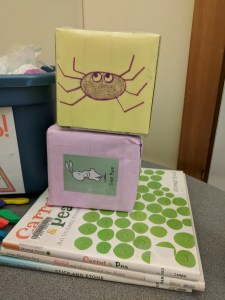
Song cube atop today’s stack of books
Hello song with ASL
Sam and Dave Dig A Hole by Mac Barnett and Jon Klassen: This went over okay, but I think it’s a better one-on-one book, or maybe a better read-aloud for the preschool group. The illustrations are a bit subtle from a distance.
Song cube: “I Had A Little Turtle” – We had a lot of littler ones this time, and grown-ups were great about chiming in and singing.
Where’s My Teddy? by Jez Alborough: This was a bit better, and I had a prop, thanks to a toddler who dragged in one of our larger stuffed bears.
“Head, Shoulders, Knees, and Toes” – Very good! Every kid knew the song and did the motions as best they could.
Handed out scarves for Have You Seen Elephant? by David Barrow, which has a hide-and-seek element. Again, this one might have been better for a slightly older group; it’s very good one-on-one, as the elephant is usually pretty obvious and the kids have fun pointing it out in each picture. Collected scarves.
Song cube: “Zoom Zoom Zoom, We’re Going to the Moon” – at least one kid was super excited about this song. I do it twice, in case it’s unfamiliar to anyone and they miss the countdown/blastoff bit at the end the first time through.
Thank YouBear by Greg Foley: Simple, sweet, and just right for this group today. Bear finds a box that he wants to give to his friend Mouse, which makes it a great segue into…
Not A Box by Antoinette Portis: Also just right for this group! Someone checked it out after storytime. (I always put all the books I read to the side so people can check them out afterward.)
Song cube: “I’m A Little Teapot”
One Pup’s Up by Marsha Wilson Chall and Henry Cole
Wow! Said the Owl by Tim Hopgood: This one is short and lends itself to being read with plenty of expression; it was pretty well received and a good one to end on.
Goodbye song with ASL
Clean up mats, put on music, dance in bubbles!
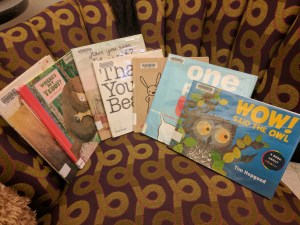
Sam and Dave, Where’s My Teddy?, Have You Seen Elephant?, Thank You Bear, Not A Box, One Pup’s Up, Wow! Said the Owl
Next week we’re closed on Monday for Veterans’ Day, and I’m hoping that by the week after that I’ll have my yoga cube ready to go so we can do some yoga poses in storytime. I also want to make sure I have a more diverse batch of books next time; I try to keep a 50/50 gender balance but today’s books were more by male authors.
Tuesday, 9am: ALA President Loida Garcia-Febo’s “Big Ideas” Talk: “Libraries = Strong Communities”
ALA President Loida Garcia-Febo’s speech put libraries at the center of their communities, and gave examples of the many different ways libraries serve their communities, from the usual (“When it comes to connecting people to information, librarians do it better than anyone…We promote reading, lifelong learning skills, equal access to information for ALL”) to the unusual (one library has partnered with a hospital so that every time a baby is born there, the mother can push a button and a gong rings in the library to announce the birth).
Garcia-Febo showed a slide of the text of Article 19 of the United Nations’ Universal Declaration of Human Rights: “Everyone has the right to freedom of opinion and expression; this right includes freedom to hold opinions without interference and to seek, receive and impart information and ideas through any media and regardless of frontiers.” She said, “Access to information is at the core of what librarians do” – and access to information leads to education, citizen engagement, and empowerment….Libraries play a critical role in leveling the playing field.”
She concluded, “We are all creating the library of the future every day. We need to continue working with community members and local organizations….Libraries are the cornerstones of democracy….Information is a human right.”
Additional resources with links, and tweets below:
Tuesday, 11am: Free Speech & Libraries, Edward Fitzpatrick
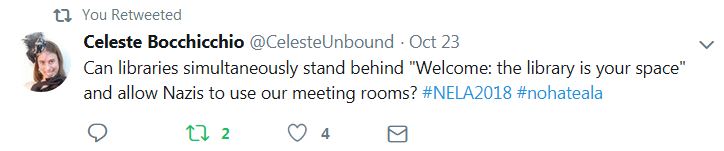
Much of the content of Ed Fitzpatrick’s talk can be found in his October 2017 Providence Journal article, “Nation needs First Amendment refresher course.” The roomful of librarians (unsurprisingly) did much better than the national average at identifying the five freedoms protected by the First Amendment, and after the talk there was some articulate pushback on the pithy idea that “The best answer to hate speech is great speech.”
A particular dilemma faced in libraries centers around our public meeting rooms. If they are open to all, does that mean we must allow hate groups such as the KKK to use them? A July 2018 feature in School Library Journal, updated with comments by Jamie LaRue and a sidebar by Martin Gardnar, “Free Speech Debate Erupts with ALA’s Inclusion of Hate Groups in Revision of Bill of Rights Interpretation,” summarizes the issue neatly. In short, the ALA’s answer is yes. (So is Ed Fitzpatrick’s: ““When you’re a public library, you’re committed to that public experiment…It doesn’t mean the library is supporting or welcoming these groups or advocating for them.”) But there are other things libraries can do to show that we don’t agree with hate speech or hate groups. However, no matter how inclusive our collections, how welcoming our displays, or how diverse our events, patrons who are the target of such hate groups may well feel threatened and unsafe in the library.
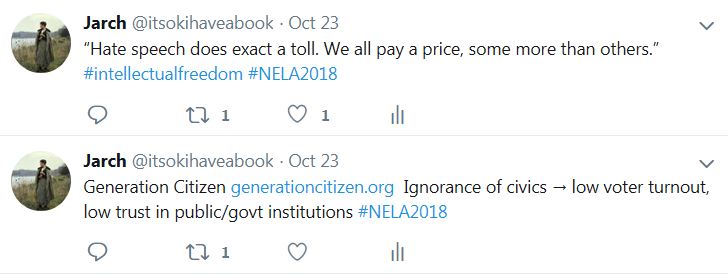
Fitzpatrick cited two books repeatedly, both by Anthony Lewis: Gideon’s Trumpet (1964) and Freedom for the Thought We Hate (2007). Even as he defended free speech, including hate speech, he admitted, “Hate speech does exact a toll. We all pay a price, some more than others….Such freedom carries a real cost.” Fitzpatrick, a white man, may not bear as much of that cost as others in our society.
Tuesday lunch: Gregory Maguire
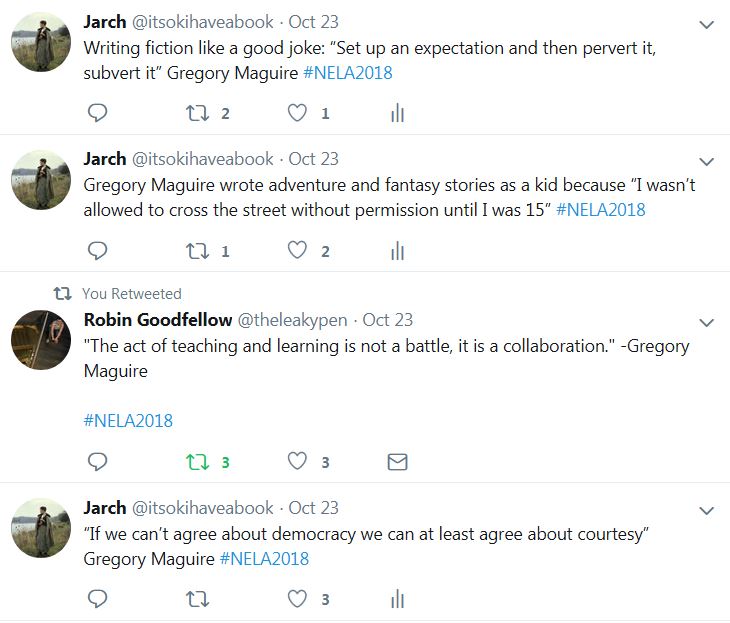
The author of Wicked (the book the Broadway show was based on) and many, many other books for children, teens, and adults spoke during Tuesday’s lunch, and he was an amusing and engaging speaker. I hadn’t known much about his childhood, or all the picture books he wrote, and I may dip into one of his more recent novels (After Alice) – it’s been a long time since I read Wicked or tried (but didn’t finish) Confessions of an Ugly Stepsister. Here are some tweets from the talk:
Tuesday, 2:30pm: Ignite!
The “Ignite!” sessions are quick, five-minute presentations on various topics:
“Time Travel Toolkit: Historical Maker Activities for Modern Kids,” Elise Petrarca, Youth Services Librarian, Cranston PL: Attendance at kids’ technology programs (like 3D printing and coding) was dropping off, so Petrarca used her background in history to come up with a new series of programs, branded “Time Travel Toolkit,” featuring stories and crafts related to a particular time period. Open to kids in grades 3-8, the goals of the program were to provide a unique, hands-on experience around an era of history, and to engage kids so they have fun and learn a little bit. It was a success, with the older kids helping the younger ones. The most popular activities were bread baking and butter churning (nor surprising, if they got to eat their creations…).
Sue Sullivan talked about ArtWeek (#ArtWeekMA); many ArtWeek events take place in collaboration with Massachusetts libraries.
“Collapse & Rebirth: Librarians as Architects of a New Humanity,” Madeleine Charney, UMass Amherst: Charney talked about hosting discussions on climate change, using the World Cafe dialogue model. She also recommended the book Emergent Strategy: shaping change, shaping worlds by Adrienne Maree Brown.
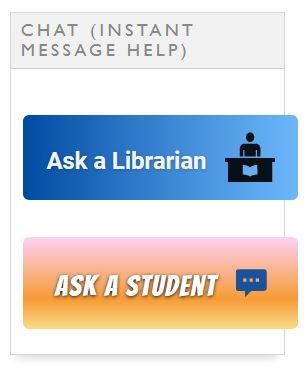
Johnson & Wales University library chat options
Four presenters from Johnson & Wales University presented “Who’s Got Your Back? Empowering Student Chat Ambassadors”: J&W librarians talked about training student employees to answer chat questions, and the results of their training.
“Touchscreen Digital Displays to Showcase Local History at the Watertown Free Public Library,” Brita Zitin: Zitin spoke about how they had made local history more accessible to library users in Watertown by placing touchscreens throughout the building. Using the software Intuiface, they made an interactive historical map, partnered with their local history society to make biographies of local historical figures, and – always popular – made features from high school yearbooks (such as guessing the decade from the hairstyle).
“From Reference Desk to Genius Bar, Public Libraries of Brookline” Callan Bignoli: Bignoli spoke about rethinking how library staff offers tech help at the (very busy) Brookline Public Library. In addition to one-on-one tech appointments, patrons can now come during drop-in tech help sessions, “Lunch and learn” sessions, and use LibChat reference. Bignoli’s advice if you’re rethinking how you offer tech help at your library:
Make sure staff are prepared – not for everything, but for many things.
Think about who’s coming in (and when). What are they asking you for help with?
Meet people where they are.
Try to get them what they came for. Does the format fit the person/topic? (Class, drop-in, 1-on-1)
Finally, Anna Mickelson from the Springfield City Library and Alene Moroni from the Forbes Library in Northampton presented “Weed This, Not That.” (Aside: I just noticed that the Springfield City Library’s tag line is “All Yours, Just Ask,” which is brilliant.) Their rapid-fire presentation included two case studies with before-and-after pictures (Before: crammed shelves. After: shelves with plenty of space for face-out titles, and no books too high to reach or so low they’re on the ground). When there’s “too much stuff” on the shelf, “people can’t find what they need. Find a reason to keep something not a reason to get rid of it.” Weed in accordance with library mission, space, etc. Different methods include item-by-item, “dusty” lists (low/no circulation in last __ years), and at the shelf (e.g. pulling books that have obvious problems like torn covers, water damage, or appallingly out-of-date information). Use professional discretion; you can do things like keeping series while getting rid of years-old “incandescent debuts,” and keep the inclusive, diverse books (put them on display!) and “get rid of the old white guys.”
Are you excited to weed, but need some talking points to convince others in your library? Weeding makes room for new items, seating areas, welcoming spaces, display opportunities, and it increases circulation. After all, “Do you still have every pair of shoes you’ve ever bought?”
All in all, a fantastic conference experience. Thank you to all the presenters, NELA and RILA, and the staff of the Crown Plaza in Warwick – professional, courteous, and unflustered in the face of fire alarms.
The New England Library Association (NELA) annual conference was in Warwick, Rhode Island this year, and it was a fantastic conference; all of the sessions I attended were worthwhile, and I saw lots of activity on Twitter (#NELA2018) to indicate that many other sessions were generating a lot of excitement as well. To top it off, the food was good, and the room temperature resembled neither saunas nor igloos. Well done, Rhode Island! Now, on to the sessions:
Monday, 9am: Finding Appeal Factors: Or What I’ve Learned from Being Twitter’s Resident Reader’s Advisory Specialist by Margaret Willison (@MrsFridayNext)
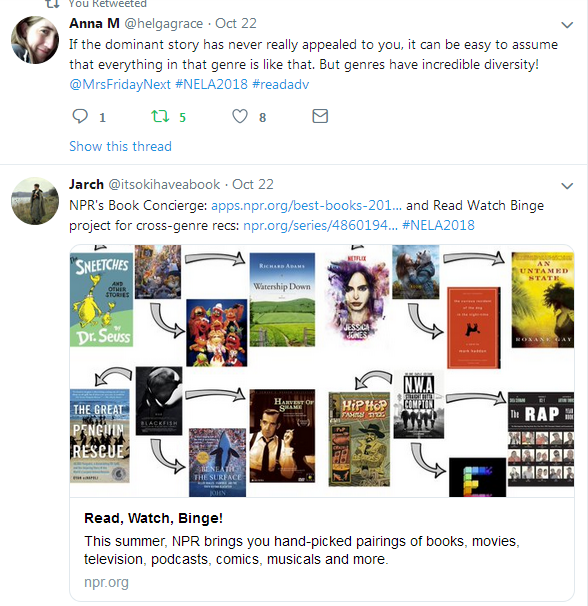
Willison had spoken the evening before about debunking the myth that “smart people like smart things and dumb people like dumb things.” Her presentation Monday morning was two-pronged: (1) how to learn to like what you don’t like (e.g. how to recommend horror if you don’t read/watch horror), and (2) cross-format recommendations (e.g. “I just watched ___, what should I read next?”). She talked about the need to step outside your natural tastes and build enthusiasm/information for other things; a great way to do this is to ask an articulate friend, and have them explain why they like what they like (not why you should like what they like). By discovering the appeal factors, you can build a common ground and work back. After all, “Just because something isn’t your cup of tea doesn’t mean you can’t understand why someone else likes it.”
Willison did a live example with an audience member who reads the Jack Reacher books by Lee Child, finding out the appeal factors, making a “wrong” recommendation (a series of books that matched in character and content, but differed in tone). This can be done for music and movies as well as for books, and that’s where cross-format recommendations come in. See, for example, NPR’s Read, Watch, Binge series (and while you’re at it, check out their incredible Book Concierge tool, which they make annually; here’s 2017). Other resources are Goodreads, Smart Bitches, Trashy Books and The Ripped Bodice (for romance), The Criminal Element and Stop, You’re Killing Me! (for mysteries and thrillers), and the publisher TOR (for sci-fi and fantasy).
Monday, 11:30am: Sensory Storytime at the Public Library by Babs Wells, Maria Cotto
Shifting gears from adult readers’ advisory to children’s services, I attended two librarians’ joint presentation about sensory storytimes they offer at their libraries. Sensory storytime is geared for kids on the autism spectrum or with other developmental issues, though neurotypical children are welcome. Wells and Cotto strongly encouraged anyone thinking of offering a sensory storytime to use the book Programming for Children and Teens with Autism Spectrum Disorder by Barbara Klipper, and also pointed to an ALSC blog post that serves as a brief how-to guide. It’s important to be aware of community resources as well, to partner with and to spread the word. (If you’re in Rhode Island, Massachusetts, or nearby, check out The Autism Project.)
Wells and Cotto described their usual sensory storytime, starting with registration: not required, but helpful, especially if it gives the librarian a chance to talk with the parent/caregiver beforehand about any special needs their child might have. They might also want a “social story,” a one-page handout that can help prepare the child for a new environment or event; it can be read like a picture book. Once the storytime has begun, it’s helpful to have visuals for everything, to ease transitions from one activity to another (books, bubbles, songs, activities, etc.). Starting with a hello song is a good idea; the librarian learns everyone’s names (parents too!) and can roll a ball to each kid and have them roll it back. Cotto said she always has a felt board or a puppet, and stools or mats for kids to sit on, and things for them to hold in their hands and fidget with. “These kids need something that will capture their attention, they need something in their hands, they like to participate.” She only reads one book, something like Dog’s Colorful Day by Emma Dodd or The Deep Blue Sea by Audrey Wood. “Go with the flow,” she advised – much like toddler storytime. After the organized part of sensory storytime, it’s playtime: they bring out more activities – popsicle sticks with velcro on the ends so kids can make different shapes, sensory sand, water marbles (but not together!), dried beans with little treasures kids can find and scoop into a cup. This can be a time for parents and caregivers to socialize (they shouldn’t be socializing or on phones during storytime; they should be involved. “I get in everyone’s faces!” Cotto said). Be sure to give plenty of warning when the program is wrapping up: five minutes, three, one, goodbye!
Lastly, remember: “When you meet one child with autism, you meet one child with autism.”
Monday, 12:45pm: NERTCL Lunch with author Tracey Baptiste
The New England Roundtable of Teen and Children’s Librarians (NERTCL) had their annual business meeting over lunch and then invited author Tracey Baptiste (The Jumbies, Rise of the Jumbies) to speak. She tried out a new talk on us, “Creativity Under Pressure.” Here are my tweets from the session, which was probably less polished than one she’d given many times, but definitely interesting (and mark your calendars for the third Jumbies book next year!).
Monday, 2:15pm: Fake News or Real News? Helping Our Patrons Tell Fact from Fake, by Victoria Palmatier and Lisa Lipshires, Springfield City Library
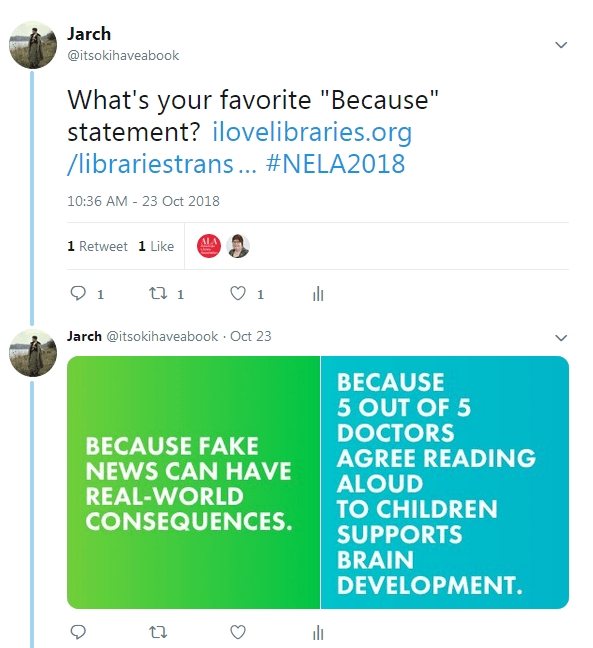
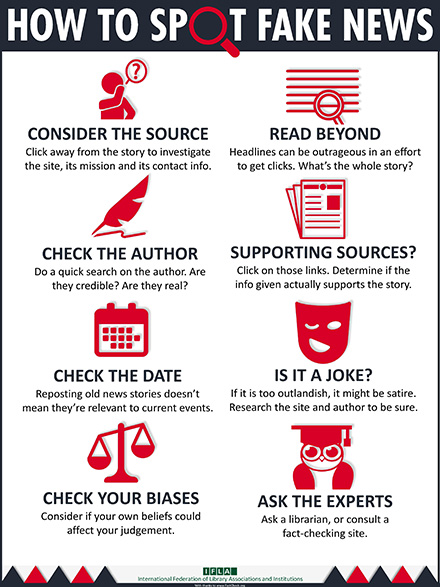
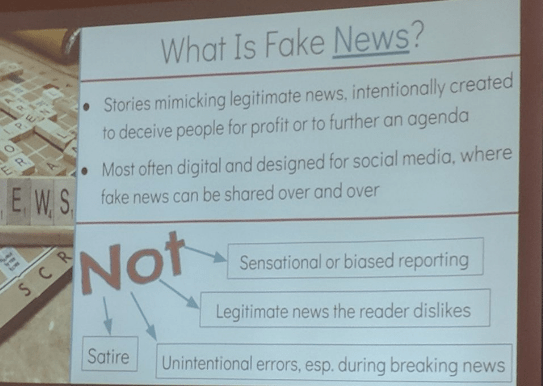
This is a topic I follow closely (See: Fake News a.k.a. Information Disorder reading list | “What is fake news?” informational handout (Creative Commons licensed) | Libraries in a Post-Truth World | Libraries in a Post-Truth World: The Conversation Continues), and the Springfield librarians’ presentation was very good, from their handout (a double-sided folded brochure called “Fake News? Real News? How to Tell Fact From Fake”) to their explanation of how they designed their workshop and what they’d do differently next time. They consulted two librarians and a journalism professor from UMass-Amherst as well as a local journalist, collected lots of resources for checking facts and photos (one I hadn’t heard of before was mediabiasfactcheck.com), suggested browser plug-ins (AdBlockPlus and Privacy Badger), and explained that in addition to checking a source’s bias, it’s necessary to check your own, especially if you’re having a strong emotional reaction to a headline.
Palmatier and Lipshires’ initial workshop was a lecture format followed by discussion, and they said that next time, they would offer a more hands-on approach in their computer lab. Another great idea they had was to have a copy of the day’s local paper for each workshop attendee, and then look at the local news online as well. They said that an in-person workshop makes the library and librarians seem approachable and legitimate, and as resources that can provide human connection in a meaningful way and make the world less confusing. (We all know we’re not going to change anyone’s mind on Facebook…)
Presenters’ slide: What is Fake News?
Monday, 4:30pm (slightly delayed due to fire alarm): Great Expectations: Leaping from High School to College, by Sarah Hunicke (Portsmouth High School), Mary C. MacDonald (University of Rhode Island), and Marianne Mirando (Westerly High School)
There is a gap between what college and university professors expect in terms of research skills and information literacy and the students’ abilities in these areas. Because this year’s high school senior is next year’s college freshman, these three presenters worked together to examine what high school librarians (and high school teachers) can do to bridge the gap. College faculty expect students to be able to: 1. determine information needed to answer questions, 2. recognize information bias, 2. distinguish scholarly vs. popular, 3. understand the publishing cycle.
“Where do our students struggle?” Practice, Process, Assessment. “Where do our instructors struggle?” Assignment design (format vs content), Process (time commitment), Additional burden (grading). The two high school librarians who were presenting wanted to help teachers integrate information literacy into their students’ assignments without greatly increasing their grading burden. They each brought an example assignment from their schools, and we split into groups to come up with ways to do just that. In one case, it was as simple as adding a section on research quality to the grading rubric, and having the students hand in an annotated bibliography early in the process. Of course, librarians can also model searching library databases and online, showing students how to broaden or narrow searches as needed, and how to use keywords instead of natural language; if students see librarians working through problems (like getting no results, or too many results), they feel more confident to work through the same problems themselves.
Some teachers may not seek librarians’ help or even accept it when it is offered; however, the idea of “coaching” is big in K-12 education right now, so one approach librarians can take is to ask teachers, “If you’re not happy with your students’ sources/bibliographies, what can we do about that?” and work together.
And that was Monday! Stay tuned for Tuesday’s sessions: the ALA President’s “Big Ideas” speech, the First Amendment in libraries, Gregory Maguire, and the Ignite sessions (quick, 5-minute presentations on different topics).
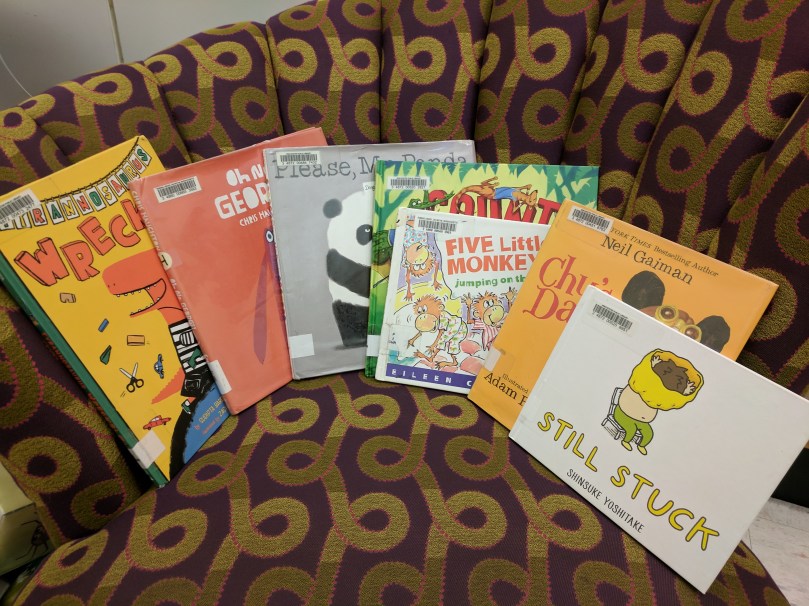
Today we had a big crowd at storytime! It was a gray fall day, so maybe the weather urged people inside, or perhaps they’re just getting back into the rhythm of the season (storytimes are a little more sporadic in the summer because of all the other programs we do). There were at least 15 kids in the 2-3 age range, plus assorted siblings and several late arrivals. In the beginning, we had more than ten but I did the name song anyway – it’s a great way to learn names and start building individual connections.
Tyrannosaurus Wrecks!, Oh No George!, Please Mr. Panda, Count the Monkeys, Five Little Monkeys, Chu’s Day, Still Stuck
“Hello Friends” song with ASL
Name song (“Hello ____, hello ___, hello ____, we’re glad you came today”)
Handed out shaker eggs for Tyrannosaurus Wrecks! by Sudipta Bardhan-Quallen, illustrated by Zachariah Ohora
Kept the shaker eggs for Oh No, George! by Chris Haughton. Collected shaker eggs after.
Song cube: ABC song
Please, Mr. Panda by Steve Antony
Song cube: “If You’re Happy and You Know It”
Five Little Monkeys Jumping On the Bed by Eileen Christelow (jumping encouraged!)
Count the Monkeys by Mac Barnett, illustrated by Kevin Cornell
Song cube: “I Had A Little Turtle”
Scarves (by audience request) for Still Stuck by Shinsuke Yoshitake. Collected scarves.
Goodbye song with ASL. Put away colored mats. Dance party with bubbles! (We have an old ipod loaded up with Raffi and Disney versions of classic kid music. And I brought my own bubbles from home because I am devoted to Pustefix bubbles.)
I skipped the flannel board and craft this week, but for next week I am thinking of a craft with paper dots and glue to go with Lots of Dots, and maybe The Very Hungry Caterpillar flannel board again…if I can make a butterfly before next Monday!


 Re-reading: I used to love re-reading, but when I started working in publishing and then in libraries, there were always so many enticing new books I didn’t re-read the ones I liked nearly as often as I used to. This fall I’ve made more time for re-reading, including the Harry Potter series (I’ve re-read the first six since the end of August). I plan to re-read the seventh, and maybe The Cursed Child as well. I’m also planning to re-read The Princess Bride (that was on my mental list for November/December even before the sad news that Bill Goldman passed away). And December wouldn’t be quite complete without re-reading Greenglass House by Kate Milford, though maybe this year I’ll re-read Ghosts of Greenglass House or Bluecrowne by her instead.