Turtles All the Way Down

Cover image of Turtles All the Way DownAza Holmes – Holmesy to her best friend, Daisy – has a mental illness, a version of OCD. More than most people, she lives in her own head, but she doesn’t feel like she has control over her thoughts; she gets into obsessive thought-spirals, during which she withdraws from her surroundings, down into her worries, fears, and compulsions – only none of those are strong enough words to communicate her experience to others. Metaphor is the best she can offer, but even metaphor falls short: “The words used to describe it – despair, fear, anxiety, obsession – do so little to communicate it. Maybe we invented metaphor as a response to pain.”

The plot, such as it is, is rather simple: Daisy convinces Aza to reconnect with an old friend from “Sad Camp,” Davis, so they can collect a reward for information on his recently disappeared billionaire father. But there’s more sadness than mystery here: Davis knows his father was a criminal and a jerk, but his younger brother Noah still hopes his father will find a way to get in touch with them. Aza and Davis do rekindle their friendship, while Daisy finds romance with fellow high school student and artist Mychal.

Climactic scenes are not related to plot, but to character: Aza going deep into a spiral; Aza and Daisy fighting; a car accident, an underground art show. The people and the relationships are the heart of the book, and it’s Aza and Daisy’s friendship that is its core. The romances fizzle, but the friendship remains – even through to adulthood, as we find out in the last few pages, which have the flavor of an epilogue even if they aren’t marked as such.

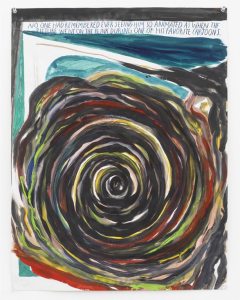
Pettibon spiral with text: No one had remembered ever seeing him so animated as when the picture went on the blink during one of his favorite cartoons.
Pettibon spiral

John Green’s hallmarks are all here: the fast-talking, articulate teens (who are more likely than the average bear to launch into enthusiastic speeches about science or art or  history), the realistic relationships with parents and other adults (Aza’s therapist, for example), frequent literary quotations, and the way that technology suffuses all the teens’ relationships, from texting and FaceTime to blogs and fanfic and Wikipedia.

But Turtles All the Way Down is a deeper dive than, for example, An Abundance of Katherines. The characters face difficult issues, and not just mental health problems, though that is the primary one for Aza; there are also tensions around money and what it means to have too much (Davis) or not enough (Daisy), and the impact of losing one or both parents.

For all Aza’s difficulty in communicating her struggle to those closest to her, Green succeeds as well as one can in bringing readers into her experience (which is also, in many ways, his own). Turtles All the Way Down met, or even exceeded, my high expectations, and I plan to read it again. The not-an-epilogue toward the end was especially touching; I teared up a little on the last page.

Additional reading: Green answers many questions from readers on this reddit thread, including an image of the Pettibon spiral (image above) that Aza appreciates at Davis’ house; he also reveals that the fast-forwarding into Aza’s adult life at the end of the novel was his wife Sarah’s idea.


Top Ten Books I read ten years ago

Once again, I’m borrowing a co-worker’s Top Ten Tuesday list to inspire my own. Hers was “Top Ten Books I read the first year I had my blog“; because my blog is not specifically a book blog, I looked to my Goodreads and LibraryThing accounts instead. I started my Goodreads account in 2007, though I didn’t start reviewing each book consistently until later.

What was I reading, then? Out of college (no more assigned reading) and into the publishing world (okay, sometimes assigned reading), bombarded with more novels than I could ever read, my reading choices fell into a few categories:

  • Contemporary fiction about which there was “buzz,” e.g. Michael Chabon’s The Yiddish Policemen’s Union, which I loved, and Ian McEwan (I tried and hated Saturday and Atonement; I liked On Chesil Beach better but decided that everyone else could just go ahead and continue loving him, but I was done).
  • Classics I didn’t read in school: No matter how good your education was, there’s no way you could read ALL the classics, but I had missed some key ones. I actually think this was for the better; I loved Pride and Prejudice much more in my early twenties than I think I would have as a teenager.
  • Nonfiction: Left to my own devices, I read barely any nonfiction for almost a year; then I realized I need to read some, so I made it a goal to read one a month. I started with a lot of memoir and biography (Audrey Hepburn, Jeannette Walls, Augusten Burroughs, Alice Sebold, Ann Patchett) and pop psychology (Malcolm Gladwell, Daniel Gilbert), but I sought out some feminist books as well, though I didn’t use that term at the time – I discovered Katha Pollitt (Learning to Drive) and read This Common Secret and The Girls Who Went Away. I caught up on classic nonfiction too, from Capote’s In Cold Blood to Joan Didion’s essays.
  • Poetry: I discovered Nick Laird’s poem “On Beauty” in Zadie Smith’s novel by the same title, and Laird’s To A Fault is still one of my favorite poetry collections.

But of course it was mostly fiction. I was just starting to separate out the authors I thought I should read from the ones I actually liked; there was some overlap, of course, but there was also Ian McEwan and Special Topics in Calamity Physics. So here’s the list part – what did I read then (mid-2007-early 2009) that I still love now?

  1. Call Me By Your Name by Andre Aciman
  2. To A Fault by Nick Laird (poetry)
  3. In the Woods and The Likeness by Tana French
  4. Ursula, Under by Ingrid Hill (I feel this one was overlooked, and I often put it on my Staff Picks shelf at the library, hoping others will discover it)
  5. The Guernsey Literary & Potato Peel Pie Society by Annie Barrows and Mary Ann Shaffer
  6. Eat, Pray, Love by Elizabeth Gilbert (the right book at the right time)
  7. The Magician’s Assistant by Ann Patchett
  8. An Exact Replica of a Figment of My Imagination by Elizabeth McCracken
  9. Magic for Beginners and Stranger Things Happen by Kelly Link
  10. Jane Eyre by Charlotte Bronte
  11. Pride and Prejudice by Jane Austen
  12. The World Without Us by Alan Weisman (nonfiction)
  13. Overture by Yael Goldstein (found this on a remainder table at the Strand; overlooked in the same way as Ursula, Under)
  14. Stardust by Neil Gaiman
  15. Touchy Subjects by Emma Donoghue

It’s more than ten. Of course it is. And this is not to be confused with my all-time Top Ten list (either the one from 2007 or the one from 2017).

What books have stayed with you over the years? Which authors do you follow faithfully, which ones have you parted ways with?


Ten Years of Reading

In the summer of 2007, I attended the Columbia Publishing Course. One of the tasks we had to complete before we started was to make a list of our ten favorite books. “My desert island, all-time, top-five” as Rob from High Fidelity would say, which means no separate lists for fiction and nonfiction, or children’s and YA and adult, just ten favorite, full stop. Naturally we all agonized over these and spent the first week discussing each other’s lists; it was a great icebreaker.

What does “favorite” mean? We each had different definitions. For me, it means I’ve read it (or listened to it) more than once. It means if I see it in a bookstore, I will reach out and touch its spine, even if I already have a copy (or more than one) at home. It means I’ve recommended it to others, probably many times.

It’s been a decade since that first list, and I wondered how different my list would look if I made it today. Which books on the original list would still be there if I made a new list? I’ve read a lot of books over these past ten years – 1,200 books is probably a low estimate – have any of them become favorites? And could I find the original list, to compare?

Turns out the answer to that last question was yes, because I may be a pack rat with a Depression-era mindset who saves kitchen string, but I am a highly organized pack rat; I found the list in less than fifteen minutes. Actually, what I found was a much longer list, divided into sections (children’s/YA and adult) with stars next to ten titles.

Favorite Books
May 26, 2007

Bridge to Terabithia by Katherine Paterson
The Face on the Milk Carton/Whatever Happened to Janie?/The Voice on the Radio by Caroline B. Cooney
The Boggart by Susan Cooper
The Bean Trees/Pigs in Heaven by Barbara Kingsolver
The Time Traveler’s Wife by Audrey Niffenegger
The Great Gatsby by F. Scott Fitzgerald
East of Eden by John Steinbeck
The Golden Compass/The Subtle Knife/The Amber Spyglass by Philip Pullman
The Brothers K by David James Duncan
Griffin & Sabine by Nick Bantock

The careful reader will notice that there are more than ten books on the list, because I used series to sneak extra ones in. I’m a little surprised at some of the books that aren’t there – A Wrinkle in Time, The Perks of Being a Wallflower – but a list of ten means tough choices.

[Note: This has been in my drafts folder for nearly a month, because I kept trying and failing to winnow my new list down to ten. But no one has set this assignment for me, and I have as much space as I like, so…fifteen it is!]

Favorite Books
Summer 2017

A Wrinkle in Time by Madeleine L’Engle
The Perks of Being A Wallflower by Stephen Chbosky
*The Golden Compass/The Subtle Knife/The Amber Spyglass by Philip Pullman
*The Bean Trees/Pigs in Heaven by Barbara Kingsolver
*Griffin & Sabine by Nick Bantock
*The Time Traveler’s Wife by Audrey Niffenegger
*The Great Gatsby by F. Scott Fitzgerald
The Magician’s Assistant by Ann Patchett
The Guernsey Literary and Potato Peel Pie Society by Annie Barrows and Mary Ann Shaffer
To A Fault by Nick Laird (poetry)
The Night Circus by Erin Morgenstern
The Likeness by Tana French
Greenglass House by Kate Milford
Station Eleven by Emily St. John Mandel
The Bone Clocks by David Mitchell

Honorable mention to Maggie O’Farrell, possibly my favorite fiction author I’ve discovered in the past few years without a book on this list.

What are your all-time favorite books? Are you made of sterner stuff than I, and able to keep your list to ten?

We Need Diverse Books

The most recent issue of Kirkus is a “diversity issue,” with about 40 pages of articles and essays that give different perspectives on diversity in literature. I’m still making my way through it, but I loved this quote from author Padma Venkatraman:

“Books are more than mere mirrors or windows; they are keys to compassion. And novels don’t just expose readers to differences, they allow readers to experience diversity. They allow us to live within another’s skin, think another’s thoughts, feel the depths of another’s soul. Novels transport, transform, and, most importantly, allow us to transcend prejudice. When we immerse ourselves in characters whose religions are different than our own, our empathy is enhanced. We move closer to embracing people of all religions.”

It reminded me a bit of the way Neil Gaiman talks about fiction (“Fiction can show you a different world. It can take you somewhere you’ve never been”), and what Caitlin Moran wrote in her essay “Alma Mater” about growing up in the library:

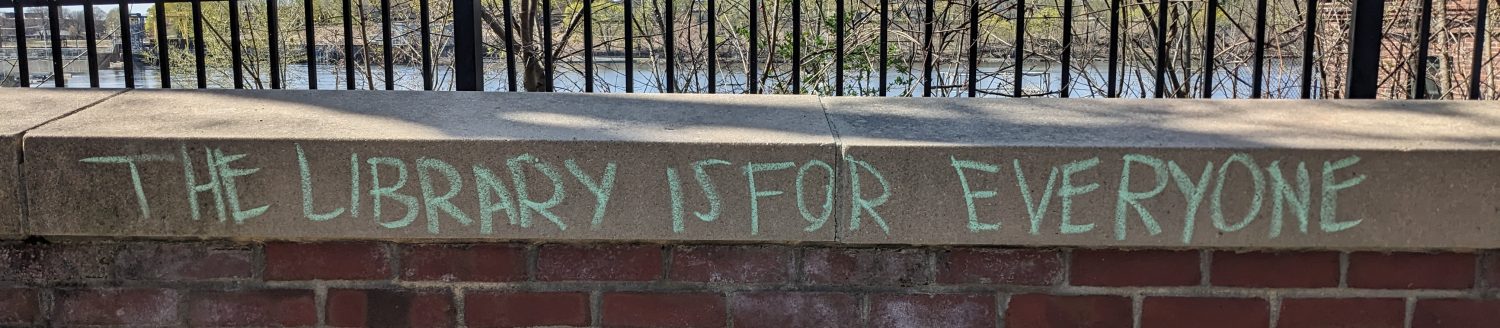
“The shelves were supposed to be loaded with books – but they were, of course, really doors….A library in the middle of a community is a cross between an emergency exit, a life raft and a festival. They are cathedrals of the mind; hospitals of the soul; theme parks of the imagination….They are the only sheltered public spaces where you are not a consumer, but a citizen instead.”

When Venkatraman writes about mirrors and windows, she is referencing Rudine Sims Bishop’s 1990 article “Mirrors, Windows, and Sliding Glass Doors.” Books that are mirrors reflect the reader’s self and own world back at them; books that are windows show the reader another person or people and world; books that are sliding glass doors allow the reader to “enter” another world.

The San Antonio Public Library page “Diversity in the Classroom: Building Your (Early Childhood) Library with Mirrors and Windows” has a video clip of Bishop from January 2015. In it, Bishop says, “Children need to see themselves reflected, but books can also be windows, so you can look through and see other worlds, and see how they match up or don’t match up to [your] own. But the sliding glass door allows you to enter that world as well, so that’s the reason diversity needs to go both ways.” She says that just as children of color need to see themselves in books, white children – who see plenty of themselves in books – need to see characters of other cultures, races, and religions as well, to provide a more accurate picture of the world as it is (“colorful”).

The #WeNeedDiverseBooks movement FAQ page cites an infographic produced by multicultural publisher Lee & Low Books (“About everyone. For everyone”), which used statistics from the Cooperative Children’s Book Center and census data. Although 37% of the U.S. population are people of color, only 10% of published children’s books contain multicultural content. Note that that includes books where the main character might not be a person of color, and it also doesn’t mean that the author was a person of color.

We Need Diverse Books virtual buttonWhere do we go from here? We need more diversity at all levels of publishing, in libraries, in schools, in the bookselling business. We need to write, publish, read, and promote diverse books; “multicultural books don’t sell” is no longer a valid argument, if it ever was. We need more stories about more different people and places. We’re getting there, but too slowly.

8/17/17 Edited to add:

As I made my way through the rest of the issue, I found two more quotes I wanted to share. The first is from Megan Dowd Lambert, an author, senior lecturer in children’s literature at Simmons, and Kirkus reviewer; she in turn is quoting Mary Robinette Kowel:

“It’s not about adding diversity for the sake of diversity, it’s about subtracting homogeneity for the sake of realism.”

Though our society is far more segregated than it ought to be, and some kids may rarely see people outside of their own race, culture, or class, the world is “colorful” and literature ought to reflect that. In fact, books are where many people encounter new ideas and perspectives and learn about the world. “Armchair traveling” isn’t just for seeing the lives of ancient royalty, dangerous mountain-climbing expeditions, or sea voyages; it may be a way to see into the next neighborhood.

“…Disability comes from scarcity and environment and other people’s prejudices as much as the body. Silencing the word can silence real injustices, emotions, and experiences. Diverse books are tools for empathy, but we can’t address what we won’t say.”

This is from Amy Robinson, children’s librarian and Kirkus reviewer. She makes an important point about environment contributing to disability. Are our built environments inclusive, or do they present barriers? (Do elevators work? Are aisles wide enough? Are there ramps or only stairs? Is signage large and clear? Are there curb cuts on sidewalks? Are sidewalks even or broken, covered in snow or cleared?) In many cases, a disability may only present extra difficulty because of obstacles in the world – in the built environment or as part of prevailing cultural and societal ideas. Let’s figure out what those obstacles are (it’s often very hard to imagine, so ask people who confront them) and start removing them.

Top Ten Tuesday: Favorite books I’ve read so far in 2017

I have yet to post one of these on a Tuesday, except by chance. Once again Linda inspired me with her list. Here are mine, listed from January (#1) to June (#10-11). Not only are there eleven instead of ten, I actually snuck (or sneaked, if you prefer) a couple extra onto the list using the “same author” justification.

  1. Waking Up White, and Finding Myself in the Story of Race by Debby Irving: This was one of the Arlington Reads Together candidates for last year, and I’m glad I finally read it – less because of the quality of writing (it was fine but not exceptional) or the format (workbook-type questions at the end of each chapter) than because of the messages about privilege, oppression, and how to work effectively for social justice. “Discrimination and privilege are flip sides of the same coin.
  2. The Wyrd Sisters and Dodger by Terry Pratchett: After years of other people indicating to me that I might really like Terry Pratchett, I read some…and I really like Terry Pratchett! The Wyrd Sisters was like Macbeth meets Oscar Wilde, and Dodger was pure fun (if you enjoy the details of the sewer system in Victorian London); I listened to the audiobook, and it was a splendid production.
  3. Talking As Fast As I Can by Lauren Graham: Having just watched the four Gilmore Girls reunion episodes, I was excited to read this, and it did not disappoint. I listened to the audiobook, which Graham reads herself of course, and it was just delightful; I was sad when it ended and wanted something just like it. (I ended up with Scrappy Little Nobody by Anna Kendrick, which was also good.)
  4. Pachinko by Min Jin Lee: A big, multi-generational novel that starts in 1910 and stretches into the late 1980s. I learned so much about Korean history, and particularly the difficult status of Koreans living in Japan (“For people like us, home doesn’t exist”).The Left-Handed Fate cover
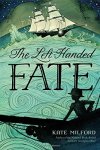
  5. The Left-Handed Fate and Bluecrowne by Kate Milford: I love Greenglass House so much and was thrilled to read a story even faintly connected. The Left-Handed Fate was a perfect historical adventure story with a touch of fantasy, and Bluecrowne provided a solid link between Fate and Greenglass. So satisfying.
  6. Pro: Reclaiming Abortion Rights by Katha Pollitt: If you’re anti-abortion, you’re unlikely to pick up this book, but if you do, it might change your mind or at least soften your position somewhat. If you’re already pro-choice, it will give you new angles to consider and strong ways to articulate your reasoning for your beliefs.
  7. The Lotterys Plus One by Emma Donoghue: I’ve read nearly all of Donoghue’s novels for adult readers, so I happily followed her into middle grade territory. The story of nine-year-old Sumac and her nontraditional (but normal to her) family celebrates diversity not by making a big deal out of it, but by making it seem like not a big deal. It’s realistic and funny and poignant.
  8. Gracious by Kelly Williams Brown: I should probably re-read this every six months or so. “There is one kind of thought that’s always useful and always gracious. That kind of thought is, “What can I do for someone else?” …This kind of thought makes the world, and you, a better place.”The Paper Menagerie cover
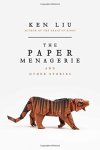
  9. The Paper Menagerie and Other Stories by Ken Liu: Someone in my book club suggested this, and I’m so glad she did. It’s long, and I had only intended to read the title story and a few others, but I read the whole thing. It’s an absolutely unique collection: stories are set in the past and future, alternative histories, on Earth and in outer space, and more. Liu has a tremendous imagination and a great gift for storytelling and character.
  10. Saints for All Occasions by J. Courtney Sullivan: This was as good as Maine, my favorite of Sullivan’s novels: a story of two sisters who come to Boston from Ireland in the 1950s, their diverging paths and stories, and how they come together again after a tragic event. Family secrets galore, and multiple perspectives, including those in the next generation.
  11. The Pearl Thief by Elizabeth Wein: I devoured this novel about pre-Code Name Verity Julie in two days. It stands alone, but having already read Code Name Verity, it was especially wonderful to see Julie brought back to life, as it were, and at home in her native Scotland. She narrates in first person, which is a different perspective than the journal entries from Verity.

Have I interested you in any of the books above? What are your favorite books that you’ve read so far this year? What books are you looking forward to?

Board books for babies and toddlers

A friend with a four-month-old recently asked me for recommendations for board books for babies – not because she couldn’t find any, but because the selection in bookstores and libraries was overwhelming. Of course, I suggested she ask booksellers and librarians, who usually know exactly what book(s) to give to kids of every age, but here is my own list:

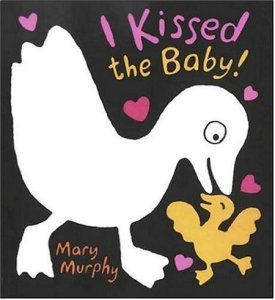
  • I Kissed the Baby by Mary MurphyI Kissed the Baby! by Mary Murphy: This is my favorite for little babies! It has the high contrast of Tana Hoban’s Black & White books, but also has repetitive, sing-song words and a touch of color.
  • Peek-a-Who? by Nina Laden: Another favorite for little babies, or kids of any age who still enjoy peek-a-boo.
  • The “That’s Not My….” series: These touch & feel books are thin on plot, but nice and tactile for when infants start reaching for the pages. They’ll start to remember where the different textures are on each page.
  • The BabyLit series: These board book versions of classics are a little silly, but a good introduction to the world of literature. We like Jabberwocky (though it’s not the complete poem), and Don Quixote, which is bilingual.
  • A Kiss Like This by Mary Murphy: Murphy’s books are sweet without being cloying. Again, this one has the repetition that kids love, and you can do the different kinds of kisses (gentle and tall, quick and small, etc.).Wow said the owl
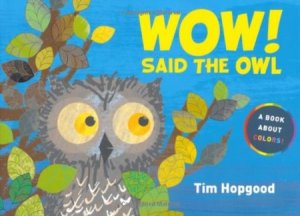
  • Wow! Said the Owl by Tim Hopgood: A little owl stays up all day and is wowed by all the colors she sees.
  • What a Wonderful World, illustrated by Tim Hopgood: Can you sing as well as Louis Armstrong? Give it a try! Or just read it.
  • Happy Hippo, Angry Duck: A Book of Moods by Sandra Boynton: Boynton is one of the queens of board books. I don’t love all of her books universally, but Happy Hippo, Angry Duck is just the right amount of goofy (and also teaches that moods change). Others of hers that I like are Hippos Go Berserk, But Not the Hippopotamus, Tickle Time, and The Belly Button Book.
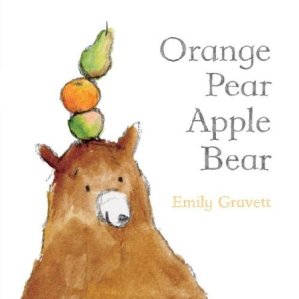
  • Orange Pear Apple Bear by Emily Gravett: Gravett’s watercolors are simple and charming. For babies who like single images on white backgrounds, this is a good choice; toddlers will enjoy the fruit and the bear.Orange Pear Apple Bear
  • I Dreamt I Was a Dinosaur by Stella Blackstone: These unique illustrations are made from felt, sequins, beads, and other craft supplies, and the text rhymes.
  • How Do Dinosaurs Say Goodnight? by Jane Yolen: A perfect rhyming goodnight book, this outlines all the bad behavior and ends with the good (“they tuck in their tails, they whisper ‘good night’…”).
  • All three of Chris Haughton’s board books: Oh No, George!, Shh…We Have A Plan, and Little Owl Lost. The first is my favorite but they all bear up well under endless repetition. The illustrations look like they were done in MS Paint, but don’t be put off.The Monster at the End of this Book
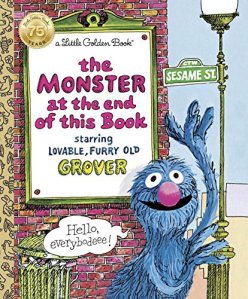
  • The Monster at the End of This Book (Sesame Street): Grover is frightened of the monster and implores the reader to STOP TURNING PAGES, taking more and more extreme measures…but it turns out the monster is not so scary after all. Great opportunity for dramatic reading here.
  • Hug by Jez Alborough: A baby monkey observes other animals hugging, then goes in search of its mommy for a hug.
  • Good Night, Gorilla by Peggy Rathmann: Should you get sick of Goodnight Moon, here’s an alternative featuring a mischievous gorilla and a clueless zookeeper.
  • Finger Worms by Herve Tullet: This book has holes in the covers and through the pages so readers can stick their fingers through to become part of the illustrations – very interactive! (Older kids will enjoy Press Here and Mix It Up by the same author.)
  • Mr. Brown Can Moo! Can You? by Dr. Seuss: Rhymes and sound effects, what could be better?
  • Dr. Seuss’s ABCs: The board book version is slightly abridged from the picture book version; both are good and include plenty of Dr. Seuss’s invented words.Chu's Day
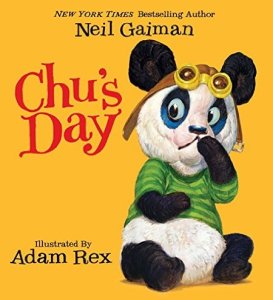
  • Chu’s Day by Neil Gaiman: This is a huge hit with my toddler (she also loves Chu’s Day at the Beach and Chu’s First Day of School). Fake sneezes are very entertaining! (See also: The Mitten by Jan Brett)
  • I Want My Hat Back and This Is Not My Hat by Jon Klassen: stories of hats stolen and retrieved, the implications are dark but babies won’t notice. Anything Jon Klassen and Mac Barnett write together is worth checking out; I love Extra Yarn.

Poems

  • My First Winnie the PoohClassic Mother Goose poems in board book form, such as The Real Mother Goose Board Book and Tomie’s Little Mother Goose (that’s Tomie dePaola, author/illustrator of Strega Nona).
  • My First Winnie the Pooh by A.A. Milne: short versions of the gentle poems we all know and love, including “The Engineer,” “Halfway Down,” and “Us Two.”
  • The Random House Book of Poetry for Children, compiled by Jack Prelutsky, is a collection that truly has something for everyone: poems short and long, funny and saccharine and sad, rhyming and not.

Read-aloud tip: “For infants, what book you read is less important than your enjoyment of it. If you have fun, baby will too!” (From my library’s pamphlet on Books for Babies, which also includes a book list by section: Board books, nursery rhymes, picture books, lullabies and songs, and poetry.)

Read-aloud tip: More often than not, the character(s) in children’s books is/are male. If this isn’t an important part of the story (e.g. the character is nameless), try using female pronouns some of the time. There’s no reason the default needs to be male.


Top Ten Tuesday: Books I was/am looking forward to

This list is a combination of two recent Top Ten Tuesday topics: most anticipated books for the second half of 2017, and books I’ve recently added to my to-read list.

The Pearl ThiefRecently finished or in-progress:

  • The Pearl Thief by Elizabeth Wein: I added this to my to-read list the instant I heard about it, and got a library copy as soon as it came out. It was a delight; I devoured it in two days. So lovely to see Julie (from Code Name Verity) again, at home in her native Scotland. With the first-person narration, her pride and courage are even more immediate, though the stakes are a bit lower this go-round, as she’s not a Nazi prisoner.
  • Holding Up the Universe and All the Bright Places by Jennifer Niven: I’ve been hearing good things about Jennifer Niven for a while now – the Not-So-Young-Adult book group at my library read All the Bright Places – so I finally picked up Holding Up the Universe on audio. I finished it on the way to a meeting at the Medfield Public Library at the end of May (more on Medfield later) and picked up All The Bright Places while I was there; I’m about halfway through now. I really like her writing: it reminds me of Cammie McGovern, Julie Murphy, and Rainbow Rowell.

Published recently(ish)

  • Ramona Blue by Julie Murphy: I loved Dumplin’ and was thrilled to learn about Murphy’s new novel; a co-worker has already read and liked it. I’m waiting for a library copy.
  • Girl in Disguise by Greer Macallister: I liked Macallister’s first novel, The Magician’s Lie, and the description of this one looks equally intriguing.Eleanor Oliphant
  • Eleanor Oliphant is Completely Fine by Gail Honeyman: How can you not want to read a book with this title? And it has a great cover. And it’s set in Scotland.
  • The Summer Before the War by Helen Simonson: Again, I’m cribbing my co-worker’s list; I too loved Major Pettigrew’s Last Stand and I don’t know why I didn’t read The Summer Before the War as soon as it came out.
  • Miller’s Valley by Anna Quindlen: I had this in my hand a couple months ago but didn’t bring it home on account of the already precarious height of my to-read stack. But I haven’t read Anna Quindlen in ages, this got great reviews, and the description is appealing.
  • Between the World and Me by Ta-Nehisi Coates: The word “essential” has been used in every review of this book that I’ve seen, and it’s a short book. There’s no reason I haven’t read it yet and I intend to read it before the end of the year.Life on Mars
  • Life on Mars by Tracy K. Smith: I don’t pick up new poetry collections often, but she’s the new poet laureate, and this sentence from a review compelled me: “As all the best poetry does, “Life on Mars” first sends us out into the magnificent chill of the imagination and then returns us to ourselves, both changed and consoled.”

Not Yet Published

  • The Book of Dust by Philip Pullman, obviously. The first installment comes out October 19 (though I’m hoping to snag a galley before then) and is called La Belle Sauvage. There was already an extract in The Guardian.
  • Jane, UnlimitedJane, Unlimited by Kristin Cashore(!!!): Just heard about this from a co-worker. Beyond excited for a new (standalone?) book from Kristin Cashore (Graceling).
  • Young Jane Young by Gabrielle Zevin: I’ve loved Zevin’s books in the past, and the Kirkus (starred) review said it’s pleasingly feminist.
  • The Runaways by Rainbow Rowell: I don’t read graphic novels or comics that much but I will follow Rainbow Rowell across genres and formats and anywhere else she goes. I want to catch up on the earlier volumes first, and Brian K. Vaughan’s Saga has also been on my list.

6/23/17 Edited to add: Turtles All The Way Down by John Green(!!!!!), coming October 10! And new E. Lockhart, Genuine Fraud, coming September 5.

Nonfiction by author

Cross-posted, with a few modifications, on the Robbins Library blog as “Nonfiction: Where to Begin?

Since finding out that the public library in Northampton, Massachusetts offers “YOUR NEXT GREAT READ LIVE!” – that is, live readers’ advisory on the Forbes Library Facebook page on Fridays – I’ve been interested in doing the same, and last month I just went ahead and started. If you follow the Robbins Library Facebook page, you might have seen these sessions from the past few Friday mornings. Some comments are quite specific, mentioning particular authors, titles, or genres; but once someone simply asked for “nonfiction.”

Nonfiction is…well, everything, really, that isn’t made up. It’s a category of reading that people tend to approach more by subject than by author. That said, there are several authors who turn out a book every few years in different interesting areas, whether narrative nonfiction or memoir/personal essays. I started brainstorming (with help from my brilliant, well-read co-workers, of course), and here’s what we came up with:

Narrative nonfiction

Local author Steve Almond has written about music (Rock and Roll Will Save Your Life), chocolate (Candyfreak), and football (Against Football: One Fan’s Reluctant Manifesto). In other words, something for everyone!

British professor and influential thinker Mary Beard’s most recent book is SPQR: A History of Ancient Rome. At over 600 pages, it may take you a while, but when you do finish, don’t worry – she’s written more.

Cover image of A Walk in the WoodsBill Bryson is well-known and well-liked; you’ve probably heard of (or already read) A Walk in the Woods – it’s the one with the bear on the cover – but he has many others, including A Short History of Nearly Everything. Bryson’s writing style is welcoming and witty.

Stephanie Coontz is a social historian and author of several books, including: Marriage, A History: From Obedience to Intimacy or How Love Conquered Marriage, A Strange Stirring: The Feminine Mystique and American Women at the Dawn of the 1960s, The Way We Never Were: American Families and the Nostalgia Trap and The Way We Really Are: Coming to Terms With America’s Changing Families.
Think you know (or remember) how it was in the ’50s? Think again.

Perhaps you are interested in letter-writing (To the Letter), fonts (Just My Type), maps (On the Map), time (Timekeepers), or a specific shade of purple (Mauve)? Simon Garfield is your man.

Cover image of The Checklist ManifestoBoston surgeon Atul Gawande is also a wonderful author, who writes with medical expertise and deep empathy, and is driven by a constant desire to improve. His most recent book is Being Mortal, but don’t miss his earlier ones: Better, Complications, and The Checklist Manifesto. (See also: Siddhartha Mukherjee.)

A staff writer for The New Yorker, Malcolm Gladwell made a splash with The Tipping Point in 2000 and has written four books since: Blink, Outliers, David & Goliath, and What the Dog Saw and Other Adventure Stories. If you’re interested in psychology and human behavior, give Gladwell a try.

Laura Hillenbrand‘s two books have been huge successes, and with good reason: they are fascinating stories, tremendously well-researched and compellingly told. Both Seabiscuit and Unbroken are very nearly un-put-down-able. Both have been made into feature films.

cover image of The Ghost MapI discovered Steven Johnson through his book The Ghost Map, about a cholera outbreak in London and how people figured out how the disease was spreading – and how to stop it. It’s like a mystery novel, except it’s real! Johnson has written several other books as well: The Invention of Air, How We Got to Now, Everything Bad is Good for You, Where Good Ideas Come From, and Wonderland. If you’re interested in innovation and discovery, past and present, try one (or more) of Johnson’s books.

Highly informative, not particularly cheerful: Elizabeth Kolbert wrote The Sixth Extinction: An Unnatural History, which won a whole slew of prizes, including the Pulitzer, in 2015; she is also the author of Field Notes from a Catastrophe: Man, Nature, and Climate Change (2007).

Mark Kurlansky writes about food and about history, often together (Salt, Cod). His most recent book is Paper: Paging Through History. Learn about the world through a new (fisheye?) lens.

One of the most prominent popular nonfiction authors, Jon Krakauer has written riveting stories of extremes: Into the Wild, Into Thin Air, Where Men Win Glory, Under the Banner of Heaven, and Missoula.

Cover image of Dead WakeErik Larson is another perennially popular nonfiction author, and with good reason: his well-researched books often use multiple narratives to tell the same story, enhancing the aspect of suspense through different perspectives. The pacing, particularly in his latest, Dead Wake: The Last Crossing of the Lusitania, is superb. His other books include The Devil in the White City, Isaac’s Storm, Thunderstruck, and In the Garden of Beasts.

Do you like extensively researched doorstoppers about historical figures? Allow me to introduce you to David McCullough, author of The Wright Brothers, 1776, John Adams, and several others.

In a starred review of The Emperor of All Maladies, Booklist wrote, “Apparently researching, treating, and teaching about cancer isn’t enough of a challenge for Columbia University cancer specialist [Siddhartha] Mukherjee…” and indeed, his “biography of cancer” won the Pulitzer Prize in 2011. Those interested in science and history should pick this one up, and try Mukherjee’s more recent book, The Gene: An Intimate History as well. (See also: Atul Gawande.)

Michael Pollan is a well-known writer on the topics of food, nutrition, sustainability, and related issues. Try The Omnivore’s Dilemma, In Defense of Food, The Botany of Desire, or Cooked. Or, for a condensed version of Pollan’s guidance, Food Rules.
Cover image of StiffMary Roach‘s clever one-word titles (with the exception of Packing for Mars, which is three words, but still intriguing) encapsulate her sense of humor and scientific curiosity, and invite you to read on to learn more about human cadavers (Stiff), the afterlife (Spook), humans at war (Grunt), sex (Bonk), and digestion (Gulp). Who knows what she’ll write about next? But it’s sure to be interesting…

Neurologist Oliver Sacks wrote about the brain and how it (sometimes doesn’t) work. Check out The Man Who Mistook His Wife for a Hat and Other Clinical Tales (1998), Musicophilia: Tales of Music and the Brain (2007), or Hallucinations (2012). Sacks published his autobiography, On the Move, just four months before he died in 2015.

Rebecca Skloot has only written one book, but what a book: The Immortal Life of Henrietta Lacks will have a lasting impact. Tumor cells taken from an African-American woman without her knowledge in the 1950s became known as “HeLa” cells, the key to many scientific discoveries. Booklist says Skloot writes with “a novelist’s artistry, a biologist’s expertise, and the zeal of an investigative reporter.”

Dava Sobel is a former New York Times Science writer. Her most recent book is The Glass Universe try it if you liked Hidden Figures by Margot Lee Shetterly – but she has been publishing steadily every few years since Longitude: The True Story of a Lone Genius Who Solved the Greatest Scientific Problem of His Time in 1995.

Cover image of Far From the TreeIf you only ever read one 900+ page book in your life, there is a very good case for Far From the Tree by Andrew Solomon. (If 900 pages is simply too many for you, it’s worth reading the introduction, which is only about 50 pages.) Solomon writes about identity, particularly when a child has an identity that isn’t shared with the parent, such as deafness, schizophrenia, or musical genius. This book will expand your understanding of other people and increase your empathy. Solomon has also written The Noonday Demon, a book about his struggle with depression.

Interested in a bit of true crime, Victorian-style? The Suspicions of Mr. Whicher by Kate Summerscale is just that; detective Jonathan Whicher of Scotland Yard provided a model for many fictional detectives. Summerscale is also the author of Mrs. Robinson’s Disgrace: The Private Diary of a Victorian Lady and The Wicked Boy: The Mystery of a Victorian Child Murderer.

Cover image of The World Without UsEven wonder what would happen to Earth if all the humans just…disappeared? Alan Weisman takes that thought experiment and expands it into a book in The World Without Us, explaining what would last, what would crumble, and what would explode in a rather dramatic fashion. In 2013, six years after The World Without Us, Weisman published Countdown: Our Last, Best Hope for a Future on Earth?

From the seemingly tame subject of the Oxford English Dictionary (The Professor and the Madman; The Meaning of Everything) to the large and explosive (Krakatoa; A Crack in the Edge of the World), Simon Winchester writes “just the kind of creative nonfiction that elevates a seemingly arcane topic into popular fare” (Booklist).

Jeffrey Zaslow was a journalist for The Wall Street Journal and also an advice columnist. He wrote thoughtful, serious, tender books about women’s lives, including The Girls From Ames and The Magic Room, and co-wrote a number of other books, including The Last Lecture by Randy Pausch and Gabby: A Story of Courage and Hope with Gabrielle Giffords and Mark Kelly.

Personal experience/memoir/essays

Cover image of The Year of Magical ThinkingJoan Didion: There are too many books to list here, but try her memoirs, The Year of Magical Thinking or Blue Nights, or the collection We Tell Ourselves Stories in Order to Live.

Jonathan Franzen is better known as a novelist (The Corrections, Freedom, Purity), but his essays are both thoughtful and thought-provoking; he has the ability to make any topic (birdwatching; the postal service in Chicago) interesting. Try How to Be Alone, The Discomfort Zone, or Farther Away.

Elizabeth Gilbert: Probably still best known for Eat, Pray, Love, Gilbert has also written Committed: A Skeptic Makes Peace with Marriage and, more recently, Big Magic: Creative Living Without Fear. She is also the author of the novel The Signature of All Things.

Nick Hornby: In addition to writing novels and screenplays (e.g. High Fidelity), Hornby has written a decade’s worth of “Stuff I’ve Been Reading” columns for The Believer. They’re collected in Ten Years in the Tub.

Cover image of On WritingStephen King: King is best known for his novels, of course, but his book On Writing: A Memoir of the Craft is “a blend of memoir and craft” that makes for fascinating reading whether or not you ever plan to become a writer yourself.

Caitlin Moran: Colorful British feminist writer Moran wrote the hilarious bestseller How to Be A Woman, as well as essay collections Moranthology and Moranifesto. She is also the author of the novel How to Build A Girl.

Ann Patchett: Beloved novelist Ann Patchett brings the same wise, considered approach and deep understanding of people to her nonfiction writing. This Is The Story of A Happy Marriage is a collection not to be missed.

Cover image of The Happiness ProjectGretchen Rubin: The Happiness Project was a year-long personal project supported with research; it’s a memoir only a very “Type A” person could write, and may lead to other interesting academic reading. Rubin followed up the success of that book with Happier At Home and Better Than Before.

Cheryl Strayed: You know her as the author of Wild, but she also spent time as the advice columnist “Dear Sugar”; many of her columns were collected and published as Tiny Beautiful Things.

What are your favorite nonfiction books or authors? Which ones on this list are new and interesting to you?
Reading Passport: Book a Trip Around the World

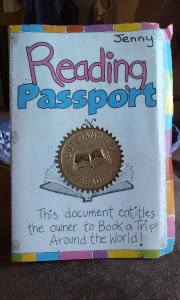
Reading Passport
Reading Passport, 1994-1995

During the 1994-1995 school year, the school librarian (we had those, back then) issued the students a Reading Passport, which entitled (pun intended?) the owner to Book a Trip Around the World (pun definitely intended)! Because I am a highly organized pack rat whose mother had storage space in her garage until recently, I still have mine.

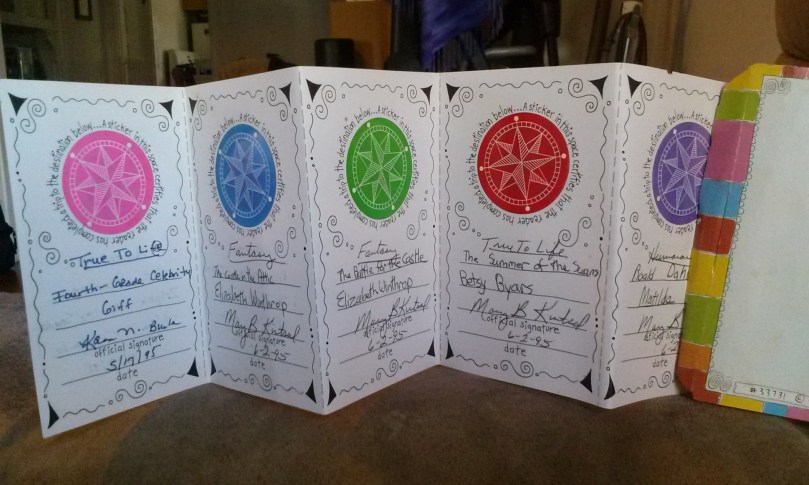
Like many of today’s popular reading challenges, students chose books in various categories (and got stickers for each book read. Who doesn’t love stickers?). Categories included classics, mystery, “true to life” (i.e. realistic), fantasy, humorous, adventure, historical fiction, animal, sports, and biography.

Some of these books I have entirely forgotten; others I remember vividly from re-reading them so often, and still adore – The Castle in the Attic by Elizabeth Winthrop, Matilda and The BFG by Roald Dahl, and Jeremy Thatcher, Dragon Hatcher by Bruce Coville. Though it’s not on the Reading Passport, 1994-1995 was also the year I read Buffalo Brenda by Jill Pinkwater. I think it was the following school year when I first read Shiloh by Phyllis Reynolds Naylor and Bridge to Terabithia by Katherine Paterson, and the year after that when I first read The Giver by Lois Lowry.

reading passport with stickers

Since 2007* when I first joined Goodreads and LibraryThing, I’ve kept a record of all my reading, but I’ve often wished for a lifelong record. I’m pleased to have unearthed this piece of my elementary school reading history, and grateful to the librarian who made it a fun experience worth documenting.

*TEN YEARS AGO.


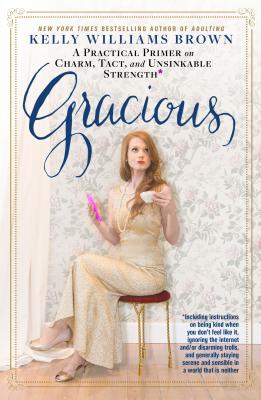
Gracious by Kelly Williams Brown

The heart of graciousness is compassion. It’s attention to those around you, whether they are your favorite person in the world or that person trying to get by you on the sidewalk. It’s kindness, and most of all, it’s giving love to those around you.”

Cover image of Gracious

What does it mean to be gracious? It’s more than just manners, although they are related (and manners, as any Emily Post devotee knows, is more about making people feel at ease than about using the right fork).

In her new book, Louisiana native Kelly Williams Brown expounds on the topic, largely by asking gracious people for their advice, worldview, philosophy, and practical tips (e.g. what to have on hand should guests drop by).

Graciousness flows from the recognition that “Every human is just as human as you are. …Though it is very (very) easy to assume otherwise, each person you will ever encounter is just as much in their own head as you are in yours.” Graciousness is “assigning and extending humanity to everyone you meet.” It is about “facing the world with kindness and compassion.”

Brown asks, “How do you live a life in which kindness and assurance, instead of anxiety and irritation, are the emotional guideposts?” And if you weren’t already interested in becoming more gracious, that might be the question that gets you interested – because who wouldn’t rather be assured than anxious, kind than irritated? Being irritated is, well, irritating. The occasional burst of righteous outrage can be satisfying, but as a constant mode of operation, it’s stressful and tiring. Wouldn’t it be more pleasant to navigate the choppy waters of life as calmly and smoothly as a steamship? (Steamships, incidentally, are Brown’s favorite style of transportation. Those who dislike flying will really enjoy her section on air travel.)

“We decide, every moment, who we shall be and what we are going to add into the world with our words and actions or lack thereof.”

As a librarian who works at a public service desk, I have many opportunities every day to practice being helpful, kind, patient, and gracious. (I say practice, because of course, I am not always all of these things.) I have a lot of practice giving people the benefit of the doubt – imagining what might be going on in their lives to explain why they are behaving a certain way right now – and practicing compassion and calm.

Brown’s section on customer service is quite good, no matter which side of the desk you’re on (and most of us have experience on both sides). She advises, “Try thinking about every relationship, no matter how brief, as an ‘us.'” What moves “us” forward? Think about the other person’s needs as well as your own, and you’re more likely to reach a conclusion that satisfies you both.

“Graciousness is about focused attention, kindness, and empathy and about moving deliberately in accordance with your values.”

In addition to being full of wisdom – both philosophical and practical – on being gracious, Brown’s book is written in a close, conversational, and often very funny way. It’s clear that she is interviewing these women (they are mostly women) because she aspires to be as gracious as she perceives them to be. As one of Brown’s subjects said, “Maybe we’re just going through life to come out on the other side with compassion.”