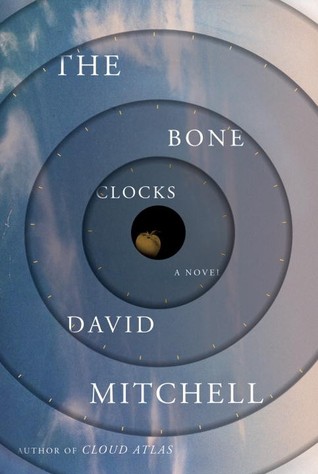
The Bone Clocks by David Mitchell

For a short summary and review, please see my review for the Robbins Library on Goodreads.

For a more complete summary (spoilers included) and quotes, please see my review on LibraryThing.

boneclocks
“You only value something if you know it’ll end.”

I did not read any reviews before reading The Bone Clocks by David Mitchell: I wanted to come to it fresh, unbiased, with no preconceived notions or other people’s opinions clouding my view or telling me what to look for. I devoured its 620 pages in four days, and then I looked at what reviewers had said about it. I started, perhaps unwisely, with James Wood’s review in The New Yorker (about which more below); the most understanding thing I can say about it is that, with his obvious contempt for the science fiction and fantasy genres, perhaps he was not the best reviewer for this book. (“Every book its reader; every reader his/her book.“)

I thought Ursula K. Le Guin’s review for The Guardian might be more sympathetic, but she calls Mitchell’s writing “anxious” and self-conscious. She wrote – surprisingly for a fantasy/sci-fi author – “I find these radical shifts of time and person difficult, and, though willing to suspend disbelief, am uncertain when to do so. Am I to believe in the hocus-pocus of the secret cult of the Blind Cathar in the same way I am to believe in the realistic portrayal of the death agonies of corporate capitalism – or should I believe in them in different ways? How many novels is it? If it is one, I just don’t see how it hangs together. Or maybe its not hanging together is the point, and I’m not getting it.” Le Guin also probes, not unjustly, at Mitchell’s choice to narrate in the present tense. I know some readers who are particularly sensitive to present-tense narration, but in this case at least, I didn’t find it troublesome. Rather the opposite: by using the present tense, Mitchell anchors the reader in each of six presents.

Joanna Kavenna, in the Telegraph (UK), is generally positive, though she doesn’t sound entirely pleased for David Mitchell that he has entered that “lit-fic kingdom of heaven” where one is both “critically acclaimed” and “wildly popular.” Michiko Kakutani, for The New York Times, provides more of a summary than any other reviewer; her review is mixed, praising the realistic parts of the novel and dismissing the “silly mumbo-jumbo” of the more fantasy-heavy sections. I found the “mumbo-jumbo” fairly easy to decode, but I could see how readers might have trouble with the denser paragraphs of it. Considered individually, the words Mitchell makes up or repurposes are all logical, even if he does sometimes use a noun as a verb (e.g. hiatus).

Pico Iyer’s take in the Sunday Book Review aligns most closely with my own, though he puts everything better. Unlike Le Guin (“How many novels is it?”), Iyer writes, “with Mitchell it’s the whole, the way he stitches the pieces together to make something greater than their sum, that makes the work unique.” He admits that the fifth section strays too far into “Marvel Comicsdom” for his tastes, adding generously, “[Mitchell’s] take on everyday life is so alive and so much his own that it seems a waste when he starts inventing realities, as so many other writers do.” In his final paragraph, Iyer concludes, “Other writers may be more moving, and some may push deeper, but very few excite the reader about both the visceral world and the visionary one as Mitchell does.”

Back to James Wood’s review in The New Yorker, in which he displays his condescension for fantasy and science fiction. He gives a head-nod to Susan Cooper’s The Dark is Rising series and Mark Haddon’s Boom! (“a terrific little book I enjoyed reading to my son a few years ago, but which I didn’t bother to treat as more than a nice bedtime game”), but clearly he believes that fantasy and sci-fi are for children (who, apparently, only read or are read to for diversion, not to set their imaginations on fire and develop worldviews).

Undoubtedly, The Bone Clocks has elements of both science fiction and fantasy, and no reviewer who scorns these genres as less serious than “literary fiction” can review it fairly. (Besides, as Holly’s father points out to her partner, Ed: “Life’s more science-fictiony by the day.”) Wood’s lack of interest in these aspects of the novel led to his misunderstanding in at least one case: there wasn’t a “schism” between the Horologists and the Anchorites; they are fundamentally different creatures. The Horologists are reincarnated; the Anchorites practice animacide (not “animicide,” as it was printed in The New Yorker. Anima = soul).

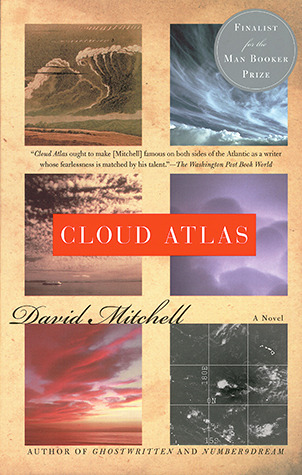
cloud_atlasFurthermore, Wood seems to disparage storytelling itself. In the opening paragraph of his review, he writes, “As the novel’s cultural centrality dims, so storytelling…flies up and fills the air. Meaning is a bit of a bore, but storytelling is alive.” I would argue that storytelling is central to the human experience, and good stories – the stories we remember and retell – do have meaning. Mitchell’s novels, particularly Cloud Atlas and The Bone Clocks, have more meaning than most of the other contemporary novels I’ve read. Wood barely addresses the sixth and final section of the novel, wherein Mitchell imagines a realistically grim version of 2043.

Some of Wood’s criticisms are fair; he writes that “[Mitchell’s] characters, whether fifteen-year-old girls or middle-aged male English novelists, sound too alike.” It’s true that Holly Sykes (at all ages), Hugo Lamb, Ed Brubeck, Crispin Hershey, and Dr. Iris Fenby (a.k.a. Marinus) are all clever, witty, insightful, and observant, but their dialogue and their thoughts are unique enough to be distinct. (Mitchell has already proved, in Cloud Atlas, that he’s capable of writing in many different voices and dialects.) And it’s not as if character was sacrificed for the sake of storytelling, either; Kakutani calls Holly “a thoroughly captivating character,” and I’m inclined to agree.

blackswangreenThough it is by no means easy reading, I love spending time in the Mitchell universe, where every novel belongs to one “‘Uber-book,’ in which themes and characters recur and overlap.” Seeing these characters reappear is like running into an old lost friend at a Christmas party: unexpected recognition, a delighted sense of “oh, it’s you!” In The Bone Clocks, nearly everyone makes an appearance: there are cameos from Jason and Julia, Alan Wall, and Nurse Noakes (Black Swan Green), Timothy Cavendish (Cloud Atlas), and the omnipresent moon-grey cat; there is a larger but behind-the-scenes role for Luisa Rey (Cloud Atlas); and Marinus (The Thousand Autumns of Jacob de Zoet) and Hugo Lamb (Black Swan Green) play significant roles.

So, what is The Bone Clocks about? It is about the life of Holly Sykes, fifteen when we first encounter her in 1984 and seventy-four when we last see her in 2043. It is about the war between the Horologists and the Anchorites, which is really a war about the value of life; the Horologists’ aim is to prevent the Anchorites from committing animacide (killing) in order to preserve their own youth. Mitchell has called The Bone Clocks his midlife crisis novel, and one can’t read it without considering aging and death on the ordinary human scale as well as the “Atemporal” one; as Nurse Noakes says to Hugo, “You’d think old age was a criminal offence, not a destination we’re all heading to.”

According to David Mitchell himselfThe Bone Clocks is about survival. And it is about the future we are all headed for if we don’t begin making drastic changes now: a scarcity of resources and a consolidation of power, lawless zones and fear, a time when we’ll remember clean water and electricity as luxuries. Of course, both survival and life can be considered on more than one scale: in The Bone Clocks, there is the individual, the species, and the Atemporals. The Horologists and the Anchorites may be pure fiction, but we still have to worry about the rest. Will 2043 look like it does in Mitchell’s vision?

11/7/14 Edited to add: Stephen King makes a similar point about literary critics and genre fiction, specifically citing The Bone Clocks, in this Rolling Stone interview. He says, “Michiko Kakutani, who writes reviews for The New York Times, is the same way. She’ll review a book like David Mitchell’s The Bone Clocks, which is one of the best novels of the year. It’s as good as Donna Tartt’s The Goldfinch, has the same kind of deep literary resonance. But because it has elements of fantasy and science fiction, Kakutani doesn’t want to understand it. In that sense, [Harold] Bloom and Kakutani and a number of gray eminences in literary criticism are like children who say, “I can’t possibly eat this meal because the different kinds of food are touching on the plate!”

Althea & Oliver by Cristina Moracho

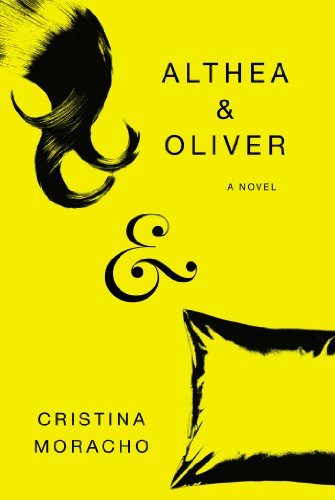
altheaoliverSometimes it’s easy to remember why you picked up a certain book: a friend recommended it, or you read a great review somewhere, or you liked the cover or the title. Sometimes one recommendation or review isn’t enough, and it’s not until you hear about a book a few times that you’re motivated to pick it up. In the case of Althea & Oliver, I first heard of it in a Booklist review, then it showed up in my e-mail through Penguin’s First to Read program. I liked the names in the title; I liked the fancy ampersand. Was that all?

If it was, it was enough. Taking place in the pre-cell phone 1990s, Althea & Oliver reminded me of some other excellent YA novels, including John Green’s Paper Towns, Katja Millay’s The Sea of Tranquility, Lauren Myracle’s The Infinite Moment of Us, and Tim Tharp’s The Spectacular Now. Set in Wilmington, NC, Althea & Oliver has a few things in common with these books: the focus is close on two characters; it takes place in the South (mostly); and while parental supervision isn’t entirely absent, Althea’s dad Garth and Oliver’s mom Nicky aren’t helicopter parents, either.

Althea and Oliver have been best friends for ten years, but just as Althea begins to see Oliver as more than just a best friend, Oliver falls asleep. Not metaphorically, and not just for a nap: Oliver falls asleep for weeks. While Oliver is asleep, he has episodes – an incident at Waffle House, for example – that he can’t remember when he wakes up. When he wakes up for real, he wants everything to go back to normal. But when it happens again, his mom Nicky begins to do some research, and discovers that Oliver isn’t the only one; what he has is called Kleine-Levin Syndrome (KLS), and there’s a study going on in New York.

Oliver doesn’t tell Althea about the study and his imminent departure, at first because he doesn’t know how, and then because of something that happens between them during one of his episodes. When Althea realizes that Oliver is gone, not just asleep, she finds out where he went and goes after him, launching herself into a new phase of life, alone. Althea arrives at the hospital in New York just minutes after Oliver falls asleep again; she winds up in Red Hook, in a house with a bunch of other young adults, and astonishingly – after being friends with no one but Oliver for years – Althea makes friends with them.

Oliver wakes up just before New Year’s, escapes the hospital with another boy in the study, and goes in search of Althea. Improbably, he finds her. He tells her about a possible solution to his KLS, but even if it solves his sleep problems, it won’t solve what went wrong between them. They can’t go back to normal – they can only go forward.

Unconventional and utterly, convincingly real, Althea & Oliver is full of well-rounded, believable characters. No one is a prop, no one is one-dimensional; from Wilmington punk friends Val and Howard (a.k.a. Minty Fresh) to the Red Hook house full of dropouts and vegans, every character in this book could be the center of his or her own story. But it is Althea who is the heart of this one; Althea who is angry and violent, heartbroken and determined, scrappy and searching; Althea who realizes, at last, that neither she nor Oliver are going to get what they want, but that there is something else out there for them both.

I received an e-galley of this book through Penguin’s First to Read program. Althea & Oliver will be published in October 2014.

“Netflix for books” already exists: it’s called the library

Even in a profession where we interact with the general public daily, it can be tricky for librarians to assess how much other people know about what we do, and what libraries offer – which is why it is so delightful to see an article by a non-librarian raising awareness of a service libraries offer. In “Why the Public Library Beats Amazon – For Now” in the Wall Street Journal, Geoffrey A. Fowler praises public libraries across the country, more than 90% of which offer e-books (according to the Digital Inclusion Study funded by the Institute of Museum and Library Services).

Noting the rise of Netflix-style subscription platforms like Oyster and Scribd, Fowler observes that libraries still have a few key advantages: they’re free, and they offer more books that people want to read.

random-house-penguin11
Graphic designer Aaron Tung’s idea for the Penguin – Random House logo

Librarians have been working with publishers for several years, negotiating various deals and trying out different models (sometimes it seems like two steps forward, one step back), but finally all of the Big Five have come on board and agreed to “sell” (license) e-books and digital audiobooks to libraries under some model. (The Big Five were formerly the Big Six, but Random House and Penguin merged and became Penguin Random House, missing a tremendous opportunity to call themselves Random Penguin House, with accompanying awesome logo.)

Thus, while Amazon’s Kindle Unlimited (KU for short – has the University of Kansas made a fuss about this yet? They should) touts its 600,000 titles, the question readers should be asking is, which 600,000 titles? All books are not created equal. The library is more likely to have the books you want to read, as Fowler points out in his article. It may be true that Amazon, Oyster, and Scribd have prettier user interfaces, and it may take fewer clicks to download the book you want (if it’s there), but library platforms – including OverDrive, 3M Cloud Library, and others – have made huge strides in this area. If you haven’t downloaded an e-book from your library recently, or at all, give it a try now – it’s leaps and bounds smoother than it used to be. You may have to wait for it – most publishers still insist on the “one copy/one user” model, rather than a simultaneous use model – but it is free. (Or if you’re impatient and solvent, you can go ahead and buy it.)

Readers' advisory desk at the Portland (ME) Public Library.
Readers’ advisory desk at the Portland (ME) Public Library.

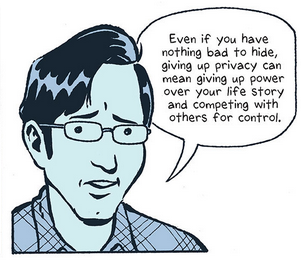
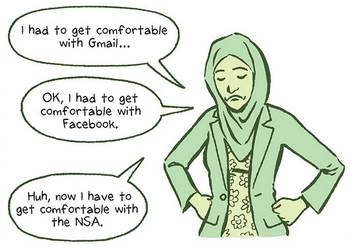
Another way in which the library differs from for-profit book-rental platforms is that, to put it bluntly, the library isn’t spying on you. If you’re reading a Kindle book, Amazon knows how fast you read, where you stop, what you highlight. Libraries, on the other hand, have always valued privacy. The next time you’re looking for an e-book, try your local library – all you need is your library card number and PIN.

Everything you think you know

A version of this post can also be found on the Robbins Library blog.


The squares marked A and B are the same shade of gray.

Humans are amazing. But we are very often wrong when we think – when we know – we are right. The example above easily illustrates how our powers of perception can mislead us. (Click on the image to see the proof and explanation.) This example is cited in the book Being Wrong: Adventures in the Margin of Error by Kathryn Schultz, but there are hundreds of other examples, and optical illusions are only one way in which our perception of a thing can be inaccurate. We can be wrong – even when we think we’re right – in hundreds of ways, dozens of times a day. Comforting thought, isn’t it? It could be, if we accept Schultz’s assertion that “errors do not lead us away from the truth. Instead, they edge us incrementally toward it.”

“That our intuition could lead us astray is troubling in direct proportion to the degree of trust we place in it.” -Leah Hager Cohen, I don’t know

If Being Wrong disturbs you, try Leah Hager Cohen’s book I don’t know: in praise of admitting ignorance and doubt (except when you shouldn’t). At just over a hundred pages, it gives a great return for time spent; in fact, I could easily see it becoming required reading for students entering high school or college. Cohen writes about learning to admit when we don’t know something, and goes further, asking, “but what about all those times we don’t know we don’t know?

Both Schultz and Cohen warn about the danger of belief hardening into certainty, and emphasize the importance of doubt. Cohen writes, “Real civil discourse necessarily leaves room for doubt. That doesn’t make us wishy-washy…We can still hold fervent beliefs. The difference is, we don’t let those beliefs calcify into unconsidered doctrine.” She continues, Fundamentalism of any kind is the refusal to allow doubt. The opposite of fundamentalism is the willingness to say ‘I don’t know.'”

For a quick, high-energy take on the same material, Hank Green (brother of John Green, author of The Fault in Our Stars, etc.) has a four-minute video entitled “Towering Mountains of Ignorance.” He says, “I’m glad that we have the desire to understand the world, that results in all sorts of great stuff. We want to know everything, we’re curious….But I think a lot of the time we end up mixing up thinking something with knowing something.”

Watch the whole video by clicking below.

hankgreen2
“I think that I know a lot of things…but the vast majority of things, vast majority, I don’t know.” -Hank Green

Hank Green: “Now, I know that I don’t know, but somehow everyone else seems to know. They all know differently from each other, but they all seem to know. When you look at all deeply at this, you realize that people aren’t basing their opinions on what they think is the best course of action or the actual best explanation, they’re basing it on their values.”

“What I’m saying is nobody’s opinions are correct…and yet it’s impossible not to tie your opinions to your concept of self.” -Hank Green

In Being Wrong, Kathryn Schultz puts it this way: “The idea of knowledge and the idea of error are fundamentally incompatible. When we claim to know something, we are essentially saying that we can’t be wrong. If we want to contend with the possibility that we could be wrong, then the idea of knowledge won’t serve us; we need to embrace the idea of belief instead.” Call it what you want – knowledge, belief, opinions, values – it/they are “inextricable from our identities,” which is “one reason why being wrong can so easily wound our sense of self.”

"I DON'T KNOW!"
“I DON’T KNOW!”

The two books mentioned above, Being Wrong and I don’t know, are nonfiction, and I highly recommend them both to anyone and everyone. But fiction, too, can be useful, in that it allows readers to see from the point of view of someone different. The link between fiction and empathy is real (Scientific American, New York Times, this blog), and reading fiction, especially books where the narrators or main characters are very different from us, can help us break down what we think we know – especially what we think we know about other people.


Half Magic, Half Real: Reading in childhood and adolescence

halfmagicRecently, over on my library’s blog, we’ve been doing a series of collaborative blog posts, where we come up with a question and each offer our answers. We started with how to fit reading into a busy schedule, and then we discussed book-to-movie adaptations. This month, I asked the impossible: One favorite book you read as a child, and one favorite you read as a teen. Naturally we struggled to choose just one each, and some of us (ahem) outright failed. But it’s a good failure, when you think back to all the books you grew up reading and they’re all so deeply embedded in your memory that you can’t choose between them.

As every librarian and bookseller and book lover knows, there are many ways to categorize books, but what I noticed about the books I remembered from growing up was the division between fantasy and “realistic” fiction. (I didn’t really read nonfiction for fun as a kid, except those DK Eyewitness ones – Crystal & Gem, anyone? – and one about King Tut’s tomb with that terrifying black and gold death mask on the cover.)

I wish I’d kept a reading log my whole life so I’d know now when I encountered each of these, but I haven’t. Here are some of the earlier books that I remember reading and re-reading:

castleintheatticHalf Magic by Edward Eager
The Castle in the Attic by Elizabeth Winthrop
Jeremy Thatcher, Dragon Hatcher by Bruce Coville
Matilda / The Witches / The BFG by Roald Dahl
Wait Til Helen Comes by Mary Downing Hahn
Voices After Midnight by Richard Peck
The Boggart by Susan Cooper
A Wrinkle in Time by Madeleine L’Engle
The Lion, the Witch, and the Wardrobe by C.S. Lewis
The Giver by Lois Lowry
The Lion Tamer’s Daughter by Peter Dickinson
The Golden Compass / The Subtle Knife / The Amber Spyglass by Philip Pullman

boggartThat whole batch – and these titles came to mind almost instantly once I’d formed the question – are fantasy. Magic, dragons, ghosts, time travel, ageless Scottish spirits, doppelgangers. I read realistic fiction too – the Boxcar Children, Nancy Drew, the Thoroughbred series by Joanna Campbell, and several standalone works by the likes of E.L. Konigsburg, Judy Blume, Chris Crutcher, Lois Duncan, Joan Lowery Nixon, and Caroline B. Cooney – and I remember those as well, but the books with an element of magic seem set apart, unique. The authors had to invent whole new worlds, or twist and shape our world in such a way that it seemed foreign. Then – Once upon a time…It was a dark and stormy night… – they invited the reader in, as a co-imaginer, a sidekick, a tagalong.

wrinkleintime2Part of the appeal of fantasy, science fiction, dystopia, fairy tale, myth, and horror is that they invite the reader to consider how she would react when placed in a strange situation, or how she would fit in to an unfamiliar world, from the safety of wherever she happens to be reading. These genres open the imagination of all readers, young and old, who are willing to suspend disbelief and engage with them. Books with these elements are, sometimes, more memorable than strictly realistic books. That element of magic catches at us, makes us think; these stories use otherworldly frameworks for concepts we have, but have no name for.

This month, I read Shirley Jackson’s literary horror novels We Have Always Lived in the Castle and The Haunting of Hill House. The latter had an introduction (“Haunted Castles, Dark Mirrors”) by Penguin Horror editor Guillermo del Toro, who wrote, “[I]t is a fact that, through the ages, most storytellers have had to resort to the fantastic in order to elevate their discourse to the level of parable….At a primal level, we crave parables, because they allow us to grasp the impossibly large concepts and to understand our universe without and within.”

goldencompassThe books I mentioned above aren’t parables, exactly; they are, first and foremost, stories, and if they have lessons in them, they are more subtle than most parables (or fairy tales or myths, for that matter). But many of them do offer a way to grasp “impossibly large concepts” at a young age. Think of the tesseract from A Wrinkle in Time, where instead of traveling in a straight line from point A to point B – commonly thought to be the shortest distance between two points – points A and B are instead brought together. Or think of any number of Philip Pullman’s inventions, from the daemon – an aspect of the personality or soul that lives outside the human body in animal form, invisibly connected – to the intention craft (just what it sounds like), to particles of consciousness (the misunderstood Dust), to a simple concept that resonates: you can visit other worlds, but they cannot sustain you for a full long lifetime, as your home world can. We can travel very far, but we still have to return home from time to time for sustenance we can’t get from any other place.

What’s your favorite childhood or teen book, magical or non-magical?

7/29/14 Edited to add: Further reading from YALSA’s The Hub: “There’s No Escaping the Power of Fantasy Fiction”  by Kelly Dickinson, and “YA Books That Changed Our Lives” by multiple contributors.


On Immunity: An Inoculation, by Eula Biss (Graywolf Press)

onimmunityOn Immunity: An Inoculation was one of the two nonfiction books at this year’s BEA Editors’ Buzz. At just about 200 pages, including the notes and acknowledgements, it is undaunting in length, which I hope will encourage even more people to pick it up.

Disease is defined as “any deviation from or interruption of the normal structure or function of any body part, organ, or system that is manifested by a characteristic set of symptoms and signs and whose etiology, pathology, and prognosis may be known or unknown.” But an obsolete use of the word disease is “lack of ease; trouble,” more like today’s unease. And disease certainly does make people uncomfortable: the idea of it causes mental and emotional discomfort, while its physical effects can range from undetected to uncomfortable to fatal.

Eula Biss wades into this uneasy territory, and finds companions in other writers, historians, philosophers, anthropologists, and doctors. During the writing of On Immunity, Biss – already a published author and essayist – became a mother, and she approaches the topic of immunity and vaccination from a mother’s point of view as well as a “citizen thinker’s” perspective. She acknowledges that all parents’ decisions – to vaccinate or not to vaccinate their children – come from the same desire: to keep their children safe. But it is better to make these decisions from a place of knowledge than from a place of fear, and knowledge is what Biss strives for, and shares, in this book.

Fears of vaccines do not seem easily quieted by an abundance of expert risk-benefit analyses assuring us that the good they do is far greater than the harm.

One of the first steps in the process of deciding whether or not to vaccinate is risk assessment, and yet humans are not as good at this as we would like to think. Biss quotes the historian Michael Willrich, who says, “Perceptions of risk…can be stubbornly resistant to the evidence of experts.” People engage in dangerous activities (e.g. driving, riding in, or walking near cars) every day, but the familiarity we develop with these activities dulls our fear of the associated risks. “The disregard for statistical risk,” Biss writes, “may be at least partly due to an unwillingness to live lives dictated by danger.”

Risk perception may not be about quantifiable risk so much as it is about immeasurable fear….When we encounter information that contradicts our beliefs…we tend to doubt the information, not ourselves.

Safe and dangerous aren’t as binary as we’d like to think, either; as toxicologists say, “the dose makes the poison.” But, Biss notes, “most people prefer to think of substances as either safe or dangerous, regardless of the dose.” I caught myself in this exact thought pattern a single day after I finished reading On Immunity, while I was reading about the ingredients in a multivitamin; it’s difficult to remember, but any substance, even water, can be toxic in large enough doses, and small doses of “dangerous” substances may be harmless.

If vaccination is a choice people make at the individual level (“allowing oneself to remain vulnerable to disease remains a legal privilege today”), it is also a choice individuals are making on behalf of the larger community in which they live. The author’s father Roger Biss, a doctor, explains, “Vaccination works by enlisting a majority in the protection of a minority.” The more people who are vaccinated and carry immunity, the safer everyone is from disease. Achieving a 100% vaccination rate in any given population is unlikely, but by aiming for that rate, we have a better chance of attaining “herd immunity.” Unfortunately, Biss discovers, “We know the threshold [at which herd immunity is lost], in many cases, only after we’ve exceeded it.”

Faced with too much information, or misinformation, some people choose not to vaccinate, threatening the protection that herd immunity confers. Yet refusing to vaccinate “undermines a system…in which both the burdens and the benefits are shared across the entire population.” Or, as the author’s sister notes, “The health of our bodies always depends on choices other people are making.”

Biss includes a wealth of references, both in the text and in the notes; she draws upon such various sources as Susan Sontag, Bram Stoker (Dracula), Rachel Carson (Silent Spring), and Jean-Paul Sartre, among others. While I read On Immunity, however, I was often reminded of a book she didn’t mention: Leah Hager Cohen’s I don’t know: in praise of admitting ignorance and doubt (except when you shouldn’t). In this slim, wise volume, Cohen – also a mother, and also a Hampshire College graduate – explores the question, “How should we make decisions when we can’t know what’s right?”

We have to make the best decision we can, based on the best information we can gather. After a careful examination of research an opinion from many sources, Biss concludes, reasonably, that vaccination is the choice that is best for the individual, and for society at large – of which we are all a part. This works to everyone’s advantage; after all, “No single person…has the genetic material to respond to all diseases, but collectively humans have enough genetic diversity for humankind to survive any disease.”

I received a galley of this book from the publisher at BookExpo America 2014. Quotes in the review above are from the galley, and may differ from the final copy. On Immunity: An Inoculation will be published on September 30, 2014.


Reading Roundup: spring, summer, and fall books

Between BEA, Edelweiss, NetGalley, and the LibraryThing Early Reviewers program, I’ve gotten a chance to read several books ahead of their official publication dates this year, and they’ve all been excellent. This list is fairly fiction-heavy, but I have a few nonfiction titles coming up as well, so if that’s your thing, stay tuned.

stuckinthemiddleStuck in the Middle with You by Jennifer Finney Boylan (paperback: April 22, 2014)

Sometimes, the simplest, most innocent questions that people ask me can demand that I either lie or else have a conversation that’s much more intimate than I want to have, simply in order to tell the truth.

Boylan is the author of two previous memoirs, She’s Not There (2003) and I’m Looking Through You: Growing Up Haunted (2008). Born James Boylan, she had a sex change but remained married to her wife Deedie, parent to their two sons, Zach and Sean. Stuck in the Middle With You gives enough background so that readers who are new to Boylan won’t be lost, but focuses mainly on parenthood and family; memoir material is interspersed with interviews with many other people on the topics of gender, family, and motherhood vs. fatherhood. (I was delighted to encounter Tim Kreider, author of We Learn Nothing, in one of the interviews.) In conversation with Christine McGinn, Boylan seems to conclude that “males and females really are two different beings…but motherhood and fatherhood are social constructs.” She also concludes that her family is more similar to other families than different – and, for what it’s worth, she and Deedie are still together while many couples who got together at the same time are now separated. A great read for anyone who’s part of a family…which is pretty much everyone.

The Vacationers by Emma Straub (May 29, 2014)vacationers

Families were nothing more than hope cast out in a wide net, everyone wanting only the best.

The term “beach read” connotes something frothy and light, indulgent and not necessarily “literary,” but just because a book is set during a family’s summer vacation doesn’t make it a “beach read.” Straub’s The Vacationers certainly isn’t fluff: it’s a two-week-long snapshot of a family (and friends) whose members are all believably flawed: the husband who had an affair and lost his job over it, the wife who isn’t sure she can forgive him, the gay couple in the midst of a nerve-wracking adoption process, the son with hidden financial troubles, the son’s responsible-but-looked-down-on older girlfriend, and finally the youngest daughter, whose goal for the summer is to get laid so she doesn’t arrive at college a virgin. Straub writes about her characters with empathy and wisdom. I didn’t read her previous novel, Laura Lamont’s Life in Pictures, but I may add it to my list now.

oneplusoneOne Plus One by Jojo Moyes (July 1, 2014)

Sometimes, she told herself, life was a series of obstacles that just had to be negotiated, possibly through sheer act of will….she could survive this. She could survive most things.

Jess and Ed both live in England, but they come from two different worlds: Ed is fantastically rich, thanks to some software he built with his friend Ronan, and Jess is scraping by, cleaning houses – including Ed’s – and bartending. This setup could easily tip over into cliche, but it doesn’t: Moyes creates fully rounded characters who are lovable but flawed, trying to do their best and making mistakes. Jess is trying to protect her ex-husband’s son Nicky from being bullied, and trying to figure out a way to afford for her daughter Tanzie to go to a nicer school where she can do higher-level maths; Tanzie has won a scholarship but Jess still doesn’t have enough to cover the rest, unless Tanzie also wins a competition. In Aberdeen. And Jess can’t really drive – so Ed ends up chauffeuring the three of them, plus Norman the dog. One Plus One is a satisfying romance that addresses issues of socioeconomic status and inequality.

landlineLandline by Rainbow Rowell (July 8, 2014)

“Lately I’ve been thinking that it’s impossible to know.”
“To know what?” she pushed.
“Whether it’s enough. How does anyone ever know whether love is enough? It’s an idiotic question. Like, if you fall in love, if you’re that lucky, who are you to even ask whether it’s enough to make you happy?”
“But it happens all the time,” she said. “Love isn’t always enough.”

If you have already read something by Rainbow Rowell (Attachments, Eleanor & Park, Fangirl), then you’re already waiting to get your hands on Landline, in which Rowell returns from YA to adult fiction. As always, she writes with a wonderful sense of humor as well as wisdom about what it’s like to be a person. Review | Additional quotes

secretplaceThe Secret Place by Tana French (September 2, 2014)

Some people are like that: everything comes out like a lie. Not that they’re brilliant liars, just that they’re useless at telling the truth. You get left with no way to tell what’s the real fake and what’s the fake one.

The Secret Place differs from French’s four previous novels in that the narration is split in two, with one half – from the perspective of Detective Stephen Moran – taking place over the course of one long day, and the other half filling in most of the back story. This is largely effective, though there are many threads to keep track of; readers are never too far ahead of Moran and his partner-for-the-day, Antoinette Conway, and there are plenty of leads that lead to dead ends. The case centers around a murder that occurred on the grounds of a girls’ boarding school; the murder went unsolved for a year, but a new clue has surfaced, brought to Moran’s attention by Holly Mackey, a student at the school. Soon, Moran begins to wonder if Holly was involved. As always, French has crafted a psychologically gripping, beautifully written, hard-to-put-down literary mystery.

stationelevenStation Eleven by Emily St. John Mandel (September 9, 2014)

The more you remember, the more you’ve lost.

The world as we know it: Arthur Leander has a heart attack onstage while playing King Lear. Audience member Jeevan, a paparazzo-turned-journalist-turned EMT, jumps onstage to help. Child actress Kirsten Raymonde watches as Jeevan tries to save Arthur, but Arthur dies. Later that evening, Jeevan receives a call from a doctor friend, telling him about a fast-moving, lethal flu that has arrived in Toronto. He stocks up on emergency supplies.

Time had been reset by catastrophe.

The world in Year Twenty: Twenty years after the Georgia Flu has killed 99.99% of the world’s population, Kirsten is a member of the Traveling Symphony, a band of Shakespearean actors and musicians always on the move between small settlements. She’s also on the lookout for anyone who might know anything about one of her few possessions, copies of the first two volumes of a graphic novel called Station Eleven. When Symphony members begin to go missing, it seems as though Station Eleven might be leaking from the page into real life.

There have been several notable post-apocalyptic novels for adults recently (The Road, The Age of Miracles, The Dog Stars), but in my opinion this is the best. The author pays attention to the logistics of the collapse, but the characters are of primary importance: the way they deal with the post-flu world, the way they are all connected in a looping way that is almost reminiscent of the best time-travel novels. I only finished reading it a few days ago, but I think it will linger with me.


Leah Hager Cohen at the Robbins Library

No Book But the World (2)Cross-posted at the Robbins Library blog.

Leah Hager Cohen graced the Robbins Library with her presence on Monday night, reading a section from her newest novel, No Book But the World, in a soft, clear, expressive voice. The passage described the main character, Ava, as a child, playing with her younger brother Fred and overhearing her parents discussing whether or not her mother should teach Ava to read sheet music. Ava wants her parents to keep talking about her, but Fred chokes on a rock, and though Ava gets him to spit it out, their parents come running to Fred’s wails.

Devoted readers will notice what Cohen herself has noticed about her books, both fiction and nonfiction: “All of my books, as I look back on them, seem to engage the idea of “other,” whether in the form of marginalized cultures or the private “otherness” we all sometimes feel in moments of loneliness or isolation. And I see all of them as part of a larger effort to reach out beyond that isolation, to fathom the unfathomable” (quote from a January 2012 interview with Steven Wingate in Fiction Writers Review). Storytelling, Cohen said, is a way of bridging the gaps, making connections between people.

Her new novel, No Book But the World, investigates the question, “What do we do about people in the world who are difficult to love?” The difficult-to-love character is Fred, who likely has an autism spectrum disorder, but his parents, Neel and June, are against “pathologizing the individual,” so Fred remains undiagnosed; Neel and June think Fred is “okay the way he is.” As the book begins, the adult Fred has been accused of a crime, and Ava is convinced that if she can only coax Fred into telling his side of the story, she can serve as the interpreter between him and the world. Ava insists that she knows Fred better than anyone – but how possible is it to know someone else? “Sympathy and empathy can go a long way toward reaching the Other, but it is arrogance to think we can know the Other.” Still, there is the hope that “if only we could tell the story well enough, complete enough, some of the pain of otherness/separateness could be alleviated.”

“Who could ever tell a story complete?” -Leah Hager Cohen, No Book But the World

During the Q&A following the reading, one reader who had already finished No Book But the World tiptoed around the ending, trying not to spoil it for those who hadn’t read it yet; she asked about Fred’s choice near the end of the book. Cohen said that her literary agent had a similar reaction: to most readers, Fred seems like a character the world happens to, but in this case he makes a surprising choice for himself. Though Cohen considered changing the ending, she ultimately kept the original.

TrainGoSorryThough lately Cohen has published more fiction (The Grief of Others, House Lights), she started out publishing nonfiction after graduating from Columbia University’s Journalism School. Journalism “seemed like a way to balance my pleasure in writing and being socially useful.” With journalism, Cohen believed, storytelling can help fill in what we don’t know. She quickly realized that “journalism is too often subservient to capitalism,” but turned one of her pieces for school into a book proposal, which became Train Go Sorry.
Another audience member noted Cohen’s exceptional vocabulary. Cohen laughed and put it more baldly: “How come you use all those words?” She answered, “I’m not trying to be inaccessible…I am aware that the tool that I have is English, is language, [and it is] pretty meager compared to all this stuff [life, the world, etc.]…The reason we’re here is to tell each other those things, [but] I can only get part of the way there through words.” She then related a story about first encountering the word “hyperbole”: “Back in adolescence, I remember having an epiphany that the whole idea of hyperbole is fallacious—since nothing we perceive, nor any words we are capable of using to express it, could ever begin to approach the fullness of the thing” (quote from the interview with Steven Wingate).

One of Cohen’s first jobs after graduating from Hampshire College college was as an American Sign Language interpreter. ASL has “a richness of expression in its visual and spatial aspects,” whereas English is linear (one word follows another word). She added, “All of this language stuff is great but it’s not the end.” However, she clearly enjoys language as a tool for play and work; she loved writing even as a child, when sometimes her “desire to enjoy making things out of language sometimes preceded having something to say.”

Though all her books share a few thematic commonalities – for example, people’s struggle to connect with and understand other people, especially those who are different – Cohen said she doesn’t rely on an outline and doesn’t plan what to write. She quoted E.L. Doctorow: “Writing is like driving at night in the fog. You can only see as far as your headlights, but you can make the whole trip that way.”

“For why are we here if not to try to fathom one another? Not through facts alone, but with the full extent of our imaginations. And what are stories if not tools for imagining?” -Leah Hager Cohen, No Book But the World

BEA 2014 Part Four: Buzzy and Boozy

BEA14FriBookExpo America, Day Three (continued)

Read about the first two sessions of Day Three here.

The Librarians Book Buzz Part II continued in much the same vein as Part I. I’ll use the same format, highlighting just a few titles I found interesting from each publisher:

  • From Random House: Station Eleven by Emily St. John Mandel; Horrorstor by Grady Hendrix (think IKEA meets haunted house)
  • From Penguin: One Plus One by Jojo Moyes (author of Me Before You); The Paying Guests by Sarah Waters; The Secret Place by Tana French; Five Days Left by Julie Lawson Timmer; and If I Knew You Were Going to Be This Beautiful I Never Would Have Let You Go by Judy Chicurel
  • From W.W. Norton: An Italian Wife by Ann Hood; The Glass Cage by Nicholas Carr (author of The Shallows); The Birth of the Pill by Jonathan Eig; Smoke Gets In Your Eyes by Caitlin Doughty; The Meaning of Human Existence by Edward O. Wilson; and the graphic novel Kill My Mother by Jules Feiffer
  • From S&S: Juliet’s Nurse by Lois Leveen; As You Wish by Cary Elwes (about whom more later); We Are Not Ourselves by Matthew Thomas; The Innovators by Walter Isaacson
  • From Workman: The High Divide by Lin Enger, and several big beautiful nonfiction books, from dinosaurs to whiskey to molecules and the ocean.
  • From New York Review Books (not to be confused with the New York Review of Books): The Burning of the World by Bela Zombory-Moldovan; Conversations with Beethoven by Sanford Friedman; and Blackballed: The Black Vote and U.S. Democracy by Daryl Pinckney

I can definitely recommend One Plus One and The Secret Place, having already read the galleys, and I’m looking forward to several of these others. The to-read list grows! (That’s the only thing it does. Never gets any shorter, only grows.)

Librarian Shout ‘n’ Share

Moderated by Barbara Genco of Library Journal, this panel was both buzzy and boozy (one suggested hashtag was #vodkaatBEA). The panelists:

  • Douglas Lord, LSTA Coordinator, Division of Library Development, CT State Library, longtime Library Journal book reviewer and Books for Dudes Columnist
  • Alene Moroni, Manager, Selection and Order, King County Library System (WA) and a 2013 Library Journal “Mover and Shaker”
  • Charlene Rue, Deputy Director of Collection Management, BookOps: The shared technical services organization of New York Public Library and Brooklyn Public Library
  • Etta Thornton-Verma, Library Journal Reviews Editor (NY)
  • Jamie Watson, Collection Development Coordinator, Baltimore County Public Library (MD) and a 2008 Library Journal “Mover and Shaker”

My notes from this session are a bit haphazard due to the pace of the panel and people jumping in with suggestions and comments, so I may not have ascribed all the suggestions correctly. I’m just going to list books that I first heard about at the Shout ‘n’ Share, omitting any that I’d already heard about during BEA (from the Editors’ Book Buzz, Librarians’ Book Buzz, giant posters hanging in the exhibit hall, etc.).

Shout ‘n’ Share finds: Fiction

Shout ‘n’ Share finds: Nonfiction

And that was the end of BEA for me. Stay tuned for a (very belated, by now) recap of BookCon.

Elizabeth McCracken in conversation with Paul Harding at Porter Square Books

thunderstruck“I’m just tickled to see you all here,” Elizabeth McCracken said to the audience after a Porter Square Books staff member and author Paul Harding introduced her. McCracken is a former public librarian and the author of Here’s Your Hat What’s Your Hurry: Stories (1993), The Giant’s House (1996), Niagara Falls All Over Again (2001), the heart-wrenching memoir An Exact Replica of a Figment of My Imagination (2008), and, this year, Thunderstruck and Other Stories. McCracken said that she had thought she might not go back to writing stories, but when a novel she was writing wasn’t working out, “I tossed it aside and it broke into pieces.” Three of those pieces, including “The Lost & Found Department of Greater Boston,” made it into Thunderstruck.*

The conversational format was excellent, especially as both writers are extremely – and in Harding’s case, surprisingly – funny (Paul Harding is the author of the Pulitzer Prize-winning Tinkers, a lyrical but decidedly un-cheery book), and McCracken taught Harding at the Iowa Writers’ Workshop, so they know each other well. Harding, a former drummer (?!), asked how McCracken settled on the sequence of the stories in Thunderstruck. They are not organized in the order she wrote them, but the oldest, “Juliet,” is first, and the newest, “Thunderstruck,” is last.

They talked about the recurring themes in McCracken’s work, particularly loss and missing people. “I just repeat the same things over and over again,” said McCracken. “A finite deck that you keep reshuffling,” agreed Harding, but while “it’s easy to keep most stories at arm’s length if you want to,” that’s impossible with McCracken’s work. She is fond of writing in the second person, which can be effective at drawing the reader in, but also has its risks.

Harding used this example:
[Author writing in second person] “You’re in a bar on a Tuesday night, snorting coke–”
[Reader reaction] “No, I’m not.”

McCracken’s “you” is more generalized, though, and works well; she shifts from third person to second so smoothly the reader may not even notice at first (“Whatever you have lost there are more of, just not yours.”). She was self-effacing about Harding’s praise (“Anything I do is entirely accidental”), but I suspect there’s rather more to it than that.

Speaking of her fascination with lost people, including relatives she’d never met, she said, “Grandfather McCracken was a genealogist.” (She pronounced it jenny-ologist, a career I’m fairly certain no one has, except possibly an obsessed young man in a yet-to-be-written Nick Hornby novel.)

They moved on to talking about the writing process. “Writing is not a particularly efficient process,” said Harding; he compared it to archaeology, digging through the rubble and picking the best bits. They talked about truth in fiction, and the “distinction between imaginary and factual truth.” McCracken, with good humor, called it “aggravating” when something she had made up turns out to be true.

sinewave_credo
Sine wave illustration from The Penguin Dictionary of Science

Harding observed that McCracken writes in “experienced time, not linear time,” and is great at “not over-determining.” He described a sine wave with his hands in the air: “Anything between here [top of sine wave] and here [bottom of sine wave] could have happened.” It’s a way of acknowledging that “somewhere in the universe, things are different.”

“It was on this day, a Monday, that we first saw Juliet.”

McCracken read from the beginning of “Juliet,” then the Q&A began. Someone asked a version of the “Where do you get your ideas?” question, and McCracken answered, “Stories can arrive in any different way…Every story in this collection occurred in a different way.”

How do you shift between the story and novel formats? “Writing a great short story is harder than writing a great novel.” She might one day write a great novel, she said, but “I am never going to write ‘A Good Man is Hard to Find.'” While that point is indisputable, and it’s true that Elizabeth McCracken is not Flannery O’Connor, this overlooks the fact that she is Elizabeth McCracken, and many readers would respectfully argue that she has already written great short stories.

Do you write poetry? “I used to write poetry. It was really bad.” She would go to poetry readings and become inspired to write poetry, but then realize, “I don’t want to write poetry; I want to write that poem you just read.” She said, “Poets are better at leaving things out.” Dream Songs by John Berryman is a favorite collection of hers.

While poets may know when to leave things out while they’re writing, McCracken knows when, where, and how to cut something she’s already written. She said it is easy for her to cut whole pages and paragraphs, but to cut “a single sentence pains me.” She is unsentimental about her writing, to the point of scrapping whole stories entirely. (At this point, I’m sure a few people in the audience considered stealing her trash in order to read these abandoned stories.) Harding asked, “If you have to cut a line you love, do you ever smuggle it into the next thing?” YES, McCracken answered, no matter how many tries it takes. And some things reappear again and again: “I’ve written a house fire into everything I’ve ever written.” McCracken is likewise fond of writing about cake, furniture, and corpses in the walls. (Need I say there was more than the average amount of laughter at this author event?) Harding suggested that these things provide the armature “while you figure out what the story is really about.”

I wanted to find a way to ask Elizabeth about the following passage from “Peter Elroy: A Documentary by Ian Casey.” Surely, only someone who taught writing could or would write such a passage:

     Somewhere, a dog barked. No, it didn’t. Only in novels did you catch such a break, a hollow in your stomach answered by some far-off dog making an unanswered dog-call. Dogs were not allowed at Drake’s Landing. Still, surely, somewhere in the world a dog was barking, a cat was hissing, a parrot with an unkind recently deceased owner was saying something inappropriate to an animal shelter volunteer.
     Outside, in the light from the Drake’s Landing floodlights, the snow sparkled like something that wasn’t snow. Diamonds, or asphalt, or emery boards.

How has teaching affected your writing? She replied that she had included the cliche sentence “Somewhere, a dog barked” because Ron Charles had said something about it on Twitter and, being “so bloody-minded,” McCracken wanted to include it in her next book. I couldn’t find the original Twitter exchange, but I’m calling this McCracken 1, Ron Charles 0.

Why did you choose “Thunderstruck” as the title? “I really like past tense verbs.” She’s interested in “what happens right after a disaster.” She also pointed out a strange fact: thunderstruck is a word, but lightningstruck isn’t – even though thunder doesn’t actually strike and lightning does.

Do you know where the novel is going when you start? “I know who’s alive at the beginning and who’s dead at the end,” but not how. (How Shakespearean!) McCracken was careful to note that her process works for her, but that doesn’t mean it’s right for everyone. “Every single writer is different. All that matters is that you manage to write from the beginning to the end.” McCracken writes chronologically, from page one through the end, then moves things around. (Cake, furniture, corpses, fire.) “Your job is to figure out what your process is” – there is no one right way. The “terrifying and wonderful” thing about fiction writing is “there are no rules. Absolutely no rules.”
McCracken told of being on a panel with her friend Ann Patchett when an audience member asked, How do you know you’ve chosen the right scene to write? In fiction writing as in life, Patchett said, “You make a decision and you stick with it.” McCracken revealed that for some, there is more second-guessing, regret, and doubt involved. “The way that you write fiction is the way you process life,” she said. Then she introduced a cooking metaphor: If writing a novel (or short story) was like making a souffle, she could stand in front of a room and teach people how to do it. Difficult, yes, but there are steps to follow; it could be done. However, “There’s no souffle in fiction writing…All you can do is make the stew you’re going to make.” (Harding said of his own creative process, “I feel like I’m taking dictation from the universe. If I’m sitting in front of the drums it comes out as rhythm, if I’m at a laptop it comes out as words.” A lovely idea, but again, there’s probably more work involved than that.)

Overall, an absolutely lovely evening. I’m so glad I got the chance to see her speak!

Someone at Porter Square Books was live-tweeting the talk.


*Edited to add 5/23/14: elizmccrackentweetSo there you have it!