Anne Fadiman: “Never Do That To A Book”

Anne Fadiman, author of Ex Libris: Confessions of a Common Reader (and other books), spoke at the Main Branch of the Cambridge Public Library on April 1 as part of Harvard University’s 375th Anniversary. In her talk she revisited the subject she addressed in one of the essays in Ex Libris, “Never Do That To A Book”: in short, she identified two different types of book lovers, the “courtly” and the “carnal.” Courtly lovers treat the book as a sacred object; carnal lovers have a more physical relationship with books – folding down pages, underlining, highlighting, and writing marginalia, and in the odd case, using bacon for bookmarks.

Though Fadiman was most likely correct to say that “Everyone in this room loves books, but not in the same way,” most of the audience identified themselves as somewhere in the middle of the courtly/carnal scale. Fadiman is, by her own admission, a carnal lover of books, believing that marginalia is “a way of turning a monologue into a dialogue.” Reading, she believes, “is a relationship like any other.”

Fadiman also said, early in her talk,”The story of our lives is the story of our books,” which reminded me of a fragment of a poem (“Improvisations of the Caprisian Winter”) by Rainer Maria Rilke (translated by Franz Wright):

So many things lie torn open
by rash hands that arrived too late,
in search of you: they wanted to know.

And sometimes in an old book
an incomprehensible passage is underlined.
You were there, once. What has become of you?

I am also somewhere in the middle of the courtly/carnal book lover scale; in books that I own, I have written and underlined (but only in pencil). I have folded down the corners of pages (but only until I finish the book – then I write down all the quotes I wanted from the dog-eared pages and un-dog-ear them). I do not splay books face-down; I do not highlight; I do not sleep with them under my pillow (though there is a stack on the nightstand and another stack on the floor).

And of course, whether the book was my own or belonged to the library, I would never use bacon for a bookmark.
Bring back the midlist!

There’s a great blog post on YARN (Young Adult Review Network) about the danger of the blockbuster mentality in the publishing world, and about the value of the fast-disappearing “midlist” – books that neither sold millions of copies nor flopped, by authors who had talent and the potential and promise to keep writing good quality books.

We can all identify the blockbusters – The Hunger Games, Twilight, Harry Potter are the obvious ones in YA, and all of those had crossover appeal, which helped them sell even more. There are adult blockbusters too – just look at The New York Times bestseller list. Again, nothing against reading popular books, but let’s brainstorm our favorite off-the-beaten path books – fiction or nonfiction, YA or adult. Here are a few of mine:

Overture by Yael Goldstein

All My Friends Are Superheroes by Andrew Kaufman

The China Garden by Liz Berry

The Good People of New York by Thisbe Nissen

The Stolen Child by Keith Donohue

A Pigeon and a Boy by Meir Shalev

The Various and Celandine by Steve Augarde

Lucky Girls: Stories by Nell Freudenberger

Love Begins in Winter: Stories, Simon Van Booy

What about you? Books that maybe haven’t hit the bestseller list or been heaped with literary awards or prizes, books that haven’t received much publicity buzz from publishers or reviewers, but good books nevertheless. Share your favorites in the comments!

Booktalk

A booktalk is exactly what it sounds like: a talk about books. Earlier this month, I gave a booktalk to the Wilmington Women’s Club at the library; it was a lot of fun picking the books, writing up a booklet ahead of time, and giving the talk.

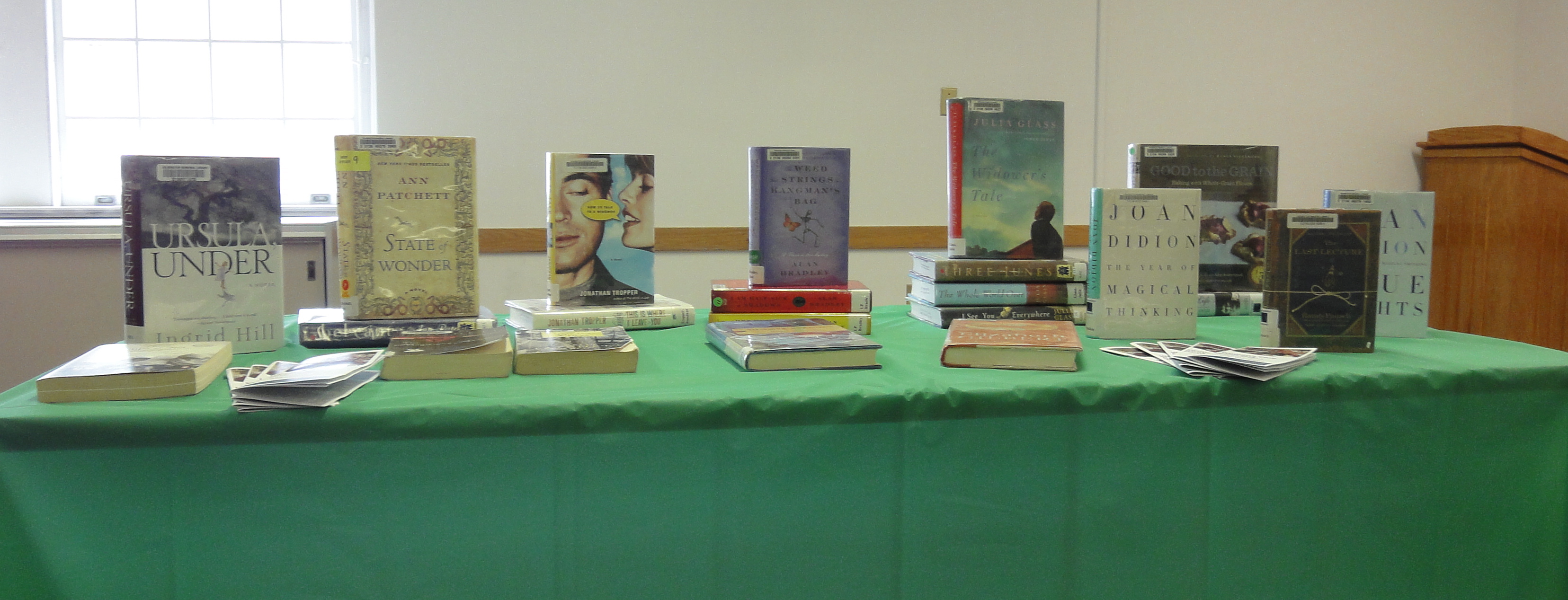
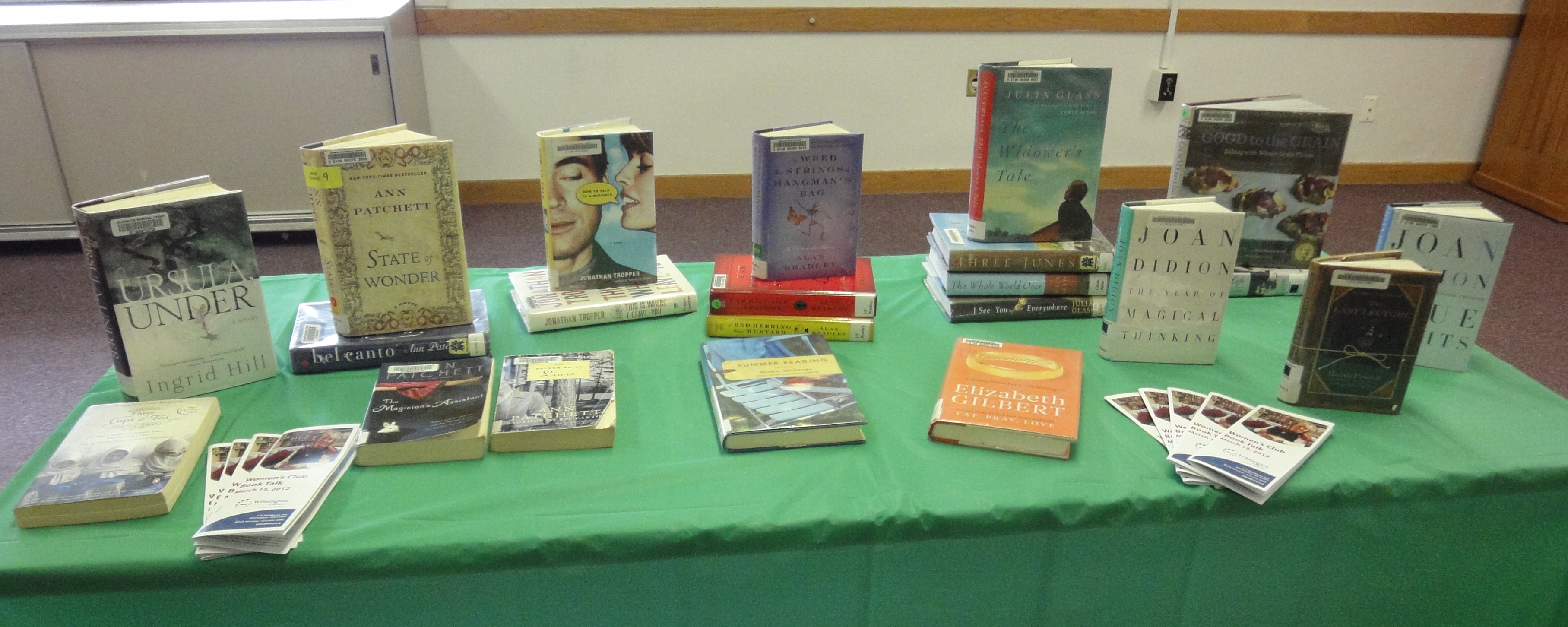
Right before the talk, I pulled all of the books I could find from the shelves and created this display. Some of the books were out, of course, but most are here, and in some cases I included the authors’ other books, if s/he had any.

From left to right: Ursula, Under by Ingrid Hill; State of Wonder, The Magician’s Assistant, The Patron Saint of Liars, and Bel Canto by Ann Patchett; How to Talk to A Widower and Then We Came to the End by Jonathan Tropper; Summer Reading by Hilma Wolitzer (An Available Man wasn’t available); Alan Bradley’s Flavia de Luce books (The Sweetness at the Bottom of the Pie is the first); Commitment by Elizabeth Gilbert; The Widower’s Tale, Three Junes, The Whole World Over, and I See You Everywhere by Julia Glass; The Year of Magical Thinking and Blue Nights by Joan Didion; Good to the Grain by Kim Boyce; and The Last Lecture by Randy Pausch and Jeffrey Zaslow (author of The Girls From Ames).

Not pictured (fiction): Her Fearful Symmetry and The Time Traveler’s Wife by Audrey Niffenegger; Wayward Saints by Suzzy Roche; The Flight of Gemma Hardy by Margot Livesey; The Tea Rose by Jennifer Donnelly; The Paris Wife by Paula McLain; I Married You for Happiness by Lily Tuck

Not pictured (YA): The Hunger Games by Suzanne Collins; The Fault in Our Stars by John Green

Not pictured (biography/memoir): Bossypants, Tina Fey; The Happiness Project, Gretchen Rubin; My Life in France, Julia Child and Alex Prudhomme; An Exact Replica of a Figment of My Imagination, Elizabeth McCracken

Not pictured (nonfiction): The Girls From Ames: A Story of Women and Friendship by Jeffrey Zaslow; The Spirit Catches You and You Fall Down by Anne Fadiman; The Girls Who Went Away by Ann Fessler; The Ghost Map by Steven Johnson

Hopefully, there’s something for everyone!

Do not pass Go, do not collect two hundred dollars: Apple and the publishers vs. Amazon?

Do you buy e-books? Did you feel surprised, taken aback, betrayed, indignant, outraged when the average e-book price suddenly jumped from $9.99 to $12-15? Now: have you thought about why those prices changed?

First, it’s important to understand that $9.99 is not the actual cost of an e-book: Amazon set that price point, and they were taking a loss on every e-book sale, in the hopes of luring more and more customers to buy their Kindle e-reader. Amazon was able to set e-book prices because they bought the books from publishers on the “wholesale” model: Amazon paid the publishers about half the cover price of the book, then set its own price for its customers.

A quick note about the real cost of a book: just because it’s a digital version – an e-book – rather than a book printed on paper doesn’t mean it was free to produce. Authors, editors, publicists and marketing people still had to be paid, offices still had to have lights on and computers running. The cost of paper and printing is somewhere in the neighborhood of $3 for a hardcover, less for a paperback.

So with the wholesale model, publishers could not set their own prices for books. With the “agency” model, however, they could: when Apple entered the e-book market, it allowed publishers to set their own prices and take 70% (Apple taking the remaining 30%). Apple also “reportedly stipulated” that publishers who used the agency model couldn’t sell their books for less to anyone else; thus, no more selling to Amazon on the wholesale model. The price change across the board is what drew the attention of both consumers and of the Justice Department, which is threatening Apple and five of the “big six” publishers with “allegedly colluding to raise prices.” (Never mind when airlines change their prices and policies one suspiciously close to the other. And do not get me started on cable companies. Or Amtrak.)

However, Washington Post columnist Steven Pearlstein advises the long view in this situation. True, when Apple broke up Amazon’s de facto monopoly, prices for consumers went up, not down; but, he points out, “What looked to consumers like a great bargain at $9.99 a book looked to others in the industry suspiciously like predatory pricing, or selling below cost today in order to gain a monopoly and raise prices in the future.” Which is better, he asks, “a market in which Amazon uses low prices to maintain its e-book monopoly and drive brick-and-mortar bookstores out of business, or one in which the major book publishers, in tacit collusion with Apple, break Amazon’s monopoly and raise prices?”

When you think about it that way, maybe paying an extra few dollars for your e-books is worth it.

Internet Archive

After having written about the Digital Public Library of America (DPLA) recently, it’s only fair that I should write about the Internet Archive as well. (Brewster Kahle, founder of Digital Librarian of the Internet Archive, is actually on the DPLA Steering Committee, so the two organizations are linked.) The Internet Archive is, quite simply, an Internet library. It is a nonprofit and was founded in 1996, so it’s been around for some time now.

One of its cool features is the “Wayback Machine,” which allows you to plug in a URL and pick a date to see what a given website looked like, say, ten years ago (if it was around then).

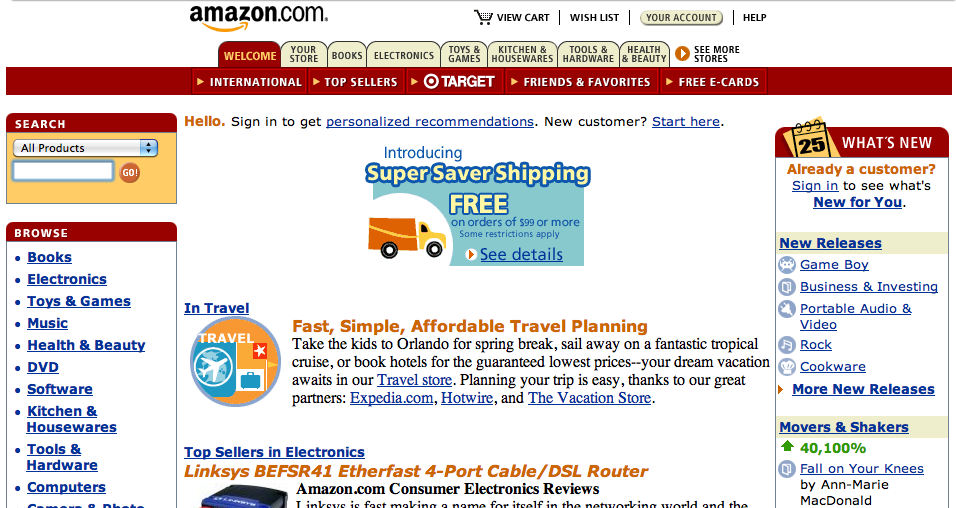
Amazon.com was around in 2002; let’s see what it looked like, shall we?

A little different than it looks today.

So the Wayback Machine is fun to play with (also, useful). And the Internet Archive’s digital library is a great project; but just in case digital copies aren’t enough, Kahle is also building a physical library (or, as The New York Times poetically puts it, an ark). “In case of digital disaster,” the article states, Kahle’s goal is to collect one copy of every book. Kahle said, “We must keep the past even as we’re inventing a new future. If the Library of Alexandria had made a copy of every book and sent it to India or China, we’d have the other works of Aristotle, the other plays of Euripides. One copy in one institution is not good enough.”

Considering how many various file formats and digital storage options we have already gone through in the past few decades, keeping one hard copy of every book isn’t a bad idea. Think about it: if you have some files on a floppy drive from 1998, can you still access them? And if you can’t access them, do they really exist, practically speaking? Whereas a book printed at the birth of the printing press hundreds of years ago can still be read by pretty much anyone (well, anyone patient enough to make their way through a whole variety of spellings).

Bookstores and Libraries

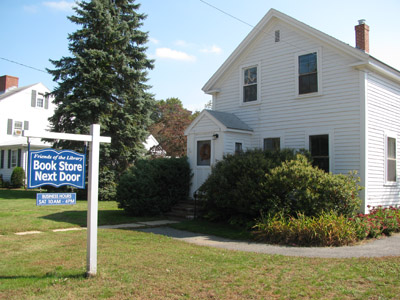
The Boston Globe ran an article yesterday about bookstores connected with libraries. The Book Store Next Door, run by the Friends of the Wilmington Memorial Library, is cited as an example. TBSND brings in funds for the library, and it’s a great place for community members to pick up cheap used books as well. Plus it’s in a charming little house – definitely worth a visit if you’re in the area!

Photo courtesy of the Wilmington Memorial Library.

A longer post about the process of weeding in libraries – i.e. getting rid of books – is in the pipeline.

Best of 2011, Part the Third: Fiction (I)

Here is the first batch of novels I’d recommend from my reading last year. Enjoy, discuss, ask questions! I’ll be posting more soon.

The first three Thursday Next books by Jasper Fforde – The Eyre AffairLost in a Good Book, and The Well of Lost Plots – are highly recommended for English majors or otherwise literary types with senses of humor. Set in a surreal version of England in the 1980s, literature is all-important, and Special Ops literary detective Thursday Next encounters such characters as Jane Eyre, Miss Havisham, and the Cheshire Cat throughout her cases. These books are extremely quirky with a lot of made-up jargon, and they’re fast-paced, but if you’re enough of a word-nerd, you’ll keep up. That said, I felt the quality of the series dropped off after the third book, which is why I only recommend the first three books here.

I’ve already raved about State of Wonder by Ann Patchett on my other blog and on the website of the library where I work, so I’ll just say here that Ann Patchett is absolutely one of my all-time favorite authors for a few reasons, all of which are on display in State of Wonder. First, there’s her complete mastery of setting; in State of Wonder, that includes both the Amazon and Minnesota. Wherever she writes about, it seems like she has lived there her whole life, the description is so rich and real. Second, her characters are real people; she understands them all so well, and there’s a real sense of empathy. Thirdly, the plot generally hinges on a situational conflict, rather than a protagonist-antagonist confrontation; this makes the story more interesting and complicated. Finally, the writing itself is just beautiful.

Geraldine Brooks is another author whose new books I always look forward to (Caleb’s Crossing is on my to-read list). She wrote March and Year of Wonders, both of which I’d recommend, as well as People of the Book, which is about a Hanna Heath, Australian rare book expert who is called in to restore the famous and long-lost Sarajevo Haggadah. Each time Hannah turns up a clue to the book’s past, the story jumps to that point in the book’s history: from Spain to Italy to Austria to Bosnia, each in a different time period, tracing the book’s journey to Hanna’s care in the present day. People of the Book is a great choice for those who enjoy stories-within-stories, those who are interested in history or rare book conservation, or those who just like good storytelling.

The Lover’s Dictionary by David Levithan was another of my “staff picks” for the library. It is Levithan’s first foray into literature for adults (he has written extensively for teens, including Boy Meets Boy and Love Is The Higher Law, and has collaborated with other YA authors – Rachel Cohn on Nick and Norah’s Infinite Playlist, John Green on Will Grayson, Will Grayson). The Lover’s Dictionary is funny and poetic by turns, showing a genuine understanding of two people in a relationship. “Definitions” – from “aberrant” to “zenith” – tell the whole story of one couple, from meeting and moving in together to fighting and making up. Through these brief snapshots – anywhere from one line to a few pages – a complete story is communicated.

Best of 2011, Part the Second: Humor and Baking

To break the general nonfiction category down to a manageable size , here are my picks for humor and baking:

Humor:

Sh*t My Dad Says, by Justin Halpern
This was funnier and had more depth than I expected it to be, considering it was spawned from a Twitter account. The quotes of the dad in question are organized thematically into categories and separated by short essays. This book really is laugh-out-loud funny (e.g., On Accidentally Eating Dog Treats: “Snausages? I’ve been eating dog treats? Why the f**k would you put them on the counter where the rest of the food is? F**ck it, they’re delicious. I will not be shamed by this.”)

Bossypants, by Tina Fey, and Is Everyone Hanging Out Without Me? (And Other Concerns), by Mindy Kaling
I wrote about these together on the library’s “staff picks” book review section. They are both in short essay format, easy to read a little at a time or straight through; but more importantly, they are smart and funny. If you like 30 Rock (Fey) or The Office (Kaling), chances are you will like these books. (Also, I found out that Mindy wrote my all-time favorite episode of The Office, “The Injury,” wherein Michael grills his foot on a George Foreman, Dwight gets a concussion, and Jim sprays him in the face with a squirt bottle. But that is neither here nor there.)

Cookbook:

Good to the Grain, by Kim Boyce
This was one of my staff picks, too. Boyce is a pastry chef and a mother, so her goal is to make healthy recipes without sacrificing any of the deliciousness – and by and large, she succeeds. Every recipe (especially the whole wheat chocolate chip cookies) I’ve made from this book has been a success. The sections are organized around the type of flour the recipes require, so you can try out one type at a time.

Best of 2011, Part the First: Young Adult

Saving the two major categories – adult fiction and nonfiction – for later, here are a few of the best young adult (YA) books that I read in 2011 (not necessarily published in 2011).

Looking for Alaska, by John Green
I was utterly blown away by this book. It is set at a boarding school in Alabama, where the main character Miles Halter (a.k.a. Pudge) comes seeking a “great perhaps.” What he finds is a teacher who makes him think, a friend who makes him laugh, and a girl who makes him dream – and breaks his heart. The structure of the book is unique: it is divided into two parts, Before and After, and instead of chapter headings there are countdowns (e.g. 121 days before; 29 days after). Looking for Alaska is a classic, tragic coming-of-age story, along the lines of Bridge to Terabithia and A Separate Peace. (I highly recommend John Green’s other books as well, including his newest, The Fault in Our Stars.)

Little Brother, by Cory Doctorow
Warning: This book will make you paranoid, for at least as long as it takes to read it and several days after. It features Marcus, a high school hacker who uses his intelligence primarily to evade the school’s efforts to invade his privacy. Marcus and his friends get drawn into a much bigger battle against a much more powerful enemy when the Department of Homeland Security picks them up after the Golden Gate Bridge is blown up. Part thought experiment, part meditation on privacy, security, and freedom (though meditation is too quiet a word to describe this book), Little Brother is thought-provoking, action-packed, and a little bit frightening – it’s our world, once-removed.

The Body of Christopher Creed, by Carol Plum-Ucci
Simply one of the best YA mysteries I have read in ages. Social outcast Christopher Creed goes missing after leaving an ambiguous note, and his classmate Torey Adams cannot let the disappearance rest – especially when rumors that Chris was murdered begin swirling, and fingers are pointed at people that Torey is sure are innocent. Torey is often introspective, musing on the nature of popularity and friendship, but this intensifies the suspense of the story rather than slowing it down. (There is also a sequel, Following Christopher Creed, which does not disappoint.)

Uglies, by Scott Westerfeld
A dystopian novel in a sea of dystopian novels, Uglies exceeded my expectations. In Tally Youngblood’s world, everyone is surgically transformed from an Ugly to a Pretty when they turn 16, and Tally can’t wait – but her transformation depends on betraying her friends, who ran away to escape being turned Pretty. When Tally goes after them, her journey and the people she meets open her eyes to what being Pretty really means. (This series continues through Pretties, Specials, and Extras. I read Pretties, and enjoyed it, but did not feel compelled to continue after that.)

A Northern Light, by Jennifer Donnelly
Fans of historical fiction: stop whatever you’re doing, go find this book, and read it. Set in the Adirondacks in 1906, A Northern Light is 16-year-old Mattie Gokey’s story. Mattie’s mother is dead, and Mattie has shouldered her duties on the farm, including taking care of her younger siblings. Mattie dreams of being a writer, and has a teacher who believes in her and encourages her; but a future as a writer is incompatible with the deathbed promise she made to her mother. Will Mattie put her family first, or her own dreams? Her decision hinges on a bundle of letters that a visitor leaves in her care, with instructions to destroy them – but Mattie reads them, and it changes the course of her life. (Inspired by the same case that inspired Theodore Dreiser’s An American Tragedy.)

Best of 2011: Prequel

[Yes, most people were more timely with their “best of 2011” lists. Better late than never, right?]

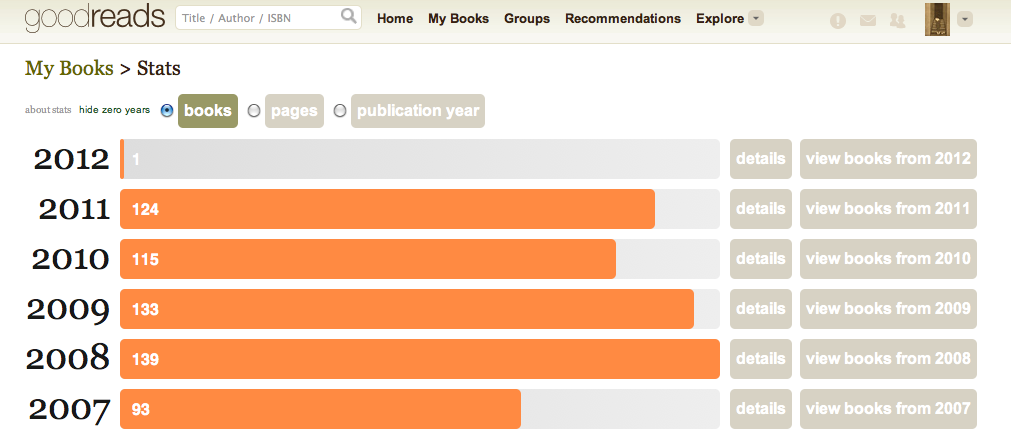
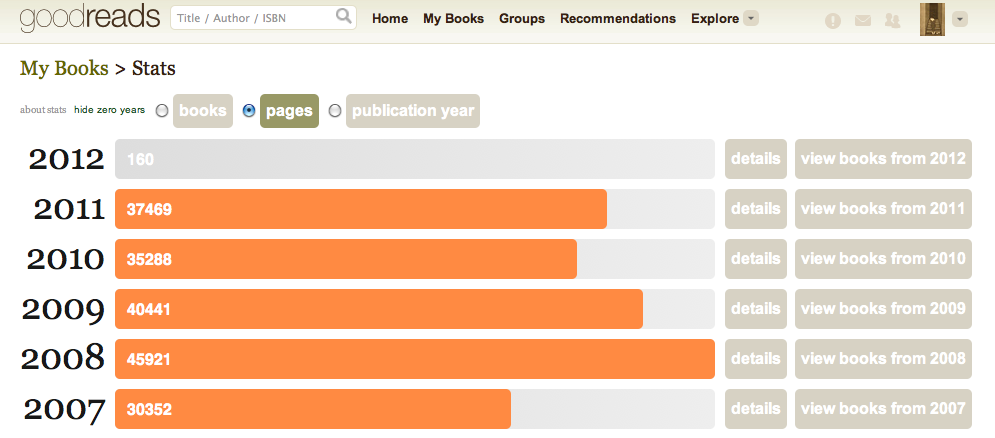
I’m not as statistics-happy as some, but I realized recently that Goodreads keeps some stats for you, and puts them into pretty little bar charts and scatter-plots. I’ve been using Goodreads pretty religiously since I discovered it mid-2007, and here’s what it had to tell me:

That’s 139 books in 2008 (the first full year I kept track), 133 books in 2009, 115 in 2010, and 124 last year, in 2011; it’s an average of 9.5-11.6 books per month.

Here’s another cool thing Goodreads calculates for you: page count! In 2008, I read 45,921 pages, or about 3,827 pages per month; last year, I read a total of 37,469 pages, an average of 3,122 pages per month. (This is just books, not articles online or for classes.)

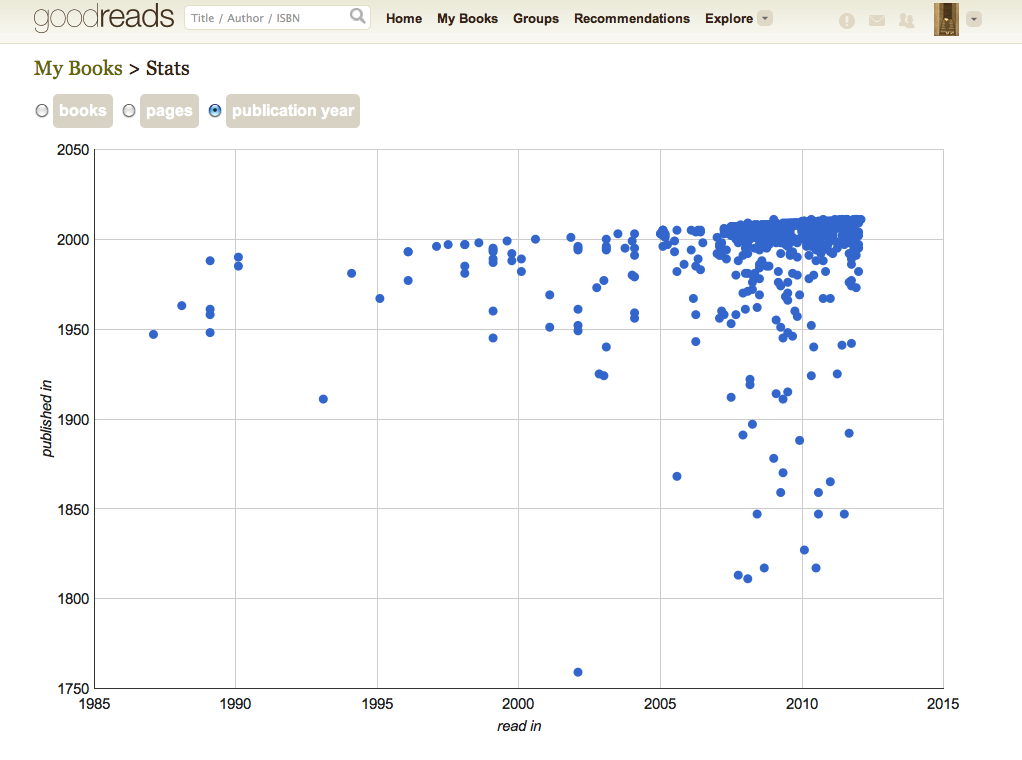
Finally, it creates a scatter plot of the publication dates of books you’ve read, with the pub date on the y-axis and the date you read the book on the x-axis. There’s a pretty dense cluster around the late ’90s and early 2000s, which makes sense as I read a lot of contemporary fiction, but there are some older books too, back as far as the early 1800s.

What statistics don’t tell you, of course, is anything about content. Which books did I love, which would I read again, which would I recommend? I’m glad you asked! I read a number of books I loved in 2011, and I’ll share those here soon. Meanwhile, here are some favorites from 2009 (I seem to have skipped a write-up for 2010): nonfiction, poetry, plays, and young adult fiction; short stories, classics, and “re-reads”; and fiction.