The Great Migration

The Amazon acquisition of Goodreads came right on the heels of another major change that I didn’t blog about here (though I did do plenty of reading about it): Google is shutting down its RSS tool, Google Reader, on July 1 of this year. This news sent its millions (but not enough millions, apparently) of loyal users in search of alternatives.

Google_Reader_logo_GalliganFor those who don’t use any RSS feed: how they work is that you add subscriptions – to blogs, news sites, or webcomics, for example – and all new content from those sites is collected in one place. It’s a great way of keeping track of content from many places on the web, especially if they post content at irregular intervals; by highlighting new content when it appears, the RSS feed ensures that none of the sites you want to follow disappear from your radar.

So, which tool to use to replace Google Reader? I don’t have a smartphone, but I wanted something that I could access from my home computer, my work computer, and my tablet; I wanted something browser-based, not an app or plugin I’d have to install. Lifehacker’s March 13 article about Google Reader alternatives is worthwhile if you’re still trying to decide which one to switch to, as is the March 14 article from Extreme Tech.
the-old-reader-logoIf I’d had a smartphone, I might have gone with Feedly (my roommate’s choice), and I’m not ruling out changing to NewsBlur (Cory Doctorow’s choice) in the future, but for now I’ve switched to The Old Reader. It did feel a bit like going back in time, and because so many others were switching over at the same time, it took a few days(!) to import the OPML file that I had exported from Google Reader, but it’s been working well so far.

Uploading my exported Goodreads data to LibraryThing took a little time as well, but not as long as I expected, and I was very pleased with the outcome; all my Goodreads “shelves” became tags in LibraryThing (e.g. young adult, science, cooking, magic, to-read). I’m still getting used to navigating around the LT interface, as I’ve only really used it for cataloging before, but I’ve had no major problems so far, and the documentation is very good, so I can often find the answers to my questions.

The LT staff, including Tim Spalding, are active and responsive members of the site. The “LibraryThing: How to Succeed in an Amazon/Goodreads World” thread has been so active that it has spawned several additional topic threads. Barbara Fister has also written a good overview about the “culture clash” that occurred when a wave of Goodreads users joined LibraryThing (“culture shock: when Goodreads and LibraryThing collide“).
LT_logoIf you’re thinking of becoming a member of LT, or if you’re just curious to learn more about what it is, you can’t do better than this collaborative piece from LT staff and members, “What Makes LibraryThing LibraryThing?” They address the difference between users and customers (LT is free only up to 200 books; after that, you’re required to pay, but the amount is “suggested” and you can get either annual or lifetime membership at a very reasonable price): “We have no ‘users.’ If you’re not the customer, you’re the product. If a social website can’t support itself on customers and straightforward products, it’ll eventually sell out what you gave it—your data, your friends, and the community itself….We want what paying creates—customers, with loyalty and rights—not “users.'”

The “user vs. customer” difference is becoming more apparent as platforms launch and close, are bought and sold. As Alex Kantrowitz noted in an article for Forbes (“Google Reader Shutdown a Sobering Reminder That ‘Our’ Technology Isn’t Ours,” March 13), “The death of Google Reader reveals a problem of the modern Internet that many of us likely have in the back of our heads but are afraid to let surface: We are all participants in a user driven Internet, but we are still just the users, nothing more. No matter how much work we put in to optimize our online presences, our tools and our experiences, we are still at the mercy of big companies controlling the platforms we operate on.”

This is something to consider seriously: the major social media sites (e.g. Facebook, Twitter) are free, and users produce the content, signing away more rights than they’re aware of by agreeing to the various sites’ Terms & Conditions. Though everyone likes free, there are some things worth paying for, and having a little more control in the content you produce, and a little more confidence that the platform on which you’re creating it won’t be unceremoniously pulled out from under you, is sometimes worth it. (Not to say, of course, that just because you pay for something, it will always be reliable, TIME WARNER. Companies go under, or they’re sold, or they change.)
demandprogressSpeaking of Terms & Conditions, the Computer Fraud and Abuse Act (CFAA) makes it extremely perilous to violate T&C (or Terms of Service); according to the Department of Justice, it can even be a felony. Read more and find out how you can take action to protect the internet as we know it.

This just in: Academic publisher Elsevier just acquired Mendeley, to the dismay of many of Mendeley’s users. Elsevier is notoriously expensive and anti-open access, whereas Mendeley is (was?) a free research and reference management tool. Many users will probably be jumping ship to Zotero, a similar service.
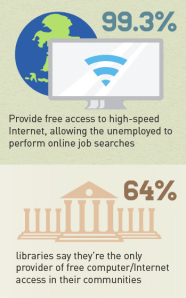
Why it makes sense to support public libraries

State Stats has created an awesome infographic about why it makes sense to support public libraries, especially during economic downturns. Unfortunately, economic downturns are precisely the times that library budgets tend to get slashed (or, in the best cases, level funded). No matter who you are – job-seeker, student, parent, someone who doesn’t want to (or can’t afford to) pay for books and movies – the library helps you! So please, take two minutes to read the infographic and pass it on.

Library Q&A

Stack Exchange, “a network of free, community-driven Q&A sites,” now has a Library and Information Science site in beta. Most of the library Q&A I have seen has been through LinkedIn groups’ discussions (mostly ALA), so this seems like a great forum for detailed, professional questions.

Because librarians are all about sharing knowledge, I’m optimistic that this site will be successful if enough library professionals know about it. So, librarian-friends, check it out! Read the FAQ before jumping in and asking/answering.

The science of working together

At the launch event for Interop: The Promise and Perils of Highly Interconnected Systems, the authors John Palfrey and Urs Gasser gave an overview of interop and provided several relevant examples. Though they began years ago on a theoretical level (does increased interop lead to increased innovation?), interop is a deeply practical topic.

“Interop” here is short for interoperability, defined as “the ability to transfer or render useful data and other information across systems (including organizations), applications, or components.” The authors decided that this initial definition, however, could be broadened into “the science of working together” on many layers: institutional, human, data, and technological.

Though it may sound abstract, there are many good examples of how interoperability is important in daily life. Solutions to big societal problems depend on interop, said Palfrey and Gasser. They talked first about “smart cities,” which depend on sharing information: between police, firefighters, and ambulances, for example, and between various forms of transit (does your bus pass also work for the subway and the commuter rail systems?).

Next they talked about open platforms, such as Facebook, which made its API available so that anyone could build an app. However, this interconnectedness has a down side: many points of connection means more vulnerability to privacy and security breaches. (This is also true of credit cards – another example of interop – which are vulnerable to identity theft.)

Facebook is an example from the private sector, but the public sector can drive interop as well, by regulation and legislation, as Europe has done for standardized cell phone chargers.

Naturally, one of the areas in which I am most interested is that of libraries. Libraries, said Palfrey, are facing two large interop problems: preservation of knowledge over time, and the lack of an open standard for e-lending.

The first issue has to do with reformatting; over the past decade or two, data has been stored not just in print, but in a whole variety of other ways, including floppy disks, microfilm, microfiche, CDs, and on computers in a variety of formats, some of which are no longer readable because the software necessary is no longer in use. Libraries must be vigilant to make sure that the information they have is preserved in an accessible form.

The second problem is one that has been in the news more or less constantly for a few years: there is no open standard for e-lending. Instead, there are a lot of proprietary formats that are not interoperable at all (e.g. you can’t read a kindle book on a nook device). “This is crazy,” Palfrey said. “Why is this [print book] still better technology?”

I hope and trust that, in the next few years, an open standard for e-lending will develop. In an ideal world, both libraries and individuals would be able to buy and lend any e-book, which could be read on any device.

Fingers crossed.

Upcoming local events

There are two local events coming up that I’m looking forward to; the first is tonight in the Harvard Law School building, where authors John Palfrey and Urs Gasser will be discussing their new book, Interop: The Promise and Perils of Highly Interconnected Systems. Palfrey and Gasser also co-authored Born Digital, and I’ve seen Palfrey speak before on the subject of the Digital Public Library of America (DPLA); he is intelligent and articulate.

The second event, at the Brookline Booksmith on June 8, is an author talk of a different sort. Jenny Lawson, a.k.a. The Bloggess, will be appearing for her new book, Let’s Pretend This Never Happened: (A Mostly True Memoir). As a fan of both blog and book, I am really excited to see her in person. If you haven’t heard of her before, I recommend reading her posts about Copernicus and Beyonce as an introduction.

Happy National Library Week!

April 8-14 is National Library Week! Show your support for your library by visiting in person, commenting on or “liking” your library’s social media pages (Facebook, Twitter, etc.) if it has them, participating in Library Snapshot Day on Thursday, volunteering, writing to your library director, or calling or writing to your local government representatives to let them know what libraries mean to you.

One of my favorite library statistics is that on average, a person will pay about $40 per year in taxes to support the library. That is less than the cost of two hardcover books – and libraries aren’t just for books (though they do usually have plenty of hardcovers, paperbacks, ebooks, and audiobooks). They also offer DVDs, public internet access, and programs – from storytime and crafts for kids, to movie screenings, to computer and technology workshops, and much more. What do you love about libraries? Leave a comment!

Anne Fadiman: “Never Do That To A Book”

Anne Fadiman, author of Ex Libris: Confessions of a Common Reader (and other books), spoke at the Main Branch of the Cambridge Public Library on April 1 as part of Harvard University’s 375th Anniversary. In her talk she revisited the subject she addressed in one of the essays in Ex Libris, “Never Do That To A Book”: in short, she identified two different types of book lovers, the “courtly” and the “carnal.” Courtly lovers treat the book as a sacred object; carnal lovers have a more physical relationship with books – folding down pages, underlining, highlighting, and writing marginalia, and in the odd case, using bacon for bookmarks.

Though Fadiman was most likely correct to say that “Everyone in this room loves books, but not in the same way,” most of the audience identified themselves as somewhere in the middle of the courtly/carnal scale. Fadiman is, by her own admission, a carnal lover of books, believing that marginalia is “a way of turning a monologue into a dialogue.” Reading, she believes, “is a relationship like any other.”

Fadiman also said, early in her talk,”The story of our lives is the story of our books,” which reminded me of a fragment of a poem (“Improvisations of the Caprisian Winter”) by Rainer Maria Rilke (translated by Franz Wright):

So many things lie torn open
by rash hands that arrived too late,
in search of you: they wanted to know.

And sometimes in an old book
an incomprehensible passage is underlined.
You were there, once. What has become of you?

I am also somewhere in the middle of the courtly/carnal book lover scale; in books that I own, I have written and underlined (but only in pencil). I have folded down the corners of pages (but only until I finish the book – then I write down all the quotes I wanted from the dog-eared pages and un-dog-ear them). I do not splay books face-down; I do not highlight; I do not sleep with them under my pillow (though there is a stack on the nightstand and another stack on the floor).

And of course, whether the book was my own or belonged to the library, I would never use bacon for a bookmark.

A Day in the Life

Toward the end of this TechCrunch article about how Random House just tripled the price of ebooks for libraries, there was a link to this well-written, insightful blog post on MetaFilter about why libraries are not anachronistic – about why, in fact, they are more essential than ever.

In the post, the author urges the reader to “imagine this: you’re 53 years old, you’ve been in prison from 20 to 26, you didn’t finish high school, and you have a grandson who you’re now supporting because your daughter is in jail. You’re lucky, you have a job at the local Wendy’s. You have to fill out a renewal form for government assistance which has just been moved online as a cost saving measure (this isn’t hypothetical, more and more municipalities are doing this now). You have a very limited idea of how to use a computer, you don’t have Internet access, and your survival (and the survival of your grandson) is contingent upon this form being filled out correctly.”

Then the author goes through every step of the scenario, and concludes, rightly, “If you have any concept of a free and equal society, then libraries are still an integral part of that.”

Building the Digital Public Library of America

On Friday a friend and former classmate and I went to the “Building the Digital Public Library of America” program at Harvard, where Robert Darnton and John Palfrey both spoke and answered questions. Darnton is the Director of the University Library and also a professor at Harvard, as well as a co-founder of the DPLA, and the author of The Case for Books, among many others; Palfrey is also a Harvard professor and the chair of the DPLA steering committee, as well as the author of Born Digital and other books.

The DPLA is envisioned as “an open, distributed network of comprehensive online resources that would draw on the nation’s living heritage from libraries, universities, archives, and museums in order to educate, inform and empower everyone in the current and future generations.” Naturally this goal is viewed by some as utopian or simply impossible, but as Darnton said Friday, “We don’t have answers, [but we do have] the determination, expertise, funds, and public support…We will make it happen.” Calling the DPLA a big task is an understatement, but, Palfrey said, “This is exactly the moment to think this big…[if we don’t] we are falling short.”

There are design challenges and technical challenges, but “these challenges can be met and will be met,” said Palfrey. As for what exactly the DPLA will contain or look like, he said, “What is the DPLA? We’re not sure yet. And we’re not sure on purpose.” People have dedicated themselves to workstreams for the five elements of the DPLA: code, metadata, content, tolls & services, and community.

The biggest challenge is that of copyright; it’s why Google Books ultimately failed. In order to succeed, there must be some agreement between the creators (authors), the publishers, and the service/platform/distributors. Unlike Google Books, the DPLA aims to provide free access, not commercial access, to a broad public. Behind the DPLA is the belief that access to information is (a) the right of citizens, and (b) fundamental to democracy.

Models of this type already exist; one is Europeana, “a single access point to millions of books, paintings, films, museum objects and archival records that have been digitised throughout Europe. It is an authoritative source of information coming from European cultural and scientific institutions.”

The digital divide is one concern; despite the growth of e-readers and e-books, and the widespread (but not complete) availability of Internet access, for many people, print content is still more accessible than digital content, especially when digital content comes encumbered with DRM and other limitations.

Another concern, raised during the Q&A on Friday, is how the DPLA will affect public libraries. The people working on the DPLA are pro-library; many are librarians. Darnton emphasized that they are designing the DPLA “not to undercut public libraries…[but rather] to reinforce public libraries.” The DPLA, he argued, would make public libraries more important: not only could they serve as an access point, but librarians could create and curate local collections. Overall, the DPLA “is a very complex ecosystem and we need guides through it.” Librarians, Darnton says, can be those guides.

This is one of my answers when people ask if librarians are necessary anymore, because “everything is on the Internet.” Perhaps it is (though not everything is Google-able) – but can you find it? The proliferation of information, both in print and online, is overwhelming – “information overload,” anyone? – and most people could use some help sifting through the hundreds, thousands, or millions of search results to find something reliable and relevant. That’s one reason why librarians are necessary – and this librarian is excited to search within the DPLA as soon as it is up and running, just over a year from now.

When Will There Be Good News?

Yes, I borrowed the title of a Kate Atkinson book for this post (although if you’re going to read her, I highly recommend Case Histories instead). It is now a full week into the new year (happy 2012!) and this is my first post; I have written others but they did not seem like the right ones with which to begin the year.

This morning, however, I read an article in the Boston Globe about a 13-year-old Massachusetts boy who contacted artists to create trees, which he would then donate the the nonprofit Reach Out and Read; the organization could auction off the artists’ trees at their annual fundraiser to raise money for early literacy.

Not only is this a cool idea, and an admirable (and successful) effort on the part of a teenage boy, but what really got to me was his quote at the end of the article: “Sometimes when people say they don’t like to read, the truth is they just haven’t found a book they like.’’ Sounds like a future librarian to me…