MLA 2015: Through the Library Lens, Part II

Here we go, Day Two of MLA! Read about Monday sessions here.

Flexibility in Library Design, or Agile Libraries that Evolve with You, presented by Lauren Stara and Rosemary Waltos of the MBLC and Sal Genovese of the Walpole Public Library (Tuesday, May 5, 8:30am)

Three cheers for Lauren Stara, who posted her presentation slides online in advance of this session. Check out her slides for lots of great visuals of “lightweight, portable, modular, convenient, approachable” furniture, from service desks to comfy chairs; she included examples from many libraries in the U.S. and Canada. (The presenters’ contact info and a link to several useful Pinterest boards are available through that link as well.) There were tons of tweets during this session (see below), and between those and the slides, I don’t have much to add except that I’m in favor of flexible, adaptable design in libraries and I want to use at least 75% of these ideas right away. Also, I’ve added Aaron Schmidt’s Useful, Useable, Desirable to my ever-growing to-read list.
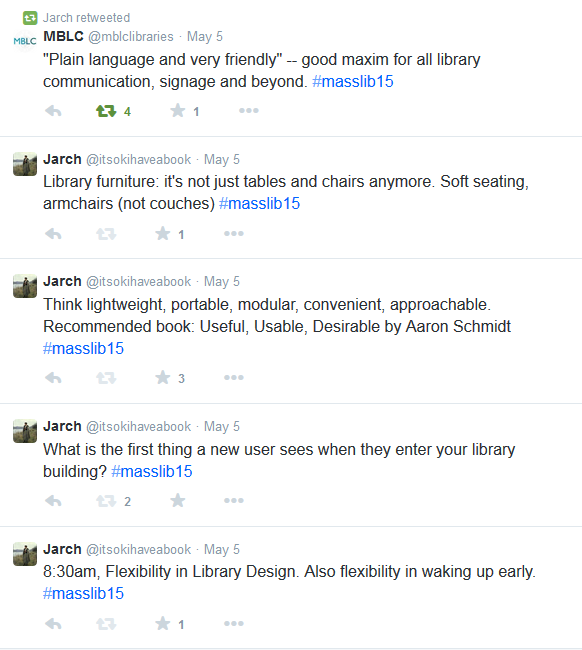
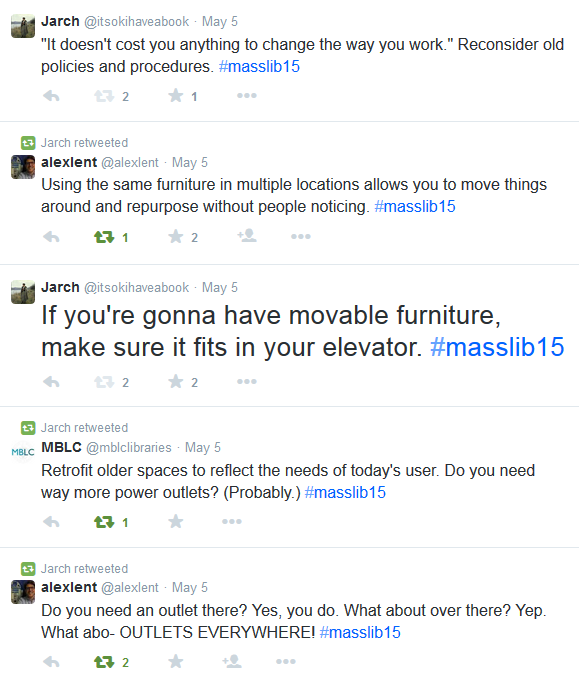
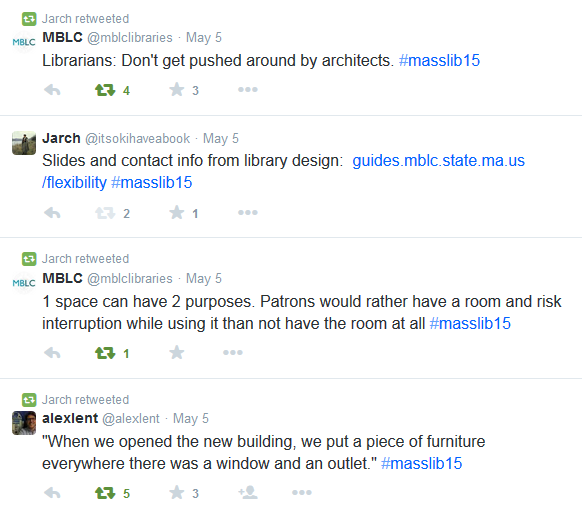
Screenshot of tweets including What is the first thing a new user sees when they enter your library building?Screenshot of tweets including If you're gonna have movable furniture, make sure it fits in your elevator.Screenshot of tweets, including "When we opened the new building, we put a piece of furniture everywhere there was a window and an outlet."

An Introduction to Fighting Surveillance and Promoting Privacy in Libraries, presented by Alison Macrina of the Library Freedom Project and Kade Crockford of the ACLU (Tuesday, May 5, 9:50am)

I’ve heard Kade and Alison before, but even though most of their presentation was familiar, it’s worth hearing and sharing again – plus I picked up a couple of new tips, as usual. Alison introduced a whole series of online privacy tools, which are also collected on the Library Freedom Project’s resources page.

Libraries can introduce patrons to some of these tools by installing them on public computers, and posting signs to explain the changes and raise awareness about protecting online privacy. The TOR browser is one option (“it’s not just for criminals anymore!”), and the Firefox browser with the DuckDuckGo search engine and HTTPS Everywhere and Privacy Badger plugins is another great choice. (I’m planning to switch from the Ghostery plugin to Privacy Badger, after learning that Ghostery sells information to advertisers – though this is something you can control in your settings if you do have it installed.) Good privacy options (secure texting and phone calls) for mobile phones  can be downloaded from Open Whisper Systems.
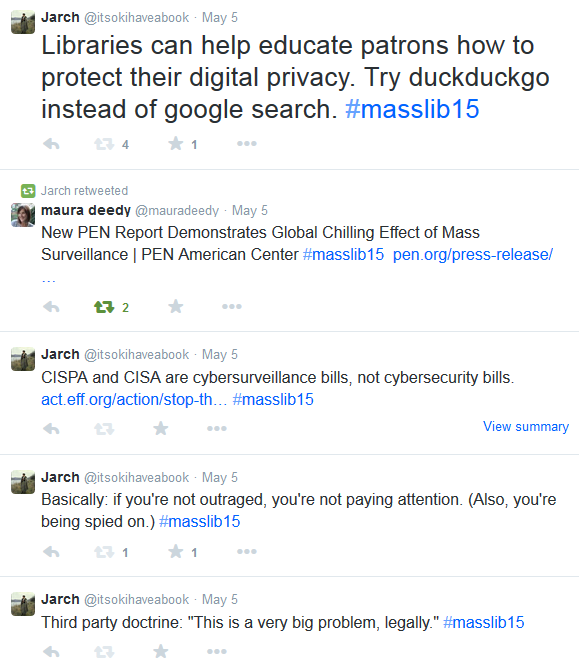
Screenshot of tweets, including Libraries can help educate patrons how to protect their digital privacy. Try duckduckgo instead of google search.

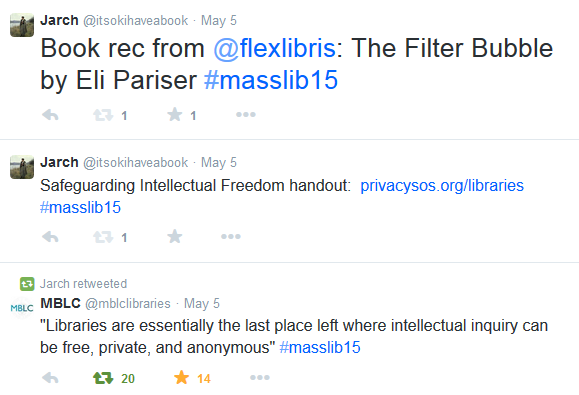
Screenshot of tweets, including Book rec from @flexlibris: The Filter Bubble by Eli Pariser #masslib15

Advocacy and Your Library, with panelists Edward M. Augustus, Jr., City Manager of Worcester; Representative Kate Hogan, 3rd Middlesex, Chair, Public Library Caucus; John Arnold, Town Moderator, Westborough. Moderators: Susan McAlister, Dinah O’Brien, and Beverly Shank, MLA Legislative Committee Co-Chairs  (Tuesday, May 5, 11:15am)

The takeaway point from this session: the importance of building a relationship with local legislators so that your only contact with them isn’t when you’re asking for money. (At the same time, “You are never going to get what you want if you don’t ask for it.”) It’s important for library staff to be involved, and also to encourage library trustees and patrons to advocate for the library; often, a patron’s voice is more persuasive to a legislator than a librarian’s. When librarians do speak on behalf of the library, the focus ought to be “We’re not here to preserve my job, we’re trying to make the community a better place.”

Demonstrating real outcomes for real people, through qualitative (anecdotes, stories) and quantitative (numbers and statistics) evidence, is most effective. Collaborating and building coalitions with other community groups is also helpful; there are many groups and limited resources. That said, libraries do a lot with a little – specifically, with 0.07% of the Massachusetts state budget.
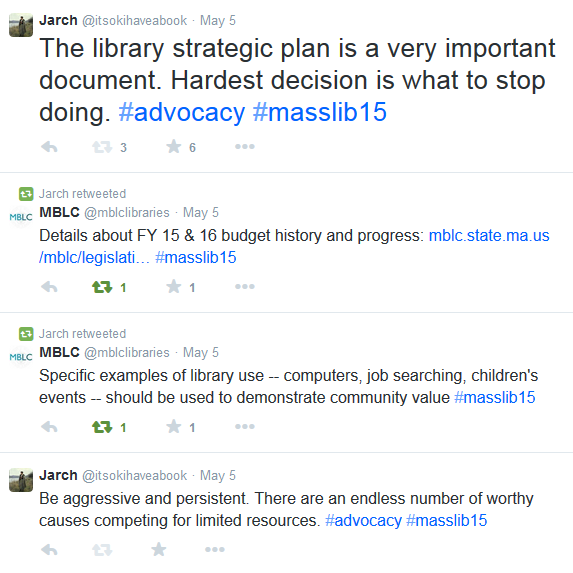
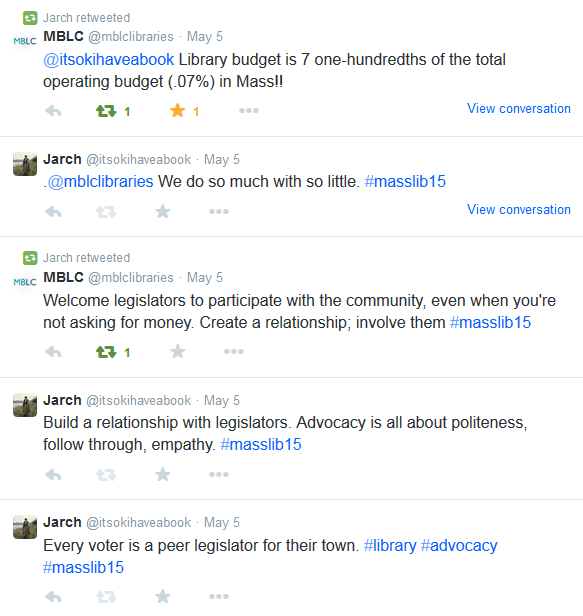
Screenshot of tweets, including Be aggressive and persistent. There are an endless number of worthy causes competing for limited resources. #advocacyScreenshot of tweets, including Library budget is 7 one-hundredths of the total operating budget (.07%) in Mass!!

A Whale of a Good Time: Summer Library Programming for All Ages, presented by Jennifer Harris and Margaret McGrath of the Plymouth Public Library (Tuesday, May 5, 2:30pm)

Attendees had two choices during this session: get inspired, or take your ball and glove and go home, because this was a hell of a summer reading program/community read (“One Book, One Community”). First of all, they got people to read Moby-Dick, which is impressive on its own. Second, they did a massive PR push, with mailings to 25,000 households and visits to all the elementary schools, raising awareness for all ages; high school art students were recruited to help with PR design. Third, they used every last drop of a $3,000 programming budget, spreading programs for all ages throughout the summer. Programs included three book discussions (it’s 600+ pages, folks), concerts on the lawn in front of the library, knot-tying lessons, a mini-readathon, a craft program series for teens, a hard tack tasting (verdict: not tasty), a movie screening, a Melville impersonator, a field trip to the New Bedford Whaling Museum, and visits from two separate inflatable whales.

Key to the success of the Plymouth Public Library program was staff buy-in and great brainstorming sessions, as well as a healthy budget, good planning, and great PR (in addition to the mailings, they were active on Facebook, Twitter, Flickr, and Pinterest, and events appeared in the Boston Globe and on local TV as well).

Our library does a Community Read (Arlington Reads Together) in the spring, separate from our summer reading programs for children, teens, and adults. I’m curious how many other libraries combine their Community Read with summer reading.

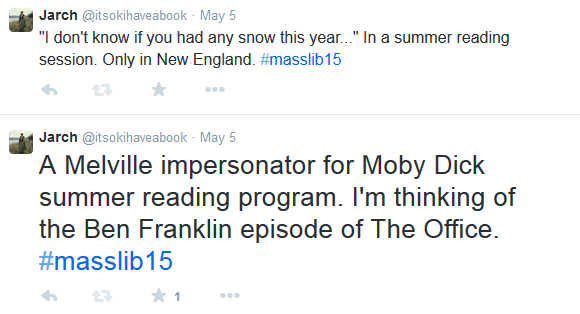
Screenshot of tweet: PR: The message has to go out so that we can bring the people in. #summerreading #masslib15Screenshot of tweet: "If someone doesn't call you back, and you call a few days later and they still don't call you back, move on!" #lifeadvice #masslib15Screenshot of tweets: A Melville impersonator for Moby Dick summer reading program. I'm thinking of the Ben Franklin episode of The Office. #masslib15

RA Toolbox: Staying Alive – Readers’ Advisory Continuing Education, presented by Laurie Cavanaugh of the Holmes Public Library, Nanci Milone Hill of the Parker Memorial Library, Molly Moss, of the Forbes Library, and Leane M. Ellis of the Lucius Beebe Memorial Library (Tuesday, May 5, 4:15pm)

Each panelist in this session had been the recipient of a LSTA grant for readers’ advisory, administered through the MBLC, so each panelist talked about how they’d implemented the grant, as well as how they’d come to be interested (and expert) in readers’ advisory. Molly had a background in science and academic libraries; readers’ advisory was the most intimidating part of working at a public library reference desk for her. She tackled the task and became involved in the Adult Reading Round Table (ARRT) of Illinois. There is now a Readers’ Advisory Round Table (RART) for every region of Massachusetts (Northeast, West, Metrowest, Southeast), and each one has a blog.

Grant money can be put toward speaker fees, conference fees, materials (books), shelf talker materials (those plastic things that clip on to shelves), staff time, and mileage. Nanci invited Duncan Smith from NoveList to speak to her staff, as well as the Sisters in Crime; Molly invited Barry Trott of the Williamsburg (VA) Regional Library. The WRL was the first library to put a “reader profile form” online; many libraries, including the Forbes in Northampton and the Robbins in Arlington, have adapted the form (with permission) to use on their own websites. Librarians at the Forbes have also done blitz-style RA, asking patrons to post to the library’s Facebook wall with a book they liked, and recommending another book based on that one.

All the panelists talked about genre studies. A typical model includes monthly or bi-monthly meetings where participants read one “benchmark” book in a genre or subgenre, and one secondary selection. This allows for common ground (the book everyone read) and new recommendations. Genre studies can be done within a library, in partnership between two libraries, and through the round table groups across the state. Virtual participants are welcome in the Massachusetts Readers’ Advisory Goodreads group.

Laurie said that readers’ advisory was “customer service in the digital age,” providing a personal touch. Leane, too, said that RA was “public service on a personal level for your readers and potential readers.” Customized forms are just one way to provide great recommendations to patrons; other models include “five to try” booklists, “If you like [author/title, TV show, etc.], you might also like [___],” subgenre booklists, and staff picks lists.

This session concentrated on the LSTA RA grant and implementing genre studies, rather than specific RA tips such as including appeal factors as well as a summary when talking or writing about a book (and no spoilers!). The RA interview was covered in a previous session, RA Toolbox: Conversing with the Reader – the Readers’ Advisory Interview. Additional RA tips and resources are available from MLS. The MLA RA Toolbox handout should, hopefully, be available soon on the Presentations & Handouts page of the conference site.
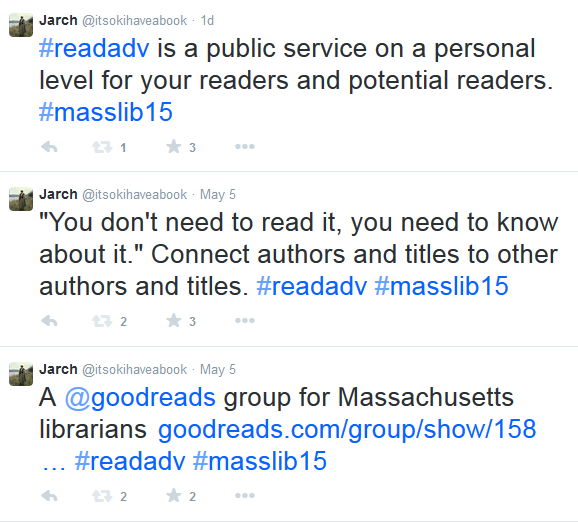
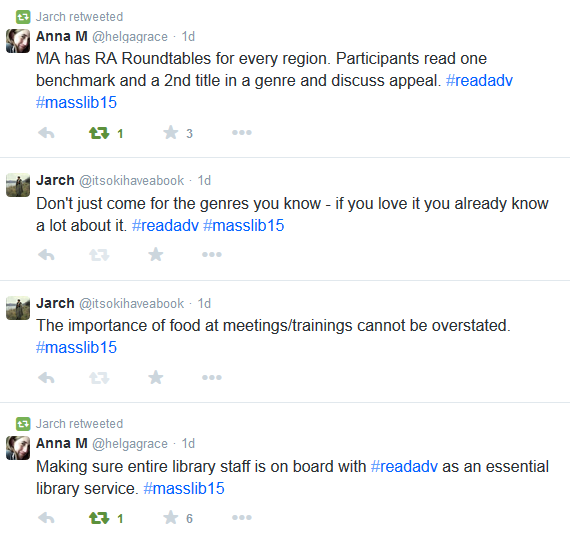
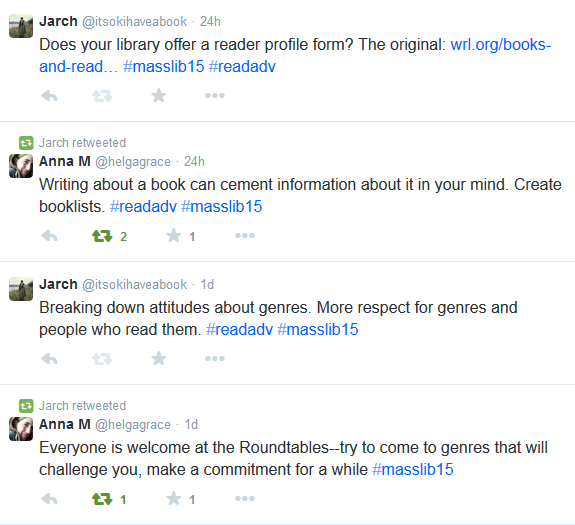
Screenshot of tweets including #readadv is a public service on a personal level for your readers and potential readers.Screenshot of tweets including Making sure entire library staff is on board with #readadv as an essential library service. #masslib15Screenshot of tweets including Writing about a book can cement information about it in your mind. Create booklists. #readadv #masslib15 2 retweets 1 favorite

Overall, a great conference experience that gave me plenty of ideas and resources to follow up on in the coming weeks, plus an opportunity to see friendly faces from grad school, past library work, fellow committee members, and even friends from Twitter.

If you have questions about any of these recaps, or have written your own recaps to share, please ask or link in the comments!

 

MLA 2015: Through the Library Lens, Part I

Thanks to my library’s wonderful support for professional development, once again I got to attend the Massachusetts Library Association (MLA) annual conference. This year’s theme was “through the library lens,” though none of the sessions I went to specifically addressed what that might mean. (Could it just be a joke about how most of us wear glasses?) (Probably not.) The conference hashtag was #masslib15 and several of us were active on Twitter during the conference.

Throughout my session recaps, I will include links to presentations and slides when possible; most aren’t available online yet, but they should be posted on the presentations & handouts page of the MLA site. (I spoke to a conference organizer about maybe having the materials posted online before the conference started; she said it was hard enough to get the details of everyone’s programs in advance of the conference, getting presentations ahead of time would be next to impossible.)

Bite-Size Learning: Staff Training a Little at a Time, presented by Michelle Filleul, Amy Lannon, and Patty O’Donnell of the Reading Public Library (Monday, May 4, 10:30am)

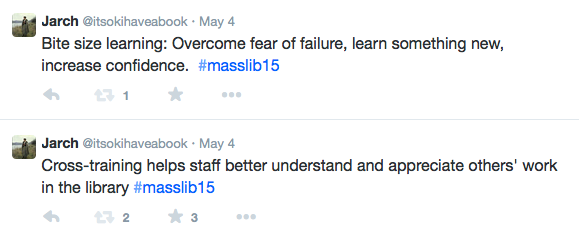
This session started off with a seven-minute video (“Did You Know 2014“); it’s worthwhile, but I recommend watching it without the sound. The main point is that the world is changing rapidly, especially technology. Libraries can encourage their staff to be “lifetime learners” and create a learner-centric culture by implementing a “bite-size learning” program: each participating staff member gets to spend an hour a week learning something new. This learning is self-directed, internally motivated, goal-oriented, and self-paced; it is relevant to the individual, and is experiential (learn by doing).

Individuals might choose to familiarize themselves with Overdrive or read storytime blogs; they might explore Ancestry.com or take a webinar on any number of subjects. Managers/leaders can start with competency checklists and tailor them to their departments. Staff set specific goals and check in with their supervisor each week to track progress; supervisors participate in the program too. Seeing department heads and directors learn new things sets a good example and breaks down the fear of failure that can accompany trying something out of one’s comfort zone.

A paralibrarian from Reading spoke movingly about how the bite-size learning helped her; she said, “Technology isn’t my thing, but learning is….I don’t want to become a senior citizen who didn’t keep up with technology. I want to communicate with the younger generation on their terms….We have to know how to do these things.” Learning new skills builds confidence in one’s ability to learn, and in one’s ability to help others – a pretty big payoff in exchange for an hour a week.

Screenshot of tweet: Self-directed learning: internally motivated, goal oriented, self-paced, relevant to learner, experiential #masslib15Screenshot of two tweets: Cross-training helps staff better understand and appreciate others' work in the library -and- Bite size learning: Overcome fear of failure, learn something new, increase confidence.

Stealth Reference: Reaching Non-Library Users, presented by Margot Malachowski from the Baystate Health Sciences Library, Anne Gancarz from the Chicopee Public Library, and John Walsh from the Newton Free Library (Monday, May 4, 1:15pm)

“Stealth reference” is a very cool name for what is usually referred to as “outreach.” Margot from Baystate talked about identifying your vulnerable populations, and aligning programs with community needs. She teaches the public directly, taking questions and answering them by mail (five stars for follow-up!), and she also teaches the people who teach the public, like The Literacy Project.

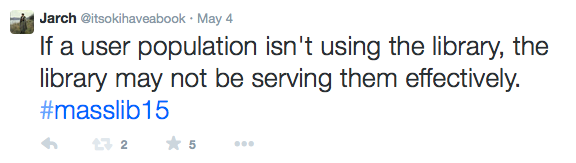
Screenshot of tweet: If a user population isn't using the library, the library may not be serving them effectively.

Anne from Chicopee asked herself, “Who am I seeking? What am I offering?” and asked what motivation potential users had to come to the library. Anne, I suspect, doesn’t sleep much: she has gone into schools, visited homebound patrons, worked with teens, connected to the visually impaired community, gone to the farmers’ market, worked with the sheriff and ex-offenders, and worked with the Council on Aging (COA); there is a bookmobile in her future. Anne suggested collaboration: with town departments like Parks & Rec, the COA, planning boards, and local events. She noticed that program popularity is cyclical; what works one year may not work the next year. “We’re always awesome and helpful,” she said, “but people don’t always know that.” If every library had a Community Services Librarian like Anne, more people would know about all the things libraries have to offer.

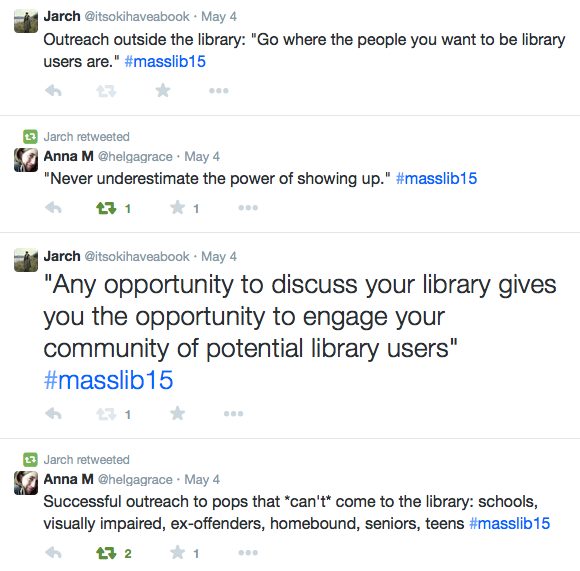
Screenshot of tweets and RTs, including "Any opportunity to discuss your library gives you the opportunity to engage your community of potential library users"

Last but not least, John also talked about leaving the library building, going where the people you want to be users are, and showing them what they’re missing. “They don’t know they want things” or they don’t think the library has them. He recommended contacting businesses in the area; even chains like Starbucks and Whole Foods sometimes have community relations people who may be eager to help. Bring some handouts with you, he advised, but those handouts should be immediately useful – a calendar of events, a link to the digital media catalog, etc.

One of the challenges libraries face with outreach efforts – assuming that library leadership supports it – is finding the time for staff to leave the building. Many public libraries are short-staffed, and most won’t consider leaving the reference desk unattended while librarians are at the farmers’ market, the high school, or the senior center. Off-desk hours are precious too – that’s when we order books and other materials, plan programs, create booklists and displays and flyers and a hundred other things – but starting small is better than nothing at all.

Connecting the Dots of Internet Freedom: The Future of Free Speech, presented by Evan Greer from Fight for the Future (Monday, May 4, 2:45pm)

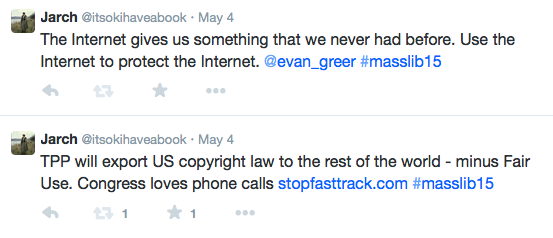
Like many privacy advocates, Evan is an impassioned speaker. She concentrated on four modern threats to freedom of expression on the Internet: (1) attacks on Net Neutrality, (2) mass surveillance, (3) overzealous copyright enforcement, and (4) secretive trade deals, e.g. the Trans-Pacific Partnership (TPP). Her presentation was both entertaining and convincing, though I suspect the people in attendance were convinced before they showed up. I tweeted throughout this session; see below for tweets and additional links.

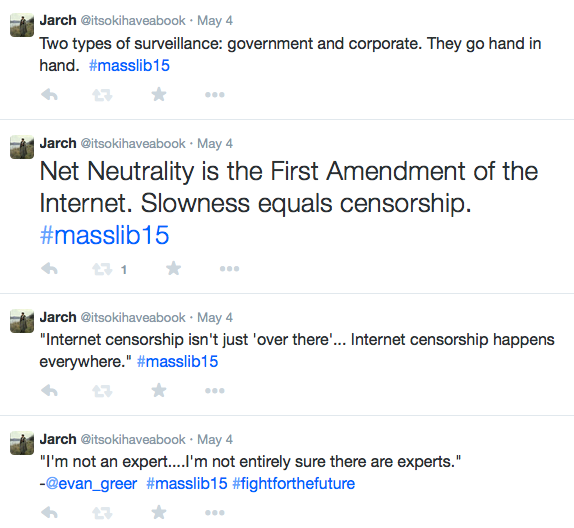
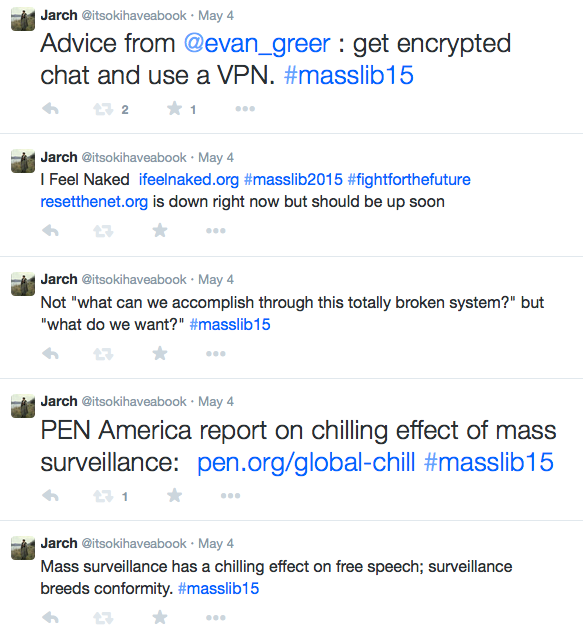
Screenshot of tweets, including Net Neutrality is the First Amendment of the Internet. Slowness equals censorship. Screenshot of tweets, including PEN America report on chilling effect of mass surveillance:  http://pen.org/global-chill  #masslib15Screenshot of tweets including TPP will export US copyright law to the rest of the world - minus Fair Use. Congress loves phone calls https://www.stopfasttrack.com/ Links:

Power of the Written Word: Librarian Influence Through Writing Reviews, presented by Kristi Chadwick of the Massachusetts Library System, Rebecca Vnuk of Booklist, and Nanci Milone Hill of the M.G. Parker Memorial Library in Dracut (Monday, May 4, 4:00pm)

Rebecca, Kristi, and Nanci all gave general advice about writing reviews as well as specific tips for which publications are looking for reviewers and whether or not they pay (mostly they don’t, but book reviewing shows engagement with the profession and looks good to potential future employers, etc.). They also talked about how they got started; they all “fell into it” (but only if “falling into it” means seeking out and creating opportunities for writing reviews and honing their blogging skills).

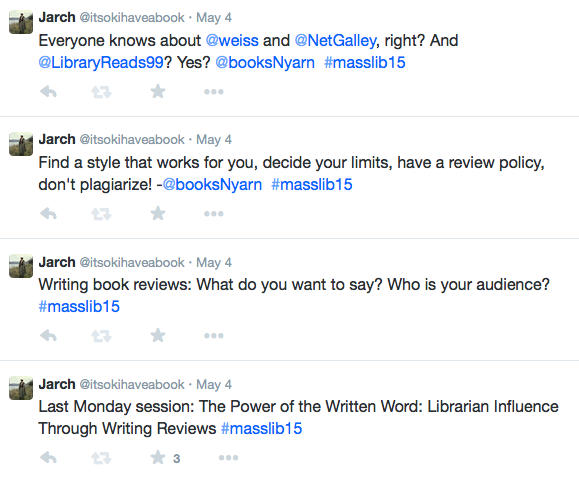
Rebecca (Shelf Renewal) talked about some of the standard review publications – Library Journal and SLJ, Booklist, Kirkus, VOYA – and their different style guides. Find your voice: is it conversational or formal? Figure out what you want to say and who your audience is. Incorporate readers’ advisory aspects (e.g. appeal factors) into your reviews, and a sense of humor. If you do get your reviews published in one of these sources, cut out your printed review and compare it to what you submitted, line by line; this will improve your reviews. Take cues from existing blogs and websites, and practice writing reviews on Amazon, Goodreads, or LibraryThing.

Kristi’s advice: find your review style, decide your limits, have a review policy, and don’t read other reviews of the book you’re reviewing (beware unintentional plagiarism). Identify the hook, the who/what/when/where/why, who the book will appeal to, and of course…no spoilers! Get e-galleys through NetGalley and/or Edelweiss and submit reviews to LibraryReads.

Screenshot of tweets, including Writing book reviews: What do you want to say? Who is your audience? #masslib15 -and- Find a style that works for you, decide your limits, have a review policy, don't plagiarize! -@booksNyarn Nanci suggested getting involved with your local Readers’ Advisory Round Table (every region of Massachusetts has one), and mentioned a few less obvious candidates for would-be reviewers and writers: NoveList, Public Libraries magazine, Bookmarks magazine, ALA Editions, the Massachusetts Center for the Book, and your local newspaper. Creating readers’ advisory materials for your own library is good practice too: shelf talkers (“If you like ___, try ___”), author and title readalikes, appeal readalikes, “five to try” (genre suggestions), etc.

As usual, presenters mentioned so many good resources and opportunities that follow-up will take me the next several weeks. And this was just day one – stay tuned for day two.

The Importance of School Libraries and School Librarians

Did your elementary, middle, and high school have a library? I attended four different schools in two states between kindergarten and twelfth grade, and each of the four had a library; each of the libraries had a librarian and books. (I wish I didn’t have to spell that out, but bear with me.) Innocently, I took the presence of these libraries for granted, and assumed all schools had them, but this is not the case. Just as “extras” like music and art programs have been cut in public schools, so have libraries.

I read two articles last month (via the essential Library Link of the Day) about school systems that lack libraries and/or librarians and/or an adequate number of books that students are able to check out. The first article, “Unequal Shelves in D.C. School Libraries Benefit Wealthier Students” (Washington Post, March 9, 2015), says that despite literacy being a high priority, the District dedicates no annual funding for school library collections. Later, the article links to a report that conclusively shows the positive impact school libraries have on students’ literacy: “A school library media program that provides up-to-date, accurate, and attractive resources, managed by a certified school library media specialist who collaborates with teachers to augment and enhance classroom instruction, results in increased test scores, particularly in reading….The most important elements of school library media programs have been the quality of staffing and the quality of collections.”

Many Pennsylvania schools are without libraries and/or librarians as well, according to the article “School Cuts Have Decimated Librarians” (Philly.com, February 2, 2015), and in that state too, there is unequal access. University teacher and researcher Debra Kachel said, “The wealthy schools have great programs, librarians teaching kids, coaching them, developing a habit of reading with those kids. Librarians are teaching critical thinking skills, how to search the Internet, how to be safe on the Internet. If you invest in a school librarian, you invest in improving student learning.” Yet many other schools don’t have librarians and lack access to library resources, despite the fact that studies have shown that students who have access to a school library and librarian – “particularly students who live in poverty and students of color” – achieve more. Despite the evidence of their value, a school librarian commented, “Somehow, we struggle to get recognized as relevant to schools.”

This is one of those bang-your-head-against-a-wall* situations, where all the research points to one clear course of action, but rather than take that course of action, unproven alternatives are substituted instead. In this case, decision-makers will point to budget issues, but that seems short-sighted to me. You want to raise reading scores, literacy rates, and maybe even a generation of people who love reading? Fund libraries and librarians in schools.

*”If you really want to get to know someone, don’t see what they like, rather find out what really pisses them off.”

For more information, here are a few resources:

Lynne Truss at the library

Late last year, I saw that Lynne Truss (author of Eats, Shoots & Leaves; cue grammatically justified string of exclamation points) was publishing a novel this spring. I requested the e-galley, and received not only the galley itself, but a note from an acquaintance asking if I’d be willing to write a blurb for it. (Claire and I met in 2007 at the Columbia Publishing Course; after a stint at Knopf, she’d landed at the excellent Melville House, whereas I had left publishing after a few years and gone into libraries instead.)

I wrote the blurb, and then I asked if, by any chance, Lynne would be doing a U.S. book tour, and if so, would she like to come speak at the library where I work? Indeed, as it happened, Lynne would be coming to the States, and incredibly, she did make a special trip to the library. And I have to say, Lynne is one of the loveliest authors I’ve ever had the pleasure to meet, as well as one of the funniest. Below is a little summary of the event.

Cross-posted at the Robbins Library blog.

Lynne Truss read to an audience of more than twenty people at the Robbins Library this past Monday night, inspiring much laughter and a few book purchases. Lynne read from her new novel, Cat Out of Hell, and she read from two sections near the beginning, “So you don’t have to know quite so much.”

Cat Out of Hell 300dpi (2)Lynne told us that the novel was commissioned by Hammer, a publisher of horror in the U.K. “I only wrote it because someone wanted it….Anything I’m asked to [write], I’m more likely to [write]….I like to write for a person.” She had never written in the horror genre before, but knew right away she wanted to write a comic gothic novel exploring the origin of the common phrase “cats have nine lives.” (Originally, her idea was for a story called Nine Lives, about a cat who had killed nine people. That’s not quite what happens in Cat Out of Hell.)

She knew from the beginning she wanted to use a pastiche structure, as she has long been a fan of “the phony documentary element of gothic novels,” which are often represented as a collection of letters and other documents (or, in the case of Bram Stoker’s Dracula, typewritten – a new technology at the time).

One concerned potential reader asked Lynne, “Does the cat die?” to which Lynne replied, “You’ll be much more worried about the dog.” (The dog is called Watson, so that his owners, Alec and Mary, can use Lynne’s favorite Sherlock Holmes line: “Come at once, if convenient. If not convenient, come all the same.”)

Lynne's American publisher, Melville House, made a video for the book's release. What do the cats think of all this?
Lynne’s American publisher, Melville House, made a video for the book’s release. What do the cats think of all this?

As for humor – Cat Out of Hell is quite funny – one audience member asked if Lynne laughed at her own jokes as she is writing. “Yes!” But humor is “high-risk: if people don’t find it funny then you’ve failed completely. And humor is very subjective.”

Structure aside, Lynne didn’t have the content of the story plotted out before she began writing. “If I don’t know where it’s going, the reader can’t possibly be ahead of me!” I’ve read a fair few mysteries in my time, and I’d agree with the author here – it would be rather difficult to guess where the story is going. You’ll just have to read it for yourself!

Other Lynne Truss books:

Eats, Shoots & Leaves: the zero-tolerance approach to punctuation

Talk to the Hand: the utter bloody rudeness of the world today, or, six good reasons to stay home and bolt the door

Making the Cat Laugh: one woman’s journal of life on the margins

The Lynne Truss Treasury: columns and three gothic novels

The passing of Terry Pratchett

Yesterday, the prolific and beloved fantasy author Terry Pratchett passed away. I found out late in the afternoon, and scrambled to put up a display of his bio and books before I left the library. Despite the fact that I’ve never read a whole Terry Pratchett book, I felt the loss, in that distant but no less real way one feels the loss of people one knows of but doesn’t know.

Except, with authors, we do know them: we know the output of their minds, their imaginations, their thoughts and ideas and convictions and feelings. Pratchett wrote some 40 Discworld books, as well as about 30 others, for adults and for teens. Readers will be discovering and re-visiting Pratchett’s writing for years to come, and even though he will not be writing any more, there is still a significant wealth of material to read and re-read. The existence of Pratchett’s books may or may not console his family and friends in their grief, but for readers, he still exists in thousands upon thousands of pages.

I am trying to think of writers that I have loved who have passed away, but, fortunately for me, many of them are still alive and writing (or were dead long before I came to their books). I remember hearing that Barbara Robinson (author of The Best School Year Ever) passed away in 2013, and of course there was Maya Angelou last spring. Musicians come to mind more readily: George Harrison in 2001, DeeDee Ramone in 2002 (I remember this only because I was supposed to see him in concert two days later), Levon Helm in 2012.

But like authors, musicians leave a legacy behind. The mind and talent that created a book or an album may be gone, but the words and the music remain.

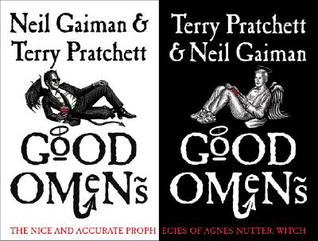
goodomensSo although, when a friend lent me a copy of a Discworld novel* during my second year of college, I didn’t get into it, I’m going to try again: perhaps with Good Omens, perhaps with Dodger. If you have a favorite Terry Pratchett book to recommend, let me know in the comments.

*The same friend lent me Neil Gaiman’s American Gods right around the same time, setting me on course to enjoy many more of Gaiman’s books since then: Neverwhere; Stardust; Fragile Things; Coraline; The Graveyard Book; The Ocean at the End of the Lane; Fortunately, the Milk; Instructions, and, currently, Trigger Warnings.

3/14/15, edited to add these additional tributes:

What to Do When Authors Die,” Swiss Army Librarian (Brian Herzog)

On the Passing of Terry Pratchett,” Gavia Libraria, the Library Loon

Terry Pratchett,” xkcd (Randall Munroe)

4/13/15, edited to add: I have now read Good Omens and enjoyed its blend of fantasy and British humor immensely. Not sure what the next Terry Pratchett book will be but I’m open to suggestions.

Dogs in the library help boost literacy

The first I heard of therapy dogs in libraries was through the Library Link of the Day in July 2012, which was a short article (“Therapy Dog Helps Children Learn“) about a retired racing greyhound who visited libraries, nursing homes, and rehab centers. I sent it to a co-worker, who asked if I knew that “Lucy the READ dog” was visiting our main library and branch that very week? I had not known.

It turns out that dogs visiting libraries in order for kids to read to them or otherwise interact with them is becoming more and more common. Earlier in 2012, Library Journal posted a piece called “Therapy Dogs’ Presence Steadily Grows in Libraries.” Meredith Schwartz wrote about a public library in Wisconsin that welcomed Reading Education Assistance Dogs (READ); children participated in the “Read to a Dog” program to improve their literacy skills. A study at Tufts University showed that reading to dogs helped kids improve more than reading to humans. Colleges and universities have also begun bringing dogs in during finals week to help students de-stress by spending time with animals.

In a public library in Ohio, the Tail Waggin’ Tutors (handler/dog teams from Therapy Dogs International) visit the library once a month. The dogs are non-judgmental listeners, who are able to give children an un-intimidating environment for reading practice. They don’t interrupt or correct, and some of them are even happy to cuddle. (“Therapy Dogs Help Give Kids Reading Confidence,” 11/2014).

Research is beginning to show that “Psychological effects of pets are profound” (Boston Globe, 1/2015). Sy Montgomery wrote, “pet-assisted therapies help troubled children, people with autism, and those suffering from Post Traumatic Stress Disorder and drug addiction. Pets help normalize brain chemistry.”

Service dogs are even sometimes used in schools to identify and help stressed-out students (“Stressed? This Dog May Help,” New York Times, 10/2014), though service dogs are in a different category than therapy dogs; they’re trained more extensively and covered under the A.D.A.

Sudo with her Dog BONES bandanna
Sudo (and her new friend Daisy) with her official Dog B.O.N.E.S. bandanna at the end of the third class.

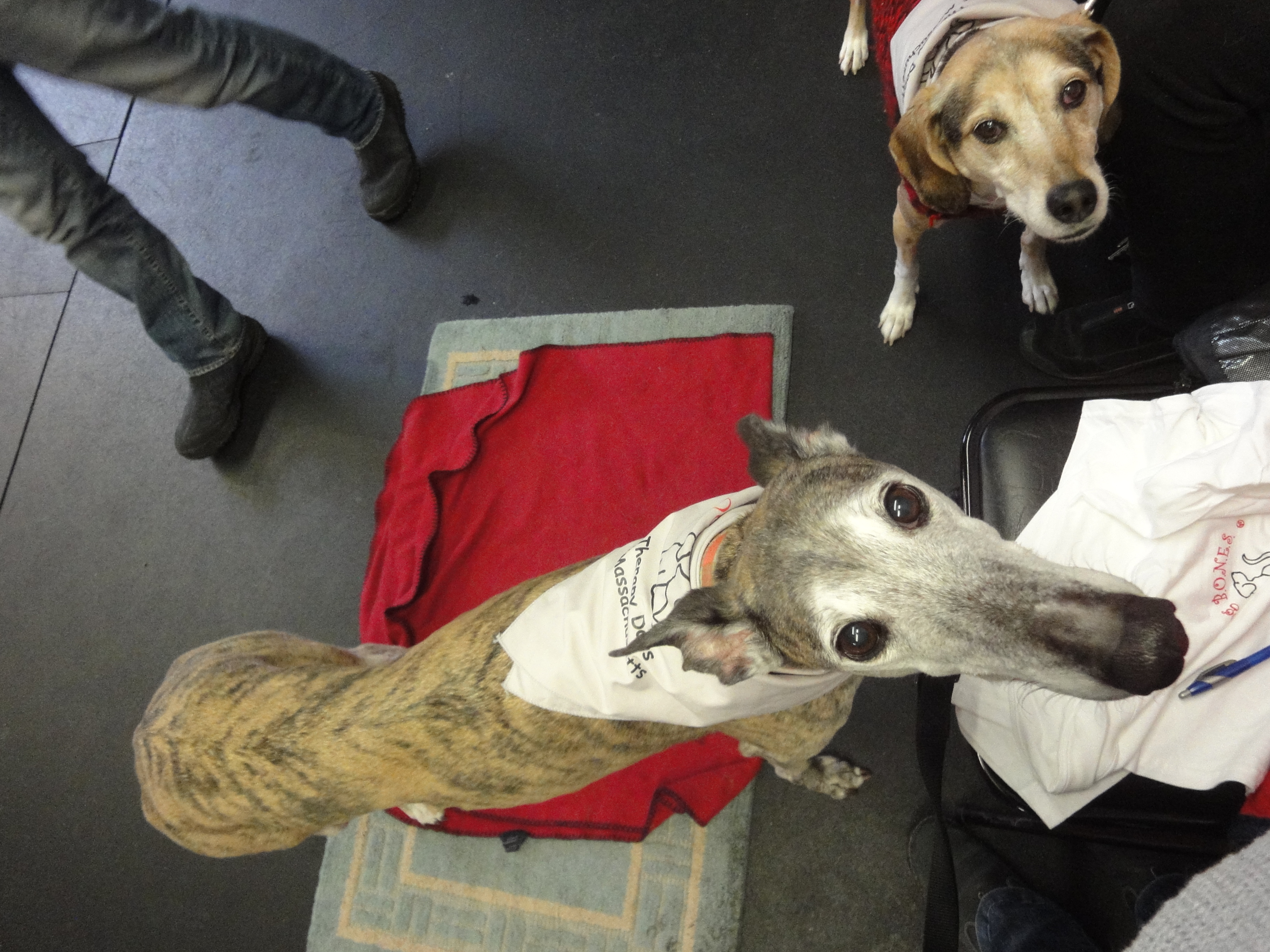
Here in Massachusetts, there’s an organization called Dog B.O.N.E.S. (Dogs Building Opportunities for Nurturing and Emotional Support) that trains volunteer handler/dog teams and helps organize visits to schools, libraries, nursing homes, assisted living facilities, hospitals, colleges and universities, and other organizations that request a team. This winter, despite the frequent blizzards, my husband and I and our greyhound, Sudo, completed a three-session training course with Dog B.O.N.E.S. Unfortunately, Sudo is a little skittish with children and wouldn’t be a good “read dog” for younger kids, but I hope that some of our classmates, instructors, or other Dog B.O.N.E.S. volunteers can visit our library this year. Meanwhile, we’ll look for opportunities to bring her to visit adults who might enjoy the soothing company of a calm, friendly dog.

Massachusetts libraries interested in having a team from Dog B.O.N.E.S. visit should contact the organization through the e-mail address on their website. Dog B.O.N.E.S. teams are insured in Massachusetts.

Five Librarian Bloggers to Follow

I’m honored to be included in this Information Today feature by Brandi Scardilli, “Five Librarian Bloggers to Follow,” along with David Lee King, Justin Hoenke (a.k.a. Justin the Librarian), Rita Meade (a.k.a. Screwy Decimal), and Joe Hardenbrook (a.k.a. Mr. Library Dude). Please read Brandi’s article and check out some of my fellow librarian bloggers’ sites!

I’ll just be over here, wishing I’d come up with a cleverer name for this blog when I started it six years ago.

JustintheLibrarianTwitter

Manual for the Future of Librarianship

libraryandMy librarian friend Brita, who knows about everything before I do, recently wrote a blog post about her submissions to the Manual for the Future of Librarianship project (under the auspices of the ALA Center for the Future of Libraries, inspired by the Long Now Foundation’s Manual for Civilization). She inspired me to do the same, and I’m sharing my submissions here as well.

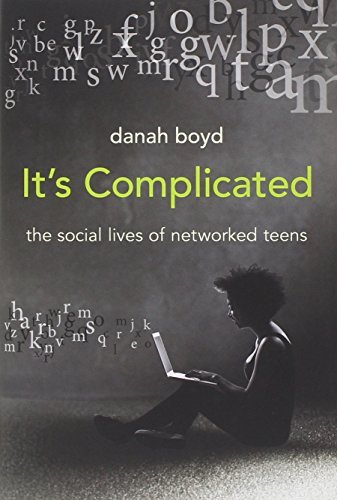
1. It’s Complicated: The Social Lives of Networked Teens by danah boyd
itscomplicatedIt’s Complicated is a must-read for teachers, parents, librarians, and anyone who disparages Millennials or “kids these days.” Researcher boyd unpicks the mindset that kids don’t care about privacy and shows how much of online life is “public by default, private through effort” instead of the other way around, making privacy difficult to obtain for those using social media. She makes the case that adults can best protect kids and teens by educating them about risks. boyd also addresses inequality and information literacy.

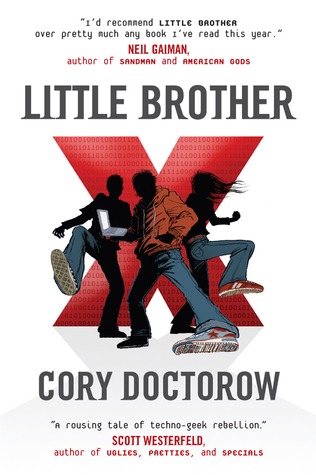
2. Little Brother by Cory Doctorow
littlebrotherLittle Brother is a young adult novel, but adults can learn a lot from it too: it’s a fast-paced story set in San Francisco before, during, and after a terrorist attack blows up the Bay Bridge. Seventeen-year-old high school student and hacker Marcus Yallow (a.k.a. w1n5t0n) and his friends are swept up by the Department of Homeland Security as the DHS cracks down on the city, and Marcus’ new mission is to expose their abuse of power. Marcus is more tech-savvy than most people, but Doctorow explains everything in a way that is interesting (and paranoia-inducing). It’s easy to imagine this scenario coming to life, and it leads readers to consider the relationship between privacy, security, and freedom. The follow-up novel, Homeland, is also worth reading.

3. “Why Our Future Depends on Libraries, Reading, and Daydreaming” by Neil Gaiman

Neil Gaiman in October 2013. Photo by Robin Mayes.

British author Neil Gaiman writes across genres and for all ages, and he’s a passionate advocate for libraries. In October 2013, he gave a particularly strong and articulate lecture on the importance of fostering literacy through teaching children to read and making sure they have access to books they enjoy. He also spoke about the positive correlation between fiction and empathy, which has now been shown in a number of studies, and the importance of libraries: “libraries are about freedom. Freedom to read, freedom of ideas, freedom of communication…Libraries really are the gates to the future.” [I wrote about this same speech at length soon after it was published online by The Guardian.]

Julia Glass at the Weston Public Library

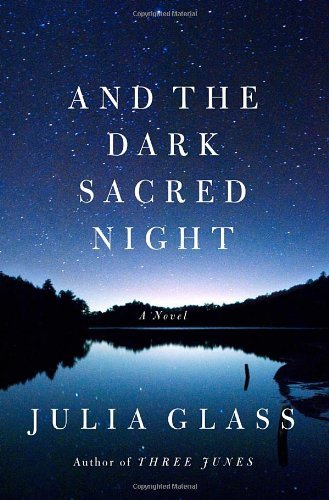
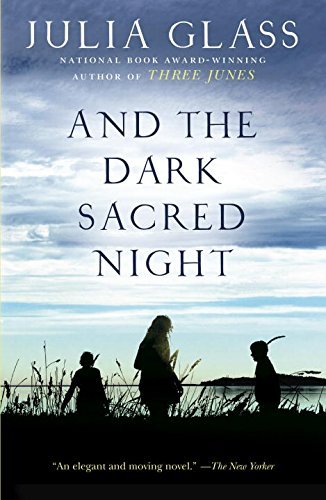
On a night that introduced me to the concept of “ice mist” (I think that’s what it was), there was a packed house at the Weston Public Library to see Julia Glass read from her newest novel, And the Dark Sacred Night. I’d seen Glass speak once before, in conversation with her editor at the McNally Jackson bookstore in Soho in 2009, and thanks to a major tidying effort, I turned up my notes from that event just a few weeks ago. At the time, Glass said:

“All serious fiction is emotionally autobiographical.”

“If you choose fiction, you distort.”

“There are always mysteries and things we will never know [about the people we’re closest to]….You cannot know everything about the people you love the most.”

Her words, and especially the concept of emotional truth in fiction, stayed with me, enough to get me out of the house on an ice-misty night. (What is that, Massachusetts? Seriously.)

Hardcover book jacket

In Weston, Glass started by observing the difference between a hardcover tour and a paperback tour: during a hardcover tour, the material is fresher in the author’s mind, but most audience members haven’t had a chance to read the book yet. With a paperback tour, on the other hand, the author may have forgotten details about the book, but the audience is more likely to have read it.

She spoke about her local connection, having grown up in Lincoln, MA and worked in the library there: “I really regard that library as my third parent.” Glass also talked about how she begins her books. Writers approach stories in different ways, but Glass comes to her stories through character. Malachy Burns’s mother Lucinda, a secondary character in Three Junes, was inspired in a unique way: Glass and her partner were stuck in traffic*, and the bumper sticker on the car in front of them read “Life: What a Beautiful Choice.”  That, Glass realized, encapsulated Lucinda’s Catholic outlook.

*Glass’s advice for couples stuck in traffic is: Don’t talk! It will only lead to fighting over whose fault it is that you’re stuck in traffic. She believes that the declining divorce rate is due at least in part to the rise of GPS devices.

Unlike some authors with ideas spilling out of their heads and onto scraps of paper everywhere, Glass says she doesn’t have lots of ideas for books. “Every time I’m coming to the end of one book, I’m terrified it’s the last one.”

“All of my books stand alone…but I do seem to be in the habit of bringing characters back.”

Paperback cover
Paperback cover

Glass’s books are all set in the semi-recent past. Does she rely on her memory to fill in details appropriate to the decade or year? She laughed at the idea of relying entirely on memory, but said that “personal stories that people tell me make their way into fiction,” and her books are usually set on “familiar turf” (New York, New England). But “research is important for every book…I always want to give myself a challenge…What’s something I really want to know about?” Fiction writers, Glass said, “are the people who want to be everything,” and researching for books is a great way to learn more about other topics and vocations. “There are so many ways of being and living in this world. The ‘what-if’ questions drive us.” Glass is particularly interested not just in what people choose to do, but in how that vocation in turn shapes them.

But research, for Glass, comes after writing. “I bluff my way through writing first, and research later.” For her books, she has interviewed oncologists; doctors familiar with HIV/AIDS treatment in the early days of the disease; classical cellists; and professional bakers of wedding cakes. She has also explored YouTube, especially when seeking particular pieces of music, and has learned to look at the number of page views to find the best quality videos. “YouTube is very dangerous.”

She writes her books from beginning to end, not allowing herself to skip over difficult scenes. Her manuscripts tend to be much longer than the final published versions of her books. Glass’ editor Deb Garrison told her, “You have a wonderful sense of responsibility to your readers…[but] they don’t have to know everything.” This revelation led Glass to cut an entire section from Daphne’s point of view from And the Dark Sacred Night.

After Glass read two scenes from the novel (one from Kit Noonan’s perspective, one from Walter’s), an audience member asked if she could talk more about her third book, I See You Everywhere. “You could see it as a novel, perhaps,” Glass said, but it’s really a collection of linked stories, all of which stand on their own; in fact, one of the stories won the Chicago Tribune Nelson Algren award, which was, Glass said, one of the best moments of her life. I See You Everywhere is her most autobiographical novel, which she published once she decided she did not want to write a memoir; “I just wanted to write about a certain kind of sibling relationship.”

I haven’t read And the Dark Sacred Night yet, but I plan to read it soon, and I can definitely recommend Three Junes, The Whole World Over, I See You Everywhere, and The Widower’s Tale. Thanks to the Weston Public Library for hosting, and to Julia Glass for a lovely and inspiring evening.

Incidentally, the ice mist has now turned to snow.

Housecleaning discovery: the Extinction Timeline

madetobreak
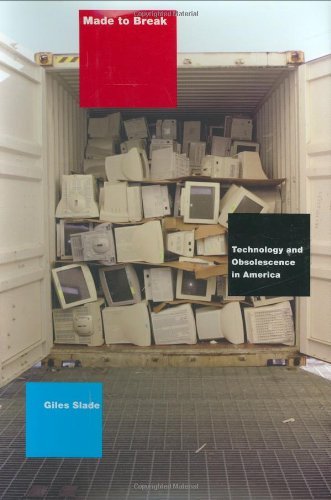
Made to Break by Giles Slade

Back in March 2013, I was trying every avenue to find a timeline of obsolescence I’d seen once during grad school. Even with the help of the Swiss Army Librarian, I came up empty-handed (though we did find a lot of other cool stuff, like the book Made to Break: Technology and Obsolescence in America by Giles Slade).

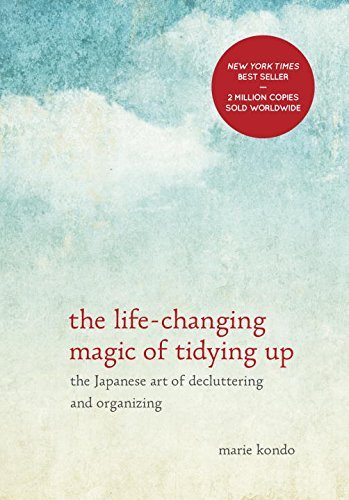
In the end – nearly two years later, as it happens – it was another book that led me to find the original piece paper I’d had in mind. That book was The Life-Changing Magic of Tidying Up by Marie Kondo (bet you didn’t see that coming, did you?). I’ve spent a good chunk of the past two weeks going through all the things in my apartment – clothes, books, technology, media, and lots and lots of papers – and at last, I found the timeline of obsolescence that I was looking for almost two years ago.

The Life-Changing Magic of Tidying Up by Marie Kondo

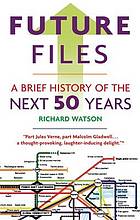
Only it isn’t a timeline of obsolescence, exactly; it’s an “extinction* timeline 1950-2050,” and it’s located – I think – in the 2010 book Future Files: A Brief History of the Next 50 Years by Richard Watson. It was created in partnership between What’s Next and the Future Exploration Network; Ross Dawson, founding chairman of the latter, wrote a blog post which includes a PDF of the timeline, “Extinction Timeline: what will disappear from our lives before 2050.”

*Existence insignificant beyond this date

Repair shops – the reason I was looking for this timeline in the first place – apparently went out of fashion (or “significance”) just before 2010, as did mending things, generally. Fortunately, the “predicted death date” for the things on the timeline is “not to be taken too seriously,” and since “a good night’s sleep” is coming under the axe just before 2040, I just have to hope that they’re wrong about that one.

futurefiles
Future Files by Richard Watson

Check out the extinction timeline yourself. Anything strike your interest? Do you agree or disagree with the predictions for the next 35 years? Discuss.

Extinction timeline 1950-2050 (PDF)