See the Sunday summary (Day 1 of conference) here.
MSLA President Jen Varney introduced Monday’s keynote speaker, the Director of Amherst College Libraries, Dr. Martin Garnar, who spoke about Fighting the Good Fight: Supporting Intellectual Fredom in Your Library. He asked, “What is intellectual freedom?” It is actually three freedoms: freedom of expression, freedom of access, and freedom from surveillance (i.e., privacy). Garnar handed out scenarios on slips of paper, and each table group considered how we would respond to, for example, a parent challenging a book from the school library collection and the principal removing the book to their office; or, for another example, a parent requesting a list of every book their child has checked out from the school library. (Pro tip: remind your administrators, public or private, that if they ignore their own school’s policy, they are open to lawsuits. Pro tip #2: Make sure you have a solid, up-to-date policy! More on that soon.)
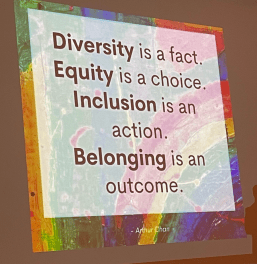
“It’s not enough to have equal access, it has to be equitable access.”
After the keynote, Garnar offered another session: The Importance of Policies: Promoting Our Principles in Practice. There are six key policies for libraries to have in place:
- Collection development and resource reconsideration
- Internet use (required by law if the library receives E-rate or LSTA funding; can be a district-wide policy)
- User behavior and library use (e.g. anti-bullying)
- Privacy and confidentiality (FERPA and state laws)
- Social media (if the library uses it)
- Use of meeting rooms and exhibit spaces
Garnar went in depth on each of these types of policies (I won’t do that here), and also offered solid reasoning about why are policies are important. Well-written, board approved policies and up-to-date procedures based on those policies achieve several things:
- Encourage stability and continuity in the library’s operations while reducing ambiguity and confusion
- Demonstrate that the library is running a businesslike operation
- Give credence to the library’s actions
- Inform the community about the library’s intent, goals, etc. (e.g. equity)
- Give the public a means to evaluate library performance and show that the library is willing to be held accountable for its decisions
- Help disarm critics
- Serve as evidence of the library’s normal practices
Policy resources:
- Selection & reconsideration policy toolkit for public, school, and academic libraries
- ALA OIF
- MSLA intellectual freedom resources
- MLS policy collection (LibGuide)
Best Features of the Statewide Databases for school libraries, Tressa Santillo, Massachusetts Library System (MLS)
Tressa (on behalf of MLS and also Transparent Language) and representatives from Gale, Britannica, and PebbleGo described and demonstrated some of the features and resources of their respective databases. I’m so grateful that Massachusetts libraries (public and school) work cooperatively to share print and digital resources; all school libraries with a certified librarian have access to databases for students and staff to use. I’ve been guiding patrons and students through and around these databases for years, but there are more resources than I realized – like alignments to standards and frameworks from PebbleGo, and a media literacy guide from Britannica. (Also from PebbleGo: an axolotl coloring page.)
Resources:
Well, I was hooked by the axolotl coloring sheet, so I went to hear Dr. Kelli Westmoreland talk more about PebbleGo and PebbleGo Next: Databases for Elementary. (Also, the only other session was the MA Teen Choice Book Awards, and since I’m not working with a teen population right now, PebbleGo made more sense. You can see the MA Teen Choice Book Award Nominees here.) Dr. Westmoreland offered a tour of PebbleGo and PebbleGo Next, explained the importance of modeling digital literacy – especially given the increased amount of time students spend on screens – and spoke about the science of reading and the importance of nonfiction texts. She showed off some of the features of PebbleGo, like the randomizer and the question of the day, and gave examples of how it can be used to support classroom teaching (e.g. librarians can create text sets). She showed examples of simple graphic organizers for inquiry (Person/Action/Trait, It Says/I Say/And So, Somebody/Wanted/And/So).
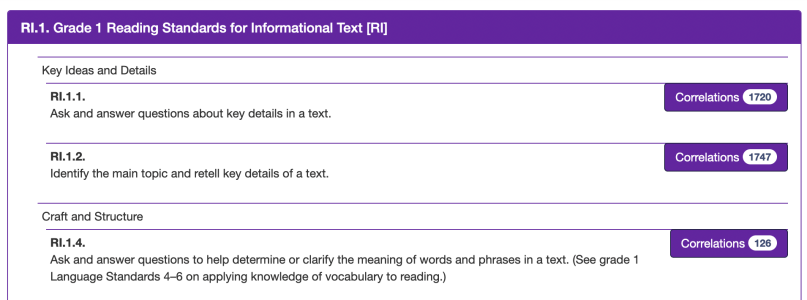
Perhaps one of the neatest features is the correlation to standards: you can look up content by standard, or standard by content.
My goal at every conference is to have at least one useful takeaway from each session, and that definitely happened this year! Plus, it was just lovely to see people in 3D. (Previous conference committees did an amazing job the past few years putting together virtual conferences full of engaging presentations from librarians and authors, and I definitely enjoy “attending” from home, but it was nice to mingle in person too, and even meet some people I’ve known for years now, but only via zoom!)
I’ve already put some of Liza’s ideas and resources about comics to use (is it possible to say enough good things about Liza Halley? I don’t think so), and I’m looking forward to adding some of the new books I picked up at vendor booths to my school library collection and seeing kids scoop them up off the New Books shelf. Thanks again to everyone involved in the conference – please leave a comment if I missed anything here, or if you want to share something about a different session you attended!
 The brilliant Liza, who insists she is not an expert on comics (but who is totally an expert on comics, and is also an excellent teacher) started us off with a variety of hands-on activities to choose from, as part of her presentation on how to teach comics/graphic novels in school, and how to get teachers, administrators, and parents on board (because GRAPHIC NOVELS ARE REAL BOOKS; this is supported by research).
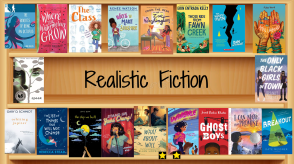


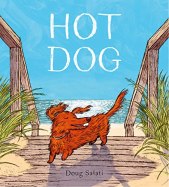


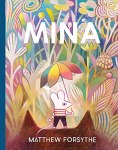

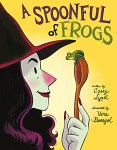
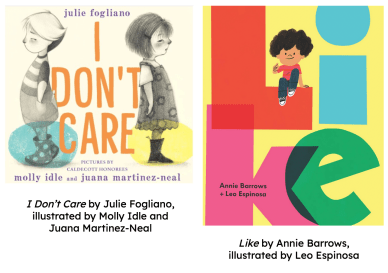
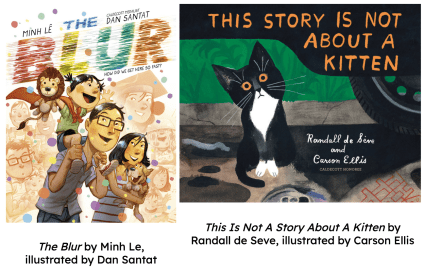
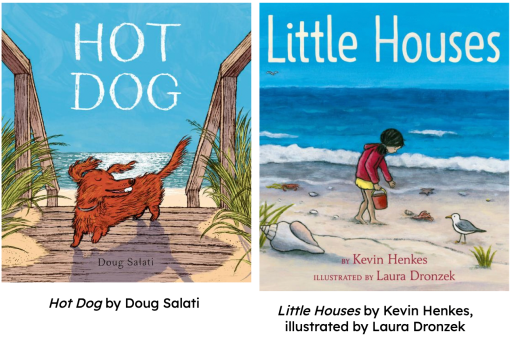
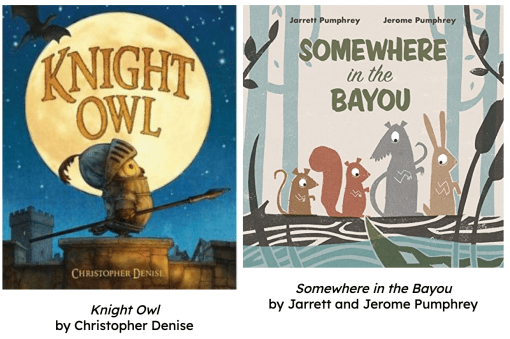
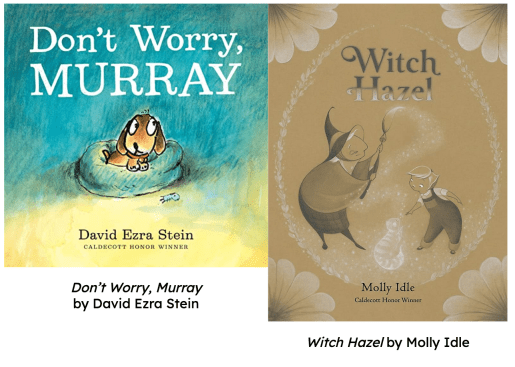
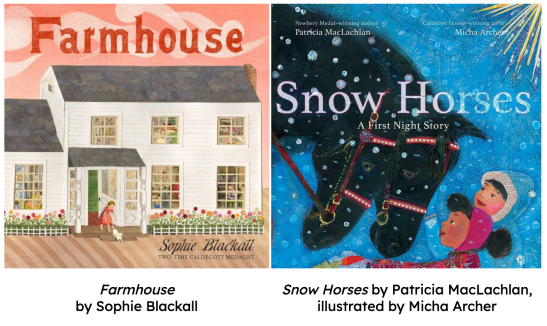
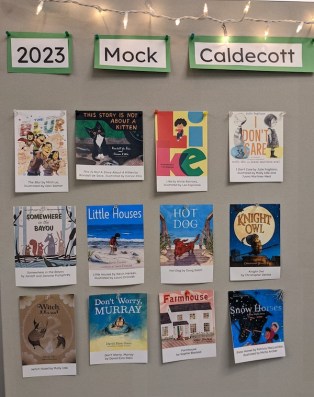 Visual supports: The award is for illustration, after all, so I wanted to create a visual environment to support our Mock Caldecott. Here are a few ways I did that:

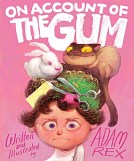 To be quite upfront, the first picture book that jumped into my head in the “funny” category was Adam Rex’s On Account of the Gum, which I maintain is one of the all-time funniest books to read aloud, and which absolutely does not get old, no matter how many times you read it. Though adults tend to think of picture books as being for little kids, this one appeals just as much or more to older kids, and even teens and adults; they can use the rhyme scheme to anticipate what’s coming next, and they have more context (e.g. they know what Picture Day is). But littles enjoy the over-the-top illustrations and the pattern and flow of the story…it’s just, hands-down, a brilliant read-aloud. Rex also wrote Pluto Gets the Call, illustrated by Laurie Keller (just think about the title for a minute) and School’s First Day of School, illustrated by Christian Robinson. (This book, narrated by a brand-new school building, contains the phrase “nose milk.”) Rex is a funny guy, but let’s move along…
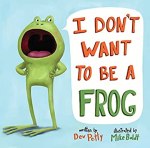 I Don’t Want to Be A Frog by Dev Petty, illustrated by Mike Boldt, is told entirely in dialogue between a young frog (who, you guessed it, would rather be a rabbit or an owl or a pig or anything but a frog), their dad, and…I won’t give it away, but this book really lends itself to the read-aloud experience, and it has delightful companions (I Don’t Want to Go to Sleep, I Don’t Want to Be Big, and There’s Nothing to Do). Dev Petty also wrote Claymates, which has some of the most unique illustrations (by Lauren Eldridge) I’ve ever seen, and plenty of humor.
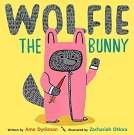 If you can hear the title Wolfie the Bunny and NOT want to read that book immediately, then we probably don’t have much in common. Ame Dyckman’s words paired with Zachariah Ohora’s illustrations absolutely live up to the promise of the title. In a neighborhood based on Park Slope, Brooklyn, a family of rabbits finds a wolf pup on their doorstep, but only little Dot is freaked out by the new addition to the family (“He’s going to eat us all up!”).
 Zachariah Ohora also illustrated Tyrannosaurus Wrecks! by Sudipta Bardhan-Quallen. (Every list of picture books has to have a dinosaur book, right? Pretty sure that’s a rule.) This is a sure-bet hit for the toddler and preschool set, and there’s a sweet social-emotional learning (SEL) component in addition to the slapstick humor. (While we’re talking about Zachariah Ohora, he also illustrated Who Wet My Pants? by Bob Shea, another very funny book, despite its serious-sounding title.)
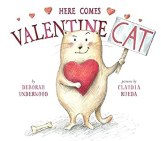 Deborah Underwood and Claudia Rueda’s “Here Comes…Cat” books (Tooth Fairy Cat, Valentine Cat, etc.) star a cat that only communicates through signs (sometimes with words, often with images), facial expressions, and body language. The narrator is in dialogue with the curmudgeonly cat, and these books definitely tickle my funny bone; Valentine Cat makes an appearance at our house every February.
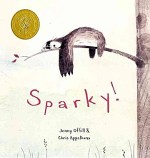 Jenny Offill has produced such delightful gems as Sparky! (a book about a girl and her pet sloth; just look at the juxtaposition between the name – with an exclamation point! – and the sloth on the cover), While You Were Napping, 11 Science Experiments That Failed, and 17 Things I’m Not Allowed to Do Anymore. The titles are descriptive enough, I think, and any grown-up who has read Offill’s books for adults is in for something completely different with these.
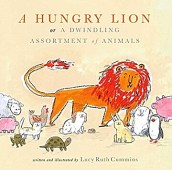 A Hungry Lion, Or, A Dwindling Assortment of Animals by Lucy Ruth Cummins: The sheer genius of this title, oh my goodness. And the vocabulary. And the smile on the little turtle’s face. And the moment the lights go out. And the double twist ending. And, and, and….If you liked the slightly macabre humor of Jon Klassen’s I Want My Hat Back but you haven’t read this, go ahead and remedy that now.
 Grumpy Pants by Claire Messer: “I’m grumpy,” declares a little penguin, and it tries a number of solutions to improve its condition, finally stripping off its clothes piece by piece and diving into a nice cold bath. Children (and adults, too!) might find that a bath, clean clothes, and a cup of cocoa are just the thing to soothe a grumpy mood.
 Still Stuck by Shinsuke Yoshitake: You’re getting undressed and your shirt gets stuck over your head – it’s happened to everyone, right? It happens to this kid, who definitely does not want assistance from Mom, and decides to accept their new state. In their imagination, they spin out what life will be like with a shirt over their head. Despite the kid’s adaptability (or resignation), Mom does swoop in to move the bedtime process along, but there’s another snag when it’s time to put on pajamas.
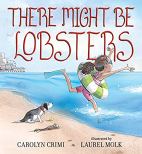 There Might Be Lobsters by Carolyn Crimi, illustrated by Laurel Molk: Poor little Sukie is afraid of everything at the beach, but when beloved toy Chunka Munka is swept out to see, Sukie must find her courage. This is an excellent read-aloud for summer storytimes for all ages – get kids to repeat the titular refrain together – and if you happen to have props with you for this read-aloud (a stuffed lobster, say, or a beach ball) all the better.
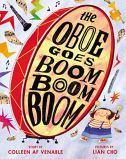 The Oboe Goes BOOM BOOM BOOM by Colleen AF Venable, illustrated by Lian Cho: A band director introduces instruments one by one, but little Felicity just can’t wait to bang on the drums and keeps interrupting – until she’s blown away by the sound of the tuba. There’s actually quite a lot of information in here about different instruments, and the way that Cho translates sound into a visual medium is outstanding.
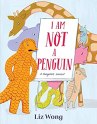 I Am Not A Penguin: A Pangolin’s Lament by Liz Wong: A poor pangolin wants to give a presentation, keeping its cool while confused audience members interrupt, until a penguin arrives to steal the show. One little girl remains for the pangolin’s informative presentation. (See also: The Angry Little Puffin by Timothy Young, which taught me permanently that penguins live “at the bottom of the world” (i.e. Antarctica) while puffins live “at the top of the world.”)
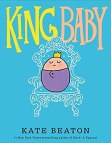 King Baby by Kate Beaton might be funnier for adults than for kids, but kids enjoy it too; it’s one of my go-to recommendations for families who are about to add a sibling. And let’s not forget Beaton’s other picture book, the crowd-pleasing The Princess and the Pony (pony farts feature prominently).
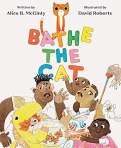 Bathe the Cat by Alice B. McGinty and David Roberts: A cat who definitely does not want a bath scrambles up a family’s to-do list as they rush to tidy before grandma arrives. Clever use of fridge magnet alphabet letters, plenty of pride, and increasingly ridiculous tasks all add to the joyful hilarity.
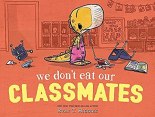 We Don’t Eat Our Classmates by Ryan T. Higgins: Pink, overalls-wearing Penelope is nervous about the first day of school, and indeed, it doesn’t go as well as she’d hoped…she discovers that it’s hard to make friends when everyone is afraid you’ll eat them. Penelope learns to exercise self-control with the help of Mrs. Noodleman and a fearless goldfish named Walter.
 “Pleasure Reading for ELL” was presented by Katy Gallagher, library teacher at Hingham High School, and Erin Dalbec, library teacher at Newton North High School. Katy cited research on immersion and dual-language education programs that showed positive outcomes for students who maintained their native language in addition to English; libraries can support English Language Learners (ELL) by providing materials in other languages. First, however, you need to figure out what language(s) the students in your school speak. Even then, it may be difficult to build a collection of books in that language; librarians using the chat feature discussed the difficulty of finding affordable, popular titles in various language, from Portuguese to Arabic.


