MLS

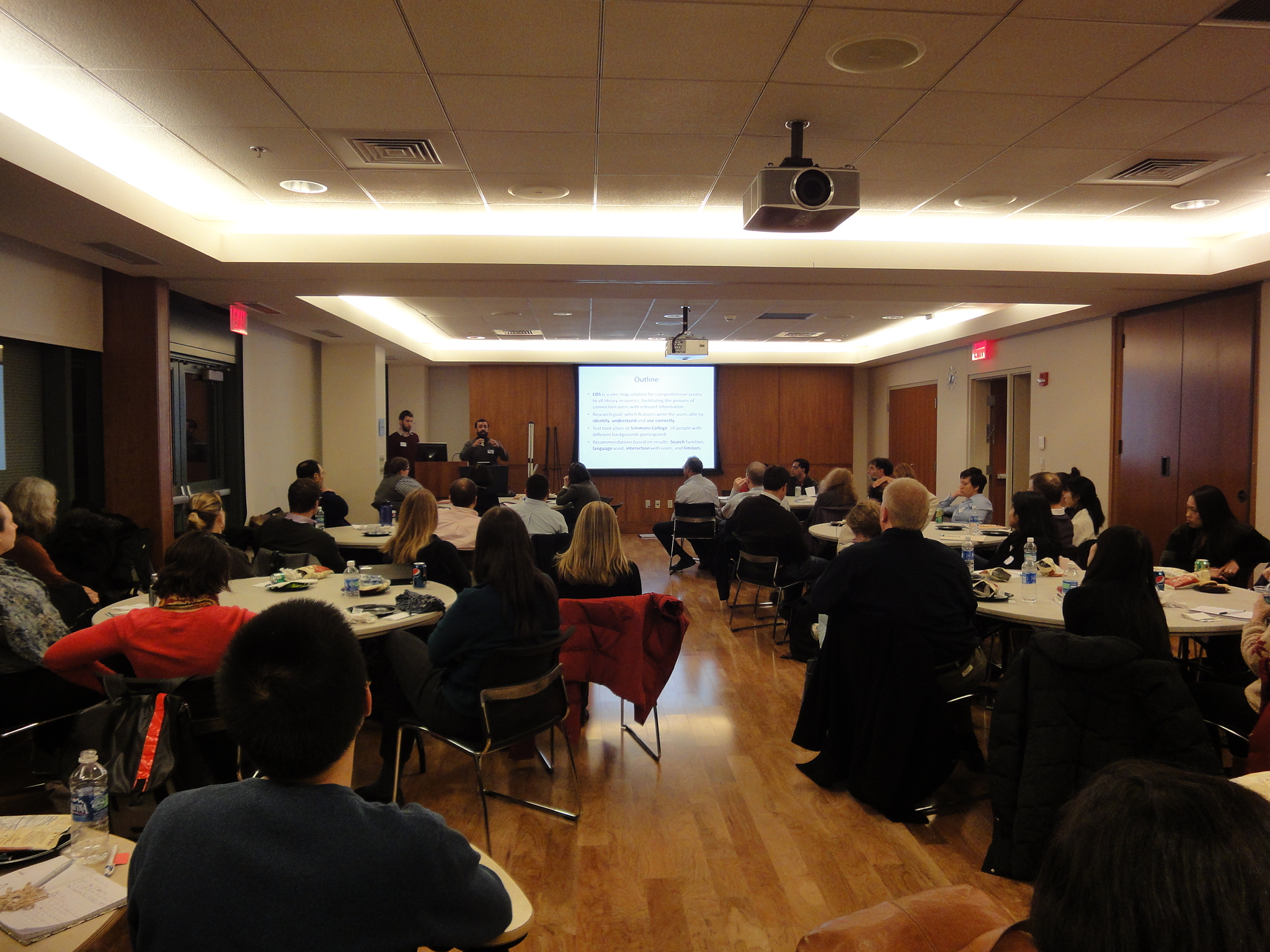
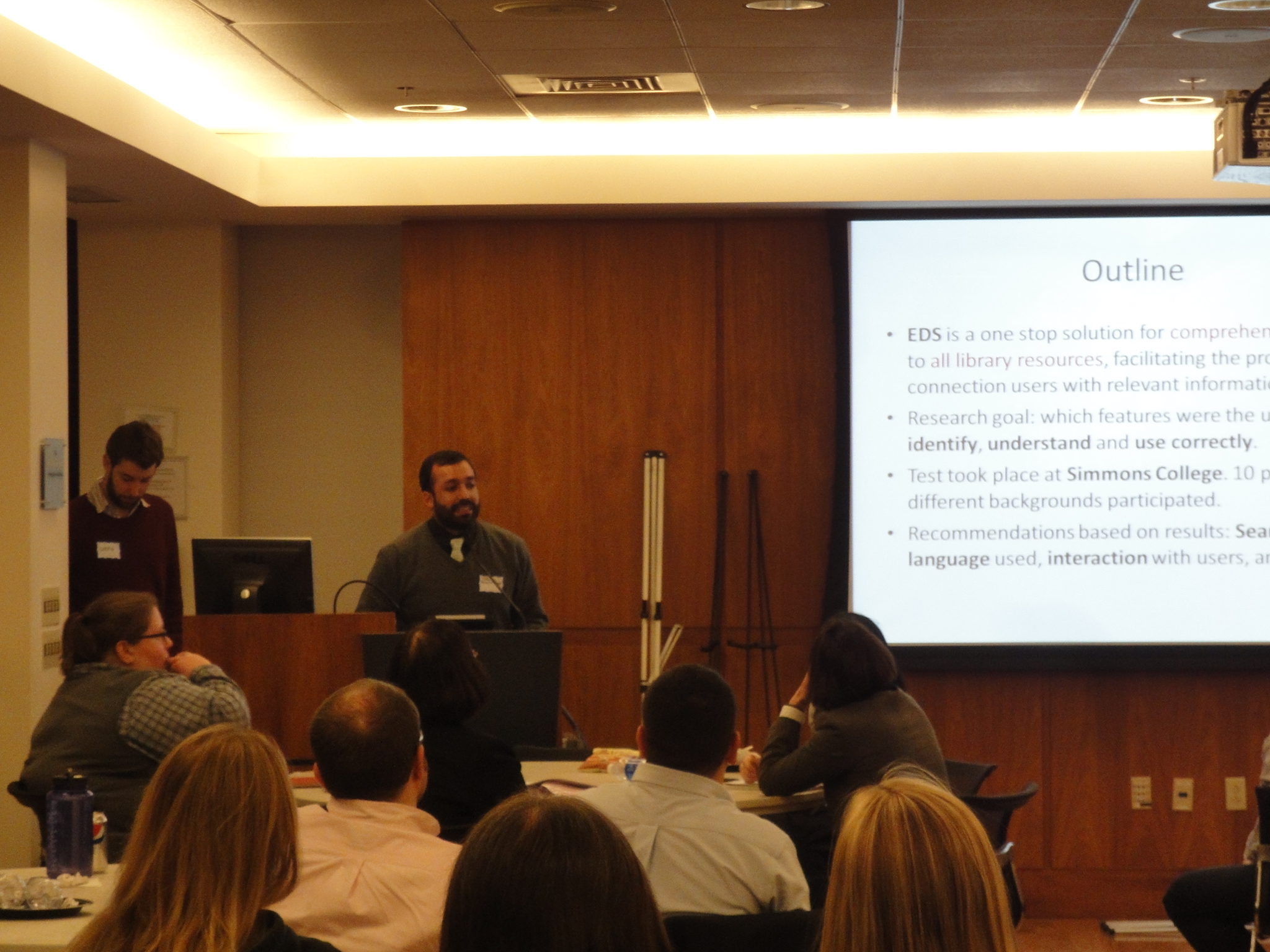
After yesterday afternoon’s half-hour group presentation in class (LIS 531Y, Usability and User Experience Research) on our team’s usability study on the EBSCO Discovery Service (EDS), and last night’s condensed presentation on the same to the Usability Professionals Association (UPA) Boston Chapter, I am completely done with papers and presentations (and all other work) for my MLS degree. HURRAY!

Photos: one group member from each EBSCO team presented the results of the usability tests to the UPA Boston meeting on at Simmons College on December 12.

As it happens, a recent (December 7) Library Journal article included comparisons of four discovery services, the first of which was EDS. Amanda Clay Powers of the Mississippi State University Libraries observed that EDS worked especially well for undergraduates (novice) and for doctoral students and faculty (advanced), but less well for upper-level undergraduates and master’s students, who were still best served by subject-specific databases.

The research we did in Usability and User Experience Research this semester was focused less on content and more on usability and specific system features (such as the cite tool, the “find similar books” option, and the ability to save or share search results). Still, the LJ article was an interesting overview, especially as it compared multiple discovery interfaces.

One Week

One week of classes left! I have been busy recently with final projects and papers (some parts of which I may post here in the future), but the end is in sight. Meanwhile, a few articles on usability, user experience, and design:

UX Hierarchy of Needs – The author proposes that there is a “UX hierarchy of needs,” namely (from the bottom up) Functionality, Information, Aesthetics, and Usability. The first two are the basic needs, the latter two are the higher needs. However, I’m inclined to switch usability and aesthetics – as a user, I’d rather a system be easy to use than pretty to look at (although aesthetics is more than just “prettiness” – it also encompasses branding).

9 Rules to Make Your Icons Clear and Intuitive – Much more thought and planning goes into (or should go into) those tiny buttons than you might think. This article (same author and site, UXMovement, as above) covers some good basic rules-of-thumb, such as labeling icons, grouping similar icons, and keeping icon order and placement consistent. However, some established icons that break one or more of these rules still work well because so many people know what to look for – the chain link representing the hyperlink, for example, or the ABC for strikethrough. (The author recommends a blue underlined L for the first, and a struck-through S instead of ABC for the latter.)

14 Guidelines for Web Site Tabs Usability – Many sites use tabs for navigation; they are good real-world metaphors (most people are familiar with filing cabinets or binders), they improve content organization, and they are “visually pleasing.” The author outlines some guidelines, illustrating many of his points with appropriate screenshots (remember when Amazon used tabs?). Among these guidelines: tab labels should be 1-2 words, in plain language; tags should be organized in an order that makes sense to users, and related tags can be grouped; and the active and inactive tabs should be clearly indicated so the user can tell what section of the website they are currently in.

Two Approaches

The Authors Guild has spoken out against Amazon’s Lending Library, arguing that Amazon’s contracts with publishers cover only the sale of books, not lending or giveaways. For additional background on this issue, here’s my November 3 post with several links. The Guild may have a point here, and urges its authors to contact their agents and publishers.

In the “good news” category, however, we have Ann Patchett’s new independent bookstore, Parnassus Books, opening soon in Nashville, TN. The most recent NYT article notes that small, independent bookstores compete “where Amazon cannot: by being small and sleek, with personal service, intimate author events and a carefully chosen rotation of books” (including e-books). Best of luck to Ann, her business partner Karen Hayes, and Parnassus Books!

Open Library

If you aren’t already familiar with Open Library, a project of the non-profit Internet Archive, you now have one more reason to head over and check it out: all 50 state librarians have voted to build an alliance with IA. What does this mean? The Chief Officers of State Library Agencies (COSLA) and Open Library will be working together to ensure free access to e-books through all public libraries in the U.S.

Already, anyone can borrow e-books from Open Library‘s collection of 10,000 e-books, provided by the Internet Archive and its partner libraries. You can borrow up to 5 books for 2 weeks each, in a variety of formats (in-browser, e-Pub, or PDF). If your public library is a member, you may have access to even more.

Happy reading!

How to Cook Without a Book?

“But a Nook can’t read, so a Nook can’t cook. So…what good to a Nook is a hook cook book?”
One Fish Two Fish Red Fish Blue Fish, Dr. Seuss

I’m sure that’s not what Barnes & Noble had in mind when they named their e-reader.

A recent article in the New York Times asks if cookbooks are obsolete (leading question much?). It describes how a number of wonderful apps are sweeping traditional cookbooks and recipe cards off the kitchen counter and back onto their shelves to gather dust.

As usual, there is plenty of room for both sides. Certainly, some people will gravitate toward these apps and e-versions of cookbooks on tablets or e-reader devices, either replacing or enhancing their print cookbooks; others will ignore the new toys (audio, video, flowcharts, built-in timers and glossaries) and continue using their print books.

There’s also a middle ground: Eat Your Books offers a way to search through all the indexes of all your cookbooks for a particular recipe. The recipes themselves can’t be accessed through the site unless they are free online, but by searching the indexes of all the books you already own, you can find what you’re looking for much more easily; it’s a way of semi-digitizing your cookbooks. You can also add blogs such as Chocolate & Zucchini and Smitten Kitchen to your “shelves” and search those too.

Incidentally, the NYT article neglects to mention what would happen if one were to spill soup onto one’s iPad.

Losing “cite” of what’s important

I’ve been thinking about citation a lot lately. (Chances are, if you aren’t a student and you just read that sentence, you’re already weeping from boredom; but if you are a student, you might have made some sort of frustrated growling sound, or perhaps banged your head against the nearest wall.) I’m in my last semester of grad school in a program where most professors require APA citation (some are flexible – you can use another format as long as you’re consistent about it). As an undergrad I used Chicago style, and in high school I used MLA, so I’ve transitioned a few times, but I was pretty sure I had APA down; after all, attention to detail is what I do. However, two professors this semester have corrected my APA style citations, which makes me think that other professors just weren’t looking that closely – or that they simply didn’t care as much about the details, just that sources were acknowledged somehow and that the writing was good.

Then this morning, I read an opinion piece in the Chronicle of Higher Education: “Citation Obsession? Get Over It!”  The author, a teacher of writing at James Madison University, says that librarians aren’t able to help students with broader information literacy concerns (such as finding, choosing, and evaluating sources) because they are overwhelmed with anxious students needing help with citations. “What a colossal waste,” he writes. “Citation style remains the most arbitrary, formulaic, and prescriptive element of academic writing taught in American high schools and colleges.” He continues, “Now a sacred academic shibboleth, citation persists despite the incredibly high cost-benefit ratio of trying to teach students something they (and we should also) recognize as relatively useless to them as developing writers.”

The author, Kurt Schick, advocates focusing on the function rather than the form of citation. Most citation styles include the same basic information: author, title, publication date, publisher. It would seem that, with the help of a style guide, it wouldn’t be too hard to put that information in the right order – and it wouldn’t be, if all we were using was books and articles from academic journals. But information can come from a wide range of sources in a wide range of formats, and there are all kinds of exceptions. As long as the core information is there, allowing others to track down the item in question, does it really matter where the periods and parentheses are? Schick argues that no, it doesn’t – not until it’s time to publish. Until then, professors’ and librarians’ and writing center staffs’ time is better spend helping students with essential information literacy and writing skills: “We could…reinvest time wasted on formatting to teach more important skills like selecting credible sources, recognizing bias or faulty arguments, paraphrasing and summarizing effectively, and attributing sourced information persuasively and responsibly.” Students should absolutely understand the importance of acknowledging their own use of others’ words and ideas in their writing; no one is arguing that the concept of citation and attribution isn’t essential. The formatting, however, may not be that important.

Until this sea change takes place, however, the form of citation remains paramount for many professors at many institutions. For anyone required to use APA, I highly recommend the Purdue OWL (Online Writing Lab) APA Formatting and Style Guide. Individual college and university libraries and writing centers may have also prepared their own handouts, guides, and tips for citation. There are also citation tools like RefWorks and Zotero, and databases often have a “cite” tool built in; these can certainly be helpful, but they aren’t perfect, and students will still need to proofread for formatting errors.

Know of any other good citation style guides online? Please share in the comments.
Amazon, Library?

In case you haven’t already heard, Amazon recently announced the Kindle Owners’ Lending Library. Unlike borrowing books from a public library (free! Well, your taxes pay for it), in order to borrow books from Amazon’s library, you must (a) own a Kindle, and (b) have Amazon Prime membership, which unless you get the student deal is $79/month. Is this bad for libraries? Actually, probably not.

While I don’t want to generalize, I will say that people who belong to categories (a) and (b) above may still visit public libraries, but they probably don’t rely on them as their only source of information/entertainment. Even for those who do have a Kindle and Prime membership, public libraries still offer a much wider selection of e-books for the Kindle and other e-readers than Amazon’s “library,” which offers just over 5,000 titles.  And, none of the Big Six – the six largest U.S. publishers – have jumped on the bandwagon yet, so although some bestsellers are available, many are not.

This isn’t a ploy to compete with libraries; it’s a ploy to sell more Kindle devices. The one advantage Amazon has is that it can lend any title instantly; there’s no wait time, unlike libraries, where – even with e-books – the library has a limited number of copies and only one patron can borrow any given copy at a time (i.e., library owns 10 copies of The Hunger Games, 10 patrons can borrow The Hunger Games at a time – just like print). However, Amazon pays publishers for this privilege – mostly a flat fee, but sometimes per item, as it’s borrowed. So Amazon isn’t making money on lending content – they’re just trying to make Kindle ownership and Prime membership as appealing as possible.

Further reading:

Wall Street Journal
Huffington Post
New York Times
Amazon (press release)

A Balanced Information Diet

This evening I went to a screening of some TED talks at MIT, sponsored by the New England chapter of ASIS&T. We watched five TED talks, with a little bit of discussion between each one.

1. Raghava KK, “Shake up your story” – the artist/father talked about how looking at multiple perspectives could lead to the development of empathy and increase creativity.

2. Wael Ghonim, “Inside the Egyptian Revolution” – Ghonim described how the Internet allowed Egyptians to connect, to realize they were not alone and had shared dreams, to collaborate and speak out. He described how the “psychological barrier of fear” led to silence, but because of the Internet, “the fear is no longer fear, it’s strength. It’s power….The power of the people is much stronger than the people in power.” (After the talk, we discussed the flip side of technology: in the case of Egypt, technology allowed people to overcome their isolation, but what about when the government controls the technology?)

3. Eli Pariser, “Beware online filter bubbles” – This was the talk I found most interesting. Pariser, an online organizer and author, talked about the invisible shift in the flow of information online; search engines show us what they think we want – but what we want to see might not be what we need to see. Although the “personalization” due to algorithmic editing can sometimes be helpful, most people don’t realize that results are being filtered or tailored in this way – and we don’t decide what gets included or what gets left out.

Left to their own devices, people tend to read sources that re-confirm their existing points of view, and this was true long before the Internet (some people read the New York Times, some read the Wall Street Journal). Editors used to be our “human gatekeepers,” but now there are algorithmic gatekeepers, and they have no concept of journalistic integrity or ethics: they just want to show us what we want to see. Eventually, we may end up with a diet of “information dessert” and no “information vegetables. The information might be “relevant,” but we won’t be presented with information that is uncomfortable, challenging, important, or that presents other points of view – and we may become less and less aware that this information exists.

This addresses only a small piece of this issue, but check out the Google Transparency Report.

4. Sunni Brown, “Doodlers, Unite!” – According to Brown, doodling during a meeting isn’t a waste of time, and it doesn’t mean you aren’t paying attention – in fact, it may be helping you process information better. (After all, don’t many group brainstorming sessions end up using a whiteboard or pen and paper to sketch out ideas?)

5. Hans Rosling and the magic washing machine – This talk certainly had the best title, and was arguably the most entertaining. Swedish professor of global health Hans Rosling described the direct connection between the washing machine and reading: when his mother got a washing machine and no longer to do the washing by hand, she had time to take him to the library instead. “Thank you industrialization…that gave us time to read books!” The middle part of his talk concentrated on the developing world, climate change, and the use of resources (1/7 of the world population uses 1/2 of the resources – washing machines included).

One of the discussion questions (offered somewhat tongue-in-cheek, I believe) after this last talk was, “Do you think the invention of washing machines has increased library circulation?” In a roundabout way, it probably has: in the industrialized world, washing machines and other time-saving devices allow us to have more leisure time, which some of us do spend reading. 🙂

Many, many more TED talks are available “free to the world.” Explore, and enjoy!

Bookmaking for Beginners

On Saturday, I took a Bookmaking for Beginners workshop taught by Sarah Smith through GSLIS Continuing Education. The workshop began with a short lecture about different kinds of bindings through history, and how contemporary artists are re-using and making books. The rest of the day was all hands-on: we started with the one-sheet fold-up and the accordion structure, then the blossom fold, Turkish map fold, and Korean map fold; then we learned how to make single-section and two-section pamphlets, and finally how to do chain-stitch.

All the books! From top to bottom: Blossom fold, Korean map fold, accordion fold (with covers), woven flexagon, Turkish map fold, two-section pamphlet, one-section pamphlets, chain-stitched binding.

From left to right: two-section pamphlet, one-section pamphlets (3- and 5-station), and Korean map fold.

This is the Korean map fold book: it’s the same one that looks like a little cedar block in the previous picture. It’s bulky because it contains six pieces of 8.5″x11″ paper, folded into 8 sections each.

This is the two-section pamphlet; the sections are each made up of four sheets of paper, each folded in half once. The cover has a pleat in the middle, and there are three “stations” (holes) where the waxed thread goes through all the layers to hold it together.

This is a one-section pamphlet, also with three stations. I gave the other pamphlets rounded corners, but I folded the edges of this cover in, so it has French flaps (like fancy trade paperback editions sometimes do).

All four pamplets: the top two have five stations, the bottom two have three.

Standing up like this, these remind me of The Monster Book of Monsters from Harry Potter (when Hagrid teaches the Care of Magical Creatures). On the left is the blossom fold; on the right, the Turkish map fold.

Here’s the Turkish map fold, open. It does fold down nice and flat – I think I have a city map of Paris folded in a similar way.

This has the best name of all: woven flexagon. We started with one long sheet (the cream-colored paper), and used a blade to make slices about 1″ apart; then, we took the colored papers and wove them between the slices. It’s quite cheerful-looking, but I have no idea what I’ll do with it.

A simple accordion fold, with covers made of binder’s board covered with decorative paper. We got to use polyvinyl acetate (PVA), an archival-safe plastic adhesive, to glue the paper cover over the board. Sarah showed us how to tuck the corners in with a bone folder to make them smooth and sharp.

The same book, lying open. I preferred the sewing to the folding; I couldn’t make the folds 100% exact. Sarah also showed us how to make an accordion fold with pockets, which I would have liked to cover with the binder’s board, but mine didn’t quite stack straight.

Finally, the chain stitch – this is the longest book, with five sections, or signatures, sewn together.

Here’s the chain-stitched booklet, closed. The stitching makes a nice pattern.

Other than being pretty, the chain stitch is also a nice binding because it allows the book to open flat, which is good for journals and sketchbooks, because you can write or draw deeper into the margins without worrying about the gutter.

All the bindings!

A flock of books – all hand-made in less than seven hours. Even though I probably won’t be using these bookmaking skills in a practical setting anytime soon, the workshop was a good experience: I learned new things, stretched the part of my brain that relates to making tactile things, and created a physical product to use or give as gifts. All in all, a Saturday well spent.

Amazon, Overdrive, Privacy?

Sarah Houghton, a.k.a. the Librarian in Black, has posted a 10-minute video offering her point of view on “why the Kindle format lending from Overdrive is anti-user, anti-intellectual freedom, anti-library, and something that all librarians should be aware of and disturbed by.” One of her core issues is that, when Kindle users borrow e-books from the library, Amazon keeps track of those records. Customers may be used to Amazon tracking their purchases, but libraries are much more careful about patron data.

The American Library Association (ALA) website has a section devoted to intellectual freedom, and to privacy and confidentiality. This section states, “Lack of privacy and confidentiality chills users’ choices, thereby suppressing access to ideas. The possibility of surveillance, whether direct or through access to records of speech, research and exploration, undermines a democratic society.” Therefore, “confidentiality of library records is a core value of librarianship.” Amazon does not care about keeping your reading or borrowing history private and confidential, and this is what Houghton – and many other librarians – are upset about. Patrons may be willing to sacrifice privacy and confidentiality for convenience, but many libraries have privacy policies in place – supported by state law – specifically in order to protect patron privacy. That isn’t something that ought to be given up lightly.