Grammar matters.

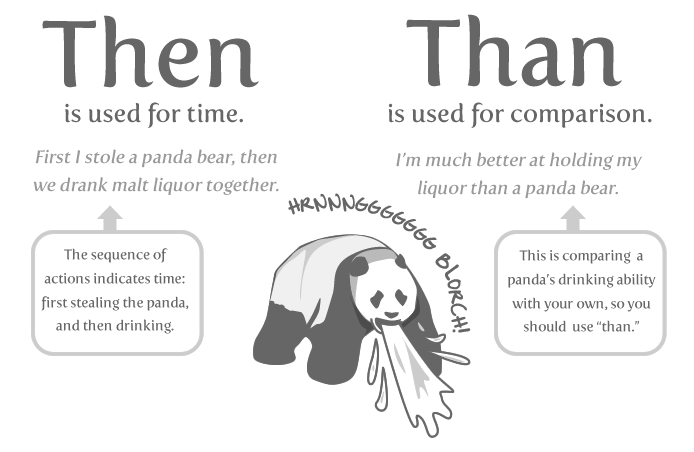
My dad sent me a link to this article today: “7 Grammar and Spelling Errors That Make You Look Dumb.” I highly recommend it if (a) you’re one of those people who cannot keep “your” and “you’re” straight, or (b) you’re one of those people who can keep “you’re” and “your” straight, and it drives you crazy that your friends, students, coworkers, etc. can’t. Within the article, there’s a link to Grammar Girl, which is also an excellent resource. Another one of my favorites is The Oatmeal, which delivers grammar lessons via comics (usually including dinosaurs or dolphins or something else amusing and lighthearted, yet memorable). Finally, there’s a great Hyperbole and a Half comic on the non-word “alot.”

Like it or not, grammar matters. I try to be non-judgmental and open-minded about a lot of things, but I absolutely judge based on grammar and spelling, and these resources allow me to admit that and justify it a little bit. In the grand scheme of things, is grammar important? Well, as the first article says, yes: potential employers and hiring committees are going to judge also. Should it be important is another question, but for now, it is. Everyone who has to write a cover letter or put together a resume is probably going to be judged on their grammar. Written communication is important – as is attention to detail, especially if you’re applying for a job. So if you’re in category (a), take advantage of the opportunity to learn from comics.

(c) The Oatmeal

Digital Public Library of America

For those interested in the Digital Public Library of America (DPLA) project, Simmons GSLIS will be streaming the plenary meeting, which is taking place this Friday, October 21, in Washington, D.C. Here’s the agenda: there are a number of amazing speakers, including David Ferriero (Archivist of the United States) and John Palfrey, chair of the DPLA steering committee and author of Born Digital. Maureen Sullivan (ALA President 2012-13) and Robert Darnton of Harvard University Libraries (and author of The Case for Books) will serve as moderators at different times of day. The Beta Sprint projects will be presented at 1:30pm.

This is a project I’m interested in and have been following for some time. I’m sorry I can’t be in D.C. on Friday, but looking forward to seeing what they have come up with. A “national digital library” is such a huge project, it’s hard to wrap your mind around – but if Europe can do it, maybe the U.S. can pull it off as well.

In defense of editors

“The only really necessary people in the publishing process now are the writer and reader,” [Amazon top executive Russell Grandinetti] said. “Everyone who stands between those two has both risk and opportunity.”

That’s a quote from a recent New York Times article about Amazon edging out publishers and dealing directly with authors. I can’t tell if it was quoted faithfully or taken out of context, but if it is a true statement of expression, I have to disagree. Even the best writers – however you define best – need editors. Not every author-editor relationship is a life-changing or earth-shattering one, but editing does improve books: editors might pose the right question at the right time, or suggest cutting an element that doesn’t move the story forward, or suggest a new angle. Writers can become so immersed in their own work they are unable to look at it clearly and objectively; here, too, an editor is helpful.

This is not to say that bad books don’t get published, even with an editor (define “bad” however you want – it’s out there). And it’s not to say that it’s completely impossible for an author to write and publish a work of quality without an editor – but that’s the exception, not the rule. After all, there are dozens of authors writing today who are top-notch, “experts” at what they do; those authors are still working with editors. Even Amazon is employing editors (though nameless executives won’t say how many).

The publishing industry gets a lot of flack. It’s not Wall Street; no one I met while I was working in publishing was in it for the money. It’s not innocent, either (come on, HarperCollins, 26?), but it does have a function, and it is a valuable part of the process by which an author produces a book and that book becomes commercially available. Amazon represents a legitimate threat to traditional publishers, but this is not the end of the world, let alone the industry. Radio wasn’t the end of books, TV wasn’t the end of books, and the Internet isn’t the end of books. If anything, the Internet proves how badly editors are needed.

Borrowing e-books from the library

This is by no means a universal set of instructions, but the New York Public Library (NYPL) blog has posted step-by-step instructions for how to check e-books out of the library with a Kindle. It’s a great visual walk-through, which is good because there are a lot of steps. I prefer the step-by-step screenshots, though – it’s the next best thing to having someone walk you through it one-on-one. (There’s a link to a video from OverDrive, as well.)

We aren’t “there” yet, but it’s exciting to see the progress being made with libraries and e-books.

Banned Books Week…

…has passed. But I just found this quote and wanted to share:

“Book-banning is ridiculous, if for no other reason than it makes people want to read the banned book even more. The exchange of ideas (even unpopular or inconvenient ones) is important in making us who we are, and helping us to promote independent thought. Also, books about witches and talking animals are awesome.” –Jenny Lawson, a.k.a. The Bloggess, for CafeMom

More “adult” than “young”

The “young adult” sector is generally considered to encompass the 12-18 set. This is a pretty huge span: there’s much more of a developmental difference between, say, a 14-year-old and a 16-year-old than there is between a 30-year-old and a 32-year-old. Obviously, some YA books are aimed toward the younger end of the spectrum – the “tweens” – and some are pitched toward an older audience. Add to this that YA is beginning to encompass a few more years in either direction – so it might span from 10 to 25 (according to YALSA) – and that’s not exactly a homogenous demographic.

Additionally, there’s no switch that gets flipped when you turn 19, and all of a sudden you are totally uninterested in The Perks of Being a Wallflower and are picking up  Jonathan Franzen’s Freedom instead. Readers in their late teens and early twenties may go back and forth between YA and adult fiction – especially if there isn’t much out there featuring main characters in that age range, as seems to be the case (“Where Are All the Young ‘Adults’?”, Young Adult Review Network; “The College Experience in YA Books,” YALSA’s The Hub). Both of those articles have a few suggestions for YA fiction featuring late teen/early 20s protagonists; I’ve added a few below as well. Feel free to add more in the comments!

Love is the Higher Law, David Levithan (set in New York; characters are high school seniors/college freshmen)

Prep, Curtis Sittenfeld (set at a Massachusetts boarding school)

I Am Charlotte Simmons, Tom Wolfe (set at a fictionalized Duke University)

The House of Sleep, Jonathan Coe (set at an English university)

Lucky Girls, Nell Freudenberger (short stories)

The Case of the Missing Hypertext Novel

Right below the Nobel article in Salon, there was an article about hypertext novels, titled “Why the Book’s Future Never Happened,” Hypertext fiction, according to Wikipedia, is electronic literature with hyperlinks that allow for non-linearity and reader interaction. (Not having read one, the impression that I get is something between a choose-your-own adventure novel and a novel told in a non-linear fashion, e.g. with flashbacks or different character perspectives.)

Apparently there was a lot of hype about hypertext fiction back in the ’90s – it was supposed to be “the next big thing,” but it never really took off. The author of the Salon article posits that hypertext fiction was “born into a world that wasn’t quite ready for it,” and additionally, its failure had more to do with its content than with the its format. That is, the first hypertext novels simply weren’t very good. (“True, the hypertext offers you the puzzle-solving pleasure of making sense of the story, arranging the pieces in your head to see the whole mosaic, but why would you do that, if the pieces don’t suggest a picture you care to see? Not every puzzle has an interesting solution.”)

The article’s author suggests that hypertext novels are even more difficult to write than regular novels, because “the sections have to be readable along multiple paths; they have to be richly related in multiple ways; and they have to keep you reading.” However, non-linear fiction has been written before: the author offers Pale Fire by Vladimir Nabokov and and Hopscotch by Julio Cortazar as examples, and I might add to that: The Time Traveler’s Wife?

Breaking news: Americans are self-involved

For those who are interested in Nobel prize politics, there’s an article in Salon.com titled “Why American Novelists Don’t Deserve the Nobel Prize.” The author cites the problem of (American) Great Male Narcissists and the “write what you know” message drilled into MFA students. I find it difficult to offer my two cents here – as many contemporary novels and “modern classics” I’ve read, it doesn’t seem to be enough to form a decisive opinion the way the Salon author (and the Nobel committee) has.

Also, like most Americans, I have not read widely outside of American and British literature, despite the admirable efforts of publishers like Europa Editions to offer works in translation (Europa published Muriel Barberry’s The Elegance of the Hedgehog; about two-thirds of the books they publish are works in translation). Furthermore, the stated criteria for the prize seem a bit vague: the Nobel prize shall be awarded for “achievements in literature,” to “the person who shall have produced in the field of literature the most outstanding work in an ideal direction.” (See the official Nobel Prize in Literature page, and the list of laureates.)

I’m sure there are tacit criteria as well, but surely of all the authors in the world, there are many who could justly receive the prize; it’s a bit like applying to a top Ivy – there are a lot of qualified applicants who don’t get in. Also, it seems unlikely that Europe is producing all the best literature. I’m not necessarily arguing that American literature is superior, but there are a number of other countries and continents in the world, and I believe there are authors there too…?

*UPDATED* I found a bit more background/insight to the Nobel issue in the New York Review of Books. Here’s a quote from the article:

“Now, let’s imagine that we have been condemned for life to making, year in year out a burdensome and near impossible decision to which the world increasingly and inexplicably ascribes a crazy importance. How do we go about it? We look for some simple, rapid and broadly acceptable criteria that will help us get this pain out of the way. And since, as Borges himself noted, aesthetics are difficult and require a special sensibility and long reflection, while political affiliations are easier and quickly grasped, we begin to identify those areas of the world that have grabbed public attention, perhaps because of political turmoil or abuses of human rights, we find those authors who have already won a huge level of respect and possibly major prizes in the literary communities of these countries and who are outspokenly committed on the right side of whatever political divide we’re talking about, and we select them.”

Read the whole article: “What’s Wrong With the Nobel Prize in Literature?”

Archiving Digital Content at Schlesinger Library, or “Terror Nova” – Amy Benson

Amy Benson lecture at Simmons co-hosted by ALASC and SCoSAA

Amy Benson is the Librarian/Archivist for Digital Initiatives at the Schlesinger Library, one of 73 Harvard libraries. The Schlesinger focuses on the history of women in America, and Amy talked to us about digital collections: the process of creating, managing, and preserving them, and the challenges.

The first collection they worked on digitizing was women’s travel writing, for an interested vendor. Next was the Charlotte Perkins Gilman Collection, which is now fully digitized, and currently they are working on digitizing the Radcliffe College Publications. All of these collections, for the most part, are analog – papers, letters, books, photos, etc. (The analog-to-digital process is, relatively, the easiest, according to Amy.)

Other types of digital collections involve capturing and preserving web content, and born-digital content. Born-digital content is especially tricky:  material comes in various physical formats (diskettes, flash drives, CDs, DVDs, cartridge tapes(!), hard drives, etc.) and multiple file formats – and then there’s e-mail (“Thinking about processing e-mail at the individual message level is a little bit crazy”). Sixty-five collections at the Schlesinger include born-digital material: it’s on more than 1900 individual media storage devices, each containing any number of files. “You begin to see we’re in a big mess,” Amy explained. Then she rephrased, “Well, not a big mess – an interesting time….There’s no shortage of things that need to be figured out in the world.”

Amy spoke about trying to expand scope of collection, but acknowledged that selection was a challenge. Radical feminists on the web, for example – Which ones do you pick? How do you know which ones people will want to use for research? Donor agreements must be worked out, both for materials already in the collection and for new acquisitions, and all incoming born-digital material must be tracked.

Another challenge in managing digital archives is deciding what to keep. And, once that’s decided, how do you preserve it? (In the Schlesinger’s case, items can be deposited into Harvard’s Digital Repository Service.) Once items are selected and preserved, how can patrons access them? “The thing that’s cool about my job is figuring out how to do all of this,” said Amy. She also mentioned the importance of documenting the process to guarantee authenticity of the final product – assuming that the end user doesn’t just give the institution the benefit of the doubt that the item is an exact copy of the original.

Essentially, digital archives are the same as any other archives: selection, accession, preservation/storage, and access are the key elements of the process. “In some ways it’s the exact same thing – you just have to do it through a computer,” said Amy. However, because the technology is new and constantly changing, and because each archives has specific needs and goals, there doesn’t seem to be a go-to set of best practices. So, what do you need to be a digital archivist? “A willingness to experiment and a love for computers.”

On mistakes and loss: “Some stuff is already lost forever. There’s actually going to be a big black hole in the ’80s…”

Interesting links:

MIT’s FACADE project

Harvard’s Web Archive Collection Service (WAX)

Updates

  • The folks at SF Signal have devised a flowchart to add context to NPR’s list of top science fiction and fantasy books (though if you follow that link to NPR, you’ll see they did at least add a blurb about each book – the initial list was really just a list). I originally posted about it here.
  • Sadly, there were technical difficulties recording the GSLIS Perspective on ALA panel, and there will be no podcast. There is, however, a podcast of the ASIS&T event from the day before.
  • James Patterson’s article on CNN links out to a number of good readers’ advisory resources for children and teens, especially boys.
  • My YA Literature class has a blog where we’ll each be posting a review of one YA book.
That’s it for now – have a great weekend!