To theme or not to theme?

Some storytime leaders are committed to themes; some aren’t. I fall into the latter camp, for some of the reasons articulated by Kary Henry on the ALSC blog, and Lindsey Krabbenhoft at Jbrary (“Storytime themes vs. storytime flow”). However, sometimes a theme emerges naturally, which happened this week.

Books on window ledge: Dancing Hands, Song in the City, I Can See Just Fine, and Mel Fell

There was an unusually small group at storytime this week, all regulars, so it was actually nice and cozy. As usual, we started with our “Hello, Friends” song with sign language, and it’s so cool to see the toddlers signing along. We read four books this week, with song cube songs and the Little Mouse flannel board activity in between:

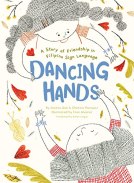
  • Dancing Hands: a story of friendship in Filipino sign language, by Joanna Que and Charina Marquez, illustrated by Fran Alvarez, translated by Karen Llagas (a Schneider Family Honor Book)
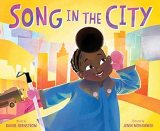
  • Song in the City by Daniel Bernstrom, illustrated by Jenin Mohammed
  • I Can See Just Fine by Eric Barclay
  • Mel Fell by Corey R. Tabor

Cover image of Dancing HandsAll of these books, in their own way, are about ability. Perception and communication also emerge as themes.
Dancing Hands worked well because it has minimal text, but shows readers how to make the signs the girls in the story are making (signs are also illustrated on the endpapers!). Dancing Hands feels a lot like My Best Friend by Julie Fogliano, illustrated by Jillian Tamaki, another favorite storytime book.

Cover image of Song in the CitySong in the City is a little bit longer, but the illustrations are super bright – featuring that warm yellow from the cover – the text rhymes, and there are a lot of sound effects. This was definitely the book that the adults in the room loved best. We all paused in the middle to close or cover our eyes, as Emmalene helps Grandma Jean do in the book, to focus on what we could hear.
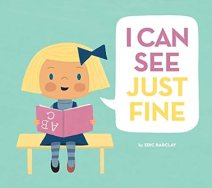
icanseeI would love I Can See Just Fine based on its title alone, but the execution is just perfect. A little girl named Paige has trouble seeing the board at school, reading her sheet music, and even identifying animals (she picks up a skunk and calls it a kitty). She is not excited to go to the eye doctor, or when they tell her she needs glasses, but when she stands in front of the huge array of frames to choose from on the wall, you can just feel her wonder and awe. She tries on lots of frames and chooses the right ones for her. I showed the group my own glasses, identifying the different parts (frames and lenses). I also shared with the group that the eye doctor is my favorite one to go to – they never give shots!
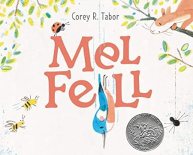
Cover image of Mel FellWe wrapped up with Mel Fell, which is about confidence and ability in a different way: a baby kingfisher’s first flight/dive. The orientation of this book is unique (in the photo above, the spine is actually on top), and there’s a fun rotation required part of the way through the story. We see community members – other residents of Mel’s tree – attempt to help, but ultimately, Mel was right about their readiness to fly!
After stories, songs, and Little Mouse, we sang and signed “Goodbye, Friends.” Our craft wasn’t connected to the books, though I did mention that peeling and placing stickers is good fine motor practice. And, as a kid, how often do you get to use as many stickers as you want? (I’m lucky in that my predecessor spent years hoarding stickers from various sources, so we have an entire box to choose from.)

Next week, we’ll be hosting a group from The Family Center, reading Hugs from Pearl by Paul Schmid, and making valentines.

Pajama Storytime

When I started as the children’s librarian, I had to make one change almost right away, taking away the Monday morning storytime because I don’t arrive at work on Monday until 11:30 (then I’m here till we close at 8pm). However, I didn’t want to reduce the number of storytimes, so I decided to try offering an evening one – a pajama storytime! Also, it was a way of expanding access for families who can’t get here mid-morning on a weekday. I wasn’t sure if it would take off, but I spent a month talking it up, and attendance has been good so far!

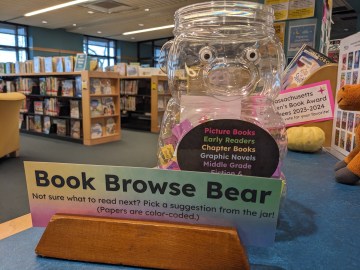
Pajama Storytime happens in the Storytime Room, where we have a rug and some colorful, cozy bean bags. I brought in a string of twinkle lights and stuffed them into a clear glass jar (my “star jar”) and I put that on the table with the books. We start right at 6:30 and read till 7. Most attendees are older – first through fourth grade – but a few toddlers show up too, so I try to put the shorter, simpler books first in the lineup, and save longer ones for after the toddlers’ attention span is exhausted.

Not every book I read at Pajama Storytime is specifically bedtime-themed, but a lot of them are. Here’s what we’ve read so far:

AreYouAwake

Goodnight Veggies by Diana Murray/Zachariah Ohora
Are You Awake? by Sophie Blackall
Goodnight, Everyone by Chris Haughton
In the Night Garden by Carin Berger
Interrupting Chicken by David Ezra Stein
Everyone’s Awake by Colin Meloy
Time for Bed by Mem Fox/Jane Dyer
Awake, Asleep by Kyle Lukoff/Nadia Alam

TellMeWhattoDreamAbout

Just Because by Mac Barnett/Isabelle Arsenault
How to Put Your Parents to Bed by Mylisa Larsen
City Moon by Rachael Cole/Blanca Gomez
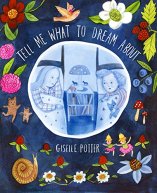
Tell Me What to Dream About by Giselle Potter
Bedtime Monsters by Josh Schneider
Hoodwinked by Arthur Howard
There Is A Crocodile Under My Bed! By Ingrid & Dieter Schubert

KittensFirstFullMoon

The Yawns Are Coming by Christopher Eliopoulos
A Spoonful of Frogs by Casey Lyall and Vera Brosgol
Night in the City by Julie Downing
Chicken Wants A Nap by Tracy Marchini
Every Dreaming Creature by Brendan Wenzel
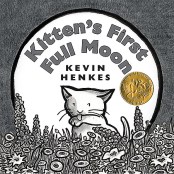
Kitten’s First Full Moon by Kevin Henkes
In the Night Kitchen by Maurice Sendak

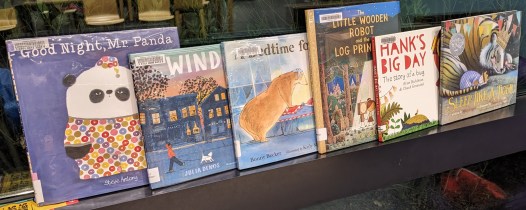
SleepLikeATiger

Good Night, Mr. Panda by Steve Antony
Windows by Julia Denos
A Bedtime for Bear by Bonny Becker/Kady MacDonald Denton
The Little Wooden Robot and the Log Princess by Tom Gauld
Hank’s Big Day by Evan Kuhlman & Chuck Groenink
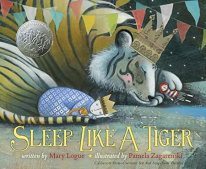
Sleep Like A Tiger by Mary Logue/Pamela Zagarenski

Books face-out on window ledge

As you can see, there’s a mix of longer and shorter ones, dreamy and goofy stories, rhyming and not, silly and soothing. I even had one parent thank me because no one had read a story to her in such a long time! (Children’s programming is important for the caregivers, too!)

Is there a Pajama Storytime at your library? What do you like about it? What would you change?

More storytimes, and rhyme time

A month flies by! Storytime is always one of my favorite parts of the work week. Here are the books and art projects we’ve done for the past few weeks, and of course we look for Little Mouse every time (“Little mouse, little mouse, are you in the [color] house?”), and open and close with “Hello Friends” and “Goodbye Friends.”

September 28 Storytime

  • I Want My Hat Back by Jon Klassen
  • The Very Hungry Caterpillar by Eric Carle (with flannel board)
  • Carrot & Pea by Morag Hood
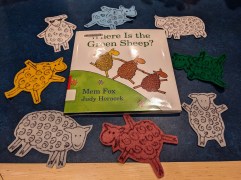
  • Where is the Green Sheep? by Mem Fox and Judy Horacek
  • Craft: Coloring with crayons on butcher paper taped to the floor

Where is the Green Sheep? surrounded by felt board sheep

October 5

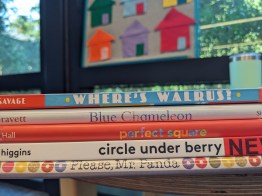
  • Please, Mr. Panda by Steve Antony
  • Circle Under Berry by Carter Higgins
  • Perfect Square by Michael Hall
  • Blue Chameleon by Emily Gravett
  • Where’s Walrus? by Steven Savage
  • Craft: Collage with tissue paper and glue sticks on construction paper

Book spines with Little Mouse

October 12

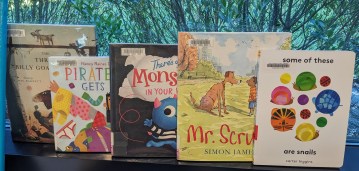
  • The Three Billy Goats Gruff by Mac Barnett and Jon Klassen
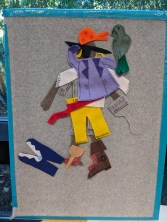
  • Pirate Jack Gets Dressed by Nancy Raines Day (with flannel board)
  • There’s a Monster in This Book by Tom Fletcher
  • Mr. Scruff by Simon James
  • Some of These Are Snails by Carter Higgins
  • Craft: Decorating die-cut paper pumpkins with markers and crayons

storytimebooks

Pirate Jack flannel board

October 19

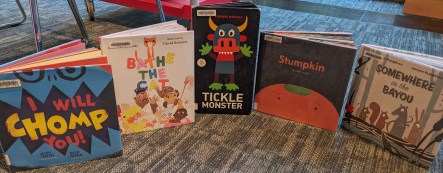
  • I Will Chomp You by Jory John and Bob Shea
  • Bathe the Cat by Alice B. McGinty and David Roberts
  • Tickle Monster by Edouard Manceau (with flannel board)
  • Stumpkin by Lucy Ruth Cummins
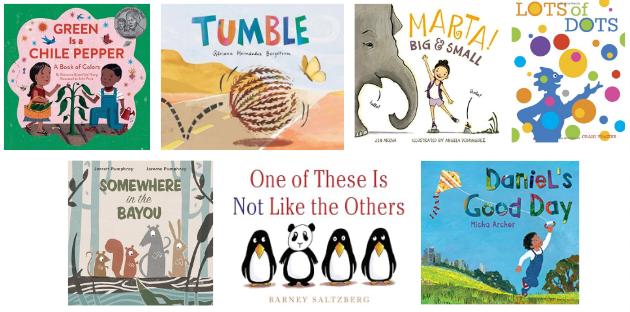
  • Somewhere in the Bayou by Jarrett and Jerome Pumphrey
  • Craft: Flannel board play with different shapes, colors, and sizes

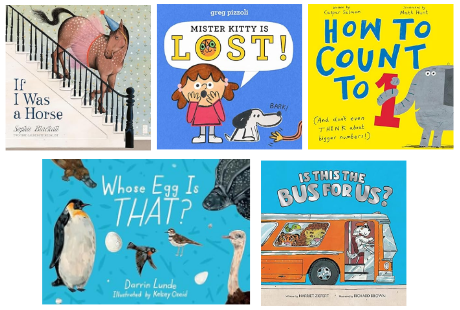
Picture book covers

October 26

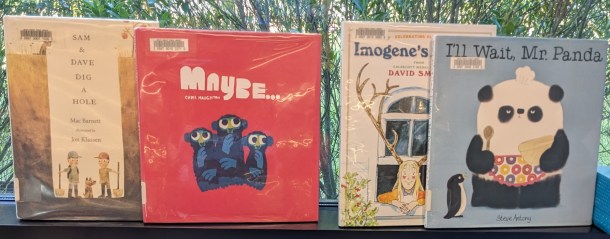
  • Sam and Dave Dig A Hole by Mac Barnett and Jon Klassen
  • Maybe… by Chris Haughton
  • How do you say? = ¿Cómo se dice? by Angela Dominguez
  • Imogene’s Antlers by David Small
  • I’ll Wait, Mr. Panda by Steve Antony
  • Craft: Dot markers, crayons, markers on butcher paper on the floor (collaborative)

Picture books, covers out, on window ledge

Storytimes I’d done plenty of before coming to SHPL, but Rhyme Time was a new program for me to lead. It’s kind of like storytime, but without books (although, I think I am going to start adding in one book each time). We do lots of songs, rhymes, fingerplay, and movement, followed by free play. I lead a lot of the songs and rhymes myself, but I also have a computer and speakers to play music. Soon, everyone will be singing and dancing along to Caspar Babypants’ “Butterfly Driving A Truck”!

I start every Rhyme Time with the same three songs:

  • Hello Friends” song
  • Hello song (“We clap and sing hello…”)
  • The Name Song (“If your name is _____, jump up and down”). This is great because each child gets their moment in the spotlight (if they want it – some just sit on laps and that’s fine!) and it creates a sense of community, helping us all get to know each other.

Then we do a selection of these songs/rhymes with movement and fingerplay. Some of them are on my song cubes (homemade tissue-box creations with a different picture on each side, corresponding to a song, like a teapot for “I’m A Little Teapot” or a spider for “The Itsy-Bitsy Spider.” Because these are short little songs, we sometimes do them three times: regular/fast/slow or regular/loud/quiet.

We end with two goodbye songs:

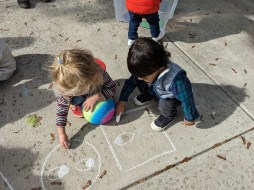
If the weather is nice (or, okay, decent) and we’re outside, I bring out sidewalk chalk and balls for the kiddos to play with. If we’re inside, it’s parachute and bubbles. This gives everyone a chance to move around and socialize.

Toddlers drawing with chalk

Back to storytime!

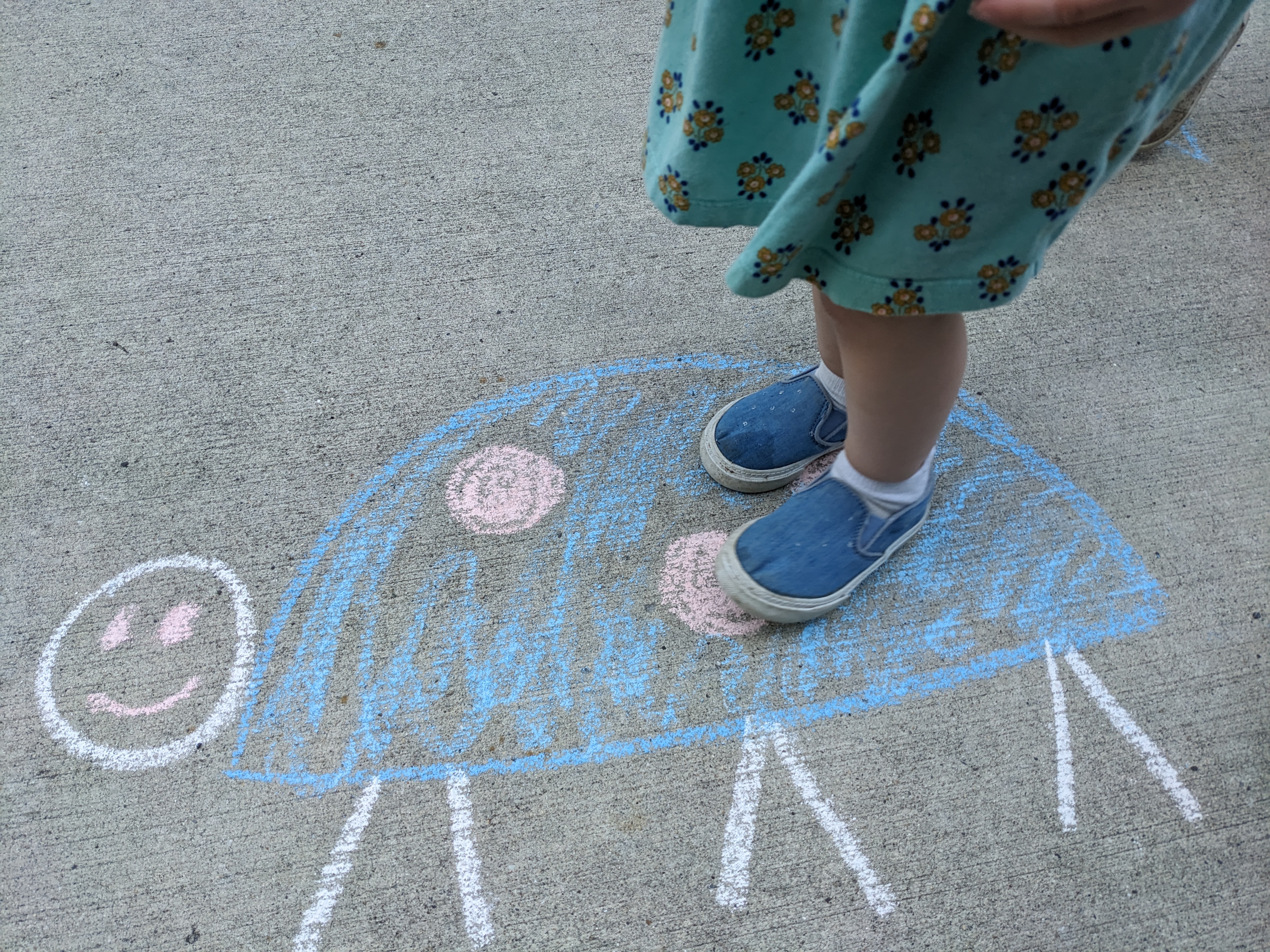
Child's legs and feet, standing on a smiling ladybug drawn in chalk

This month I returned to public libraries and am really enjoying being a children’s librarian again, serving kids and their caregivers with book recommendations, weekly storytimes and rhyme times, arts and crafts, and all those “did you know…?” hidden gems that the library offers, like the OpenDyslexic font built into Libby.

I’m especially thrilled to be doing storytimes again. I’ve modeled my current program on the “Step Into Storytime” I did at the Winchester (MA) Public Library, which was aimed at two- and three-year-olds and their siblings and caregivers. I don’t intentionally choose themes (although three of today’s five books involved elephants), and I lead off with the longest book, as attention spans tend to wane over time.

Here’s my storytime format, with today’s books and activities as an example:

  • Welcome, introduction
  • Early literacy tip: the five ECRR practices (TALK, SING, READ, WRITE, PLAY) all support children’s early literacy skills
  • “Hello Friends” (Jbrary) with ASL
    • Teach/review signs for “hello” and “friends” 
  • There’s A Bear on My Chair by Ross Collins
  • Oh, No! By Candace Fleming
  • A Kiss Like This by Mary Murphy
  • “Little Mouse” game with flannel board (“Little mouse, little mouse, are you in the [color] house?”)
  • A Parade of Elephants by Kevin Henkes with flannel board (today it just so happened that there were five kids, and I have five elephants! So they each got to hold one the whole time, and stick them to the board at the end)
  • Now by Antoinette Portis
  • “Goodbye Friends” (Jbrary
    • Teach/review signs for “goodbye” and “friends” 
  • Craft: Rubber stamps and stamp pads on construction paper 

Last week’s books were Mina by Matthew Forsythe, Huff & Puff by Claudia Rueda, Pete’s A Pizza by William Steig, Matilda’s Cat by Emily Gravett, and Lots of Dots by Craig Frazier. Books that have interactive elements, like Huff & Puff, or can be made interactive (like pretending to roll out dough and sprinkle cheese for Pete’s A Pizza) are great for holding the attention of little ones and the engagement of adult caregivers as well, who can help the littles with the actions, improving large and fine motor skills. 


Picture books Mina, Huff & Puff, Pete's A Pizza, Matilda's Cat, and Lots of Dots in front of a flannel board set up with Little Mouse

Books we read the first week of September were The Giant Jumperee by Julia Donaldson, Spots in a Box by Helen Ward, Triangle by Mac Barnett, and Grumpy Pants by Claire Messer. Both Jumperee and Triangle were checked out afterward, which I take as a mark of success; I always tell families that they are welcome to borrow anything I read aloud at storytime.

As it’s September, one batch of kids has just started preschool or kindergarten, so the storytime regulars are on the younger side; lots of them come to Rhyme Time also (more on that later). I’ve been pulling from my list of great books to share with two- and three-year-olds, as well as newer picture books (I made that list in 2019). I’ve also been keeping crafts basic and process-oriented: so far, we’ve used dobbers/dotters (“do-a-dot art sponge tip applicators”), glue sticks, and rubber stamps – all washable and nontoxic, of course.

What are your favorite read-aloud books to share with littles? Favorite arts and crafts?

Success stories: great read-alouds for K-3

There’s a big difference between reading a picture book to yourself, reading it with one other person, and reading it to/with a group. (If you frequently read aloud to children and you haven’t already read Megan Dowd Lambert’s Reading Picture Books With Children, I highly recommend it for making your storytimes more interactive and engaging.) Without further ado, here are some of the picture books that worked incredibly well at my school this year, for students in kindergarten through third grade:

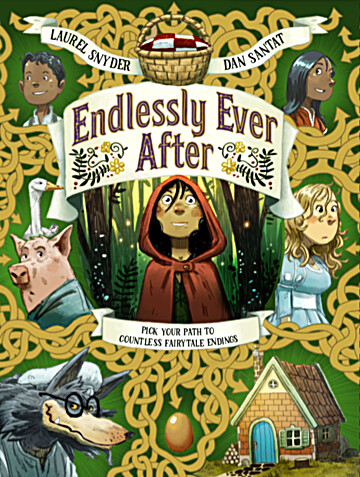
  • Endlessly Ever After by Laurel Snyder and Dan Santat: Cover of Endlessly Ever AfterBecause this is a choose-your-own-adventure book, you can read it several times with the same group (and they will ask for it again and again!). Every time a choice comes up, I read both choices and ask them to vote. This works with upper elementary as well as with the younger grades.
  • Don’t Hug Doug by Carrie Finison and Daniel Wiseman: Cute, friendly, glasses-wearing Doug likes YOU, he just doesn’t like hugs, except under very specific circumstances (are you Doug’s mother? Is it bedtime?). Approachable Doug is the perfect character to deliver this important message about consent.
  • Dozens of Doughnuts by Carrie Finison and Brianne Farley: This is a rhyming delight, with the most delicious endpapers ever. Perfect for fall, just as bears like LouAnn are going into hibernation.
  • The Leaf Thief by Alice Hemming and Nicola Slater: An autumnal, excellent execution of the buddy comedy featuring high-strung Squirrel and tolerant Bird is a funny story and a great way to explain what happens to leaves in fall. There’s a spring version, too (Don’t Touch That Flower!)
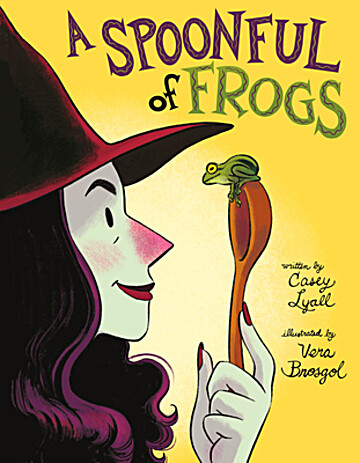
  • A Spoonful of Frogs by Casey Lyall and Vera Brosgol: spoonful of frogsThe witch main character and the frogs she tries to add to her soup are perfect for around Halloween time, and “PUT the FROGS on the SPOON” may become a mantra.
  • Triangle/Square/Circle by Mac Barnett and Jon Klassen: These three books, as a group, worked beautifully when kindergarteners were learning about shapes, and they are just fantastic to read aloud; they don’t get old, and the characters’ feelings and dilemmas are easy for the kids to understand and empathize with.
  • That’s Not My Name by Anoosha Syed: thatsnotmynameThis is great for the beginning of the year when everyone is learning each other’s name. Most kids can relate to the experience of having someone mispronounce your name or call you the wrong name, and they know the feeling; this book encourages them to insist on being called the right name the right way, and take the time to do the same for others.
  • I Want My Hat Back/This Is Not My Hat by Jon Klassen: Yes, more Klassen, but these two books are brilliant for all ages. Ask the kids what happened at the end; their inferences may surprise you.
  • How to Apologize by David LaRochelle and Mike Wohnoutka: Straightforward, kid-friendly language and funny illustrations present an important lesson in a humorous and impactful way. A good one for the beginning of the year, or any time. Cover image of Hot Dog
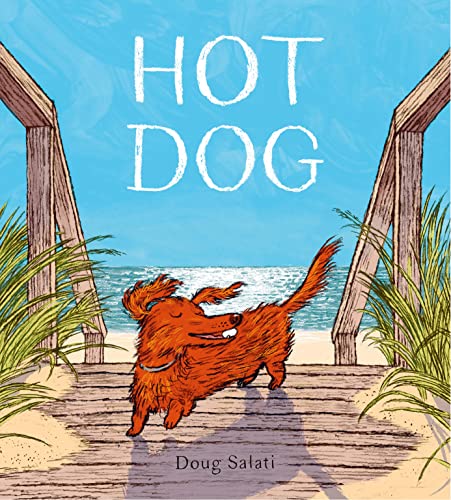
  • Hot Dog by Doug Salati: This year’s Caldecott winner was popular not just during our Mock Caldecott unit in January, but kids have been asking me to borrow it since then – it clearly stayed with them.
  • Knight Owl by Christopher Denise: A Caldecott honor book that was also included in our Mock Caldecott unit (it got the most votes in our school), Knight Owl features absolutely beautiful art, an adorable hero, and a solution involving pizza.
  • Somewhere in the Bayou by Jarrett and Jerome Pumphrey: “Smack! Splash!” This book is built on pattern, repetition, onomatopoeia, surprise, and empathy. It was fantastically popular in our Mock Caldecott, and so fun to read aloud – it truly doesn’t get old.
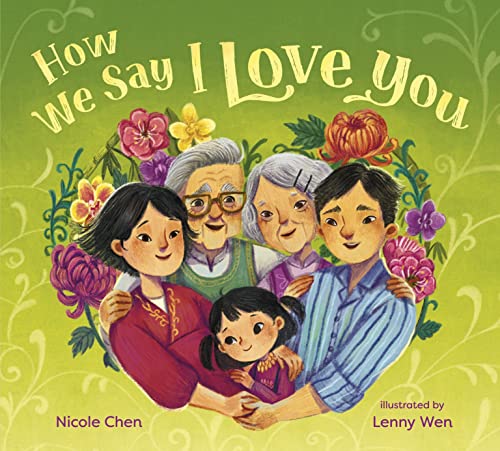
  • How We Say I Love You by Nicole Chen and Lenny Wen: howwesayiloveyouThis has strong appeal on three levels: first, there’s the seek-and-find element (a heart on each page); next, the cultural representation; and finally, the way it opens a discussion of how we show love in our own families. Every single class I read this book with (first through third grade) came up with a whole list, with nearly every kid contributing, and some adding more than one idea.
  • Sam and Dave Dig A Hole by Mac Barnett and Jon Klassen: Yes, Barnett/Klassen again. The kids absolutely freak out as Sam and Dave remain oblivious to the “spectacular” pink gems they bypass as they dig. Kids notice that the dog knows where they should be digging, though, and they love comparing the front and end spreads to spot the differences.
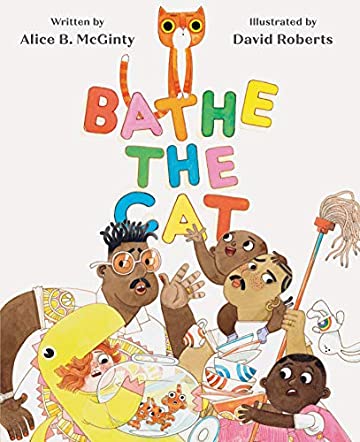
  • Bathe the Cat by Andrea Beaty and David Roberts: Cover image of Bathe the CatPure good fun; the kids catch on quickly as the family’s to-do list gets more and more ridiculous. Great representation, too, of a mixed-race family with two dads.
  • How Do Dinosaurs… by Jane Yolen and Mark Teague: These rhyming stories are classics for a reason. I like …Learn to Read and …Go to School for the relevant educational setting. Many kids will already be familiar with this series, if not these specific titles, and they’re usually happy to see and hear them again.
  • Interrupting Chicken by David Ezra Stein: The idea and the execution are equally good, the humor is spot-on, and the two sequels maintain the quality of the original (when you store your cookies in a clock, it’s always cookie time!).
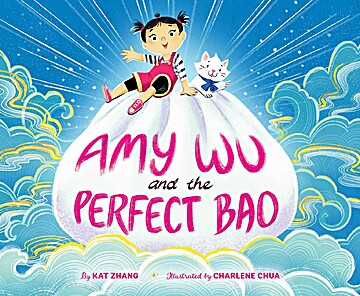
  • Amy Wu and the Perfect Bao by Kat Zhang and Charlene Chua: amywuperfectbaoKids identify with Amy’s problem, and even if the word “bao” is unfamiliar, nearly every culinary tradition has a version of dumplings (knish, empanada, pierogies, etc.). Amy finally figures out the solution to her problem, and her loving, supportive family (including pink-haired grandma and adorable white kitten) is right there with her.
  • A Seed Grows by Antoinette Portis: I think this is what’s called “deceptively simple,” but it’s brilliant in its simplicity. It ties in with K/1st curriculum when they study plants, and there’s an opportunity to build in movement: start in a crouch as a seed, grow up toward the sky/ceiling, branch arms for leaves and blossoms, and gently fall back down.
  • The Adventures of Beekle by Dan Santat: caldecott-beekleThis Caldecott winner uses color effectively to show an (un)imaginary friend’s journey into the real world. (See also: Real to Me by Minh Lê and Raissa Figueroa)
  • Don’t Touch My Hair by Sharee Miller: A little Black girl loves her hair, but doesn’t love when other people touch it without asking. She tries running away from the problem, but eventually uses her voice to set boundaries.
  • Oh, No! by Candace Fleming: Effective use of repetition encourages students to participate in the chorus (“oh, no!”) as one animal after another falls into a pit, then cheer for their eventual escape as the meaning of the final “oh, no” shifts.

Do you have any knock-em-out-of-the-park read-alouds? Please share in the comments!

ALA Youth Media Awards 2023

Cover image of Hot Dog
What a day for a dog!

Last year, I followed the ALA YMA on Twitter while preparing to teach seventh graders online research skills; the year before, I watched in my pajamas with my five-year-old on my lap. This year, I missed the beginning of the livestream, but the timing worked out so that a third grade class was in the library when the Caldecott awards were announced, and they were so excited!

As I watched not just the Caldecotts but all the other awards roll in, it struck me more than any previous year how many deserving books there are. Not that I disagree with the committees’ choices – plenty of books I cheered for, others I hadn’t read – but there are just so. many. good. books in any given year! And because I was on this year’s Heavy Medal committee (Mock Newbery) and ran a Mock Caldecott program at my school, I was more attuned than usual to award predictions.

So rather than recap today’s winners, I’m going to list a few middle grade and picture books I think could have gotten awards, and just happened not to, but are still wonderful and you should read them:

Middle grade:

  • A Rover’s Story by Jasmine Warga
  • Violet and Jobie in the Wild by Lynne Rae Perkins
  • The Ogress and the Orphans by Kelly Barnhill
  • Different Kinds of Fruit by Kyle Lukoff
  • Where the Sky Lives by Margaret Dilloway
  • The Insiders by Mark Oshiro
  • The Door of No Return by Kwame Alexander
  • Black Bird, Blue Road by Sofiya Pasternak
  • A Duet for Home by Karina Yan Glaser

Picture Books

  • Mina by Matthew Forsythe
  • Blue: A History of the Color as Deep as the Sea and as Wide as the Sky by Nana Ekua Brew-Hammond, illustrated by Daniel Minter
  • Sweet Justice by Mara Rockliff, illustrated by R. Gregory Christie
  • A Spoonful of Frogs by Casey Lyall, illustrated by Vera Brosgol
  • I Don’t Care by Julie Fogliano, illustrated by Molly Idle and Juana Martinez-Neal
  • Endlessly Ever After by Laurel Snyder, illustrated by Dan Santat
  • Farmhouse by Sophie Blackall
  • Snow Horses by Patricia MacLachlan, illustrated by Micha Archer

Squirrels that turn out to be cats, magic doors that lead to a refuge and friendship, a Mars rover with human emotions, a choose-your-own-adventure fairytale, escaping frogs, an unsung civil rights hero, some beautiful collage, and more – there’s something for everyone, and awards are only a piece of it all. Congratulations to all authors and illustrators who put something out into the world in 2022; readers are grateful.

Mock Caldecott 2023

In my first year as an elementary school librarian, I had to do a Mock Caldecott. It was one of the programs I’d heard other elementary librarians (and some children’s librarians at public libraries) talk about for years and it always sounded like a fun way to get kids engaged and excited. Plus, it’s a good chance to focus on the (incredible) art, and consider things like trim size and shape, endpapers, use of the gutter, use of color, light and dark, and media. I always look to see if there’s an art note on the copyright page about what materials the illustrator used, and kids are sometimes surprised (especially the born-digital art).

Here’s how I ran our program, loosely based on Travis Jonker’s:

Intro/practice week (first week of January):

  • Introduce the Caldecott Award. What is it for? Who decides? Which books (illustrators) are eligible? Even the youngest students grasp the difference between an author’s job and an illustrator’s job, and learn that if there’s one name on the cover, it means that person did both jobs.
  • Read two past Caldecott books, and have a vote (by show of hands). Make the tally visible on the whiteboard. In kindergarten and first grade, we read Kitten’s First Full Moon by Kevin Henkes (2005) and This Is Not My Hat by Jon Klassen (2013). In second and third grade, we read Beekle by Dan Santat (2015) and Watercress by Andrea Wang, illustrated by Jason Chin (2022).

Week One:

  • Now it’s onto this year’s Caldecott contenders! I requested several books from my public library, using my own reading from the past year as well as The Horn Book’s Calling Caldecott blog and Betsy Bird’s predictions on her Fuse8 blog at SLJ. Ideally, I’m looking for books with less text, because classes are only 40 minutes and we want to do book checkout too. I use the Whole Book Approach, which means I welcome students’ observations while we’re reading – which means it takes longer to read a book aloud.
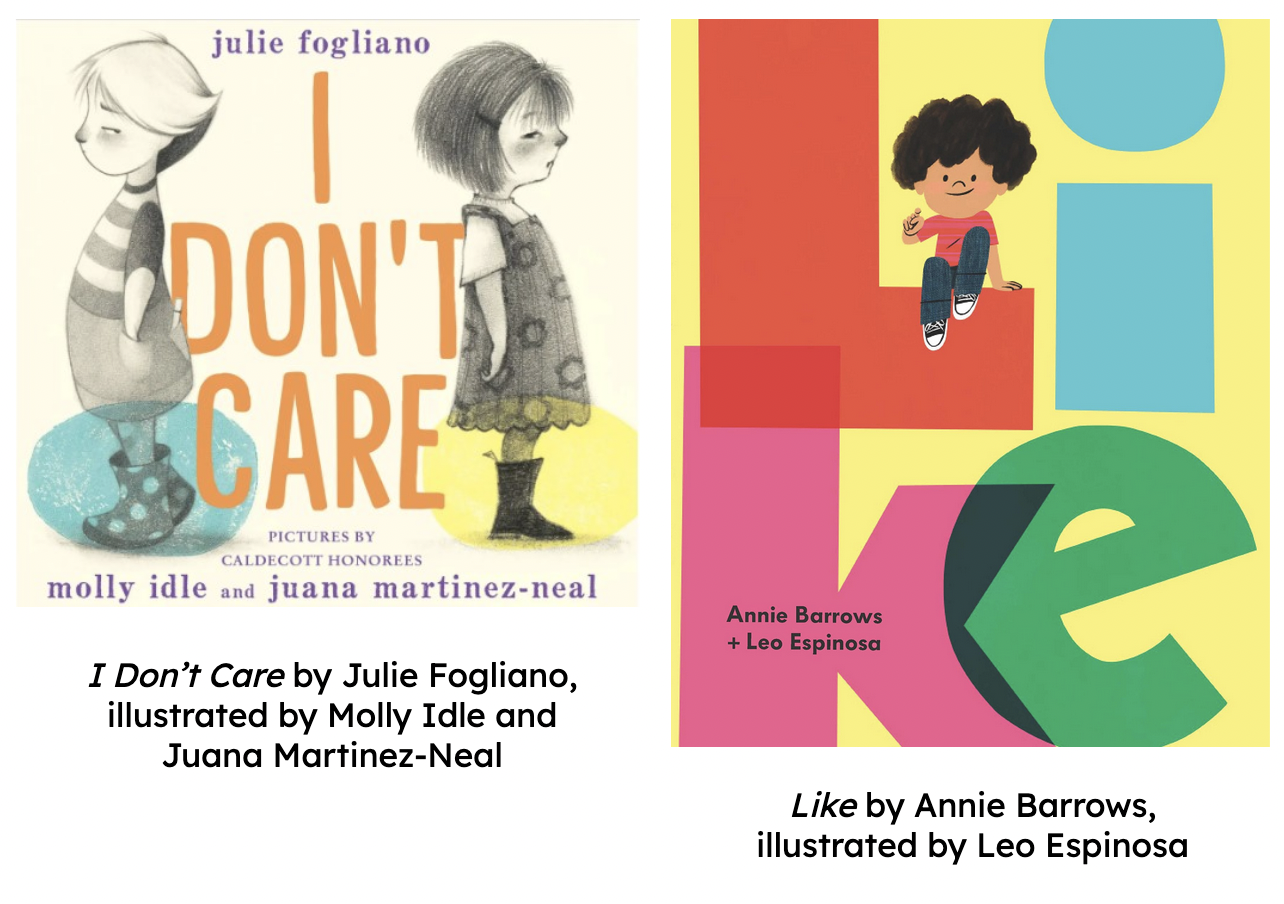
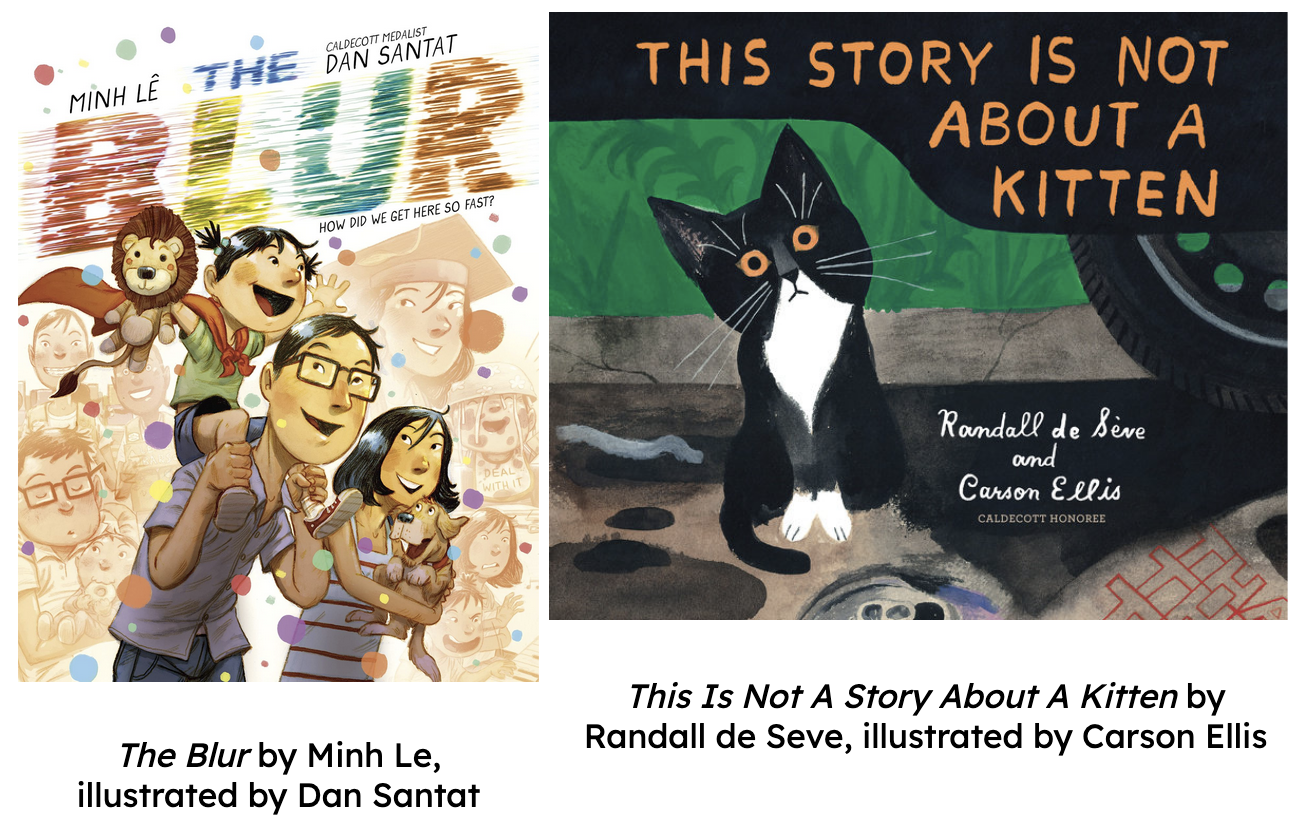
  • Kindergarten and first grade read I Don’t Care by Julie Fogliano, illustrated by real-life best friends Molly Idle and Juana Martinez-Neal, and Like by Annie Barrows, illustrated by Leo Espinosa. Second and third grade read The Blur by Minh Lê, illustrated by Dan Santat, and This Is Not A Story About A Kitten by Randall de Sève, illustrated by Carson Ellis. I note when illustrators have previously won a Medal or an Honor.

Cover images of I Don't Care and Like

Cover images of The Blur and This Story is Not About A Kitten

Week Two:

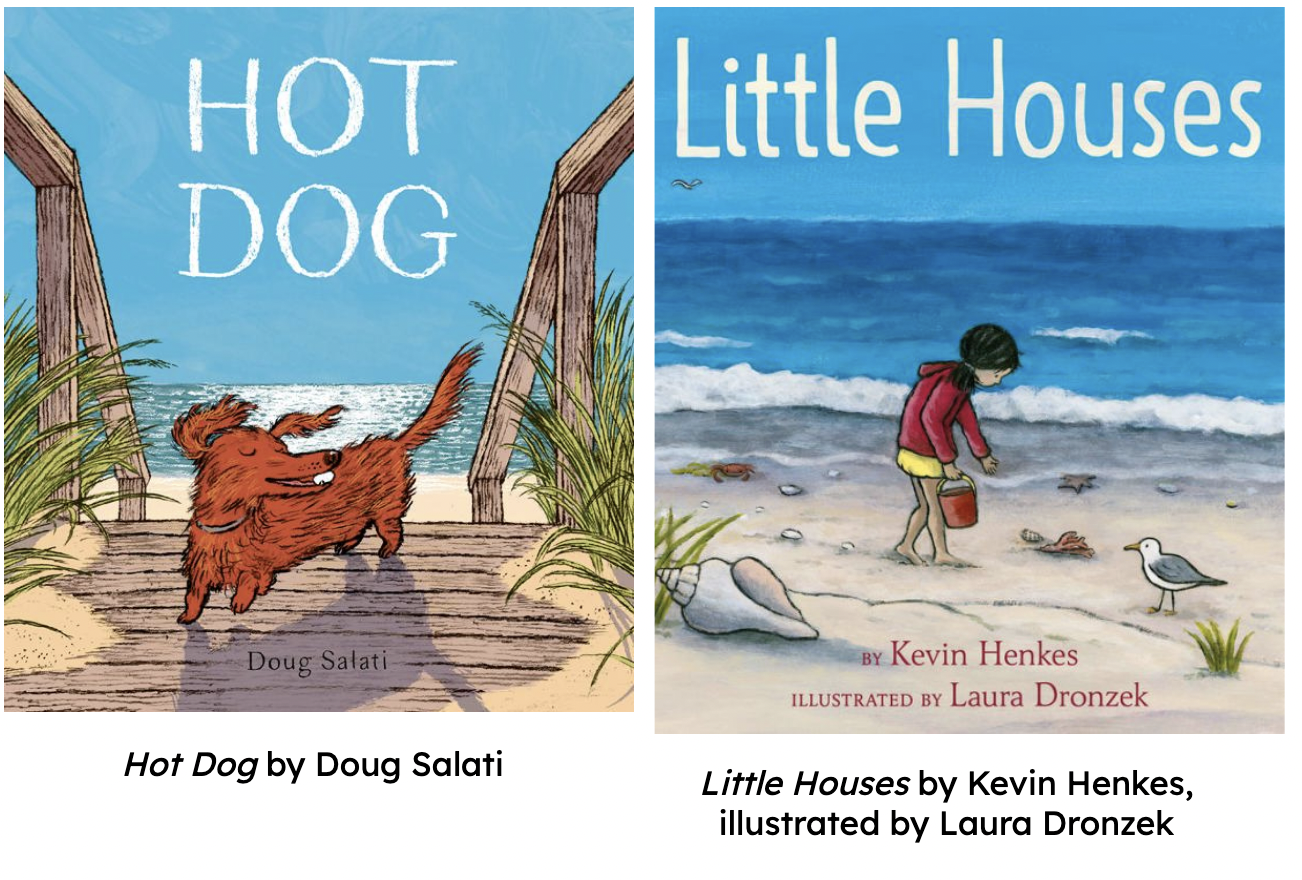
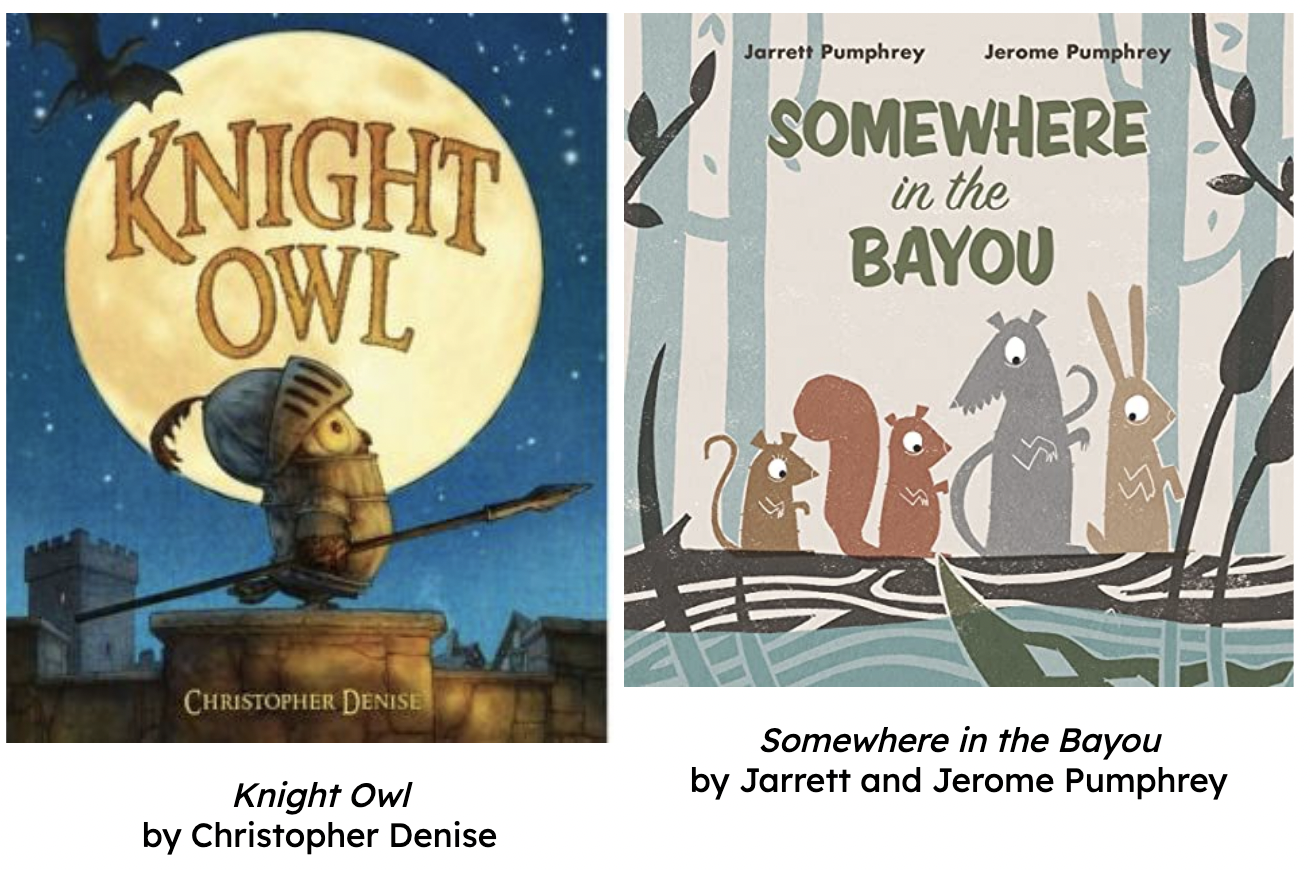
  • Kindergarten and first grade read Somewhere in the Bayou by Jerome and Jarrett Pumphrey, and Little Houses by Kevin Henkes, illustrated by Laura Dronzek. Second and third grade read Knight Owl by Christopher Denise and Hot Dog by Doug Salati. Actually, this week we mixed it up a little bit; one of the first grade classes read the second and third grade pair of books, and one of the other first grades read Hot Dog and Little Houses. Attention spans vary, and it seemed like the right call at the time.

Cover images of Hot Dog and Little Houses

Screen Shot 2023-01-25 at 8.40.44 PM

Week Three:

  • Here we started to run into a few scheduling snags, including a (planned) holiday and some (unplanned) weather-related time off (a full snow day, a delayed start, and an early dismissal). It’s winter in New England, after all. That’s okay! We’re not being super scientific or mathematical about this, though I am keeping track of the tallies and figuring out the total votes for each book each week, and noting the number of classes that read each book.
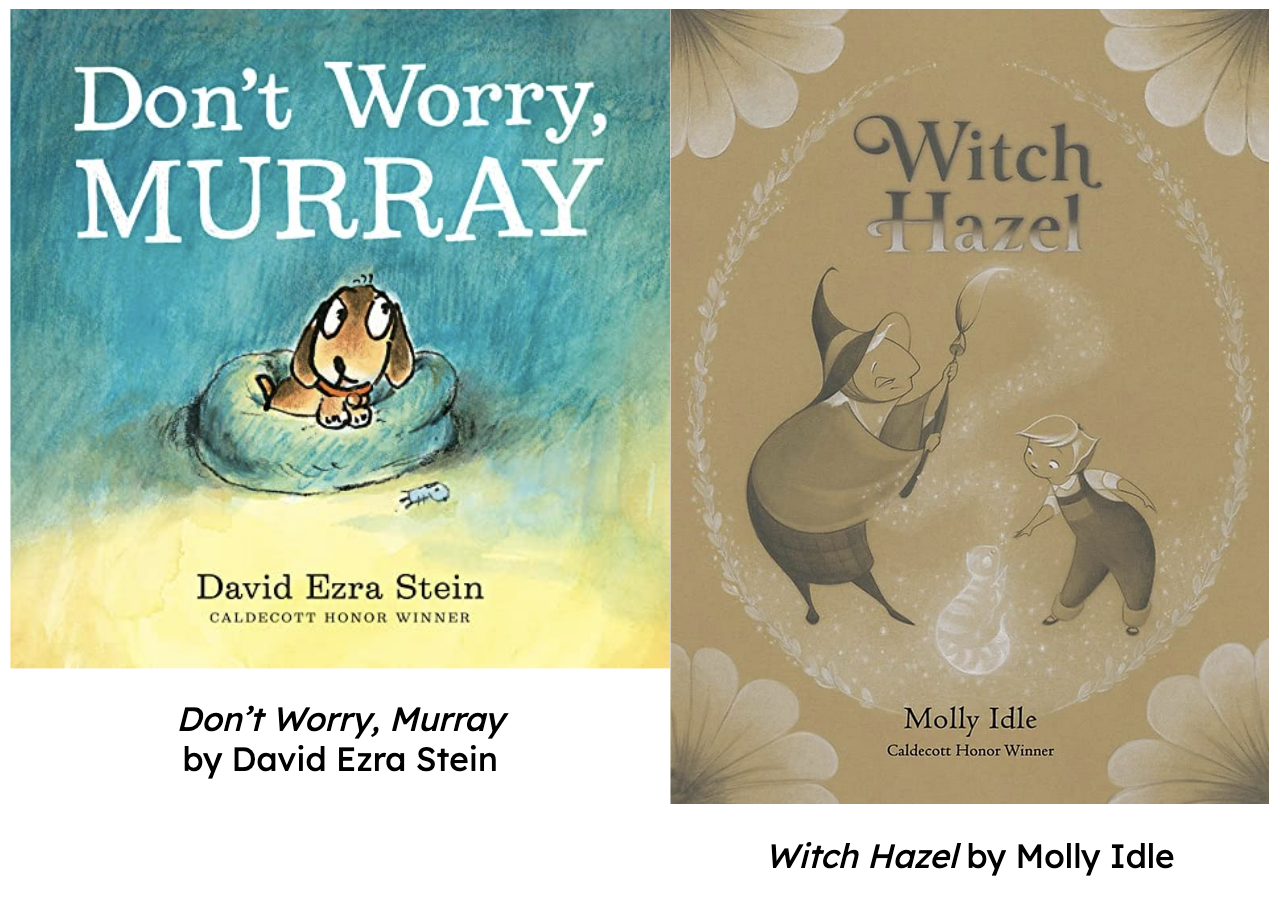
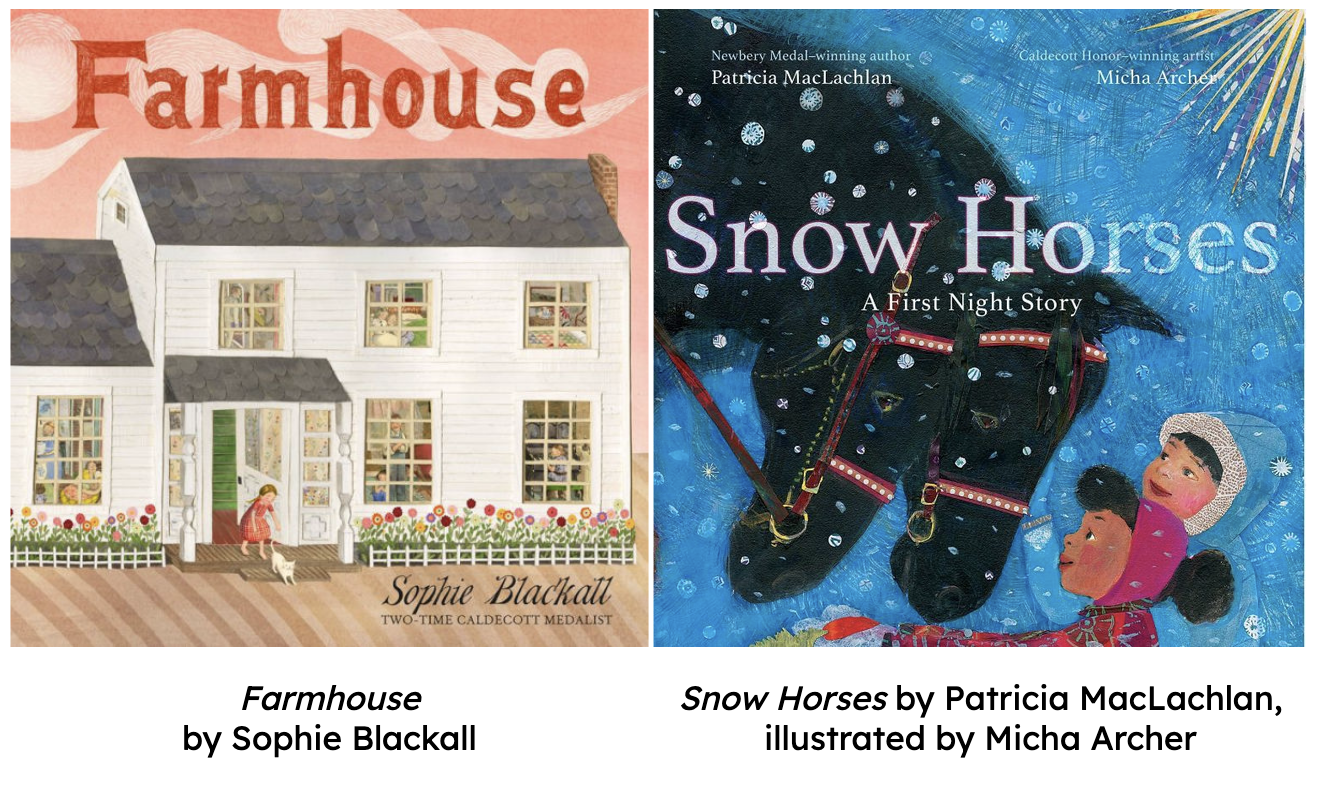
  • Kindergarten and first grade read Don’t Worry, Murray! by David Ezra Stein and Witch Hazel by Molly Idle. Second and third grade read Farmhouse by Sophie Blackall (who has already won twice!) and Snow Horses by Patricia MacLachlan, illustrated by Micha Archer. This final pair of books is absolutely gorgeous, and my second- and third-grade students are an observant bunch, so we’re pretty squeezed for time given that these two are more text-heavy than some of the others (and Farmhouse is all one long sentence!).

Screen Shot 2023-01-25 at 8.42.49 PM

Cover images of Farmhouse and Snow Horses

Now, are the titles we read my top picks for the 2023 Caldecott? Not necessarily, although I think a lot of them have a very strong chance and I’d be delighted to see them get a shiny gold or silver medal. A few contenders we’d read earlier in the year: Endlessly Ever After by Laurel Snyder, illustrated by Dan Santat; Mina by Matthew Forsythe; Berry Song by Michaela Goade, John’s Turn by Mac Barnett, and The Three Billy Goats Gruff by Mac Barnett, illustrated by Jon Klassen. So, these are the ones that were fresh for my students, and that I could get from my public library in time.

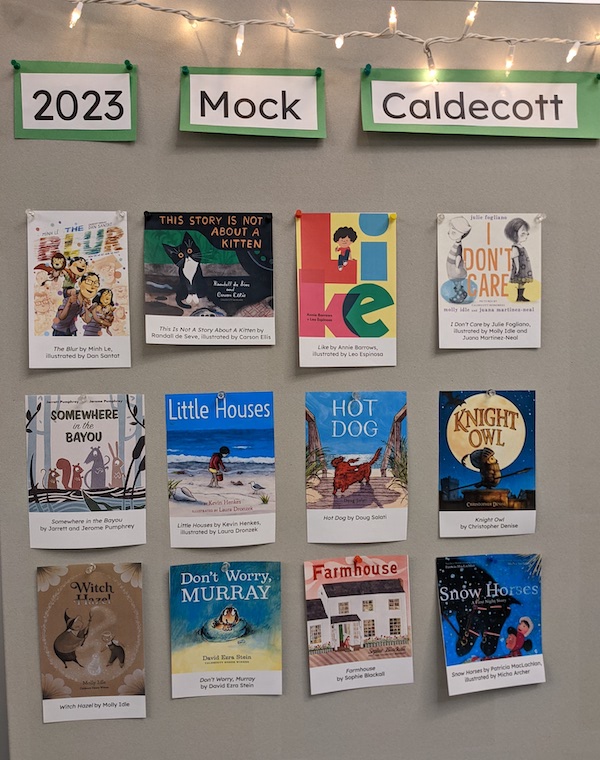
Bulletin board of 2023 Mock Caldecott with images of book coversVisual supports: The award is for illustration, after all, so I wanted to create a visual environment to support our Mock Caldecott. Here are a few ways I did that:

  • A few years ago at a conference I got a poster with all of the Caldecott winners on it, plus that year’s honor books. I put that up on our whiteboard, and kids frequently pointed out books they’d read (even pre-readers could recognize the book covers). (Note: I would love an updated poster like this, and no one seems to make one! Let me know if you know of a source…)
  • On the easel whiteboard, I kept each week’s tally (photographing it regularly in case anyone erased it, accidentally or on purpose). Results were so different from class to class!
  • On my bulletin board, I printed out cover images of the Caldecott contenders we read, along with title, author, and illustrator info. This helped us remember what we’d read in past weeks, and make connections; for example, one third grader noticed that The Blur and Farmhouse took place over a long span of time, whereas This Is Not A Story About A Kitten and Snow Horses took place over the course of just one day/night.
  • I covered several tables with face-up Caldecott winner and honor books from past years and encouraged students to check those out – many did! (And some just wanted My Weird School or A-to-Z Mysteries or Wimpy Kid or the Biscuit books, and that’s fine too. But at least they saw them as choices, and picture book circulation increased! Though lots of students were baffled about why some books had “the sticker” and some didn’t.)

At the end of our program, I figured out all the tallies and reported our results to the 2023 Mock YMA blog. Knight Owl got the most votes, followed by Somewhere in the Bayou, The Blur, Don’t Worry Murray, Farmhouse, and Hot Dog. And today, it worked out that one of my third grade classes was in the library during the live Caldecott announcements, and they went wild for Knight Owl and Hot Dog. It was gratifying to see them throw their hands up and cheer for books they recognized (I was cheering too, of course!).

Did we predict the winner? Not exactly, but two out of five ain’t bad. Did we read some great picture books? Absolutely! Will I do it again next year? Yes! What will I do differently? Mainly, I’ll start requesting books from my public library ahead of time, really concentrating on the ones with less text, so we can focus on the illustrations without being rushed during our 40-minute periods. I could change the way we vote – I was thinking of some clear jars and colored pom-poms that kids could use as their votes after reading four or five books over the course of a few weeks, instead of having two books go head to head each week.

Overall, it was a fun program I hope to run again next year. Now, as we’re about to enter Black History Month, I’m thinking of doing something similar (minus the voting) with Coretta Scott King award and honor books. Heck, there are enough awards to focus on a different one each month of the school year…

Mother/Daughter Book Club: Second Year

Nearly everything is back to being in-person again, but the Mother/Daughter Book Club we started during the height of the pandemic is still going strong. It’s a great way for the “baby friends” – these first graders have known each other since they were infants – to stay in touch since we’re geographically scattered now. Now that the kiddos are older, I run book club less like a library storytime program: instead, we chat a bit till everyone arrives, I read a book or three, and then back off a bit for the girls to have their own time drawing, talking, and playing. (And I’ve heard some absolutely wild imaginative stories! Look for some truly inventive graphic novels to hit the shelves in twenty years or so.)

Without further ado, the books we read together in 2022:

Mother/Daughter Book Club 2022 slide of cover images
Jabari Jumps, Hornswoggled, The Oboe Goes Boom Boom Boom, The Polio Pioneer, Life, Marta Big & Small, Up in the Garden and Down in the Dirt, Over and Under the Snow, Aaron Slater Illustrator, Bathe the Cat
Cover images of books
Endlessly Ever After, Molly on the Moon, When Aidan Became A Brother, Amy Wu and the Warm Welcome, Every Dog in the Neighborhood, Mina, Flowers Are Pretty Weird, A Spoonful of Frogs
Cover images of books
Summer Camp Critter Jitters, Flowers Are Pretty Weird, Not A Bean, How to Eat A Book, Books Aren’t for Eating, The Three Billy Goats Gruff, Nothing Rhymes with Orange

Last year we read 13 books in 11 months, and this year we read 24 books in 11 months (Flowers Are Pretty…Weird is on two different slides by accident, we only read it once. Though I think we also read Butterflies Are Pretty…Gross by the same author/illustrator pair). As the girls have gotten more used to and comfortable with the Zoom experience, their attention span is a bit longer, so we usually read two or three books at each meeting.

Looking at the collection above, we definitely tilted toward humor this year, as well as science topics, fairytale/folktales, and books with SEL (social-emotional learning) themes. What patterns will emerge next year? We’ll see! With Betsy Bird cranking out her annual “31 Days, 31 Lists” of children’s books, we’ll have plenty of material to choose from.

Picture book read-alouds to make you laugh

What makes a picture book funny? A sense of humor is unique and personal – what makes one person laugh out loud might elicit only a small smile from another, and vice versa – but there are a few themes. Slapstick, physical comedy is one; “potty” humor is another (the farting pony in The Princess and the Pony by Kate Beaton, Who Wet My Pants? by Bob Shea). Cleverness is appreciated, especially the kind that winks at the reader and lets them in on the joke; kids like the feeling of knowing more than the main character does (hide-and-seek books use this tactic). Interactive, fourth-wall-breaking humor often works equally well in storytimes and one-on-one reading, as kids are ready and willing to engage. Some readers delight in the absurd (the increasingly strange to-do list in Bathe the Cat, the pile of unlikely “solutions” in On Account of the Gum). A twist or surprise ending can be very effective as well, such as in A Hungry Lion or Tyrannosaurus Wrecks!, especially if it follows a sweet emotional moment of resolution.

Recently I ran into a friend who is a youth services librarian at a public library. She said that they’d just put up a display of funny picture books, but realized they were not a diverse bunch. She thought I might have some ideas, and…I do!

onaccountofthegumTo be quite upfront, the first picture book that jumped into my head in the “funny” category was Adam Rex’s On Account of the Gum, which I maintain is one of the all-time funniest books to read aloud, and which absolutely does not get old, no matter how many times you read it. Though adults tend to think of picture books as being for little kids, this one appeals just as much or more to older kids, and even teens and adults; they can use the rhyme scheme to anticipate what’s coming next, and they have more context (e.g. they know what Picture Day is). But littles enjoy the over-the-top illustrations and the pattern and flow of the story…it’s just, hands-down, a brilliant read-aloud. Rex also wrote Pluto Gets the Call, illustrated by Laurie Keller (just think about the title for a minute) and School’s First Day of School, illustrated by Christian Robinson. (This book, narrated by a brand-new school building, contains the phrase “nose milk.”) Rex is a funny guy, but let’s move along…

Cover image of I Don't Want to Be A FrogI Don’t Want to Be A Frog by Dev Petty, illustrated by Mike Boldt, is told entirely in dialogue between a young frog (who, you guessed it, would rather be a rabbit or an owl or a pig or anything but a frog), their dad, and…I won’t give it away, but this book really lends itself to the read-aloud experience, and it has delightful companions (I Don’t Want to Go to Sleep, I Don’t Want to Be Big, and There’s Nothing to Do). Dev Petty also wrote Claymates, which has some of the most unique illustrations (by Lauren Eldridge) I’ve ever seen, and plenty of humor.

wolfiethebunnyIf you can hear the title Wolfie the Bunny and NOT want to read that book immediately, then we probably don’t have much in common. Ame Dyckman’s words paired with Zachariah Ohora’s illustrations absolutely live up to the promise of the title. In a neighborhood based on Park Slope, Brooklyn, a family of rabbits finds a wolf pup on their doorstep, but only little Dot is freaked out by the new addition to the family (“He’s going to eat us all up!”).

Tyrannosaurus WrecksZachariah Ohora also illustrated Tyrannosaurus Wrecks! by Sudipta Bardhan-Quallen. (Every list of picture books has to have a dinosaur book, right? Pretty sure that’s a rule.) This is a sure-bet hit for the toddler and preschool set, and there’s a sweet social-emotional learning (SEL) component in addition to the slapstick humor. (While we’re talking about Zachariah Ohora, he also illustrated Who Wet My Pants? by Bob Shea, another very funny book, despite its serious-sounding title.)

herecomesvalentinecatDeborah Underwood and Claudia Rueda’s “Here Comes…Cat” books (Tooth Fairy Cat, Valentine Cat, etc.) star a cat that only communicates through signs (sometimes with words, often with images), facial expressions, and body language. The narrator is in dialogue with the curmudgeonly cat, and these books definitely tickle my funny bone; Valentine Cat makes an appearance at our house every February.

sparkyJenny Offill has produced such delightful gems as Sparky! (a book about a girl and her pet sloth; just look at the juxtaposition between the name – with an exclamation point! – and the sloth on the cover), While You Were Napping, 11 Science Experiments That Failed, and 17 Things I’m Not Allowed to Do Anymore. The titles are descriptive enough, I think, and any grown-up who has read Offill’s books for adults is in for something completely different with these.

Cover image of A Hungry LionA Hungry Lion, Or, A Dwindling Assortment of Animals by Lucy Ruth Cummins: The sheer genius of this title, oh my goodness. And the vocabulary. And the smile on the little turtle’s face. And the moment the lights go out. And the double twist ending. And, and, and….If you liked the slightly macabre humor of Jon Klassen’s I Want My Hat Back but you haven’t read this, go ahead and remedy that now.

grumpypantsGrumpy Pants by Claire Messer: “I’m grumpy,” declares a little penguin, and it tries a number of solutions to improve its condition, finally stripping off its clothes piece by piece and diving into a nice cold bath. Children (and adults, too!) might find that a bath, clean clothes, and a cup of cocoa are just the thing to soothe a grumpy mood.

stillstuckStill Stuck by Shinsuke Yoshitake: You’re getting undressed and your shirt gets stuck over your head – it’s happened to everyone, right? It happens to this kid, who definitely does not want assistance from Mom, and decides to accept their new state. In their imagination, they spin out what life will be like with a shirt over their head. Despite the kid’s adaptability (or resignation), Mom does swoop in to move the bedtime process along, but there’s another snag when it’s time to put on pajamas.

mightbelobstersThere Might Be Lobsters by Carolyn Crimi, illustrated by Laurel Molk: Poor little Sukie is afraid of everything at the beach, but when beloved toy Chunka Munka is swept out to see, Sukie must find her courage. This is an excellent read-aloud for summer storytimes for all ages – get kids to repeat the titular refrain together –  and if you happen to have props with you for this read-aloud (a stuffed lobster, say, or a beach ball) all the better.

Cover image of The Oboe Goes Boom Boom BoomThe Oboe Goes BOOM BOOM BOOM by Colleen AF Venable, illustrated by Lian Cho: A band director introduces instruments one by one, but little Felicity just can’t wait to bang on the drums and keeps interrupting – until she’s blown away by the sound of the tuba. There’s actually quite a lot of information in here about different instruments, and the way that Cho translates sound into a visual medium is outstanding.

notapenguinI Am Not A Penguin: A Pangolin’s Lament by Liz Wong: A poor pangolin wants to give a presentation, keeping its cool while confused audience members interrupt, until a penguin arrives to steal the show. One little girl remains for the pangolin’s informative presentation. (See also: The Angry Little Puffin by Timothy Young, which taught me permanently that penguins live “at the bottom of the world” (i.e. Antarctica) while puffins live “at the top of the world.”)

kingbabyKing Baby by Kate Beaton might be funnier for adults than for kids, but kids enjoy it too; it’s one of my go-to recommendations for families who are about to add a sibling. And let’s not forget Beaton’s other picture book, the crowd-pleasing The Princess and the Pony (pony farts feature prominently).

bathethecatBathe the Cat by Alice B. McGinty and David Roberts: A cat who definitely does not want a bath scrambles up a family’s to-do list as they rush to tidy before grandma arrives. Clever use of fridge magnet alphabet letters, plenty of pride, and increasingly ridiculous tasks all add to the joyful hilarity.

wedonteatourclassmatesWe Don’t Eat Our Classmates by Ryan T. Higgins: Pink, overalls-wearing Penelope is nervous about the first day of school, and indeed, it doesn’t go as well as she’d hoped…she discovers that it’s hard to make friends when everyone is afraid you’ll eat them. Penelope learns to exercise self-control with the help of Mrs. Noodleman and a fearless goldfish named Walter.

Finally, every kid I know would insist that The Book With No Pictures by B.J. Novak be included on any list of funny picture books, and they’re right. BLURP.

What are your favorite funny picture books?

How middle grade has changed (in) a generation

Working in a middle school library for the past year, I have been more conscious than ever about what books I am putting into kids’ hands – and, if the match is right, into their heads and hearts. They might read a chapter and put it down, or they might slog through and forget it after they’ve finished a required project…or, they might remember it forever. With that in mind, I (a) always encourage kids to return a book they’re not enthusiastic about and try something else instead, and (b) am extra mindful of representation. When reflect on the books that stayed with me (list below), nearly all of them feature white, American kids, and the few books that centered Jewish characters were all historical fiction set during WWII and the Holocaust (except for Margaret. Thank you, Judy Blume).

  • A Wrinkle in Time by Madeleine L’Engle (1962)
  • Are You There, God? It’s Me, Margaret by Judy Blume (1970)
  • Bridge to Terabithia by Katherine Paterson (1977)
  • The Devil in Vienna by Doris Orgel (1978)
  • The Castle in the Attic by Elizabeth Winthrop (1985)
  • Matilda by Roald Dahl (1988)
  • The Devil’s Arithmetic by Jane Yolen (1988)
  • Number the Stars by Lois Lowry (1989)
  • A Horse Called Wonder (Thoroughbred series #1) by Joanna Campbell (1991)
  • The Boggart by Susan Cooper (1993)
  • The Giver by Lois Lowry (1993)
  • The Golden Compass by Philip Pullman (1995)
  • The View from Saturday by E.L. Konigsburg (1996)

It’s a disservice to kids – to any readers – when only “mirrors” books or only “windows” books are available to them. Everyone deserves to see themselves reflected in literature (and art, music, movies, TV, magazines, etc.). The presence of a character similar to you says You exist. You matter. But only reading about characters like yourself is limiting; reading about those who are different in some way provides a window into another way of experiencing the world: They exist. They matter.

I have read so many middle grade books in the past few years that I couldn’t have imagined existing a generation ago. There are books with trans and non-binary characters, like Kyle Lukoff’s Different Kinds of Fruit and Too Bright to See and Ami Polonsky’s Gracefully Grayson and Alex Gino’s Melissa. There are books with Muslim protagonists by S.K. Ali and Saadia Faruqi, Hena Khan and Veera Hiranandani, and books with Latinx characters like Meg Medina’s Merci Suárez, Celia Pérez’s The First Rule of Punk, and Pablo Cartaya’s Marcos Vega Doesn’t Speak Spanish. There are books that address contemporary racism and microaggressions and police violence, like Blended by Sharon Draper. There are books by and about Indigenous people, like Rez Dogs by Joseph Bruchac and Ancestor Approved by Cynthia Leitich Smith and others. There are books that explore the histories and modern experiences of Asian American and Pacific Islanders, like Finding Junie Kim by Ellen Oh, Other Words for Home by Jasmine Warga, and Inside Out & Back Again by Thanhha Lai – the last two of which are in verse, a form I never encountered as a young reader but which is becoming more and more popular now (and with good reason). There are books about fat-shaming and fatphobia and body positivity, books that show what good therapy looks like, characters who experience mental illness or poverty, frank discussion of periods and endometriosis, and activism.

There is nothing inherently bad about the books I read and loved as a kid; I still re-read and love them, and am starting to share them with my daughter (and discuss parts that are sexist, racist, or otherwise problematic). But as a collection, they don’t show the dazzling breadth and depth of human experience that children’s literature illuminates now, from picture books through middle grade to young adult. I am so grateful to the authors and illustrators who create these works, let readers step into their characters’ shoes, learn about their lives, and grow in empathy, and I feel lucky to be able to put these books into kids’ hands.