Today we had a big crowd at storytime! It was a gray fall day, so maybe the weather urged people inside, or perhaps they’re just getting back into the rhythm of the season (storytimes are a little more sporadic in the summer because of all the other programs we do). There were at least 15 kids in the 2-3 age range, plus assorted siblings and several late arrivals. In the beginning, we had more than ten but I did the name song anyway – it’s a great way to learn names and start building individual connections.
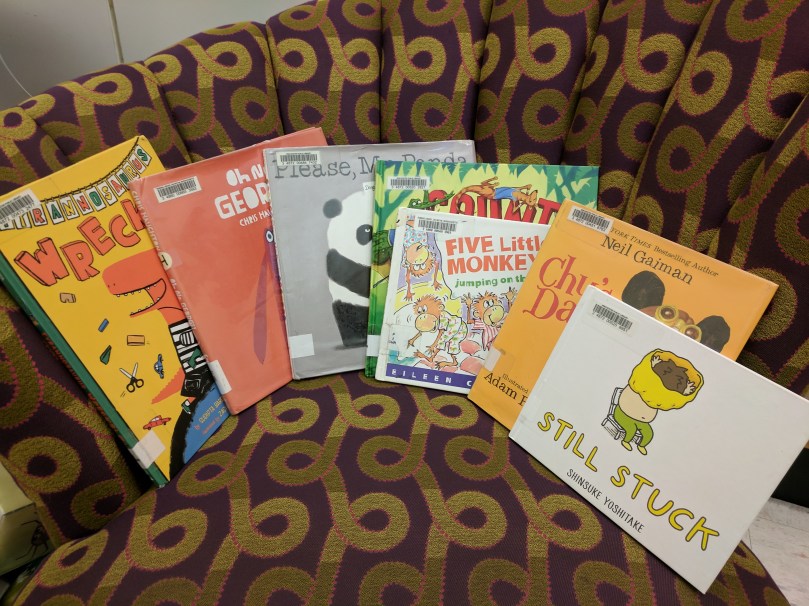
Tyrannosaurus Wrecks!, Oh No George!, Please Mr. Panda, Count the Monkeys, Five Little Monkeys, Chu’s Day, Still Stuck
“Hello Friends” song with ASL
Name song (“Hello ____, hello ___, hello ____, we’re glad you came today”)
Handed out shaker eggs for Tyrannosaurus Wrecks! by Sudipta Bardhan-Quallen, illustrated by Zachariah Ohora
Kept the shaker eggs for Oh No, George! by Chris Haughton. Collected shaker eggs after.
Song cube: ABC song
Please, Mr. Panda by Steve Antony
Song cube: “If You’re Happy and You Know It”
Five Little Monkeys Jumping On the Bed by Eileen Christelow (jumping encouraged!)
Count the Monkeys by Mac Barnett, illustrated by Kevin Cornell
Song cube: “I Had A Little Turtle”
Scarves (by audience request) for Still Stuck by Shinsuke Yoshitake. Collected scarves.
Goodbye song with ASL. Put away colored mats. Dance party with bubbles! (We have an old ipod loaded up with Raffi and Disney versions of classic kid music. And I brought my own bubbles from home because I am devoted to Pustefix bubbles.)
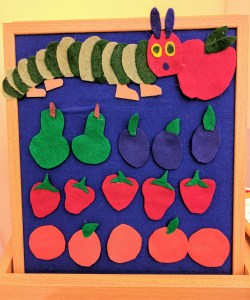
I skipped the flannel board and craft this week, but for next week I am thinking of a craft with paper dots and glue to go with Lots of Dots, and maybe The Very Hungry Caterpillar flannel board again…if I can make a butterfly before next Monday!
This week I attended a meeting of the MetroWest Program Planners at the Hopkinton Library, and after the meeting we got a tour of the recent redesign and addition (they reopened October 2017).
Fold-up tables and lightweight chairs
There was so much to love about the new library, I almost don’t know where to begin. But if you’ve been reading here long, you know how I love mobile, modular furniture, so we can start with the fact thateverything is on wheels: tables, chairs, displays, even the circulation desk (though the circ desk, we were told, is heavy and they don’t plan to move it often. The reference desk is not on wheels, but that is because it moves up and down). Many of the tables fold up, as well, so they can be folded and wheeled out of the way to make room for events.
Now, let’s go upstairs, and work our way down. Upstairs is the children’s room; it has historically been upstairs, and it was important (to the community? to the staff?) that it remain there. It had beautiful light from lots of windows; a friendly low desk with display space built into it (they feature a different kid’s collection each month); a central area with low tables and chairs; a puppet theater and a Duplo table; and plenty of little reading nooks with built-in benches (okay, not modular, but very cozy). There was also a glassed-in separate room for storytimes and other programs, with a little cart of floor mats, built-in storage cabinets, and two sinks (big and small). Perfection!
Above, clockwise from top left: A brilliant, double-pun bulletin board display; the central area of the children’s room; a puzzle corner; a reading nook.
Downstairs on the main floor is the circulation desk, new books, adult fiction, the teen room, a large meeting/conference room (formerly part of an Episcopal church, incorporated into the library in 1967 if I remember right), and a smaller board room that was part of the original library (complete with grandfather clock donated in the early 1900s).
Let’s talk about the teen room: the awesome, amazing teen room! Separated by a glass wall from the public computer area, adult fiction, magazines, and newspapers, the teen area is obviously unique; visual clues such as paint color and matching carpet squares (bright blue) set it apart from the rest of the library. There is a laptop bar, plenty of comfy “mitt” chairs, tables and chairs for group work, and of course, a great selection of teen books.
The teen room: laptop bar, tables and chairs, stacks with endcap displays, and the mitt chairs by the windows on the right.
Downstairs on the basement level (with with some windows high up and some skylights – skylights in the meeting rooms! – there was plenty of natural light) is the reference desk, which can move up or down with a switch, so librarians can be seated or standing. (There is also a beautiful heritage quilt on the wall behind the desk.) There is a small reference collection in addition to the nonfiction, a local history room, meeting rooms for small groups, and a larger meeting room set up as a classroom – that’s where Girls Who Code takes place, and there’s a laptop cabinet (on wheels, of course) in the room.
Above: Was it weird to take photos of these? Yes. But I love the inclusive signage AND the transparency built into the door lock so people waiting can tell at a glance if it’s vacant or occupied without having to knock or try the door.
Above: Offering bags for wet umbrellas is a nice touch (and protects the new carpet); cafe-style seating across from the circulation desk offers visitors a place to snack.
Throughout the library, most of the display space is on beautiful endcaps, where books are face-out. In many places, displays are coordinated so a flyer for an event is positioned above relevant books. Overall, it’s an impressive, clean, friendly place that will serve its population flexibly for years to come. Bravo, Hopkinton!
There was a smaller group at storytime today, but that allowed me to do the name song (“____ is here today, ____ is here today, let’s all clap our hands, ____ is here today”) after our usual “Hello friends” song. If the group is bigger than ten or so, I don’t do it, but because we only had seven or eight today, we did. I think it’s a good way to start because all the kids feel included, and it helps me learn the names, so I can address kids by name throughout the storytime.
When we use the song cube, or sing a new song, I make sure we do it twice, because young brains are hungry for patterns and repetition.
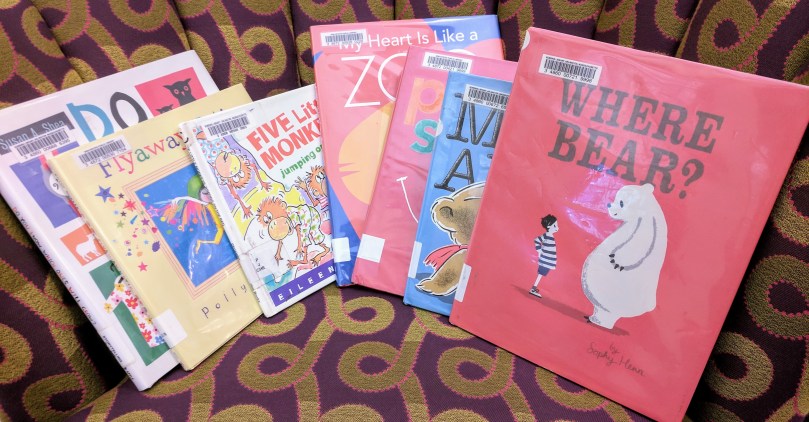
Do You Know Which Ones Will Grow?, Flyaway Katie, Five Little Monkeys, My Heart Is Like A Zoo, Perfect Square, Make A Wish Bear, Where Bear?
Welcome: Glad you’re here, please keep the doors clear, take snacks outside, feel free to come and go as needed.
“Hello Friends” song with ASL
Name song
Book: Do You Know Which Ones Will Grow? by Susan Shea
Song cube: “I Had A Little Turtle”
Hand out scarves
Book: Flyaway Katie by Polly Dunbar
Book: Five Little Monkeys by Eileen Christelow
Collect scarves
Book: My Heart Is Like A Zoo by Michael Hall (with flannel, but not interactive)
Song and activity: “Shake Your Sillies Out” with shaker eggs
Song cube: “I’m A Little Teapot”
Book: Perfect Square by Michael Hall
Song cube: “Itsy-Bitsy Spider”
Book: Make A Wish Bear by Greg Foley
Song: “Twinkle Twinkle Little Star”
Book: Where, Bear? by Sophy Henn
Goodbye song with ASL
Activity: coloring with crayons on a big piece of butcher paper (one bowl of crayons at each corner of the paper)
Today kicks off our fall series of storytime programs, and mine is “Step Into Storytime” for two- and three-year olds (though siblings are allowed to join, and we’re pretty lenient about ages; the come-and-go-as-necessary philosophy enables kids and their grown-ups to leave if they’re having a tough time and come back in when they’re ready, or next time).
T435 PL REP FC
We started off, as usual, with an introduction and a few guidelines (keep doors clear, take snacks outside), then our welcome song: “Hello friends” with sign language. I sang it through once with the motions, then showed each sign (should have done that first!), then we sang it through again, and lots of the kids and adults participated. Next:
Song cube: “Zoom zoom zoom, we’re going to the moon” (standing, twice)
Book: Fall Is Not Easy by Marty Kelley
Activity: Adding leaves to the tree on the flannel board. I think every kid participated and we had 16 leaves!
Song cube: “I had a little turtle”
Book: Hooray for Hat by Brian Won (“Show me your grumpy faces!”)
Song cube: “ABCs”
Book: The Very Hungry Caterpillar by Eric Carle
Activity: Very Hungry Caterpillar flannel board. At the appropriate point in the story, a kid would come up and remove the fruit the caterpillar ate that day (apple, pears, plums, strawberries, oranges). One kid who wanted to participate didn’t get a chance to take fruit off the board so I let her take the caterpillar off. And note to self: I need to make a butterfly!
Song cube: “The Itsy-Bitsy Spider” (standing, twice)
Book: Chu’s Day by Neil Gaiman and Adam Rex (kids loved the big sneeze!)
Song/activity: I passed out shaker eggs and we stood to sing “Shake Your Sillies Out.” Kids brought the eggs back to the front and put them in the bag at the end of the song.
Book: The Duckling Gets A Cookie by Mo Willems (I put my flannel Pigeon and Duckling up on the flannel board but we didn’t do anything with them)
Song: “Twinkle Twinkle Little Star” to calm a slightly squirrelly crowd. I meant to do the “Goodbye Friends” song with ASL like usual but I forgot!
Activity: Coloring with crayons. I traced one of the pages from Blue Chameleon and made copies for kids to color however they liked. We have a giant bin of crayons and they color right on the floor – next time I would scoop a few smaller bowls of crayons and spread them out around the room. People were great about putting the crayons back when they were finished!
Overall, this was a great storytime. Hooray for Hat seemed to be a favorite, several kids recognized The Very Hungry Caterpillar, and I think the Mo Willems book might have been more successful earlier in the lineup.
We have a whiteboard along one wall, and after “Welcome to Step Into Storytime!” I had written the five activities that support early learning: Talk, Sing, Read, Write, Play. Next time I want to incorporate more early literacy information into the storytime for caregivers, explaining in a sentence here and there why I’m doing what I’m doing (why sing songs twice, for example, and why do fingerplay or sign language) to support that early learning.
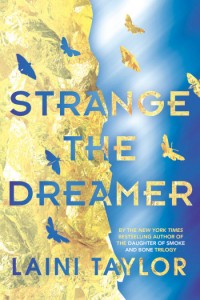
In her Printz Honor acceptance speech, Taylor discussed the importance of fantasy, now more than ever. “Human decency depends on empathy,” she said. “Empathy depends on imagination.” And what fantasy gives readers, especially young ones, is the ability to imagine worlds that can be remade. They can look at a community that mirrors our own and imagine it changed, and only by imagining it changed can we hope to change it.
That reminded me of what Neil Gaiman had to say on the topic of fiction and empathy. I’ve quoted from this speech of his before, but here it is again, slightly abridged:
“And the second thing fiction does is to build empathy….You get to feel things, visit places and worlds you would never otherwise know. You learn that everyone else out there is a me, as well. You’re being someone else, and when you return to your own world, you’re going to be slightly changed…
You’re also finding out something as you read vitally important for making your way in the world. And it’s this:
The world doesn’t have to be like this. Things can be different.
….Fiction can show you a different world. It can take you somewhere you’ve never been. Once you’ve visited other worlds, like those who ate fairy fruit, you can never be entirely content with the world that you grew up in. Discontent is a good thing: discontented people can modify and improve their worlds, leave them better, leave them different.”
The bit above in bold (emphasis mine) is crucial. I included it in a slide when I presented on “Readers’ Advisory in an Age of Uncertainty” at MLA last spring, alongside recommendations of fantasy, sci-fi, dystopian, and other speculative literature.
Personally, I haven’t encountered anyone who has flat-out declared that fantasy books are lesser than other books. Certainly, there are people who say they don’t like the genre, and that’s fine – every reader their book, etc. – though in closing oneself off to entire genres, one is likely to miss some great stories.
But Taylor makes a good point about fantasy being important “now more than ever.” I went looking for the full text of her Printz honor speech and couldn’t find it (let me know if you can!), but I did find a post by Karen Silverman about Strange the Dreamer on the SLJ blog “Someday My Printz Will Come.” Between Silverman and Reagan, I’ve been convinced to make Strange the Dreamer my first Laini Taylor book (finally!) and continue straight on to Muse of Nightmares.
As a side note, SLJ and Library Journal are pretty much the only places on the internet where the comments are constructive, intelligent, interesting, and relevant. Elsewhere, I usually stop scrolling at the end of the article and pretend comments don’t exist.
On the topic of fantasy, The Atlantic recently ran a piece entitled “Why the British Tell Better Children’s Stories.” I forwarded it along to all my children’s/YA reader/librarian friends, and while a few objected to the competitive aspect of the comparison (“There are so many good books on both sides of the pond!”), I won’t hesitate to admit that many of the magical books I loved as a kid (and still love) start with that tear in the fabric between our world and the other: “A tear in this fabric is all it takes for a story to begin.”
Of course there are incredible, magical, fantastical books from the U.S. and the U.K. (never mind all of the other countries in the world). But I’ve been listening to the audiobook of Peter Pan by J.M. Barrie, read by Jim Dale, and I shivered when I heard Wendy ask, “Boy, why are you crying?” Pure magic.
My second all-ages summer storytime was this morning, and it was a full house! I didn’t get an exact headcount because people came and went, but the room was full, and I think I put out at least 30 mats, and all were in use. Like last time, I started with a welcome and a reminder to keep doorways clear so people could come and go. I also explained I would be placing the books I read during storytime to the side of my chair and anyone was welcome to check them out afterward.
Book: There Might Be Lobsters by Carolyn Crimi, illustrated by Laurel Molk. This is one of my absolute favorites, and I brought along a stuffed lobster to show every time the line “…there might be lobsters” came up in the story. Some kids began shouting along, which was just what I’d hoped.
Song cube: I made a song cube with pictures on each of the six sides that correspond to a simple song; the first one was “If you’re happy and you know it, clap your hands.” I tried to get a different song to come up each time…sometimes a little manipulation was required.
Book: Oh No, George! by Chris Haughton. Some of the older kids had good guesses about what George would do.
Song cube: “I Had A Little Turtle”
Prop/toy: Hand out colored scarves (the Golden Rule of Storytime: you get what you get and you don’t get upset!). I enlisted three of the older kids to help pass out scarves, which we keep stored in empty tissue boxes.
Song: “Shake Your Sillies Out” waving scarves around
Book: Huff & Puff by Claudia Rueda. We “huffed and puffed” or waved the scarves at the appropriate times during the story. All of the kids were super into it! Collected the scarves afterward, with helpers.
Book: Bark, George by Jules Feiffer – another book about a dog named George!
Song cube: “Itsy Bitsy Spider” (twice)
Book: They All Saw A Cat by Brendan Wenzel (only fair to read a cat book after two dog books)
Song cube: “I’m A Little Teapot” (twice)
Book: Still Stuck by Shinsuke Yoshitake. Most kids can relate to this one, and the grownups appreciated the humor too – I heard a few chuckles.
Song cube: “Zoom Zoom Zoom, We’re Going to the Moon”
Book: One Little Blueberry by Tammy Salzano, illustrated by Kat Whelan
Today was my very first official library storytime! It was an “all ages” summer storytime, so I brought more books than I was planning to read, so that I could be flexible depending on who showed up. There was a good mix, from infants to about four years old. I didn’t get an exact headcount, but I think there were at least 15-20 kids, with several trailing in throughout the storytime (it’s supposed to be a 45-minute program, though we ended about ten minutes early).
Here’s what we did, with a huge hat tip to my fellow (and far more experienced) children’s librarians, Lauren and Ms. B:
Welcome, thanks for coming, introduced self, mentioned a few ground rules (leave the doorways clear, take snacks outside)
Song cube: I made a song cube with pictures on each of the six sides that correspond to a simple song; the first one was “If you’re happy and you know it, clap your hands”
Book: Roller Coaster by Marla Frazee (I like to rotate the book 360 on the “it goes all the way around” page)
Song cube: “I Had A Little Turtle”
Prop/toy: Hand out colored scarves (the Golden Rule of Storytime: you get what you get and you don’t get upset!). I enlisted two of the older kids to help pass out scarves, which we keep stored in empty tissue boxes.
Book: Huff & Puff by Claudia Rueda. We “huffed and puffed” or waved the scarves at the appropriate times during the story. All of the kids were super into it! Collected the scarves afterward.
Book: Tickle Monster by Edouard Manceau
Activity: My husband made flannel pieces for our own Tickle Monster; I set them up before storytime, and as I read each page and a piece of Tickle Monster disappeared, I took off the corresponding pieces. With a group of all older kids I would have let them come up and take the pieces off, but because we had a lot of littles and this was my first time, I did it myself.
Song cube: “I’m A Little Teapot”
Prop/toy: Hand out shaker eggs. Shake shake shake…stop!
Book: Tyrannosaurus Wrecks by Sudipta Bardhan-Quallen. Kids shook their eggs every time Tyrannosaurus “WRECKS!” (And sometimes in between.)
Song: “Shake your sillies out” (with the eggs). Collected eggs.
Book: Please Mr. Panda by Steve Antony
Okay, we have time for one more song cube and one more book…
Song cube: “Zoom Zoom Zoom, We’re Going to the Moon”
Music and dance and bubbles! “You’re Welcome” from Moana, bubbles. The kids were pretty into it, especially the bubbles. Some trickled out right away, others stayed longer. I had put out all of the books I read during storytime and invited people to check them out – several were taken!
Another thank you for coming, and a reminder to check the schedule for our other summer programs.
I’m already looking forward to my next summer storytime in August! What are your favorite read-aloud books? Favorite tie-in activities to do with scarves, shaker eggs, puppets, etc.?
The Massachusetts Library Association conference was in Framingham this year; I followed along on Twitter (#masslib18) for the first two days, and attended (and presented) on the third and final day.
It seems that the opening keynote by Debby Irving, author of Waking Up White, was extremely well received. For those who missed it, she has a TEDx Talk here.
The first session I attended on Wednesday morning was Co-Creating Library/Social Services Partnerships: A Statewide Collaboration, presented by Michelle Eberle of MLS, Joe Vallely from the MA Department of Mental Health, and Shelley Quezada from MBLC. Michelle showed data that a majority of libraries are interested in partnering with social workers, but only 30% already do, to manage issues like homelessness, mental health, substance abuse, and help for immigrants. Library workers are interested in partnering with social workers – perhaps even students of social work – and in receiving staff training such as mental health first aid. MLS has a LibGuide for “Responding to the Social Services Needs of Our Library Communities.“
Next, Joe told the room about the outreach and engagement teams serving over 1600 individuals within Massachusetts. They have had a few trainings at different libraries to introduce themselves (“what we do”) and look for ways to collaborate. “We have a common mission,” which gives us the opportunity to collaborate to assist people in need. “You provide a safe, warm place where many individuals, who are very fragile, go.” Many are clients or potential clients – how can we begin to assist? The organization Eliot was also mentioned, a part of PATH (the federal Project for Assistance in Transition from Homelessness).
Shelley spoke next, telling the audience about available LSTA grants and how MBLC can help with the grant process. Before applying for a grant, she said, there are a number of questions to ask, including: Who are your best community partners? How do you identify them? What is the overarching goal for your library to achieve? What resources do you need (staff, materials, training, equipment, publicity, space, etc.)?
Shelley reeled off a list of additional resources, including: Massachusetts Behavioral Health Partnership, Mass Legal Help, the Opioid Overdose Prevention project of Mass.gov, and Mass 211. Audience participants added Pine Street and Rosie’s Place. Audience members also spoke up to say that “Even with a social worker on staff, there are overwhelming needs”; staff training is still necessary for trauma-informed care, mindfulness, etc., and a series of trainings is better than a one-time session (grant funding can help with this!). One person also spoke about enforcing library policies apologetically, but “It’s okay to have rules. Rules keep people safe.”
The need for social services for a variety of often related issues (mental health, homelessness, substance abuse, domestic violence) is receiving more attention recently due to the movie The Public (trailer), which writer/director/actor Emilio Estevez said was inspired partly by an article by Chip Ward (I’m guessing this one: “How the Public Library Became Heartbreak Hotel,” 2007).
For the next morning session, I chose Charlie Grosholz’s interactive session on “The Role of Fantasy in the Library.” This was a small, hands-on session in which Charlie led participants through three exercises: world building, character creation, and role play. But first, a definition: What is fantasy? It is the “improbable, impossible…held down by rules.” (As any reader of fantasy knows, even magic has rules; otherwise it would be surrealism.) Any of these three exercises would be a great prompt for a creative writing workshop, but they could be used in a variety of other programs too, or to re-envision the library itself. For example…
Around Halloween time, a library in a walkable area might host a program starting with a zombie attack scenario: Where in town are the safest places, the most valuable resources?
Character creation can be used to develop personas; staff can collaborate to build personas based on library “characters,” an exercise that can build empathy.
Role play allows people to build social skills, public speaking skills, empathy, and conflict resolution skills. Charlie ran a successful murder mystery party for teens, complete with costumes, music, artifacts, and Shirley Temples (there was a speakeasy theme). Role play can also be used for emergency preparedness drills, or even in ELL conversation groups.
If your library has (or is thinking of starting) a Library of Things collection, acquire some board games; you can build programming around each new game as you introduce it, and bring fans of the games together.
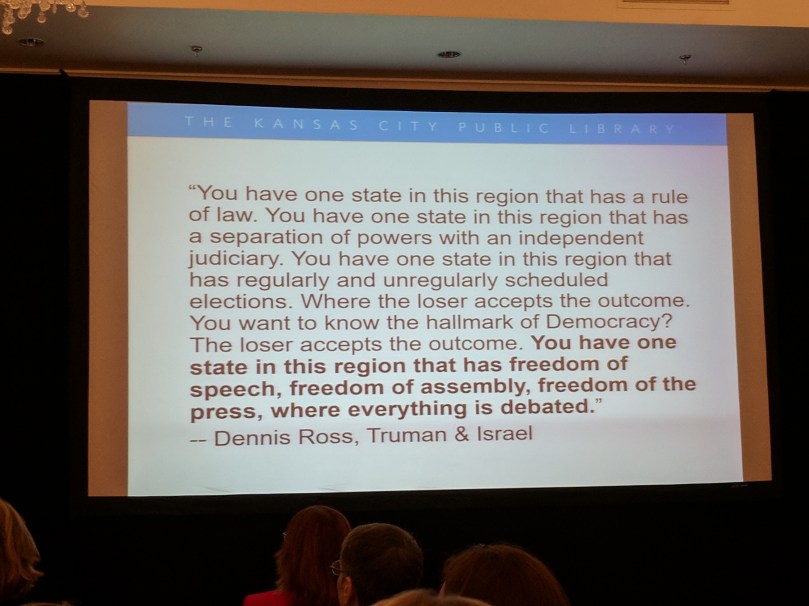
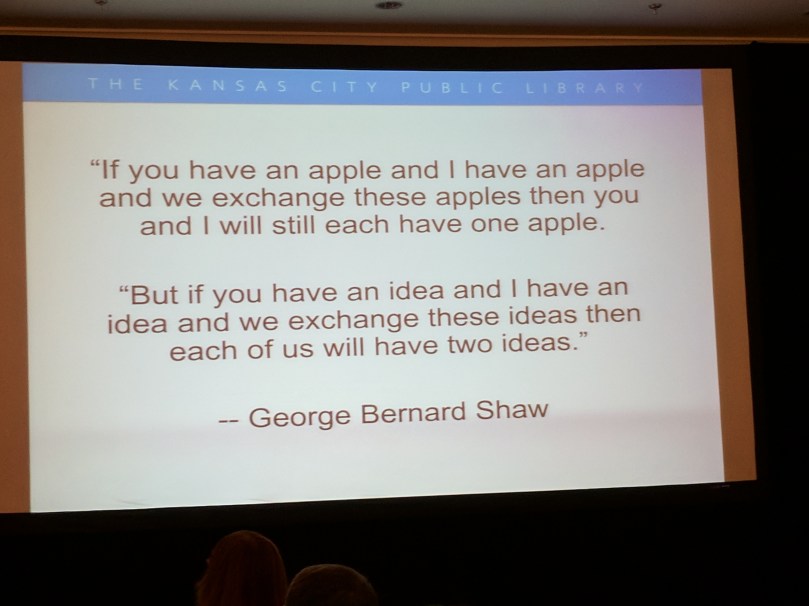
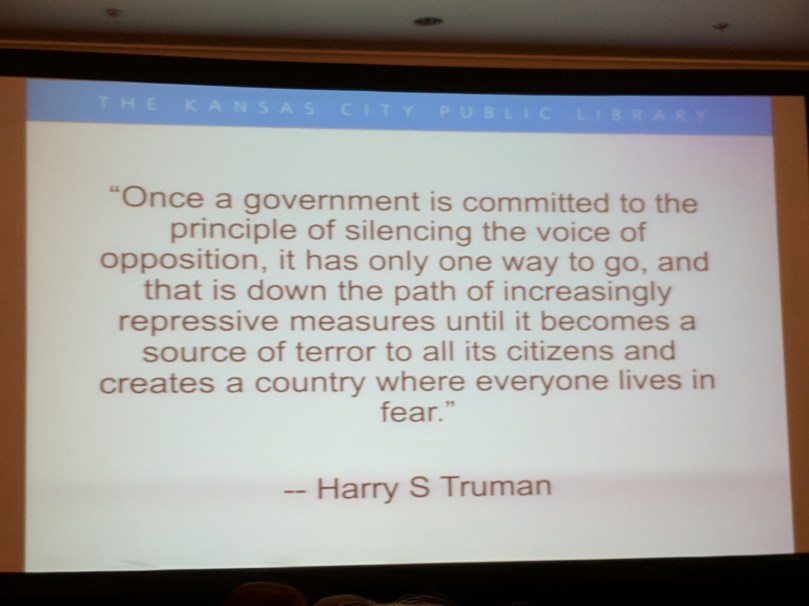
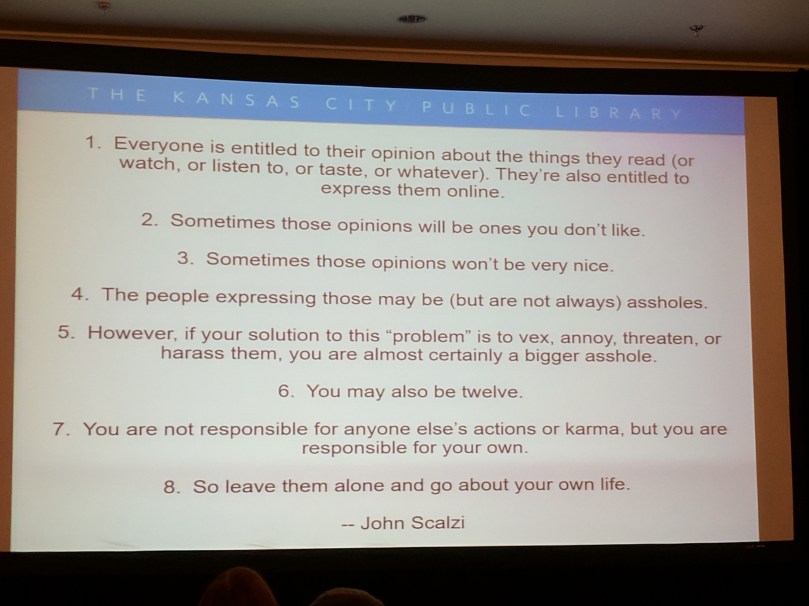
The last program of the morning was a general session, “Librarians on the Front Line: Protecting Free Speech,” presented by Steve Woolfolk of the Kansas City Public Library. Woolfolk’s name may be familiar to those in the library world; he was arrested during a program at his library for defending a patron’s right to speak. Though the case seemed incredibly clear-cut (for an overview, see the American Libraries article from October 2016), it dragged on until he was ultimately cleared. The incident certainly didn’t shake his dedication to free speech and the free exchange of ideas; when an audience member asked if it had had a chilling effect on programming at KCPL, Steve replied, “Nope! If anything, we’re getting more controversial.”
The First Amendment, he said, is about more than just being able to say what you want; “you have a right to express your ideas, and I have the right to be exposed to your ideas.” He pointed out that the government does not lead on issues, the public does – and librarians are already “committed to opening people’s minds.” He asked, why can’t we do with ideas what we do with books? Recommend something outside their comfort zone. “Nobody’s obligated to agree with the ideas they hear…but we have to make an effort to understand why people believe the things that they do.”
Steve’s talk was very well received, and I wasn’t the only one taking photos of his slides to post to Twitter.
Dennis Ross quote from the Truman & Israel author eventGeorge Bernard Shaw quoteHarry S. Truman quoteJohn Scalzi quote (from his blog)
After a break for lunch, it was time for “Readers’ Advisory in the Age of Uncertainty,” which I presented along with Kevin O’Kelly from Somerville Public Library and Louise Goldstein from Waltham Public Library. We each took a different angle on the topic: Louise talked about the “Initiating Inspiration” book group at the Waltham library, in partnership with the Agape Spiritual Community. The group met five times in its first year, discussing five different titles. Kevin talked about bibliotherapy, from the little-known Sadie Petersen Delaney (“Our Lady of Bibliotherapy”) to author Alain de Boton’s “School of Life” to the Changing Lives Through Literature program. And I talked about readers’ advisory at the reference desk, whether people are looking for escapism or a deeper understanding of current topics (or – through speculative literature – both!). My handout with book lists is here.
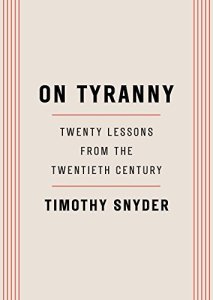
The closing keynote session featured Timothy Snyder, professor of history at Yale and author of (most recently) On Tyranny: Twenty Lessons from the Twentieth Century (2017) and The Road to Unfreedom: Russia, Europe, America (2018). The talk was entitled “The New Authoritarianism: Where It Comes From and What Readers and Citizens Can Do About It,” and was essentially a summary of On Tyranny. If you missed the talk, read the book – it’s only 126 pages.
All in all, it was a worthwhile conference day! And let’s not forget Book Cart Drill Team…
Tim Wu is a lawyer who clerked for a Supreme Court justice, worked at a Silicon Valley startup, then moved into academia; he’s now a professor at Columbia and a columnist for the New York Times. But if his name rings a bell for you, it’s probably because he coined the term “Net[work] Neutrality” in 2003.
The fundamental idea of Net Neutrality, said Wu, is that the user should decide what the internet is. The carrier (Internet Service Provider, or ISP) shouldn’t get in the way. ISPs should be “a medium in the true sense of the word medium, respecting the wishes of those on each side.” They should be “faithful agents” providing reliable service, not blocking, discriminating, or censoring.
The federal government adopted Net Neutrality as a rule under the Bush administration, but the Trump administration killed it (though it’s likely to return under the next administration). Why were they focused on that? “Free flows of information can be very threatening to those who wish to consolidate their power. The censorial instinct remains very strong.”
The next issue threatening our democracy, said Wu, is the “crisis of attention.” (His newest book is called The Attention Merchants: The Epic Scramble to Get Inside Our Heads.) “Our attention has become our scarcest and most valuable resource…[and] when you have a purely attention-based business model, the competition runs to the bottom. It’s not who can be the most accurate, it’s who can capture attention.”
As Cory Doctorow says, if you’re not paying for the product, you ARE the product. Wu put it differently, as he described an 1830s New York newspaper publisher’s idea to re-conceive the audience as a product to sell to advertisers. The advertising model, he said, is “the harvesting and resale of human attention.” And this is the “original sin” of nearly all of the Internet’s giants: they “embraced advertising as their only business model and tied themselves business to attention harvesting.” (Wikipedia, as a recent New York Magazine article pointed out, is an exception.) This, despite Google founders’ early recognition that “advertising-supported search engine will always be biased, always serving two masters (users and advertisers) and cannot be expected to produce reliable results.”
The dark consequences of this setup are clear, with new examples in the news every day (most recently, the Facebook/Cambridge Analytica scandal). Sites and platforms based on an advertising model are driven to capture people’s time and attention, and to learn more about them in order to offer targeted ads – or to manipulate them.
“We’re at a moment in our democracy…information flow has changed how this country is governed.” What can be done? What should be done? Wu asked. Whose responsibility is it, who are the trustees of our time? He argued, “The largest information intermediaries of our time…must start operating with a true sense of fiduciary public duty or face regulatory consequences….The goal of aiming for truth is something that the tech industry needs to learn right now. The time has come.”
For the final two programs of the day, I indulged my YA-loving side. First was “How to Adult: Teaching Life Skills to Teens” presented by Kayla Marie Figard of San Mateo County Libraries and Elizabeth “Biz” Tanner of the County of Los Angeles Public Library. Their “How to Adult” programs teach “life hacks,” i.e. necessary life skills like healthy cooking, public speaking, car maintenance, etiquette, time management, organization, stress management, mindfulness, finding a first apartment, money management, self-defense, first aid, laundry (and sewing and mending), and the list goes on!
A slide from “How to Adult” shows a word cloud of some popular topics
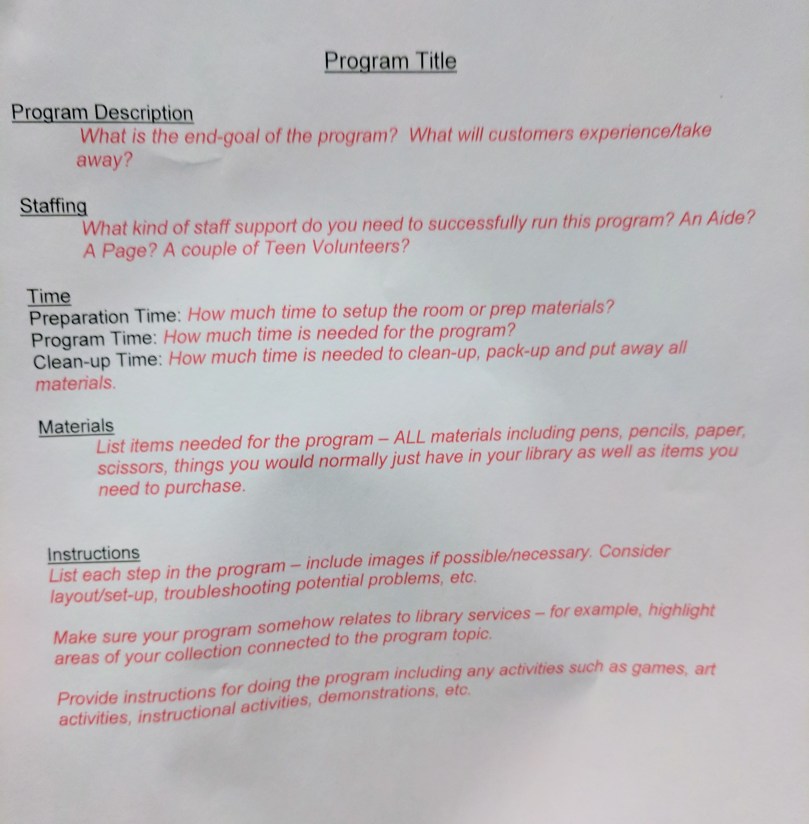
The presenters provided many short activities (tongue twisters for public speaking; a “multitasking is a myth” task) and a very handy program planning worksheet (see below). Some of their workshops for teens were single events, while others were a series. Nearly all included food, a surefire way to boost attendance at any program. Librarians ran some workshops, while others were conducted by outside presenters. With some research, you can find willing partners, like county/city/town departments, credit unions, and local businesses; some presenters may come for free, others may charge a fee.
Program planning worksheet
To decide on the topic(s), ask teens what they want to know! Think about your own young adult life – what did you wish you had known, and what surprised you? Talk to teachers at local high schools – they will know what school does(n’t) offer and where students’ knowledge gaps are.
Along with planning and running the programs, the presenters discussed evaluation and measuring outcomes – required for grant-funded programs, but good for every program. They suggested: (1) determine anticipated outcomes, (2) ask: do the programs teach teens something? Do they feel better prepared for adulthood? (3) conduct pre- and post-program surveys to assess growth.
This was an excellent program: the presenters were good speakers, and came prepared not just with their slides, but with copies of their worksheets, planning documents, examples and activities from their workshops. A+!
For the very last PLA program, I went to the YA Crossover, or “AAP Crossover Appeal: Books that Work for Teens and Adults.” Despite the program’s title, it didn’t really focus on the “crossover” aspect so much as the teen aspect, except in the sense that some of the audience had read some of the authors’ books as young adults, and still loved them.
Luanne Toth of School Library Journal moderated the panel of four authors:Ally Carter, Carolyn Mackler, Gayle Forman, and Ashley Woodfolk. Woodfolk is a debut author (The Beauty That Remains), and the other three are further into their careers. Mackler’s most recent book, The Universe is Expanding and So Am I, is a sequel to The Earth, My Butt, and Other Big, Round Things (a Printz honor book in 2004).
Here are a few quotes and paraphrases from the panel:
“I write about young people but I don’t write young stories” -Gayle Forman
“Young people are given license to feel your feelings.” There’s this idea that as you age you don’t feel things as strongly/intensely. You do have to moderate your feelings but you do have them. Satisfying as a writer and a reader. -Gayle Forman
“A lot of what happens in high school shapes your adult life….And you don’t really get it until you get older.” YA writing is cathartic because it helps revisit and dissect what happened & what you felt. -Ashley Woodfolk
“The world would be a lot better if we all read more broadly and more representatively.” -Ally Carter
“Libraries are our outposts in every corner of the country” (some places don’t have bookstores or people can’t afford books) -Ally Carter
“Encourage people to read everything…a kid might want to read something you won’t expect they want to read. Find out what a kid wants/needs” – Ashley Woodfolk
“Every book is a mirror. No matter how different somebody is from you, there is still an emotional through-line.” -Gayle Forman
And that is a wrap! See all PLA 2018 posts here. I’m so glad I had the opportunity to go to this conference, and I think I made the most of it, attending a variety of sessions and programs. I do wish I had a Time-Turner and could have been to even more. If you were at PLA, or followed along via a great blog or Twitter thread, please share your favorite links!
My first event on Friday was another stop at the PLA Pavilion for “Early Literacy Enhanced Storytimes: Intentionality is the Key” with Saroj Ghoting, an early childhood literacy consultant (earlylit.net). Presenters packed a lot into these 20-minute sessions; Ghoting addressed the challenge of keeping adults engaged during children’s storytimes, and provided several specific examples* to make storytimes more interactive. She also noted the different types of interaction during a storytime: librarian-children, librarian-adults, children-adults, and adults-adults. Adults value time with and advice from each other, and if they’re engaged during stortytime, they’re more likely to do the same activities with kids at home. Adult-child interaction also supports rich language development for children.
*Examples included books that lent themselves to two call-and-response parts, like Too Much Noise (kids make animal sounds, adults say “too noisy!”),The Cow Loves Cookies(adults say “but the cow loves…” and kids say “cookies!”), and Jump, Frog, Jump (adults say “how did the frog get away?” and kids say “jump frog jump!”).
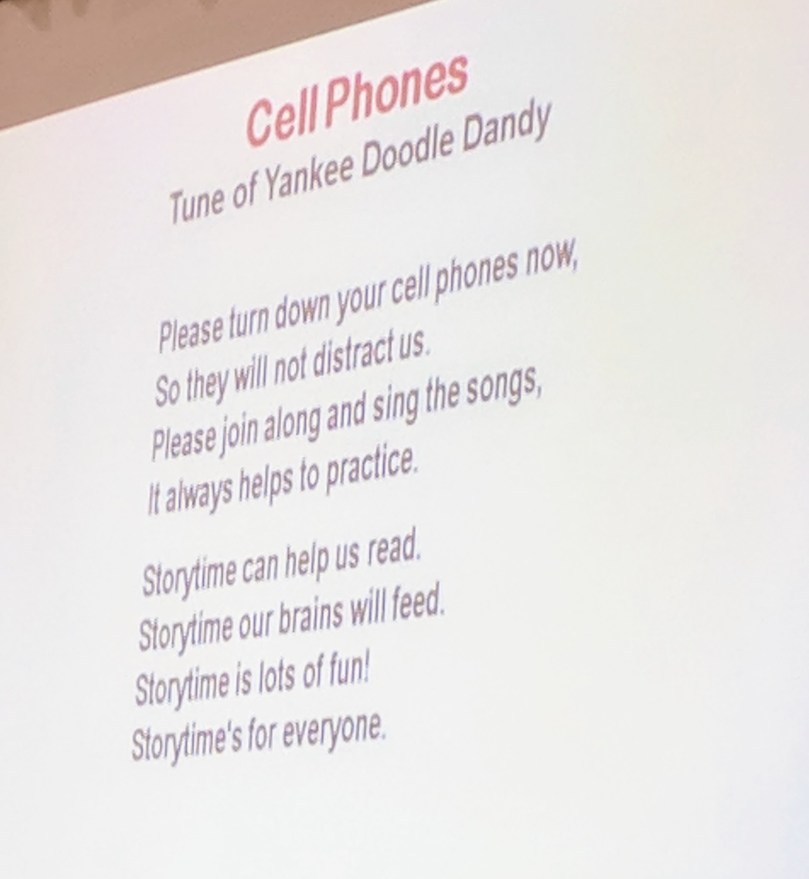
Slide from Saroj Ghoting’s presentation: song lyrics to “Cell Phones,” to be sung to the tune of “Yankee Doodle”
After the “Enhanced Storytimes” session, I went over to the Children’s Book Buzz on the other side of the exhibit hall to hear about more upcoming children’s and teen titles, but left in time to get to the first morning program, “The Path to U.S. Citizenship Can Start at Public Libraries.” Laura Patching from the U.S. Citizenship and Immigration Service (USCIS) spoke first, giving a short history of the service and talking about its work in and with libraries: sending community relations officers to do naturalization workshops, including mock interviews; setting up “Citizenship Corners” or “New Americans Corners”; and the “Bridges to Citizenship” program. Community relations officers will visit any library; find your local one by e-mailing public.engagement@uscis.dhs.gov.
Next, Tiffany Nardella and Nate Eddy from the Free Library of Philadelphia (“Start here. Go anywhere”) spoke about their work welcoming new Americans in the library, in partnership with USCIS and with other partners, like the Office of Adult Education and the Welcoming Center for New Pennsylvanians. And Michelle Gordon of the Fresno County Public Library in California said that naturalization ceremonies in libraries are “the best thing that I do,” and “If you don’t work with USCIS yet, do it! It’s worth it.” She suggested inviting local representatives to these ceremonies – new citizens are new voters! Elected officials might come or not, but it’s nice to invite them.
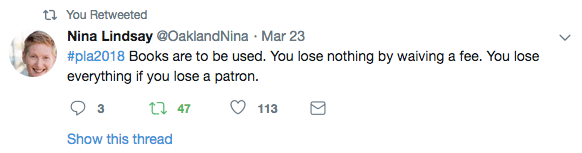
A tweet from the program “Eliminating Fines and Fees on Children’s Materials to Create a Win-Win for Your Library and Your Community,” during the same morning time slot as the citizenship program.
After the citizenship program, I followed a tweet from @NYPLRecommends and chatted with the hosts of the New York Public Library’s “The Librarian Is In” podcast, Gwen Glazer and Frank Collerius, who were delightful. I rarely listen to podcasts, but I am sure I would enjoy theirs.
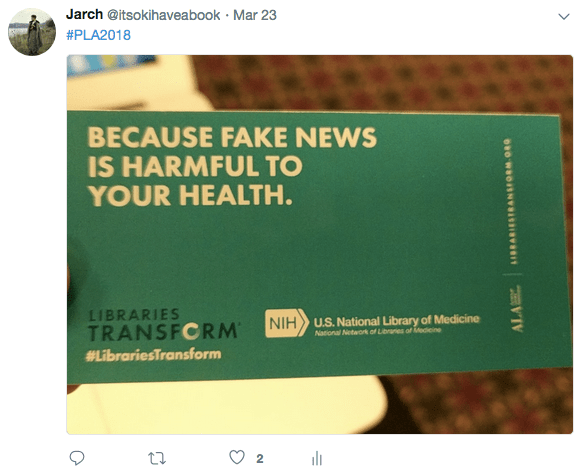
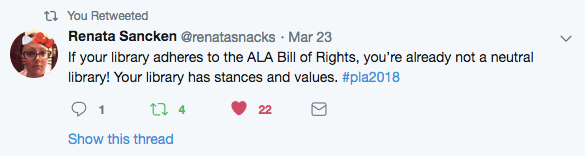
I ate my lunch sitting on the floor and listening to the Adult Book Buzz, and then it was time for the afternoon programs. The first one I attended was “Refuting the Idea of ‘Neutral’: Supporting Civic Engagement & Information in the Library,” presented by Amy Holcomb, Amy Koester, and Mimosa Shah, an enthusiastic team from Skokie, IL. As the title of their program indicated, they refuted the idea that libraries are neutral: “If your library adheres to the Library Bill of Rights, you are not neutral.” Being neutral, however, is not the same as being nonpartisan; the library can have a stance (being in favor of access to good information) without taking a political position.
A tweet from the “Refuting the Idea of ‘Neutral'” panel
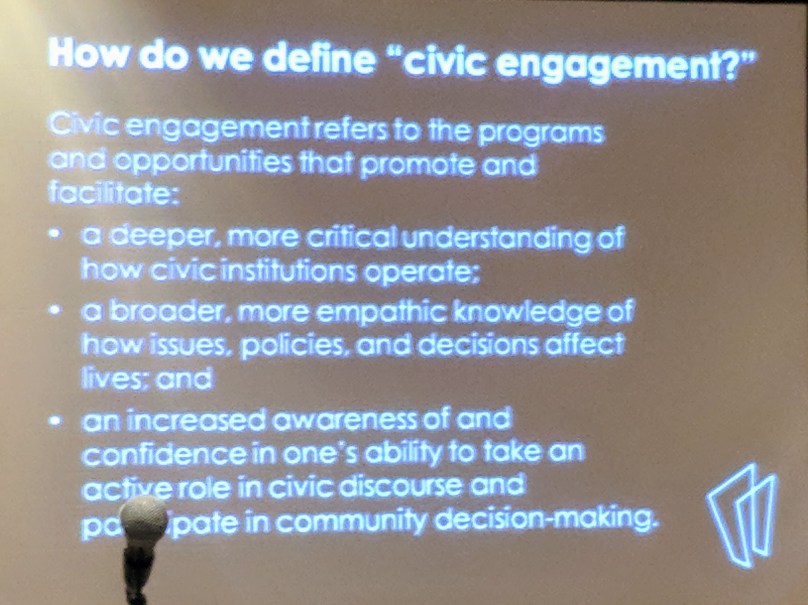
The Skokie Public Library started a Civic Lab to promote and facilitate citizen engagement by increasing awareness of issues, facilitating conversation, and providing access to quality information. They hoped to achieve several goals: to have patrons participate, not just passively consume; to offer more active, participatory experiences; and to have patrons engage with information so they feel confident and can make decisions based on that information. “We don’t want to get them to a particular point of view, we want them to have a point of view. If you have bad information, whoever gave you that information is making up your mind for you.”
The Civic Lab is a pop-up event in the library four times a month, addressing topics planned in advance as well as those that are timely and topical . Library staff at the pop-up station facilitate discussion between patrons, and each pop-up has a banner, display crates, media, books, and an activity. They suggest having “multiple access points [e.g. reading, listening, viewing]….There isn’t a right way to engage, it’s whatever is comfortable for the patron.”
How do we define “civic engagement”? Slide from Skokie.
Skokie also offers news discussion groups, which are scheduled events about quality news sources and how to navigate through the many news outlets. These cover news literacy in general as well as specific topics. They employ the reflective listening model for discussion.
There were also some good strategies for engaging kids and teens, from gamification (activities and questions that are more like trivia than quizzes) to clever program titles (“The media wants your brains” for teens). To get adults – patrons and staff alike – engaged, have them bring experiences from their own lives and family histories; “help people understand how much they can learn from each other.”
“The library is a place for difficult discourse.”
Programs like these can be equally inspiring and intimidating; you might want to do something similar in your library, but you’re already doing many other programs and displays. “Don’t add ‘civic engagement’ [on top of] everything you’re already doing,” the Skokie team suggested; rather, “Apply a civic engagement lens to what you’re already doing….Do a civic engagement audit of what you already offer.”
During the Q&A after the panel, someone asked, “How do you keep it to a discussion and not regurgitation of strongly entrenched opinions?” The Civic Lab team advised, “As a facilitator, restate what they’re saying and then ask to hear from someone else.” You can say, “You obviously believe this very strongly. How did you come to hold that belief, what are your sources? Tell me more, where can I find more information?” They said, “Opinions are fine, we want people to have informed opinions based on facts.”
“We want people to have informed opinions based on facts.”
For the final program of the day, I went to “The Information Needs of Citizens,” presented by Lee Rainie of the Pew Research Center. Lee Rainie is a regular at library conferences; he is an excellent speaker, with excellent data which, it just so happens, supports the value of libraries. Although the country is experiencing “a crisis of truth, a crisis of trust, a crisis of democracy,” there are a few institutions and professionals that the public still trusts: librarians, teachers, and the military.
It’s no surprise that someone from a “fact tank” still believes that “facts matter.”
“Facts are the atomic unit of truth.”
“Facts drive outcomes for individuals and societies.”
“Facts underlie justice” – they are the cornerstone of democracy.
Facts are democratic. Facts are tied to trust – when trust grows, good things come from that. Trust in a culture binds people together, to overcome vulnerability and uncertainty. Trust cements interdependence.
Librarians, Rainie said, are in the vanguard of people who are going to help us solve these problems. Libraries are a free, open, trusted institution for learning. Research shows that people are glad that libraries are still here and providing access to information, helping bridge the digital divide and navigate the information environment online, and serving people and communities and on issues like net neutrality.
Lee Rainie from the Pew Research Center with a slide about what people say they want/need from libraries and librarians
The next library will be built around five new insights:
People seek personal enrichment and entertainment in new ways
People seek knowledge and reference expertise in new ways (reference questions have gone down in number, but up in complexity)
Some groups especially need and want access to technology through trusted institutions (library as tech hub, tech support, wifi)
Learning is a social process, an ongoing process (learning happens in networks)
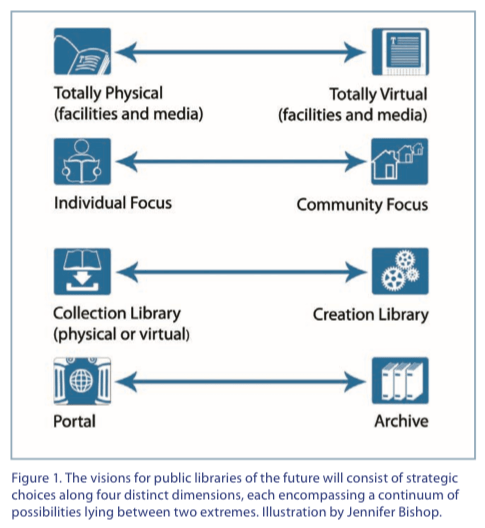
Where they fit on these continuums (PDF: ALA’s Confronting the Future report) physical/virtual, individual/community focus, collection/creation, archive/portal, everything for everyone/specialized niche
Figure 1 from the ALA Confronting the Future Report
Rainie concluded, “A day spent with librarians is a better day.”




 But Taylor makes a good point about fantasy being important “now more than ever.” I went looking for the full text of her Printz honor speech and couldn’t find it (let me know if you can!), but I did find


 The closing keynote session featured Timothy Snyder, professor of history at Yale and author of (most recently) On Tyranny: Twenty Lessons from the Twentieth Century (2017) and The Road to Unfreedom: Russia, Europe, America (2018). The talk was entitled “The New Authoritarianism: Where It Comes From and What Readers and Citizens Can Do About It,” and was essentially a summary of On Tyranny. If you missed the talk, read the book – it’s only 126 pages.






 Jenny Arch